

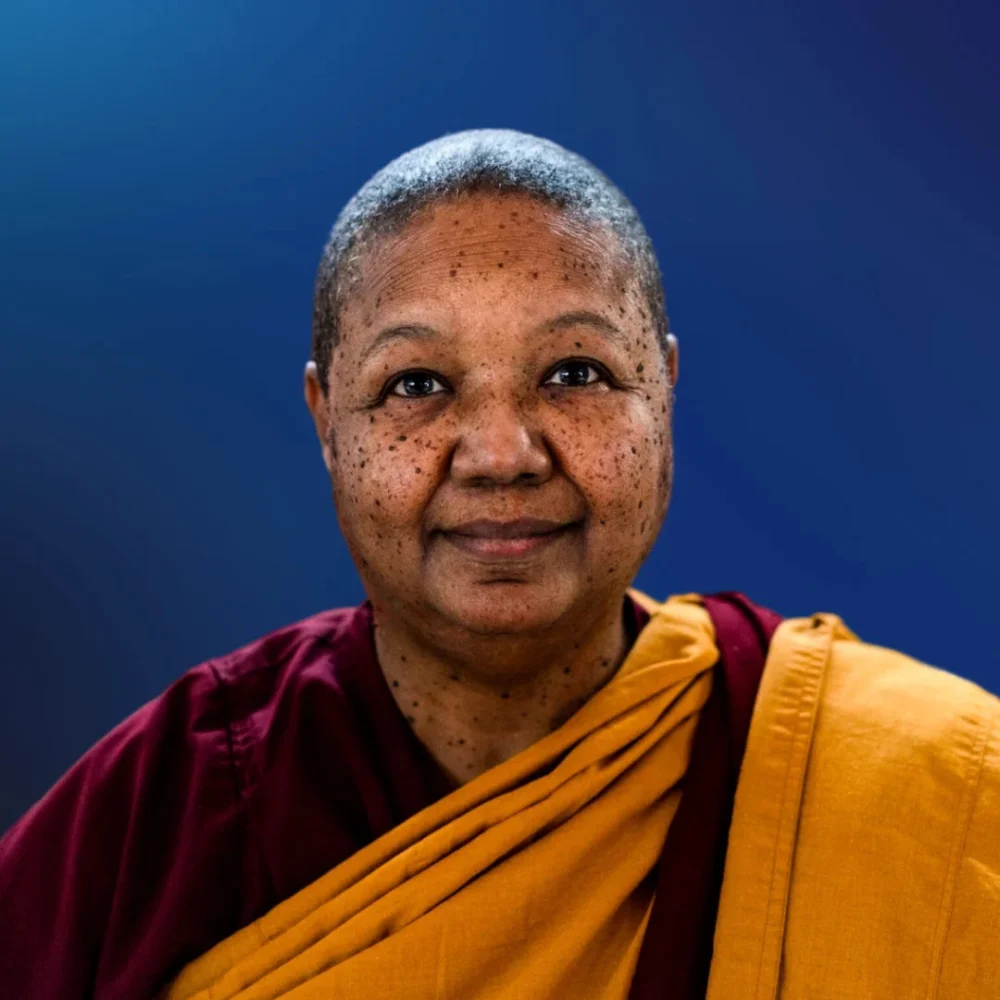
Venerable Pannavati Bhikkhuni, a pioneering figure whose spiritual journey spanned Christian pastorate, Theravada and Chan Buddhist traditions, and profound engagement with Mahayana and Vajrayana teachings, died on Thursday, February 26, at 1:30 p.m. EST. Her passing marks the end of an era for the many communities and individuals she touched with her fearless compassion, unwavering dedication to service, and unique synthesis of diverse spiritual paths. She was a lineage holder in the Zen Peacemaker Order and a disciple of H.H. Dorje Chang Buddha III and Rinpoche Zhaxi Zhouma.
A shared statement from the Heartwood Mandala community in Hendersonville, North Carolina, where she served as spiritual leader and cofounding teacher, poignantly conveyed the profound sense of loss: "Our dearest teacher, Venerable Pannavati, left her body on this auspicious day, 2/26/2026 at 1:30 p.m. EST. Her monastics, two lay residents and Kaye, her devoted Kappiya and friend, held vigil for her from 9 a.m. through her transition. Words will never explain how she impacted all of our lives and touched our hearts. Her joy was contagious, and her fearless compassion paved the way for so many people. She was a true kalyanamitta, and her favorite thing to do was to give a dharma talk! Everything that she did was for the dharma and for saving sentient beings."
Venerable Pannavati’s life was a testament to breaking barriers. As an African American Theravada bhikkhuni (nun), she was an anomaly in a field historically dominated by other demographics. Reflecting on this in a 2012 interview, she stated, "I don’t think I’m the first, but I do believe I’m the only one." This observation underscored her pioneering role in a spiritual landscape that, while often espousing universal truths, has historically grappled with issues of representation and inclusivity.
Her spiritual practice was deeply intertwined with action. Venerable Pannavati consistently emphasized the necessity of engaged Buddhism, asserting, "It is not enough to sit on our zafus. These times call for compassionate action to be an integral part of our practice." This philosophy guided a lifetime of humanitarian work, which included establishing Buddhist practice centers, fostering community among India’s Dalits (formerly known as "Untouchables"), providing crucial housing and support for homeless young people, and tirelessly advocating for the full ordination of Theravada Buddhist nuns.
A Life of Founding and Fostering
Venerable Pannavati, alongside the late Venerable Pannadipa, cofounded Embracing Simplicity Hermitage, a contemplative Buddhist order situated near Hendersonville, North Carolina. This initiative laid the groundwork for subsequent endeavors, culminating in the 2017 cofounding of Heartwood Refuge. This nonsectarian intentional community and residential center evolved into Heartwood Mandala, a global sangha that continued to flourish under Venerable Pannavati’s spiritual directorship.
A significant aspect of her commitment to social welfare was the establishment of My Place, Inc. in 2009. This organization provided essential housing, education, and job training for homeless and at-risk youth, and its success led to its adoption as a model program by the state of North Carolina. The program’s comprehensive approach, addressing immediate needs while fostering long-term self-sufficiency, served as a beacon of hope for vulnerable youth.
Championing Women’s Ordination
Venerable Pannavati was a formidable advocate for the recognition and empowerment of women in monastic life. Historically, the full ordination of bhikkhunis faced significant challenges and was outright forbidden in countries like Thailand and Cambodia. In a landmark achievement, she facilitated the ordination of fifty Thai bhikkunis in 2009, followed by ten Cambodian nuns in 2010. These ordinations, carried out with the support of the broader Buddhist monastic hierarchy, represented a significant step forward for gender equality within the tradition.
Reflecting on her motivations, she shared with Tricycle magazine in 2011, "After [I became] a Theravada nun . . . I could really see the patriarchal aspect of institutionalized Buddhism, and I became very disenchanted with it. I needed to walk my own path, so I just did what I felt that I had to do, and I found support from senior Thai monks and Western nuns." This personal conviction fueled her broader advocacy for women’s rights within religious institutions.
She was also a founding circle director of Women of Compassionate Wisdom, an international Buddhist Order and Sisterhood. Michaela Haas, author of Dakini Power, lauded Venerable Pannavati’s "unwavering support for women," emphasizing her insistence on "equality and respect in Buddhist life for both female monastics and lay sangha."
Global Reach and Radical Inclusivity
Venerable Pannavati’s commitment to the disempowered extended far beyond American shores. In 2011, responding to an appeal from an individual working with the Dalits in India, she "adopted" ten Dalit villages. Her support manifested in tangible assistance, including educational programs, sanitation initiatives, and micro-grants, all aimed at fostering egalitarian communities grounded in Buddhist principles. The individual who initially contacted her recounted his surprise at finding her by "googling a Black Buddhist nun," and his reasoning that an African American Buddhist would possess a unique understanding of racism and marginalization. Venerable Pannavati herself recognized the parallels, stating, "I didn’t think any people could feel more marginalized than African Americans, but there are [some]!"
Her lifelong dedication and impact were recognized with numerous accolades, including the Outstanding Women in Buddhism Award in Bangkok in 2008. In her acceptance speech, she articulated a powerful message of solidarity: "I accept it for all the women everywhere struggling under patriarchal oppression, for all the girls in countries where they are sold to provide the means for the boys to excel, for all the African Americans who are seen in so many spiritual traditions as lesser."
A Journey from Christianity to Buddhism
Born in Washington, D.C., in 1950, Venerable Pannavati’s early life was marked by a dynamic spiritual seeking. She described herself as a "tough kid" and a "straight-out street fighter" in her youth, a stark contrast to the contemplative path she would later embrace. Her early spiritual experiences were rooted in Christianity. "I felt the love of Jesus enter my heart when I was 6," she recalled, and by her teenage years, she was playing piano and organ at First Rising Mt. Zion Baptist Church.
However, her spiritual explorations extended beyond the confines of her upbringing. At age 13, she experienced spiritual phenomena, including speaking in tongues, which, while disavowed by the Baptist church, led her to the Pentecostal tradition. Her journey continued through a charismatic televangelist preaching the prosperity gospel, where she served as a Christian pastor. This was followed by periods of engagement with Unitarian Universalism and Taoism before she found her ultimate spiritual home in Buddhism.
In 1985, a profound vision guided her away from established religious institutions and onto a personal path of exploration. This marked the beginning of what she described as a "fifteen-year dark night of the soul," a period of intense introspection and seeking for meaning. During this time, she recognized the limitations of intellectual understanding without emotional mastery, noting, "I knew and understood the Bible, but I had not mastered my emotions." Meditation became a crucial tool in this process, enabling her to confront her inner landscape and find a more stable spiritual foundation. "When I got to the place where I was no longer afraid of myself—[where I knew I wouldn’t] act in some way that I would come to regret five minutes later—I knew I was on the right path."
Her life also encompassed secular experiences, including three marriages, raising children, and earning master’s degrees in business and education, later adding a PhD in religious studies. She also owned businesses. Reflecting on her marriages, she spoke of the truth of impermanence, noting, "I enjoyed every one of them. But in life, there is this truth of impermanence, and things are constantly changing." By age 40, she felt she had explored the breadth of secular life, stating, "I had done everything, good and bad, that I wanted to. Becoming a nun was really like stepping into a freedom, something that was the last thing for me to do—or be."
A Vision of Nonsectarian Dharma
Venerable Pannavati’s trans-lineage orientation naturally led her to become a profoundly nonsectarian teacher. She often cautioned against rigid divisions within Buddhist traditions: "We shouldn’t think in terms of Theravada versus Mahayana or Vajrayana, or arhat versus bodhisattva. When we start dividing in this way, we get into dogma. But the Buddha was talking about actual organic experience."
This philosophy was embodied in the vision statement of Heartwood Mandala: "Heartwood is neither defined by a single lineage nor confined by any single sect or practice. Our retreats, refuge, courses, training, practical life, and social engagement in the world are geared not towards an outward show of Buddhism as a religion but towards cultivation of the inner integrity and the development of being that the Dharma inspires. . . Heartwood is a container for nonsectarian practice, conscious living, and empowerment in service."
Her commitment to inclusivity extended to her stance on racial affinity groups. When invited to speak to People of Color (POC) groups, she famously responded, "I’m not a Black dharma teacher; I’m just a dharma teacher. Call me back when you want me to come and talk to your whole sangha." She believed in the necessity of bridging divides and fostering understanding among all practitioners.
Overcoming Adversity in Hendersonville
The establishment of Embracing Simplicity Hermitage in Hendersonville, North Carolina, a historically ultraconservative and predominantly white area, was itself an act of courage and faith. It was in this very county, as a 13-year-old visitor, that she experienced a deeply traumatic encounter with racism. A Ku Klux Klan incident at her aunt’s home, where she was confronted for not stepping off the sidewalk for a white woman, left an indelible mark. Despite her vow never to return, she did, and against considerable odds, she successfully integrated her Buddhist center into the community. Her background as a Christian pastor and her academic credentials in religious studies proved invaluable in building bridges and earning the respect of local residents, many of whom offered support and even joined the sangha. "I believe in people’s ability to change," she wrote. "I believe we all possess buddha-nature. We just need help discovering it."
A Legacy of Practical Wisdom and Music
The success of My Place, Inc. extended to its social enterprise, My Gluten-Free Bread Company, which operated from 2011 to 2013. This bakery not only funded the organization’s operations but also provided invaluable work experience for its residents, mirroring the model of the Greyston Bakery.
Venerable Pannavati’s dharma name, "Pannavati," a fusion of the Hindi word for "emerald" or "wisdom" (panna) and the suffix meaning "the one who has" or "female sage" (vati), perfectly encapsulated her essence. She was known for her warmth, generosity, and a practical approach to dharma that resonated deeply with practitioners worldwide. Until her retirement, she led retreats at approximately fifty centers annually and maintained regular visits to Dalit communities, often accompanied by members of her sangha. She was a frequent guest teacher at prominent meditation centers such as the Insight Meditation Society (IMS) in Massachusetts and Spirit Rock in Northern California. Her recorded teachings, available on platforms like YouTube, are characterized by their clarity, humor, and insightful connections to her rich life experiences.
Her commitment to service remained strong even in her later years. She continued her work in India until the onset of the COVID-19 pandemic, managing migrant summer camps for children and young adults, providing local resources for families in need, and assisting in hurricane recovery efforts. The Dharmacharya Program, a two-year training path for serious practitioners leading to non-monastic ordination, which she helped establish, enrolled over one hundred students between 2013 and 2022.
A testament to her expansive spirit was her deep love for music. This passion led to the formation of her dharma singing group, DharmaVoci. The group’s recordings, blending traditional Buddhist chants with contemporary musical styles, served as a beautiful expression of her ability to weave together diverse spiritual and artistic traditions.
A memorial service is being planned for Venerable Pannavati by Heartwood Mandala, likely in April, with further details to be announced. In the interim, individuals are welcome to schedule visits to the sangha to pay their respects and connect with her enduring legacy. Her passing leaves a profound void, but her teachings and the communities she nurtured will continue to inspire and guide countless individuals on their spiritual paths.

