

A landmark study conducted in 2026 on BTBR mice, a widely recognized laboratory strain employed to model autism, has unearthed compelling evidence of divergent autism-like behavioral changes between males and females. The research, which challenges traditional approaches by deliberately focusing on sex as a critical variable, provides crucial insights into the heterogeneity of autism spectrum disorder (ASD) and underscores the necessity of sex-inclusive research in animal models. Female BTBR mice in the study exhibited a reduced capacity for habit formation and displayed less engagement in social interactions with other mice. In stark contrast, their male counterparts encountered greater difficulties in mastering a balance task and showed significantly slower initiation in approaching an unfamiliar peer. This differentiation in behavioral profiles offers a nuanced understanding of how autism-like traits manifest, hinting at underlying biological distinctions that warrant further investigation.
The Enduring Enigma of Autism and Sex Differences
Autism spectrum disorder, a complex neurodevelopmental condition, has long presented a diagnostic disparity, with boys and men historically receiving diagnoses at a rate four to five times higher than girls and women. This imbalance has fueled extensive debate and research into whether females are genuinely less susceptible or if the diagnostic criteria and understanding of presentation are inherently biased towards male phenotypes. Emerging theories suggest that females may employ more sophisticated "camouflaging" strategies, masking their difficulties to conform to social expectations, leading to underdiagnosis or later diagnosis. The 2026 study directly addresses this critical gap in understanding by meticulously analyzing sex-specific behavioral patterns in an established animal model, providing empirical data that supports the notion of distinct presentations.
BTBR Mice: A Gold Standard for Idiopathic Autism Modeling
The BTBR T+ Itpr3tf/J mouse strain, commonly referred to as BTBR mice, holds a prominent position in autism research. These inbred laboratory animals naturally exhibit a range of behaviors that strikingly resemble core features of autism in humans, including impaired social interaction, repetitive behaviors, and altered communication. Crucially, no single gene has been engineered into these mice; instead, their autism-like traits stem organically from their unique genetic background, leading researchers to classify them as an idiopathic autism model. This characteristic makes BTBR mice particularly valuable, as human autism is also largely idiopathic, with complex genetic and environmental interactions rather than a simple monogenic cause.
The widespread adoption of the BTBR strain as a standard model followed a pivotal 2008 study by McFarlane et al. This foundational research systematically compared BTBR mice with C57BL/6J mice, a common laboratory strain, establishing a comprehensive behavioral phenotype for the BTBR model. McFarlane and colleagues highlighted significant deficits in social approach behaviors, reduced reciprocal social interaction, increased repetitive grooming, and abnormal vocalizations in BTBR mice. These findings unequivocally demonstrated the strain’s utility in mimicking the core diagnostic criteria of ASD, cementing its role in preclinical research aimed at elucidating the disorder’s mechanisms and testing potential interventions.
A distinctive neuroanatomical feature of BTBR mice, consistently observed and confirmed in the 2026 study, is the congenital absence of the corpus callosum. This thick bundle of nerve fibers typically facilitates communication between the brain’s two hemispheres. Its agenesis in BTBR mice provides a compelling parallel to findings in some individuals with autism, where atypical brain connectivity is a frequently reported observation. The lack of a corpus callosum in BTBR mice may contribute to their behavioral phenotypes by altering interhemispheric communication and broader neural circuit functions, offering a unique opportunity to study the impact of specific brain structural anomalies on autism-like behaviors.
A Deliberate Focus on Sex: Addressing a Research Blind Spot
Historically, much of preclinical autism research, particularly studies utilizing animal models, has predominantly focused on male subjects or aggregated data from both sexes without specific disaggregation. This approach, while convenient, risks overlooking crucial sex-specific biological and behavioral mechanisms. The disproportionate diagnosis of autism in males has often led to the assumption that male models are sufficient to represent the entire spectrum. However, the work by Jackson et al. at Michigan Technological University, the team behind the 2026 study, was deliberately designed to challenge this paradigm. Their central hypothesis was that sex fundamentally alters which behaviors are affected in the BTBR model, mirroring the clinical observation of varied presentations in human males and females with autism. This conscious decision to prioritize sex as an analytical factor marks a significant step towards more inclusive and representative scientific inquiry in neurodevelopmental research.
Methodical Dissection of Behavior: The Experimental Design
To meticulously investigate sex differences, the research team subjected young adult BTBR mice, aged 6 to 8 weeks at the study’s commencement, to a rigorous battery of standard behavioral tests. Each test was carefully selected to probe distinct domains of behavior relevant to autism-like traits. These included:
- Operant Conditioning for Habit Formation: Assessing the mice’s ability to learn and form habits, differentiating between goal-directed actions and automatic responses.
- Motor Learning and Coordination (Rotarod Test): Evaluating motor skill acquisition, balance, and coordination under increasing challenge.
- Social Interaction Paradigm: Quantifying exploratory behavior and engagement with a novel conspecific (stranger mouse) in a controlled environment.
- Elevated Plus Maze: A standard test for anxiety-like behavior and risk assessment, measuring exploration of open versus enclosed arms.
This comprehensive testing battery allowed the researchers to generate a multi-faceted behavioral profile for both male and female BTBR mice, enabling direct comparisons not only against standard lab mice but also between the sexes within the BTBR strain. The robust design ensured that subtle, sex-specific differences could be detected and analyzed statistically, providing a strong empirical foundation for the study’s conclusions.
Female BTBR Mice: A Shift in Habit Formation
One of the most striking findings of the study pertained to habit formation. Behavioral scientists distinguish between two primary modes of action: goal-directed actions, which are performed consciously to achieve an immediate outcome, and habits, which are automatic, stimulus-driven responses triggered by specific situations, even if the original reward is no longer relevant. Typically, with sufficient repetition, laboratory mice transition from goal-directed behavior to habit formation.
The study found that most BTBR mice successfully learned to press a lever for a reward, and their learning pace was comparable to standard mice, although they pressed the lever more frequently overall. It is noteworthy, however, that 6 out of 22 BTBR mice failed to learn the task entirely and were subsequently excluded from the lever-related analyses, suggesting a subset within the strain may have more profound learning difficulties.
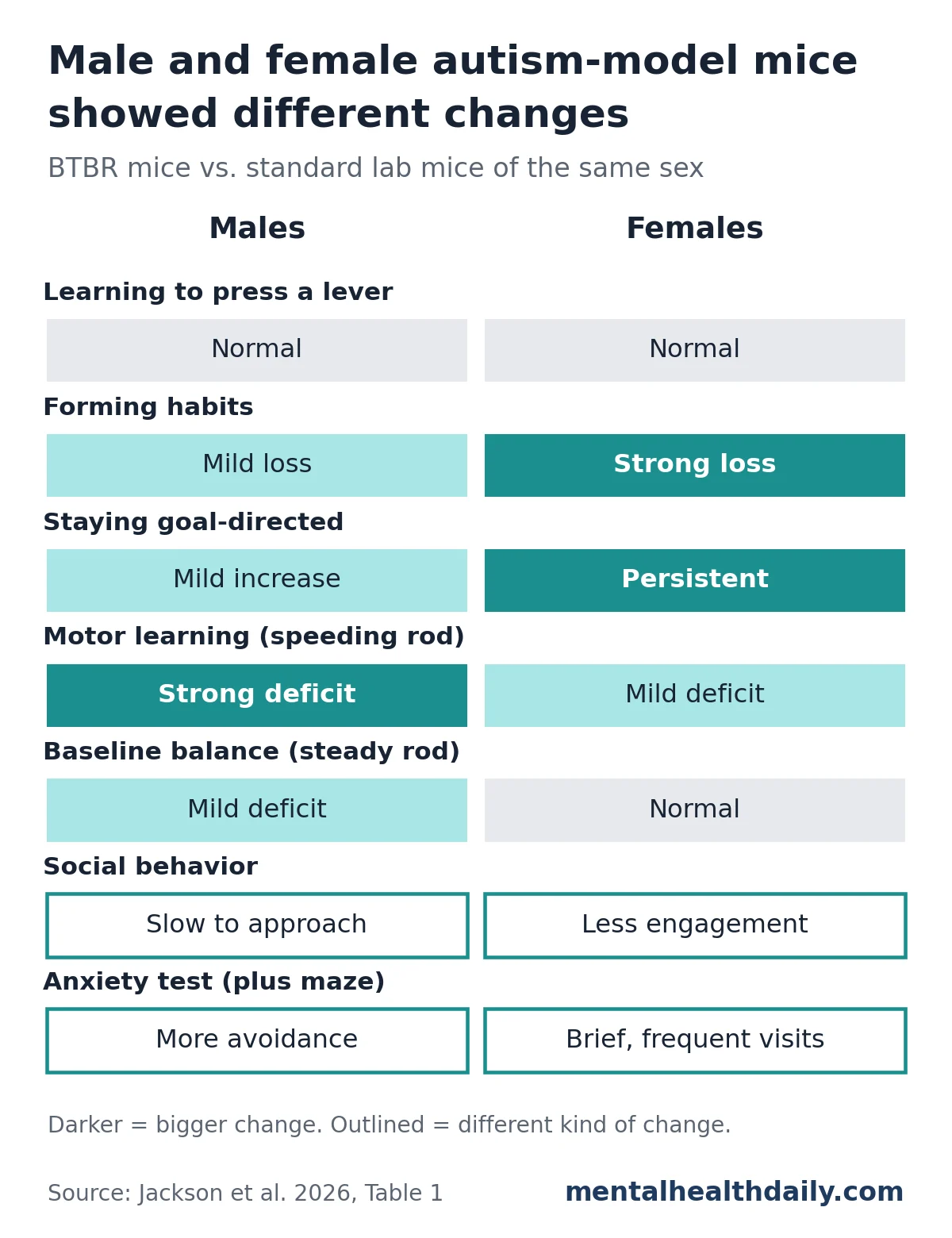
The critical divergence emerged during habit training. Female BTBR mice exhibited significantly weaker habit formation compared to standard females, pressing the lever notably less (p < 0.001). This indicated that their behavior remained more goal-directed. In contrast, male BTBR mice showed no significant difference in lever pressing compared to standard males (p = 0.86), suggesting their habit formation was largely intact.
To confirm the nature of this difference, researchers employed two classic checks for habit:
- Reward Devaluation: The reward (e.g., food pellet) was devalued (e.g., by making the mice sick if they consumed it). If behavior is habitual, the mice will continue to press the lever even if the reward is undesirable. If it’s goal-directed, they will stop.
- Contingency Degradation: The causal link between the action (lever press) and the outcome (reward) was weakened or removed. Habitual behavior persists, while goal-directed behavior diminishes.
Collectively, these tests strongly suggested that female BTBR mice maintained a goal-directed mode of action even after extensive training that typically induces habitual behavior in standard mice. The researchers theorize that this phenomenon is linked to an altered balance between these two behavioral modes, which are known to rely on distinct circuits within the striatum, a deep brain region crucial for action selection and reward processing. While direct measurements of striatal activity were not performed in this study, the behavioral data provides a compelling rationale for future neurobiological investigations into these pathways. This finding could have implications for understanding rigidity or flexibility in routines often observed in individuals with autism, potentially manifesting differently across sexes.
Male BTBR Mice: Challenges in Motor Learning and Adaptation
The assessment of motor learning revealed another key sex-specific difference. On the accelerating rotarod, a test that requires mice to maintain balance on a rotating rod that gradually speeds up, standard mice of both sexes demonstrated clear improvement with successive trials, indicating successful motor learning. However, BTBR mice as a collective group failed to show similar improvement, suggesting an overall deficit in adapting to increasing motor demands.
Upon disaggregating the data by sex, a clear pattern emerged:
- Males: Male BTBR mice displayed a strong deficit in motor learning on the speeding rotarod and also exhibited a mild deficit in baseline balance on a steady rod.
- Females: Female BTBR mice showed only a mild deficit on the speeding rotarod and maintained normal baseline balance.
The researchers interpreted these results as indicative of a problem primarily with adapting to escalating motor challenges rather than a generalized impairment in balance, with males being more significantly affected. This specific finding notably contrasts with the 2008 characterization study by McFarlane et al., which, using a different battery of motor tests, reported no significant motor impairment in BTBR mice. This discrepancy highlights the importance of test sensitivity and the specific motor domains being assessed, suggesting that while gross motor function might appear normal, more complex adaptive motor learning can reveal subtle deficits, particularly in males. These motor learning difficulties could be relevant to the motor stereotypies and coordination issues often observed in individuals with autism.
Social Nuances: Engagement vs. Approach
Social interaction, a core domain of autism, also presented distinct sex-specific patterns. As a group, BTBR mice entered the designated zone around a stranger mouse less frequently than standard mice (p < 0.001), consistent with general findings of reduced social interest in the model. However, a deeper dive into the data revealed critical nuances between the sexes:
- Females: Female BTBR mice displayed a reduction in overall social engagement, spending less time in the stranger zone and making fewer entries into it compared to standard females.
- Males: Male BTBR mice showed a significantly slower latency to approach the stranger mouse, indicating a hesitation or delay in initiating social interaction, even if their total engagement time might not be as profoundly reduced as in females.
These distinct social behaviors—reduced engagement in females versus delayed approach in males—suggest different underlying social processing mechanisms or coping strategies. The findings resonate with a 2024 study by Bove et al., which similarly reported reduced social interaction in both male and female BTBR mice, alongside other sex differences. The Bove study specifically noted that repetitive behavior patterns differed between sexes, and signs of oxidative stress in the hippocampus, a brain region critical for memory and emotion, were observed exclusively in males. This accumulating evidence from multiple studies strengthens the argument for distinct neurobiological and behavioral presentations of autism-like traits across sexes in animal models.
Anxiety Assessment: Different Strategies, Not Increased Anxiety
The elevated plus maze, a widely used assay for anxiety-like behavior, revealed another layer of complexity. Overall, BTBR mice did not significantly differ from standard mice in their entries into the walled (safe) arms (p = 0.44) or the time spent there (p = 0.13), suggesting no general increase in anxiety. However, once again, the sexes diverged in their behavioral strategies:
- Males: Male BTBR mice exhibited more avoidance behavior, making fewer entries into the open (anxiety-provoking) arms and spending less time there compared to standard males. This pattern is often interpreted as heightened anxiety or risk aversion.
- Females: Female BTBR mice displayed a pattern of brief, frequent visits to the open arms, a behavior that can be indicative of a different coping strategy—perhaps a cautious exploration rather than outright avoidance or sustained freezing.
The researchers interpreted these as different ways of handling perceived risk rather than a generalized increase in anxiety across the BTBR strain. This interpretation aligns with the 2008 characterization study, which found no evidence of heightened anxiety-like traits in BTBR mice. The subtle sex differences in risk assessment strategies highlight the need to move beyond simple "more" or "less" anxiety interpretations and instead consider the qualitative differences in how individuals, or in this case, mice, navigate potentially stressful environments.
Implications for Autism Research: A Call for Sex-Inclusive Science
The 2026 study by Jackson et al. represents fundamental animal research, but its implications for the broader understanding of autism are profound. Primarily, it unequivocally demonstrates that sex profoundly shapes which behaviors are affected in at least one prominent autism mouse model. This finding serves as a powerful mandate for all future preclinical research in neurodevelopmental disorders to incorporate both sexes into their experimental designs and to analyze data for sex-specific effects.
Key Limits and Future Directions:
While groundbreaking, the researchers themselves acknowledge the inherent limitations of their work:
- Translational Gap: This study is basic animal research and does not directly reveal how autism differs between men and women in humans, nor does it have immediate treatment implications. The leap from mouse behavior to human experience requires careful consideration.
- Model Specificity: The findings are specific to the BTBR strain, which represents only one of many animal models for autism. Its unique characteristics, such as the absent corpus callosum, may not be generalizable to all forms of autism.
- Indirect Brain Measures: The study focused on observable behaviors without direct measures of underlying brain circuits. While inferences about the striatum or other regions are plausible, they remain hypotheses without empirical neurological data.
In light of these limitations, the researchers issue a critical call to action: subsequent studies across other autism models must integrate sophisticated behavioral analyses with direct measures of brain circuits and neural activity. Techniques such as functional magnetic resonance imaging (fMRI) in animal models, electrophysiology, optogenetics, and immunohistochemistry could provide invaluable insights into the specific neural pathways and molecular mechanisms that underpin these sex-specific behavioral differences. Understanding these neural underpinnings is the next crucial step towards deciphering the complex interplay of genetics, brain development, and environment in shaping the diverse presentations of autism.
Broader Impact and the Path Forward
The findings of the 2026 study have several broader impacts:
- Refining Diagnostic Criteria: By illustrating the distinct ways autism-like traits can manifest, this research contributes to the growing body of evidence advocating for more flexible and sex-sensitive diagnostic criteria for human autism. A deeper understanding of female-specific presentations could lead to earlier and more accurate diagnoses for girls and women who might otherwise be overlooked.
- Targeted Interventions: While not directly therapeutic, identifying sex-specific behavioral and potentially neurological vulnerabilities lays the groundwork for developing sex-informed interventions. For instance, therapies for motor learning might be prioritized for males, while social engagement strategies might be tailored differently for females.
- Ethical Imperative: The study reinforces the ethical imperative for inclusivity in animal research. Excluding one sex or failing to analyze sex-specific data risks generating incomplete or misleading scientific conclusions, thereby hindering progress in understanding complex human conditions.
- Understanding Heterogeneity: Ultimately, this research underscores the profound heterogeneity of autism spectrum disorder. It moves beyond a monolithic view, emphasizing that autism is not a single entity but a constellation of traits that can manifest in myriad ways, influenced by factors such as sex.
As the scientific community continues its quest to unravel the complexities of autism, studies like the 2026 BTBR mouse research serve as vital signposts, guiding researchers towards a more comprehensive, nuanced, and ultimately, more effective understanding of this intricate neurodevelopmental condition. The focus on sex differences is not merely a statistical exercise but a fundamental shift towards acknowledging the full spectrum of human experience within autism.

