

The historical figure of the Buddha, Siddhartha Gautama, is often celebrated for his profound insights into the nature of human existence. However, beyond his deep understanding of life’s inherent challenges, his genius also lay in his ability to envision an entirely new form of existence, a testament to the creative impulse at the core of his teachings. This radical reimagining of life was not an abstract philosophical exercise but a direct response to the tumultuous landscape of fifth-century BCE India. This era was characterized by unprecedented social, political, economic, and religious upheaval, a period of immense flux that presented significant challenges to individuals and communities alike. The Buddha’s teachings emerged as a guiding force, offering a framework for navigating this instability and cultivating a way of life that transcended the prevailing turbulence.
Rather than merely reiterating established traditions, the Buddha forged a novel approach to understanding and engaging with the world. Early Buddhist scriptures frequently assert that his teachings were "a teaching which has never been heard before," a claim that, while potentially interpreted as religious rhetoric, points to a genuine innovation. This assertion suggests that the path towards overcoming frustration, paralysis, and hindrances—a path that leads to personal and collective flourishing—is not solely dependent on practices like mindfulness and resolve, but critically involves the application of creative imagination. In this light, suffering is reframed not as a problem to be eradicated, but as a potent source of transformative power, an element to be embraced and creatively reshaped into a viable way of life.
Art as a Conduit for Engaging with Suffering
Across cultures and throughout history, the arts have served as a vital space for the creative engagement with suffering. This tradition can be traced back to ancient Greece, and in the Western world, the Christian artistic heritage stands as a particularly powerful testament to this engagement. The crucifix, as a central icon within this tradition, exemplifies this profound connection. Many of the most significant works of Western art depict the crucifixion, often with startling realism, vividly portraying the physical and emotional anguish. In regions like Mexico and Spain, churches often feature visceral representations of suffering, emphasizing blood, gore, and misery, a direct confrontation with dukkha, the Pali term for suffering. While Northern European traditions, particularly Protestantism, may adopt a more sanitized approach, the elevation of pain and suffering into devotional art remains a striking characteristic of Christian artistic expression.
This perspective resonates with the insights of J. W. N. Sullivan, a prominent English writer on science and culture during the early 20th century. In his seminal 1927 work, Beethoven: His Spiritual Development, Sullivan opens with the observation: "Few men have the capacity fully to realize suffering as one of the great structural lines of human life." Sullivan posits that suffering is not merely an undesirable state to be overcome, but a fundamental element that shapes and defines human identity. He believed this understanding was central to Ludwig van Beethoven’s worldview, with the composer viewing suffering not only as an unavoidable condition of existence but also as a source of profound illumination.
This interpretation might appear counterintuitive to a traditional Buddhist perspective, which typically focuses on liberation from suffering. However, Sullivan’s Beethoven, and by extension the secular approach advocated in contemporary thought, embraces suffering not as something to be avoided but as a condition to be accepted unconditionally—that is, without the overlay of greed, hatred, or delusion. This unconditioned acceptance finds powerful expression in great works of art, offering countless examples that can resonate deeply on a personal level.
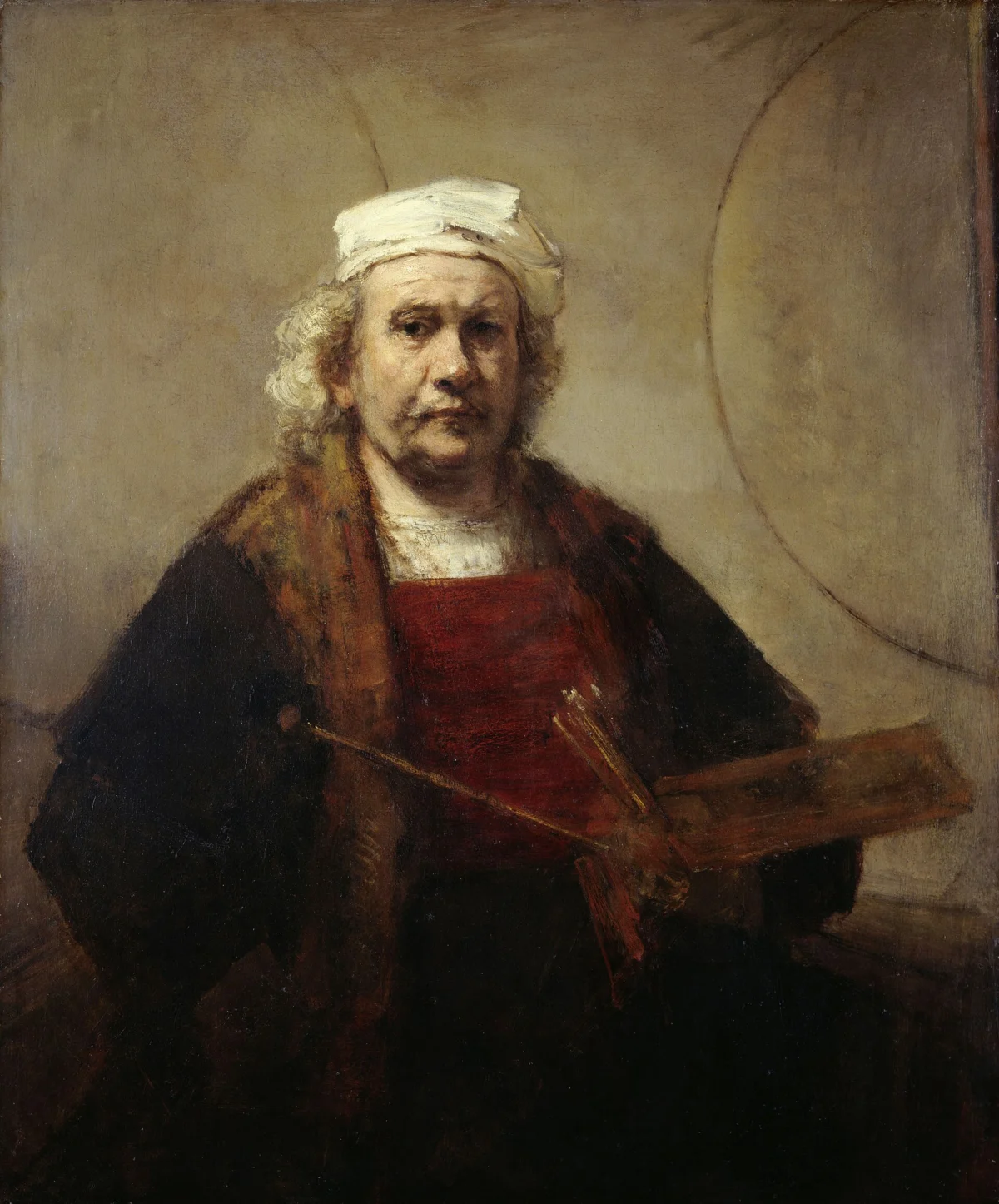
For instance, the late self-portraits of Rembrandt van Rijn offer a poignant contemplation of human suffering. As he aged and faced significant personal and financial hardship, including bankruptcy and the loss of his grand studio in Amsterdam, Rembrandt turned to his mirror. His unflinching gaze captured the reality of his aging form, the struggles etched onto his face, and the profound emotional weight he carried. The self-portrait housed at Kenwood House in London, along with others in the National Gallery, exemplifies this meditative process, transforming personal hardship into enduring artistic testament.
Similarly, the work of Hakuin Ekaku, a Japanese Zen master and artist of the Edo period (1686–1769), demonstrates a comparable sensibility. His rapid brushstroke paintings often convey a profound sense of grief, sorrow, puzzlement, and confusion, mirroring Rembrandt’s introspective approach. This contemplative practice, where the artist grapples with the raw material of their own experience, is indeed found within Buddhist traditions.

Music, too, offers a powerful avenue for engaging with suffering aesthetically. The slow movements of Schubert’s symphonies, or Beethoven’s late string quartets and piano sonatas, are imbued with a deep and unforgettable sorrow, yet this sorrow is harmoniously integrated within a profound serenity. As Sullivan observed of Beethoven’s later works, they possess "a serenity which contains within itself the deepest and most unforgettable sorrow. And yet a sorrow which is transformed by its inclusion in that serenity." These musical compositions, saturated with tragedy and loss, demonstrate a striking beauty born from pain, where suffering and aesthetic transcendence are not in opposition but are inextricably interwoven.
An Aesthetic Practice for Cultivating Awareness
It is through the act of embracing suffering, rather than evading, denying, or ignoring it, that the gateway to beauty opens. The cultivation of serenity, equanimity, quietude, and tranquility, often associated with meditative practices, serves not to foster a narrow, self-indulgent sense of well-being, but to create the necessary space for confronting suffering. By dwelling in stillness, individuals can observe what might otherwise be shocking or horrifying, acknowledging it with a simple, profound affirmation: "Yes, this is the state of our existence."
As this initial reactivity subsides, a sense of the miraculousness of the world, its inherent wonder and beauty, begins to emerge. Retreats, where the mind grows still, often reveal a world that becomes more vibrant and radiant. By slowing down, stopping, and engaging in simple acts of looking, listening, and hearing, one can perceive the exquisite beauty in the mundane—the color of leaves, the intricate patterns of flowers, the quiet presence of a rabbit. This renewed awareness, fostered by mental stillness, allows for an appreciation of the sublime, that which inspires both wonder and a touch of unease, a recognition of the profound and sometimes unsettling nature of existence.
Therefore, contemplative and meditative experiences are not purely cognitive or affective. While they enhance understanding and cultivate positive emotions like love, compassion, and joy, they are also inherently aesthetic, deeply connected to the perception of beauty. The haiku by the Japanese Zen monk Bashō, "Departing spring / Birds crying / Tears in the eyes of fish," encapsulates this aesthetic dimension of meditative experience. This verse evokes a poignant sense of beauty intertwined with a subtle, almost melancholic awareness of impermanence and loss, resonating with T.S. Eliot’s concept of the sublime—an experience of "an infinitely gentle, infinitely suffering thing."
Examining early Buddhist texts reveals that this aesthetic sensibility has long been an integral aspect of the spiritual path. A discourse recounts an encounter between the Buddha and a seeker named Pukkusāti, in which the Buddha employs a metaphor that illuminates the role of the aesthetic, and creativity more broadly, in spiritual development. The Buddha compares the process of refining the mind to the work of a goldsmith:
"Imagine a goldsmith who has prepared a furnace of fire. He’s heated his crucible, his little porcelain or enamel cup, and he’s taken a piece of gold with his tongs and placed it inside the crucible. Sometimes he blows on it, sometimes he sprinkles water on the fire, and sometimes he just stands back and observes what’s going on. In this way… the gold becomes refined, rid of impurities, malleable and radiant, so that he can fashion from it whatever kind of ornament he likes."
Through this metaphor of the goldsmith, a creative artisan, the Buddha equips Pukkusāti, and by extension all practitioners, to engage creatively with the circumstances of life. This highlights a practice of awakening and human flourishing that extends far beyond rote mindfulness. It involves actively and skillfully working with one’s mind and life. Much like a master goldsmith employing tools, materials, and expertise at the furnace, individuals can coordinate their equanimity, focus, and energy to transform the fundamental components of their experience—the five aggregates of form, feeling, perception, mental formations, and consciousness. This creative practice of the dharma, the teachings, enables individuals to envision and ultimately embody the kind of person they aspire to be, much as the goldsmith shapes purified gold into any desired ornament.
The implications of this perspective are far-reaching. By reframing suffering not as an adversary but as a raw material for growth, individuals and societies can unlock new potentials for resilience, innovation, and well-being. The integration of aesthetic awareness into contemplative practice suggests a more holistic approach to human development, one that values not only intellectual understanding and emotional regulation but also the capacity for appreciating beauty and finding meaning in the often-challenging tapestry of existence. This approach, rooted in ancient wisdom and echoed in modern artistic and philosophical discourse, offers a compelling framework for navigating the complexities of contemporary life and fostering a more flourishing future.

