

A comprehensive 2026 survey of 2,519 individuals in Germany has revealed a significant correlation between reporting a traumatic event and increased credulity – a tendency to accept information from others without critical evaluation. This elevated credulity was also found to be linked with a greater severity of symptoms associated with Post-Traumatic Stress Disorder (PTSD) and Complex PTSD (CPTSD). The findings, derived from a representative sample of the German population, shed new light on the intricate relationship between psychological trauma and how individuals process information from their social environment, with potential implications for understanding and treating trauma-related disorders.
Unpacking Epistemic Trust, Mistrust, and Credulity
At the heart of this research lies the concept of "epistemic trust," which refers to an individual’s capacity to discern the reliability, relevance, and value of information received from others. It is a fundamental psychological mechanism that underpins how humans acquire knowledge, form social bonds, and navigate the world through shared understanding. Researchers delineate three overlapping stances that individuals adopt when encountering information from others:
- Epistemic Trust: This involves a balanced openness to learning from others, coupled with the ability to critically evaluate the source and content of information. It signifies a healthy, discerning approach to social learning.
- Epistemic Mistrust: Characterized by an excessive and pervasive skepticism towards information from others, often leading to a reluctance to engage in social learning or form trusting relationships. Individuals exhibiting high epistemic mistrust may view others as inherently deceptive or unreliable.
- Epistemic Credulity: This is the propensity to accept information uncritically, without sufficient scrutiny or validation. It implies a readiness to take others’ word at face value, potentially leaving individuals vulnerable to misinformation or manipulation.
The theoretical framework underpinning this work posits that early caregiving experiences play a crucial role in shaping these epistemic stances. Consistent, reliable, and supportive care fosters a foundation for healthy epistemic trust, enabling children to learn effectively from their caregivers and, subsequently, from broader social interactions. Conversely, unreliable, inconsistent, or harmful caregiving environments can disrupt this developmental trajectory, pushing individuals towards either chronic suspicion (mistrust) or indiscriminate acceptance (credulity). These early habits can profoundly impact an individual’s ability to learn from and navigate relationships throughout their life.
Understanding PTSD and Complex PTSD
The outcomes tracked in the German survey, PTSD and Complex PTSD, represent the severe psychological consequences that can arise from traumatic experiences.
-
Post-Traumatic Stress Disorder (PTSD) is a well-established mental health condition that can develop after experiencing or witnessing a terrifying event. Its core symptoms typically include re-experiencing the traumatic event (e.g., flashbacks, nightmares), avoidance of trauma-related thoughts or reminders, negative alterations in mood and cognition (e.g., persistent negative beliefs, emotional numbing), and alterations in arousal and reactivity (e.g., hypervigilance, exaggerated startle response). These symptoms significantly interfere with daily functioning and quality of life.
-
Complex PTSD (CPTSD), a more recent diagnostic category included in the World Health Organization’s International Classification of Diseases, 11th Edition (ICD-11), extends beyond the traditional PTSD symptoms. It typically arises from prolonged or repeated exposure to highly threatening or inescapable events, particularly in childhood or within relationships where escape is difficult. CPTSD includes all the core symptoms of PTSD, but also adds a constellation of symptoms referred to as Disturbances in Self-Organization (DSO). These DSO symptoms manifest as:
- Difficulties in emotion regulation: Problems managing intense emotional states, leading to outbursts or emotional numbness.
- Negative self-perception: Persistent feelings of worthlessness, shame, guilt, or self-blame.
- Relationship difficulties: Significant challenges in forming and maintaining stable, healthy relationships, often characterized by mistrust, avoidance, or intense interpersonal conflict.
The inclusion of CPTSD and its DSO components in the study highlights a nuanced understanding of trauma’s impact, particularly concerning how chronic interpersonal trauma can profoundly affect an individual’s sense of self and their ability to relate to others.
The German Trauma and Trust Survey: A Rigorous Approach
The study, led by Eileen Lashani et al., utilized data from a meticulously designed representative survey of the German population. Conducted between December 2020 and March 2021, the survey employed a random sampling method to ensure its findings were generalizable across the diverse German populace. A hallmark of the study’s scientific rigor was the preregistration of its hypotheses and methods, meaning the researchers publicly declared their research questions and analytical plan before data analysis commenced. This practice enhances transparency and reduces the risk of confirmation bias, bolstering the credibility of the findings. The survey collected detailed information on participants’ reported traumatic experiences, their epistemic stances (using instruments like the Epistemic Trust, Mistrust, and Credulity Questionnaire – ETMCQ), and symptoms of PTSD and CPTSD. This comprehensive data collection allowed for a robust examination of the proposed links between trauma, trust, and mental health outcomes.
Credulity: A Consistent Aftermath of Trauma
A primary finding of the German survey was the consistent observation that individuals who reported experiencing a traumatic event exhibited higher levels of credulity compared to those who reported no such experiences. This pattern held true regardless of when the trauma occurred or its specific nature, challenging some initial research hypotheses.
The researchers had initially anticipated that childhood trauma, particularly trauma occurring within close relationships, would exert a more significant and detrimental impact on epistemic trust compared to traumas experienced in adulthood or those of a non-relational nature. However, the data presented a more complex picture:
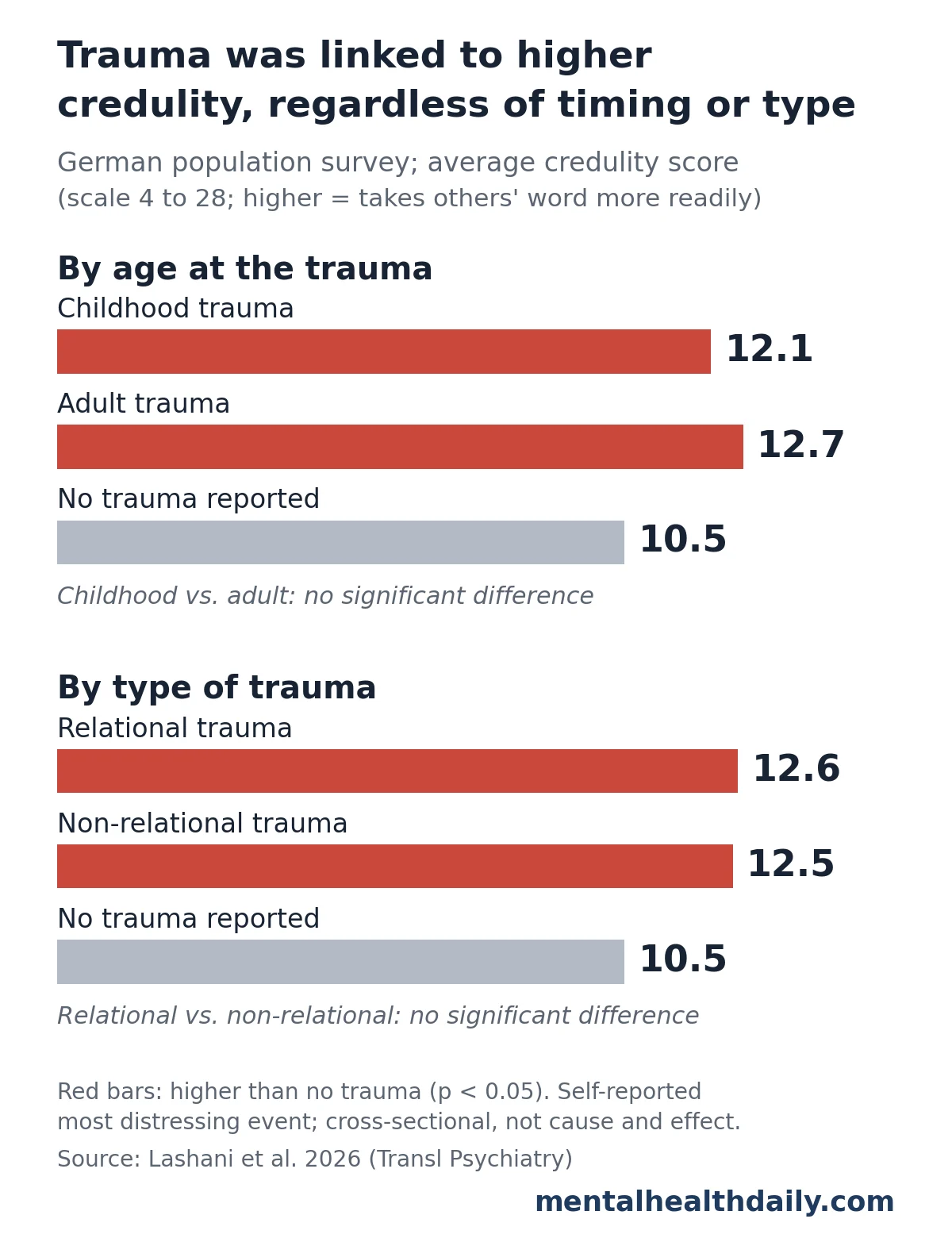
- Age at Trauma: Surprisingly, the study found no significant difference in levels of trust, mistrust, or credulity between individuals who experienced trauma in childhood and those who experienced it in adulthood. Both groups, however, demonstrated markedly higher credulity than the no-trauma group. The effect sizes were moderate, with a Cohen’s d of 0.31 for childhood trauma and 0.43 for adult trauma (where 0.2 indicates a small effect and 0.5 a moderate effect), indicating a meaningful difference.
- Type of Trauma: Similarly, relational trauma (occurring within interpersonal relationships) and non-relational trauma (e.g., accidents, natural disasters) showed almost identical credulity scores (12.6 and 12.5 respectively), both significantly higher than the 10.5 score observed in the no-trauma group. Trust and mistrust levels did not differ across these trauma types.
These findings suggest a pervasive impact of trauma on credulity, indicating that the experience of a traumatic event itself, rather than its specific timing or relational context, may be a primary driver for this shift in epistemic stance. The researchers noted their surprise that adult trauma showed a slightly larger credulity gap, and further analyses indicated this was not explained by how recently the event happened or by demographic factors such as age, gender, education, and income, as adjusting for these variables left the results unchanged.
The Singular Impact of Sexual Violence and Intentional Harm
While the broad categories of trauma showed similar effects, a more granular analysis revealed specific types of trauma that stood out. Individuals who identified sexual violence as their most severe traumatic event exhibited the highest credulity score, averaging 15.4. This was substantially higher than both the no-trauma group (with a large effect size of d = 0.98) and individuals who named a loss as their worst event (d = 0.62). It is important to note, however, that this specific subgroup was relatively small, comprising only 34 individuals.
Further supplementary coding, which grouped emotional, physical, and sexual violence under the umbrella of "intentional harm" inflicted by another person, reinforced this pattern. Trauma resulting from deliberate harm by another individual was consistently linked to greater credulity compared to other forms of trauma, regardless of the age at which it occurred. This specific finding underscores the unique psychological impact of interpersonal violence, where the violation of trust by another human being may particularly predispose individuals to an uncritical acceptance of information.
Credulity’s Link to PTSD and Complex PTSD Symptoms
Beyond simply observing higher credulity after trauma, the study explored whether credulity, mistrust, or trust could act as a mediator between trauma exposure and the development of symptoms. The third preregistered prediction was that all three epistemic stances would help explain the connection between trauma and symptoms. However, only credulity demonstrated a significant mediating role.
This type of analysis, known as mediation analysis, examines whether a third variable (in this case, credulity) lies on the causal pathway between two other variables (trauma and symptoms). While a one-time, cross-sectional survey cannot definitively prove causation, it can identify patterns consistent with such a pathway. The researchers explicitly cautioned that these findings indicate a consistent pattern rather than definitive proof of cause and effect. Nevertheless, the consistent link between credulity and both PTSD and CPTSD symptoms suggests that an increased tendency to accept information uncritically may play a role in how trauma manifests psychologically. This indicates that credulity is not just an incidental outcome of trauma but could contribute to the ongoing symptomatic experience.
Unveiling Nuances: The Critical Role of Childhood Relational Trauma in Exploratory Models
While the initial preregistered hypotheses did not find significant differences between childhood and adult trauma, or relational and non-relational trauma, the researchers conducted additional exploratory analyses. These models, which combined timing and type of trauma, revealed more striking and nuanced patterns, particularly regarding childhood relational trauma.
When timing and type were considered together, a distinct pattern emerged:
- Childhood relational trauma (at 18 or younger), when compared with non-relational trauma at the same age, was significantly linked to:
- Lower levels of epistemic trust.
- Higher levels of epistemic mistrust.
- Higher levels of epistemic credulity.
- More severe symptoms of Disturbances in Self-Organization (DSO), a core component of CPTSD.
Crucially, relational trauma experienced in adulthood did not show these specific links. These combined, more complex models also demonstrated a substantially greater ability to explain the variation in symptom severity. They accounted for 27% of the variance in PTSD symptoms (compared to 12% in simpler models) and a striking 43% of the variance in DSO symptoms (compared to 17% in simpler models). This suggests that while trauma broadly impacts credulity, childhood relational trauma may have a particularly profound and multifaceted effect on an individual’s epistemic stances and, consequently, on their capacity for self-organization and overall mental well-being.
A final exploratory model further suggested a potential causal chain: childhood relational trauma could lead to lower epistemic trust and higher credulity, which in turn could contribute to more DSO symptoms, and subsequently, more PTSD symptoms. The researchers, however, emphasized the preliminary nature of these findings and the critical need for replication, especially given that only 106 participants reported experiencing a childhood relational event.
The Evolving Landscape of Epistemic Trust Research
The 2026 German survey stands as a significant contribution to a growing body of research exploring the relationship between epistemic trust and trauma. It builds upon and is consistent with earlier seminal work in the field:
- Questionnaire Origins (2021): The Epistemic Trust, Mistrust, and Credulity Questionnaire (ETMCQ), a key instrument used in the German survey, was developed and validated by Chloe Campbell et al. in UK samples in 2021. Their initial research found that both mistrust and credulity were linked to adverse childhood experiences and a higher incidence of mental health symptoms. Importantly, they showed that these epistemic stances partly accounted for the connection between early adversity and later psychological distress.
- Parallel German Survey Program (2022): Another study by Hanna Kampling et al., published in 2022, analyzed data from 2,004 participants within the same 2020–2021 German survey program. This research established a link between adverse childhood experiences and increased PTSD and CPTSD symptoms, mediated partly by personality functioning. Their findings further highlighted the importance of epistemic trust, showing that its inclusion in their models significantly raised the explained variation in personality functioning from 16% to 41%.
- Clinical Applications (2024): A 2024 pilot study, involving 50 patients with complex PTSD undergoing a six-week psychodynamic inpatient rehabilitation program, offered initial insights into therapeutic interventions. The study reported substantial reductions in symptoms, and notably, these improvements were observed alongside gains in epistemic trust. While this pilot lacked a control group and was small in scale, it provided an early indication that fostering epistemic trust might be a viable therapeutic target for complex trauma.
The 2026 German survey, therefore, not only corroborates the earlier work on credulity but also pushes the boundaries of understanding by providing the first direct comparison of childhood versus adult trauma within the context of epistemic trust research. This novel comparative aspect offers crucial data for refining developmental models of trauma and its impact on social cognition.
Methodological Caveats and Future Trajectories
While the findings are compelling, the researchers also highlighted several limitations inherent in the study’s design:
- Cross-Sectional Design: As a one-time survey, the study cannot establish definitive cause-and-effect relationships. While mediation analyses suggest pathways, longitudinal studies are needed to confirm causal links between trauma, credulity, and symptoms.
- Self-Report Bias: All data, including trauma history, epistemic stances, and symptoms, were self-reported. This introduces the potential for recall bias, social desirability bias, or subjective interpretation, which could influence the accuracy of the data.
- Retrospective Accounts of Trauma: Participants reported on past traumatic events, sometimes many years after they occurred. The accuracy of retrospective accounts can be influenced by current emotional states and memory distortions.
- Limited Sample Size for Specific Traumas: While the overall sample size was robust, certain specific trauma categories, such as sexual violence (34 individuals) and childhood relational trauma (106 individuals), had smaller subgroup numbers. This necessitates cautious interpretation of findings related to these specific categories and underscores the need for replication in larger, targeted studies.
These limitations underscore the need for continued research using diverse methodologies, including longitudinal studies, experimental designs, and clinical trials, to further validate and expand upon these findings. Future research could also explore cultural variations in epistemic trust and credulity following trauma, as well as the neurobiological underpinnings of these phenomena.
Clinical and Societal Implications: Navigating Credulity for Trauma Recovery
The consistent signal of heightened credulity following trauma carries significant implications for both individual recovery and broader societal well-being. The researchers suggest that an uncritical readiness to accept others’ words could pose multiple risks:
- Increased Vulnerability: Individuals with elevated credulity may be more susceptible to manipulation, exploitation, or re-victimization, perpetuating cycles of harm.
- Challenges in Relationships: It could hinder the ability to form discerning, healthy, and supportive relationships, as boundaries between reliable and unreliable information (and people) become blurred.
- Impediments to Therapy: In a therapeutic context, credulity might paradoxically make it harder for individuals to benefit from supportive and evidence-based interventions. While they might readily accept the therapist’s words, they may struggle to critically engage with the information, integrate it effectively, or differentiate it from unhelpful external messages.
This perspective aligns with the preliminary findings from earlier treatment research where improvements in epistemic trust were observed concurrently with reductions in complex PTSD symptoms. While that work was small and uncontrolled, it provides a promising avenue for intervention. If fostering a more balanced epistemic stance – one that encourages discerning trust rather than indiscriminate credulity – can ease trauma symptoms, it opens new pathways for therapeutic strategies.
For individuals grappling with the aftermath of trauma, characterized by persistent difficulties with sleep, mood, relationships, or daily functioning, seeking professional help is crucial. Mental health professionals trained in trauma-focused treatments can provide tailored support, helping individuals process their experiences, develop healthier coping mechanisms, and cultivate a more balanced and discerning approach to information and relationships, ultimately fostering resilience and recovery.

