

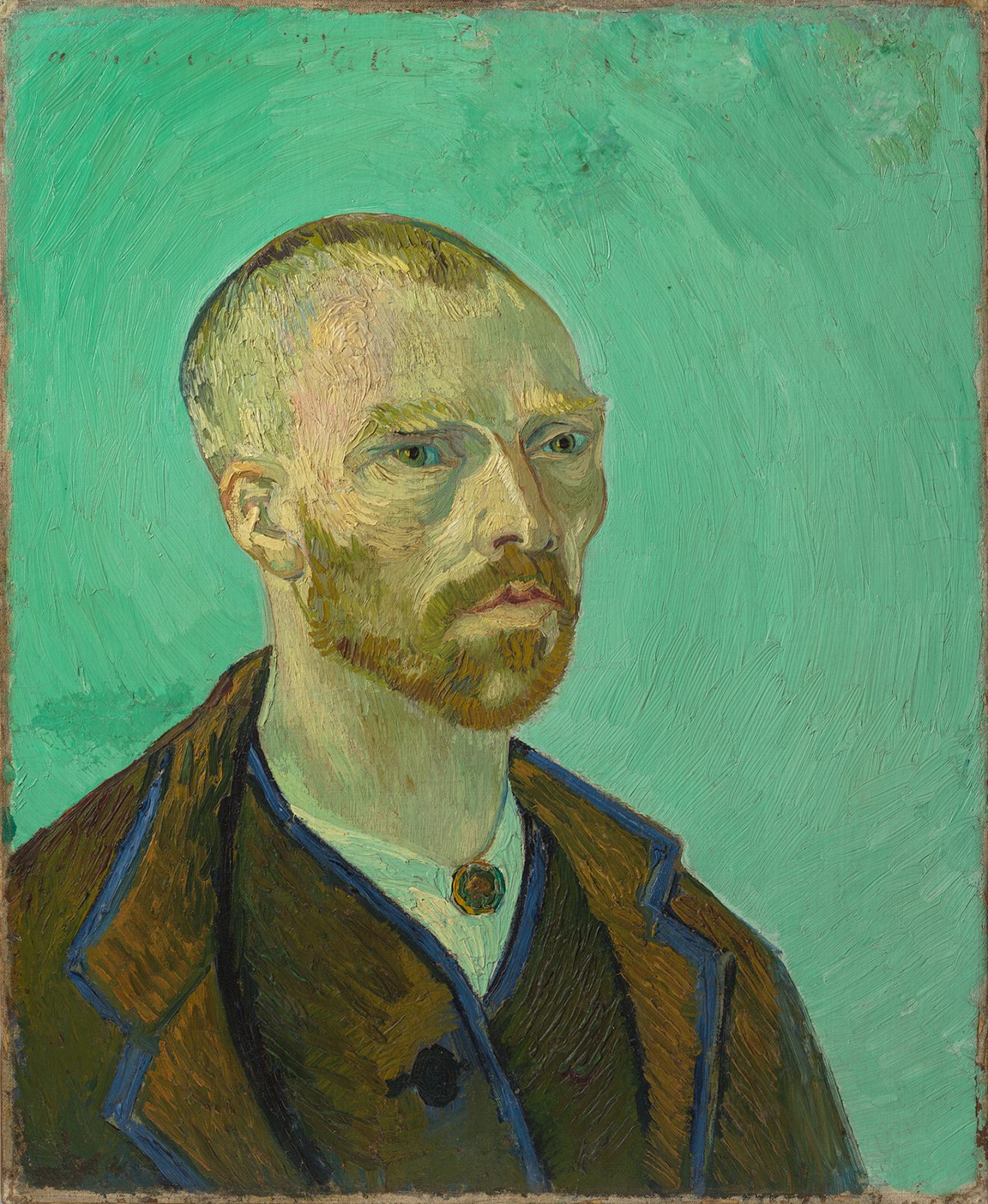
The Harvard Art Museum, a sanctuary of artistic masterpieces, recently became the stage for a profound personal revelation concerning the nature of reverence. Within its hallowed halls, a singular Van Gogh self-portrait commands attention, its luminous intensity transcending the brilliance of neighboring works by luminaries such as Cézanne, Monet, and Picasso. This iconic painting, originally conceived as a gift for Paul Gauguin and later sold for a mere 300 francs, radiates an ethereal Veronese green backdrop, imbuing the artist’s visage with a light, fervor, and fierce human singularity that captivates the observer. It presents itself not merely as a painted image but as an uncapturable phenomenon, an icon that opens a spiritual dimension, revealing the clarity and intensity of Van Gogh’s perception and transfiguring the ordinary into the extraordinary. This transformative power humbles the viewer, presenting undeniable evidence that thwarts attempts at reduction, demanding instead a reverential gaze.
Reverence, as explored in this context, is posited as a vital human response, an innate capacity that allows individuals to attune to what is truly excellent, uplifting, and transcendental – that which lies beyond complete assimilation or appropriation. It is described as a force that ennobles daily routines, sacralizes moments, and organizes the world according to a hierarchy of values, defining a sacred horizon. Without it, humanity is reduced to mere reproductive organisms, genetic transmitters, and survival machines. Reverence, like a subterranean spring, bubbles up when confronted with the sublime, purifying perception and ennobling our sense of relation. Yet, this essential human trait is frequently stifled, mistrusted, and even derided, dismissed as naiveté, undue humility, or glorification of submission. Recognizing, honoring, and refining this primordial capacity is presented as integral to the Buddhist life and essential for any connection with the transcendent or sublime. In a world increasingly described as "deconsecrated," the virtue of reverence is seldom valued, leading to a void where intuition of higher value and glory once resided.
The article argues that while modern society may direct reverence towards pop stars, politicians, influencers, and models, these figures often fall short of sustaining such profound regard. While they may embody certain values to a limited extent, their inherent fallibility inevitably leads to disappointment, cynicism, and a diminished willingness to trust in one’s reverential impulse. This leads to a critical conclusion: reverence is not a luxury but a necessity for meaningful human flourishing. The absence of reverence, it is argued, erodes the very foundation of value, leaving behind a landscape of competing choices ranked by whim or habit rather than merit, devoid of any true call and response.
The transcendent, it is contended, cannot be discerned through a "consuming gaze" which inevitably reduces, flattens, and brutalizes it, trivializing the uncontainable by forcing it into digestible forms and relegating icons to mere signs. In contrast, reverence aligns with the glory of the sacred, allowing its effulgence and grandeur to unfold. This mode of perception renders the sacred manifest – the transcendent, the vast, the filled with wonder and awe – bringing into awareness that which is supremely and gloriously valuable. Reverence, therefore, not only makes the sacred perceptible but also shapes our response to it, fostering a state of offering oneself in service to the ideal, becoming a vessel through which the sacred finds expression. In this state, the sacred is not an object but the very context within which perception, meaning, and value arise, astonishing and blessing us.
Personal Journeys of Reverence: From Skepticism to Devotion
The author’s personal journey into the realm of reverence began with an initial encounter at a Buddhist center, marked by customary ritual acts such as bowing before the Buddha, offering incense, and performing puja (supreme worship). Initially, bowing before a statue felt both awkward and compelling. A prior estrangement from any reverential sensibility, partly stemming from a childhood church experience where the sacred was perceived as absent, left the author feeling summoned yet hesitant. The church environment, described as carrying a "lingering scent of elsewhere," offered no tangible bridge or opening to that perceived spiritual dimension. This initial awkwardness manifested as self-consciousness, with gestures of reverence feeling "bogus" and directionless.
Later, as a regular at the Leeds Buddhist Centre, the author received a small brass Buddha image from a fellow philosophy student. This gift inspired the creation of a personal shrine, a space adorned with a satin cloth and the Buddha image at its center, surrounded by other now-forgotten valued items. The practice of bowing before this image, though cherished as a manifestation of the sacred, was accompanied by a feeling of inauthenticity, a "hazy intuition" of what the sacred truly signified or how it might reshape one’s life horizon.
A significant step in cultivating reverence occurred during preparation for ordination into the Triratna Buddhist Order, which involved the practice of "going for refuge and prostration." This devotional exercise entails visualizing a "refuge tree" – a symbolic representation of sacred values and lineage – and performing physical prostrations before this imagined scene. Subsequently, through the medium of light, one is meant to absorb blessings from the revered figures on the tree. The ideal completion of this practice involves 100,000 prostrations, a goal the author admits to not yet reaching. Undertaken as part of a centuries-old tradition within Tibetan Buddhism, this practice, performed daily for about two years with roommates, initially met with resistance, irritation, and boredom rather than reverence. However, the practice operated "underground," gradually redirecting volition, steering the author towards an encounter with the Three Jewels, and shaping the response to them.
A more profound integration of reverence occurred in 2016 during an ordination retreat near Alicante, Spain. As part of the retreat’s ritual structure, following the "Salutation to the three jewels," the panchang pranam – the "five-point salutation" – was performed. This practice involves kneeling and touching the forehead and palms to the ground three times, a standard Indian gesture of deep reverence and respect, extending beyond a simple bow. The author resolved to adopt this as a daily practice. Even now, performing the panchang pranam can evoke feelings of clumsiness, self-consciousness, and contrivance, prompting questions of sincerity and purpose: "Do I really mean this? What am I bowing to anyway? Isn’t this just a kind of performance?" Despite these internal dialogues, the persistence of the gesture is noted to be slowly breaking down stubborn resistance, melting away distance, and bringing the capacity to connect with what is worthy of reverence closer. The practice, it is observed, wears down cynicism, pride, and clinging to self-power, leading to moments of self-surrender and providing a language to intuit the transcendent.
Reverence in the Buddhist Tradition: A Pathway to the Sacred
The article asserts that humanity possesses an innate capacity for admiration, an impulse to look upward, and an intuitive response to what calls for service, what appears noble and exalted. This capacity is presented as something to be treasured and refined, an expression of the urge to reach toward infinite value or to allow it to reach towards us.
Newcomers to Buddhism are sometimes surprised by the practice of reverence, as they may not categorize Buddhism as a conventional "religion" and may associate such acts with blind belief or subservience. The article clarifies that in Buddhism, reverence is directed towards the Buddha, seen as the pathfinder, exemplar, and guide who demonstrates the way to enlightenment – the ultimate possibility of human existence. Reverence serves as the means to enter into a relationship with this possibility, bridging the gap between it and our present consciousness.
Reverence is characterized as integral to the Buddhist life, providing a language for intuiting the sacred. Counterintuitively, the more enlightened a being becomes, the greater their impulse and capacity for reverence. This is illustrated by the example of the great bodhisattva Dharmakara (who would become Amitabha Buddha) in the Larger Pure Land Sutra, vowing that beings reborn in his Pure Land would honor all buddhas everywhere and at all times.
The Buddha himself emphasized the importance of reverence, valuing its embodiment in devotional acts. A pivotal discourse in the Pali Canon, the Garava Sutta, highlights the centrality of reverence in the Buddhist worldview. Reflecting on his spiritual awakening, the Buddha states, "One experiences suffering if dwelling without reverence or deference." The term translated as "suffering" is dukkha, encompassing dissatisfaction or lack. "Reverence" (garava) also signifies admiration, amazement, and delight in the existence of those superior in creative ability or spiritual attainment. These attitudes, akin to vandana (salutation) and puja (worship), express skillful emotion connected to relating with what is worthy and magnificent, reflecting sensitivity to values beyond the mundane self. "Deference" (patissa), derived from a root related to listening, signifies paying careful attention to counsel, particularly within the teacher-disciple relationship.
According to Buddhist teachings, living without reverence and deference invites suffering because it implies recognizing nothing beyond oneself, no point of reference higher than one’s egocentric will. This perspective, where "we ourselves are, so to speak, as good as it gets," is deemed terrifying and profoundly insufficient for the majority of humanity. As Sangharakshita puts it, "To live without looking up to anyone represents an impoverishment of one’s emotional life and, indeed, an impairment of one’s very humanity."
The article posits that humanity needs something to look up to, a transcendent orientation that inspires the actualization of deepest aspirations. Without it, a sense of emptiness and depression can prevail. The recognition that one is not yet the most noble being possible, and that admirable qualities and noble actions can be developed, underscores the importance of garava and patissa in recognizing and responding to more complete and refined manifestations of our highest ideals.
A dharma life, lived with integrity, embodies the principle of reverence or devotion. This does not necessitate constant ritualistic performance but can be expressed through simple, everyday actions like cleaning a shrine room, making tea for a respected friend, or offering a small gift. The entire practice, including meditation, becomes a quiet offering of attention and presence.
The Mandala of Reverence: Mapping Values and Transcending Idolatry
To cultivate a deeper understanding of reverence, the article suggests a "spiritual inventory" of how and toward what reverence is expressed in one’s life. This self-examination aims to clarify one’s most prized values. A crucial question posed is whether one is reverencing something mundane, a potential focus for idolatry as defined by theologian Paul Tillich, or something that genuinely uplifts and inspires self-transcendence. The distinction is made between an idol, which is perceived as opaque and incapable of inviting movement beyond itself, and an icon, which is rendered transparent to the light invested in it, enabling a transmutation from idol to icon.
This process can be conceptualized as creating a "mandala of reverence," where a mandala serves as a map of value. What is placed at the center of this mandala signifies what is truly valued, or what one "goes for refuge to." Through this exercise, individuals may discover that their prioritized values are mundane. The exercise facilitates differentiation between false or limited refuges and the ultimate, true refuge. For Buddhism, the most complete refuge is the Three Jewels, functioning as the transcendental object. If the Three Jewels are not at the center of one’s mandala of reverence, it signifies a form of "idolatry" – settling for a limited refuge, remaining alienated from one’s ultimate concern and the true significance of life.
Through devotional acts and attitudes directed toward the Three Jewels, individuals can restore and celebrate their connection with their ultimate concern, allowing it to bless their existence. To go for refuge to the Buddha means to comport oneself towards the Buddha as a focus of devotion, inspiration, and aspiration, converting the Buddha image into an icon. It signifies a commitment to minimizing, and ultimately closing, the breach between one’s mind and the mind of the Buddha, with the ultimate aim of becoming the Buddha. Through reverence, individuals permit the transcendent to reconstitute them, yielding to the weight of its glory, which, in turn, fills them with blessing.
This exploration of reverence, rooted in personal experience and Buddhist philosophy, suggests a path toward a more profound and meaningful engagement with life, transcending the limitations of a superficial or consuming gaze and opening up the possibility of genuine awe and spiritual realization.

