

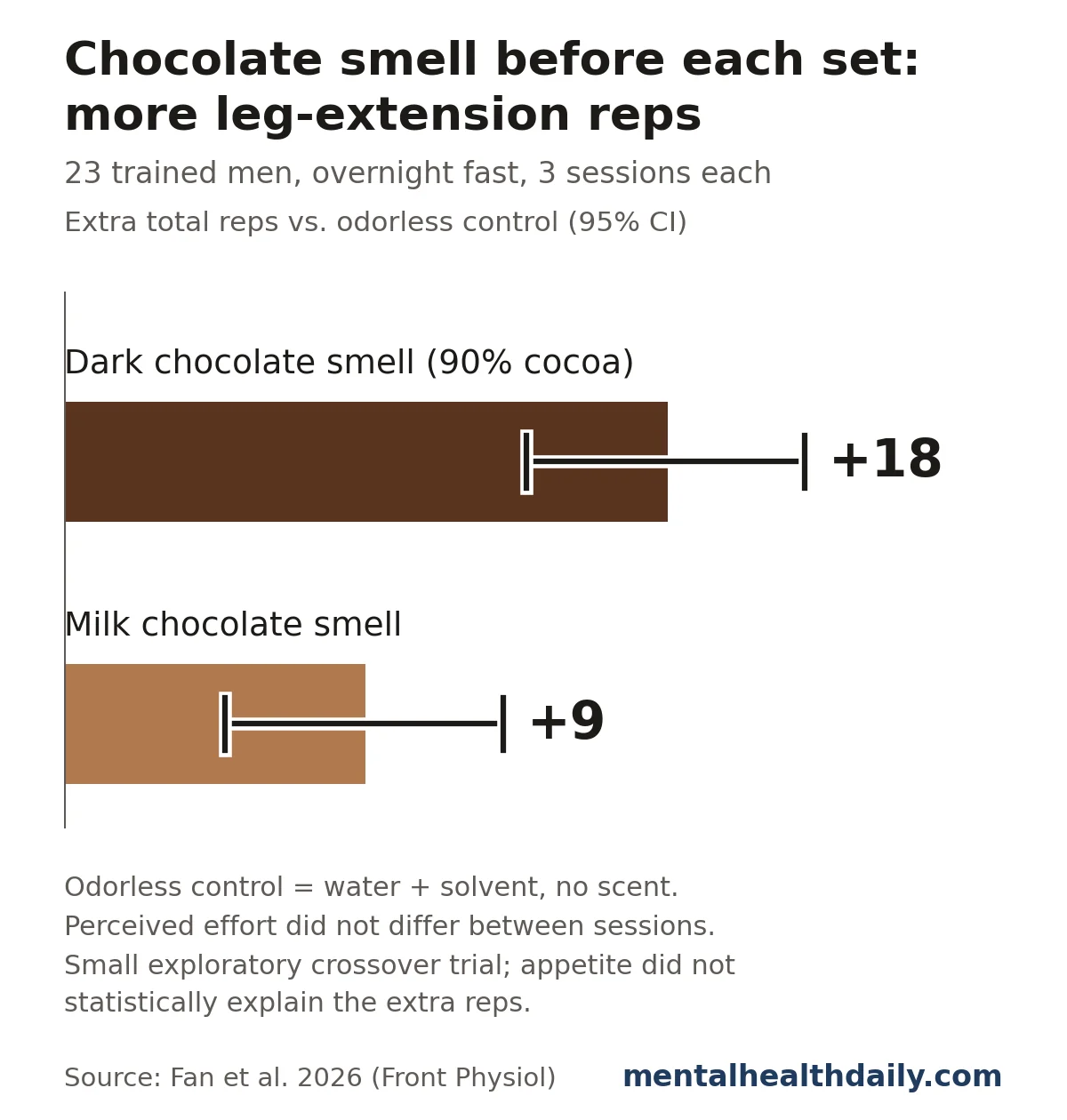
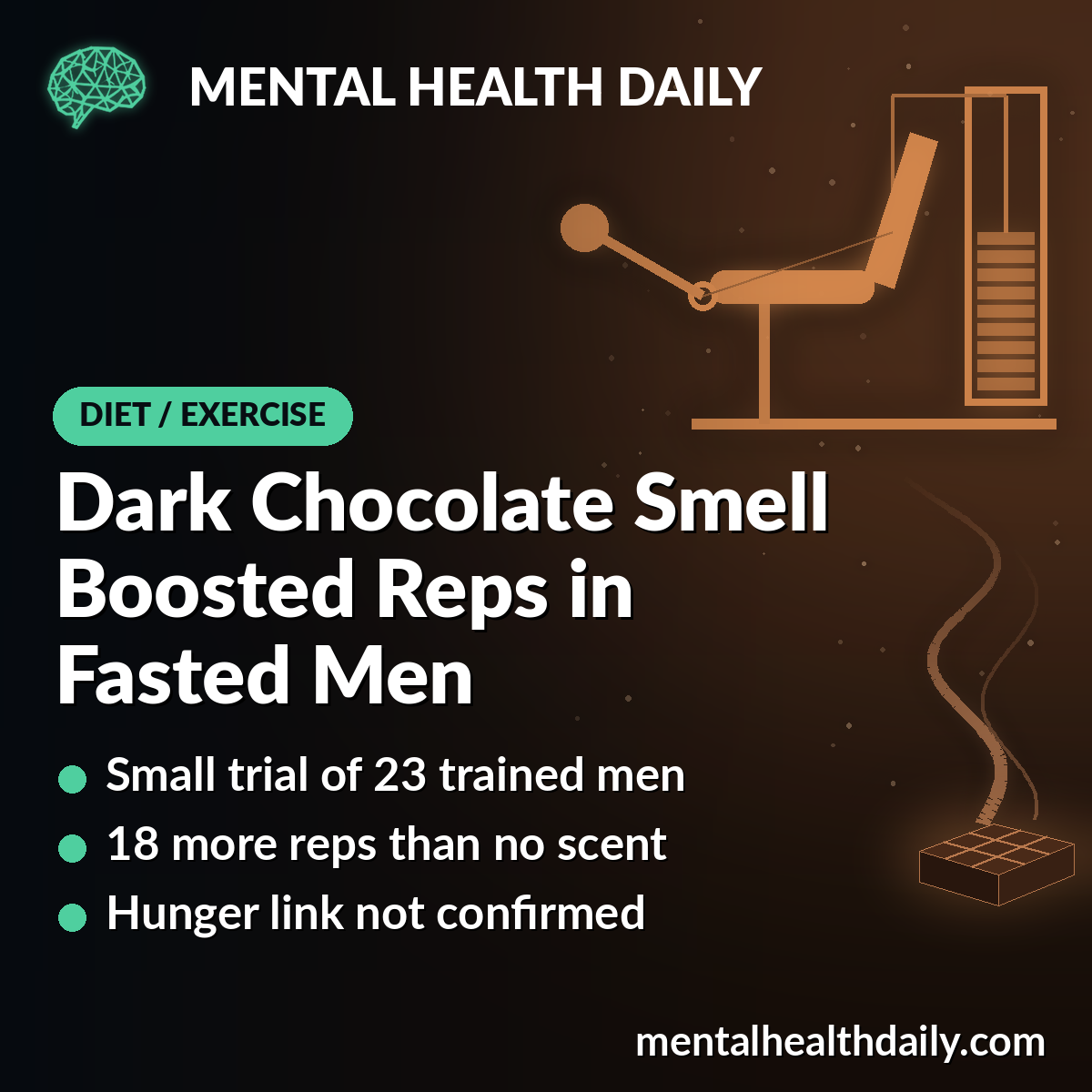
A groundbreaking 2026 crossover trial has unveiled a fascinating link between the sense of smell and physical performance, demonstrating that inhaling the scent of dark chocolate for 30 seconds before and during a workout significantly enhances the number of leg-extension repetitions completed by fasted, resistance-trained men. Participants exposed to dark chocolate aroma performed an average of 18 more reps compared to an odorless control, while a milk chocolate scent also showed a benefit, adding 9 reps. This intriguing finding, published by Xiaohan Fan et al. at the University of Malaya in Kuala Lumpur, opens new avenues for understanding non-pharmacological performance enhancement strategies, particularly in fasted training scenarios where hunger can often impede endurance.
The Methodology Behind the Olfactory Boost
The study rigorously recruited 23 healthy men, with an average age of 23, all of whom possessed at least two years of consistent weightlifting experience, training at least twice a week. A critical design element was the fasted state of the participants; all men typically consumed breakfast, making the approximately 10-hour overnight fast a deliberate departure from their routine and a key condition for observing the scent’s impact on hunger-related performance decrements.
Each participant underwent three distinct test sessions, spaced at least four days apart to prevent carryover effects, with the order of scent exposure randomized. The scents were meticulously prepared: a 90% dark chocolate solution, a milk chocolate solution, and an odorless control, each presented as a freshly mixed liquid in identical glass jars. To ensure consistent scent release, all three liquids contained a small, uniform amount of propylene glycol, a common solvent. Crucially, the trial was double-blinded; neither the participants nor the staff responsible for counting repetitions were aware of which jar contained which scent, minimizing potential bias.
The "smelling routine" was precise and frequent: participants held the designated jar 2 to 3 centimeters below their nose, inhaling deeply for 30 seconds with paced breathing (3 seconds in, 3 seconds out). This ritual was performed four times within the 15 minutes immediately preceding the exercise session and then repeated before every subsequent set of leg extensions. This consistent and repeated exposure to the scent was paramount to the experimental design, aiming to maintain the olfactory stimulus throughout the workout.
The workout itself consisted of leg extensions, a well-controlled isolated exercise, performed at 80% of each man’s 10-repetition maximum (10RM) – the heaviest weight they could lift exactly 10 times. A rest period of 3.5 minutes was enforced between sets, with the exercise continuing until the participant could no longer complete a full set of 10 repetitions. The primary outcome measure was the total number of repetitions completed across all sets.
Beyond physical performance, the researchers diligently tracked subjective experiences. Between scent exposures, participants rated their hunger, fullness, desire to eat, and the pleasantness of the smell using 100-millimeter visual analog scales (VAS), ranging from "not at all" to "extremely." After each set of leg extensions, perceived effort was assessed using the Borg CR10 scale, a 0-to-10 rating of perceived exertion.
Remarkable Performance Gains and Unchanged Perceived Effort
The results were compelling: the presence of chocolate scent made a distinct and statistically significant difference in total repetitions. Compared to the odorless control, men completed an impressive 18 more total leg-extension reps when smelling dark chocolate (95% CI 13.8 to 22.1). The milk chocolate scent also contributed positively, leading to 9 more reps (95% CI 4.8 to 13.1) than the control. Furthermore, dark chocolate significantly outperformed milk chocolate by a margin of 9 reps. The data also indicated that participants in the dark chocolate session completed approximately one additional set compared to both the control and milk chocolate sessions, which showed similar numbers of sets.
Perhaps one of the most intriguing findings was related to perceived effort. While perceived exertion naturally increased with each successive set across all three sessions, the scent itself had no clear differential impact on these ratings (p ≥ 0.31). This suggests that participants performed substantially more work—an additional 18 reps with dark chocolate—without subjectively feeling that each set was harder. This decoupling of workload and perceived effort holds significant implications for training potential, as it implies a capacity for greater volume without a commensurate increase in subjective strain. However, it’s important to note that effort was only rated after each set, and the study did not delve into broader psychological states like overall motivation, mood, or specific measures of muscle fatigue, leaving room for further exploration into how participants might have felt during these additional repetitions.
Divergent Effects on Hunger and Pleasure Perception
The two chocolate scents exhibited distinct effects on hunger and pleasure ratings. The dark chocolate scent notably reduced subjective feelings of hunger and the desire to eat, while simultaneously increasing feelings of fullness during the 15 minutes before exercise, compared to both the odorless control and the milk chocolate scent. Interestingly, the pleasantness rating for dark chocolate was not significantly different from the odorless control, suggesting its performance-enhancing effect was not solely tied to hedonic pleasure.
In contrast, the milk chocolate scent did not demonstrate a significant reduction in hunger. Instead, it slightly increased the desire to eat and was rated as marginally more pleasant than the control, with a modest difference of 3.1 mm on the 100-mm VAS scale. Hunger ratings observed during the exercise phase largely mirrored these pre-exercise patterns, with dark chocolate consistently associated with the lowest hunger levels. The researchers prioritized the pre-exercise ratings as a clearer indication of a direct scent effect, acknowledging that exercise itself can temporarily suppress appetite.
Unraveling the Mechanism: Beyond Simple Appetite Suppression
While the study’s title proposed that chocolate odor improved performance "through appetite suppression," the internal mediation analysis conducted by the researchers did not definitively confirm this direct causal link. A mediation analysis is a statistical technique used to determine if an observed effect between two variables (e.g., scent and reps) operates through an intermediate variable (e.g., appetite). The researchers tested three specific pathways:
- Whether dark chocolate scent led to lower hunger, which then led to more repetitions.
- Whether dark chocolate scent led to greater fullness, which then led to more repetitions.
- Whether milk chocolate scent led to higher pleasantness, which then led to more repetitions.
The analysis revealed that only a small fraction of the observed performance gain—12% for the hunger pathway and 14% for the fullness pathway with dark chocolate—could be statistically explained by changes in appetite or pleasantness. The pleasantness pathway for milk chocolate explained 0% of the effect. Consequently, the researchers concluded that these analyses did not robustly establish hunger, fullness, or pleasantness as the primary mediating mechanism for the improved performance.
However, a separate within-person correlation analysis did provide some supporting evidence for an appetite-related story. This analysis indicated that for any given participant, sessions where they reported lower hunger before exercise were associated with completing more repetitions (r = -0.47), and sessions with greater fullness correlated with more reps (r = 0.38). Pleasantness, notably, showed no such link to reps (r = 0.01). While these correlations suggest a relationship consistent with an appetite-driven effect, they cannot definitively prove causation, leaving the exact physiological or psychological pathways largely open to further investigation. The effect might be a complex interplay of cognitive factors, mood, motivation, and subtle physiological shifts not fully captured by the measured variables.
Historical Context and Related Research on Olfaction and Performance
The concept of smell influencing physiological and psychological states, including appetite and performance, is not entirely new. The olfactory system is uniquely wired, with direct connections to the limbic system, which governs emotions and memory, and the hypothalamus, a key regulator of appetite and physiological drives. This direct neural pathway provides a plausible biological basis for the profound, often subconscious, effects that scents can have.
Regarding appetite specifically, a 2010 preliminary study involving 12 young women found that smelling 85% cocoa chocolate increased feelings of satiety, and this response was tentatively linked to changes in ghrelin, a hormone known to stimulate hunger. While a very small study with only 6 women randomized to the smelling condition, it laid early groundwork for investigating chocolate scent’s role in appetite modulation.
The current research group from the University of Malaya, often in collaboration with UK researchers, has a history of exploring the nuances of fasted training and its impact on performance. Their previous work has consistently shown that fasted resistance training can often lead to a reduction in total repetitions or overall performance. For instance:
- A 2018 study from this group demonstrated that overnight fasting reduced total repetitions during leg press exercises in trained men.
- Similar findings were reported in a 2021 study examining back squats and bench presses, where fasting negatively impacted performance.
- A comprehensive review in 2023 further consolidated evidence suggesting that fasting generally compromises high-intensity exercise performance, particularly in resistance training.
Given that the participants in the current chocolate scent study were habitual breakfast eaters, their fasted state represented a significant deviation from their normal routine, making the observed performance enhancement even more noteworthy against a backdrop where fasting typically hinders performance. However, it’s crucial to acknowledge that not all studies align with this view. A Brazilian trial in trained young men, for example, found that 12 or 16 hours of overnight fasting, while increasing hunger, did not significantly alter strength, jump height, or repetitions on exercises like the back squat and leg press. Such conflicting results underscore the complexity of fasted training effects and the need for context-specific research.
Another critical consideration is the "expectancy effect" or placebo effect. A systematic review published in 2021, encompassing 32 studies and 1,513 participants, revealed that placebo and nocebo (expecting harm) effects on sports performance are real, with a pooled effect size of d = 0.38, indicating a small to moderate impact. This bears directly on the chocolate trial, as the control condition was simply an "odorless" jar, rather than a neutral, non-food scent. The mere presence of a pleasant, food-related smell, particularly one associated with reward and energy, could potentially induce a positive expectancy effect, contributing to the observed performance gains. Participants might have unconsciously anticipated a benefit from the chocolate scent, leading to increased effort or endurance, even if not consciously perceived as "harder."
Limitations and Future Research Directions
Despite its intriguing findings, the chocolate smell exercise study comes with several inherent limitations that warrant cautious interpretation and guide future research. The relatively small sample size of 23 men, while sufficient for statistical significance in this specific crossover design, limits the generalizability of the findings to broader populations. The study also focused exclusively on a single, isolated exercise—leg extensions—leaving open the question of whether similar effects would be observed in compound movements, other muscle groups, or different exercise modalities. The short-term nature of the intervention, with each scent tested in a single session, means long-term effects or adaptations remain unexplored.
A significant limitation is the exclusive inclusion of men. Women, with their distinct hormonal profiles, metabolic responses, and potentially different olfactory sensitivities, might respond differently to these scent interventions. Furthermore, as previously discussed, the use of an "odorless" control rather than a neutral, non-food scent raises the possibility of a substantial placebo effect contributing to the chocolate-induced performance gains. Without a true neutral odor control, it’s challenging to isolate the specific effect of the chocolate scent from the general psychological impact of receiving an intervention. The study also did not measure psychological variables such as motivation, mood, or specific markers of muscle fatigue, which could provide deeper insights into the mechanisms underlying the extra repetitions. Finally, as the mediation analysis demonstrated, the precise physiological and psychological mechanisms remain largely unexplained, necessitating further investigation.
Future research should aim to address these limitations by incorporating larger and more diverse cohorts, including women, across various age groups. Expanding the exercise repertoire to include compound movements and different types of training would enhance the generalizability of the findings. Investigating longer-term interventions could reveal whether these acute effects translate into sustained performance improvements or adaptations. Crucially, future trials should employ odor-matched controls (e.g., a neutral, non-food scent) to better isolate the specific effects of the target odor from placebo effects. Integrating measures of psychological factors like mood, motivation, and expectation, alongside physiological markers such as specific hormone levels or brain activity patterns, could provide a more comprehensive understanding of how olfaction influences exercise performance.
Implications for Athletes, Fitness Enthusiasts, and the Industry
The findings, while exploratory, present an exciting, low-cost, and calorie-free potential strategy for individuals engaged in fasted workouts. For athletes or fitness enthusiasts who train in a fasted state and find their performance or endurance hampered by feelings of hunger, a brief whiff of dark chocolate between sets could serve as a simple, non-invasive experiment. The appeal lies in its minimal invasiveness and absence of caloric intake, aligning perfectly with the principles of fasted training.
However, experts caution against over-extrapolation from a single, small-scale study. A sports scientist might suggest that while the results are intriguing, they should be viewed as preliminary. The real-world impact on elite athletic performance, which often involves complex movements and higher stakes, still needs to be rigorously tested. A registered dietitian might highlight the psychological power of sensory cues, noting that while the scent might temporarily suppress hunger, it doesn’t provide actual nutritional support, and athletes should still prioritize their overall nutritional strategies. A neuroscientist might hypothesize that the dark chocolate scent could be stimulating neural pathways associated with reward or satiety in the brain, subtly shifting the perception of effort or delaying the onset of central fatigue.
The implications for the broader fitness and sports nutrition industry are also noteworthy. If these findings are replicated and further mechanisms elucidated, it could lead to the development of novel "olfactory performance aids"—perhaps scented inhalers or diffusers designed to optimize training sessions. Such products would represent a departure from traditional oral supplements, offering a unique sensory approach to performance enhancement.
In conclusion, the University of Malaya’s research offers a tantalizing glimpse into the subtle yet powerful influence of smell on physical endurance, particularly in challenging fasted states. While the exact mechanisms remain to be fully uncovered, and further extensive research is warranted, the idea of harnessing the power of a dark chocolate aroma to push through those extra reps is an innovative concept that could potentially redefine aspects of pre-workout routines and performance psychology. For now, maintaining modest expectations while embracing the spirit of experimentation seems to be the prudent approach for those looking to sniff out a new edge in their fitness journey.

