

A groundbreaking 2026 survey of 486 undergraduates in China has unveiled a concerning trend: college students who perceived their AI learning tools as highly adaptive reported significantly less enjoyment, increased anxiety, and greater boredom throughout the semester. Furthermore, these students demonstrated weaker study self-management skills by the semester’s end, raising questions about the long-term impact of highly personalized educational technologies on student autonomy and well-being. This study, conducted by Jing Li et al., sheds light on a potential "personalization paradox" where the very tools designed to optimize learning might inadvertently undermine crucial independent study habits and emotional engagement.
The Rise of Adaptive Learning and the "Personalization Paradox"
The integration of artificial intelligence into education has been heralded as a transformative force, promising tailored learning experiences that cater to individual student needs. At the heart of this revolution are adaptive learning platforms, sophisticated digital tools that employ algorithms to dynamically adjust the educational content presented to a student. These platforms meticulously track user data – including answers, response speed, and error patterns – to modify the difficulty, sequence, pacing, and feedback of learning materials. Much like a dedicated human tutor, these systems aim to guide students along an optimal learning path, providing just the right challenge at the right time. Globally, and particularly in highly competitive educational systems like China’s, the adoption of such technologies has surged, driven by the promise of enhanced efficiency, improved academic outcomes, and the ability to address diverse learning styles at scale.
However, alongside the enthusiasm, a growing concern among researchers has been the emergence of a "personalization paradox." This paradox posits that while adaptive software excels at making planning and pacing decisions, it may inadvertently deprive students of opportunities to develop these critical decision-making skills themselves. This is particularly relevant to self-regulated learning (SRL), a vital set of metacognitive habits that enable students to effectively manage their own study processes. SRL encompasses a range of skills, including setting clear learning goals, planning study strategies, monitoring one’s own comprehension, adjusting approaches when encountering difficulties, and evaluating learning outcomes. These skills are well-established predictors of academic success, especially in online and higher education environments where independent study is paramount. If AI tools consistently make these decisions for students, the fear is that students may become passive recipients of information rather than active architects of their own learning journeys.
Unpacking the Chinese Undergraduate Experience with AI
The study, conducted across one academic semester from September 2025 to January 2026, involved undergraduates from 28 classes at four distinct Chinese universities. This timeframe placed the survey squarely within a period of rapid technological advancement and increasing reliance on digital learning tools, particularly in post-pandemic educational landscapes. Each participating student had utilized at least one AI-based learning tool in the preceding semester, indicating a widespread familiarity with such technologies within the surveyed population.
The research employed a longitudinal survey design, collecting data at different points throughout the semester to capture evolving perceptions, emotional states, and study habits. Initially, 523 questionnaires were distributed, yielding 486 valid responses at the study’s commencement. The sample was relatively balanced in terms of gender, with 53.1% men, and an average age of 20.5 years, representing a typical undergraduate demographic. The researchers maintained a high retention rate, with a total dropout of only 7.6% across the semester, and opted to retain partial responses rather than discard them entirely, enhancing the robustness of their data.
Students reported spending an average of 3.8 hours per week interacting with various AI tools. The range of tools utilized was diverse, extending beyond traditional adaptive learning platforms to include AI-powered search engines, translation tools, writing assistants, and more general learning management systems. Crucially, the researchers noted that only specific categories, such as AI tutoring platforms and course recommendation systems, were genuinely adaptive in their functionality. Consequently, the study’s primary measure of "adaptiveness" reflected students’ subjective perception of how tailored and personalized their overall AI learning environment felt, rather than being tied to a single, universally adaptive product. This nuanced approach acknowledges that a student’s experience is shaped by their interpretation of the technology, not merely its inherent design.
Emotional Pathways to Weakened Self-Regulation
The core findings of the study revealed a clear and statistically significant link between students’ perception of their AI environment as highly adaptive and a decline in self-regulated learning (SRL) at the semester’s close. Simple correlations painted a stark picture: a higher adaptive-environment score was inversely related to SRL (r = –0.33), enjoyment (r = –0.28), and positively correlated with anxiety (r = 0.31) and boredom (r = 0.35). These initial correlations suggested that the more students felt their AI tools were taking the reins, the less engaged and more stressed they became, ultimately impacting their ability to manage their own studies.
To delve deeper into these relationships, the researchers employed a structural equation model (SEM). This advanced statistical technique allowed them to simultaneously test a chain of causal links, providing a more comprehensive understanding of how different factors interact. The SEM, which adjusted for confounding variables such as gender, academic year, field of study, weekly AI usage hours, and the primary type of AI tool used, confirmed the hypothesized pathway: perceived adaptiveness of AI tools directly influenced students’ emotions, which in turn mediated their self-regulated learning. Specifically, the model demonstrated that an adaptive-feeling AI environment led to reduced enjoyment, increased anxiety, and heightened boredom. Each of these emotional states then independently contributed to a reduction in self-regulated learning. Enjoyment was positively associated with SRL, while anxiety and boredom exhibited negative associations, as intuitively expected. Collectively, this emotional pathway explained a substantial 28.4% of the observed differences in self-regulated learning among students.
The researchers drew upon control-value theory to explain why these emotions might be involved. This psychological framework posits that academic emotions are largely determined by two key factors: how much control students feel they have over their learning tasks and how much they value those tasks. When an algorithm consistently makes decisions about what to learn, when, and how, students may experience a diminished sense of control over their educational journey. This reduction in perceived control can directly contribute to increased anxiety, as students may feel less agency in their own success or struggle. Furthermore, material that is too precisely tuned to a student’s current level, while efficient, might inadvertently strip away the challenge or novelty that makes learning engaging, leading to feelings of boredom. If the AI is always "just right," students may not experience the satisfaction of overcoming genuine obstacles or the intrinsic motivation that comes from pursuing self-directed interests.
AI Literacy: A Critical Buffer Against Negative Emotions
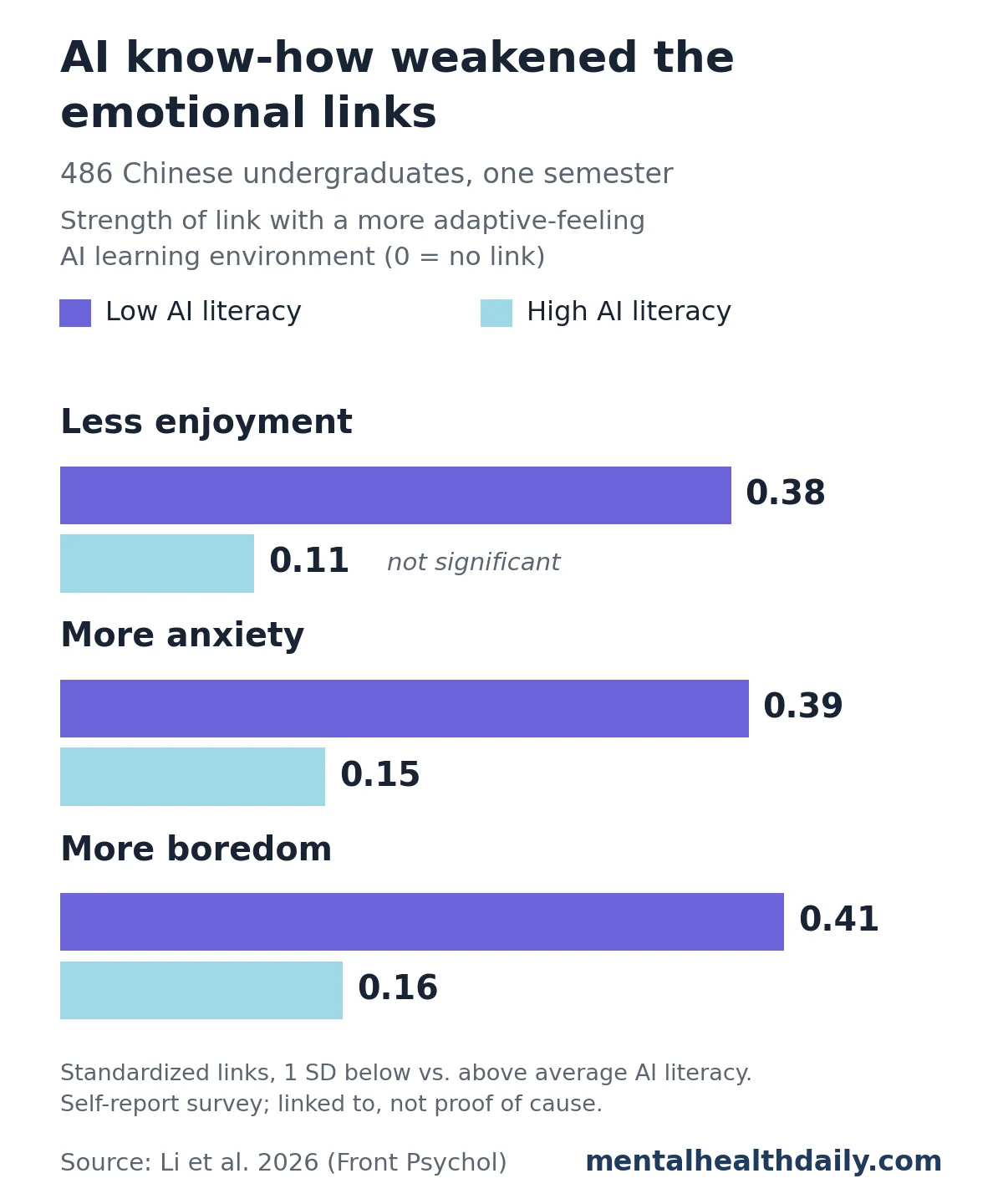
A particularly insightful finding of the study was the moderating role of AI literacy. The impact of an adaptive-feeling AI environment on student emotions was not uniform across all participants; it significantly varied based on a student’s understanding of AI. Among students who scored one standard deviation below the average in AI literacy, the links between perceived adaptiveness and negative emotions (less enjoyment, more anxiety, more boredom) were robust and strong. However, for students who scored one standard deviation above average in AI literacy, these links were considerably weaker. For instance, the correlation between adaptive AI and less enjoyment dropped from 0.38 for low AI literacy students to a statistically insignificant 0.11 for high AI literacy students. Similar reductions were observed for anxiety (from 0.39 to 0.15) and boredom (from 0.41 to 0.16).
This buffering effect extended to the ultimate impact on study habits. The emotional pathway leading to weaker self-regulated learning also shrank significantly for students with higher AI literacy. For boredom, the negative link to SRL diminished from –0.14 at low AI literacy to –0.04 at high AI literacy. Indeed, for highly AI-literate students, none of the three emotional routes (enjoyment, anxiety, boredom) clearly maintained a significant link to self-regulated learning. This suggests that students who possess a better understanding of how AI tools function – their capabilities, limitations, and underlying algorithms – are better equipped to navigate adaptive learning environments without succumbing to emotional distress or a decline in self-management. They might understand why a system makes certain recommendations, when to trust it, and perhaps more importantly, when to override it and assert their own learning strategies.
It is important to note, however, that AI literacy was measured as an existing trait in students, not as an intervention taught by the study. Therefore, the research cannot definitively conclude that providing AI literacy training would produce the same buffering effect. Students who are already highly AI-literate may possess other distinguishing characteristics, such as higher self-confidence, superior prior academic performance, or a more proactive learning disposition, which could also contribute to their resilience in adaptive learning settings.
Broader Context: Reconciling AI’s Promise with Its Perils
The findings of this Chinese survey resonate with and add crucial nuance to existing research on AI in education. While the current study highlights potential pitfalls, it does not entirely negate the documented benefits of adaptive technologies. For instance, a meta-analysis of 50 controlled evaluations of intelligent tutoring systems previously found a median gain of 0.66 standard deviations in test scores, roughly equivalent to moving an average student from the 50th to the 75th percentile. This demonstrates that adaptive tutoring can be highly effective in boosting measurable academic performance. The 2026 Chinese survey, however, did not measure grades, focusing instead on the more qualitative aspects of the learning experience – emotions and self-management. This distinction is critical: AI may enhance rote learning and factual recall, but at what cost to deeper engagement and the development of lifelong learning skills?
Further supporting the "personalization paradox" concern is a field experiment involving nearly 1,000 Turkish high school math students. In that study, a plain GPT-4 chat assistant initially boosted practice grades by an impressive 48%. However, once access to the AI was removed, these students scored 17% lower than a control group who never had AI assistance. This suggests that an over-reliance on unguarded AI help can create dependency, weakening students’ independent problem-solving abilities. Interestingly, a modified tutor version designed to offer hints rather than direct answers largely avoided this detrimental drop, underscoring the importance of how AI assistance is delivered. This aligns with the Chinese study’s implication that simply having adaptive tools isn’t enough; the design must foster, not hinder, student autonomy.
The emotional pathway identified in the Chinese study is also consistent with broader educational psychology research. A meta-analysis of 68 studies found clear links between study emotions and academic performance: enjoyment of learning was positively correlated with better academic outcomes (ρ = 0.27), while boredom was negatively associated with performance (ρ = –0.25). These established relationships lend credence to the Chinese survey’s model, which posits that negative emotions elicited by highly adaptive AI can indeed lead to poorer self-regulated learning.
Implications for Students, Educators, and Developers
The findings carry significant implications for various stakeholders in the educational ecosystem. For students currently utilizing AI learning tools, the study offers practical advice. It underscores the importance of maintaining a degree of personal control over one’s learning journey. If an AI platform dictates every next step, students may benefit from consciously setting their own weekly goals, proactively planning their review sessions, and independently tracking their progress outside the confines of the application. The survey itself found that students with stronger self-management habits reported greater enjoyment and less boredom, reinforcing the idea that active participation fosters positive emotions. Crucially, developing AI literacy is presented as a vital skill. Understanding how AI tools work – their logic, their biases, and their limitations – empowers students to discern when to follow recommendations and, equally important, when to override them based on their own learning needs and preferences.
For educators and university administrators, the study highlights the need for a balanced approach to AI integration. While the efficiency benefits of adaptive learning are undeniable, institutions must consider the pedagogical design of AI tools to ensure they complement, rather than undermine, the development of critical thinking and self-regulated learning skills. This could involve developing AI literacy courses as part of the curriculum, training faculty to guide students in effective AI tool usage, and advocating for platforms that are more transparent about their algorithms and allow for student customization. Universities might also need to foster a learning culture that values process and autonomy alongside outcomes.
For AI developers and designers, the research provides a clear call to action for ethical and student-centric design. Future adaptive learning platforms should aim to explain their recommendations, allowing students insight into the "why" behind algorithmic suggestions. More importantly, designers should incorporate features that enable students to adjust the level of adaptiveness, set their own learning parameters, and actively participate in planning their study paths. This iterative design process, informed by empirical research on student well-being and long-term learning outcomes, will be crucial in mitigating the "personalization paradox" and ensuring AI tools genuinely enhance, rather than diminish, the human learning experience.
Limitations and Future Directions
While highly informative, the study acknowledges several limitations. Its reliance on self-report data means that student perceptions and emotional states are subjective and could be influenced by reporting biases. Furthermore, the correlational nature of the study prevents definitive conclusions about causation. While the structural equation model suggests a plausible pathway, experimental designs, such as randomized controlled trials, would be necessary to establish direct causal links between adaptive AI use and changes in emotions or self-regulated learning. The measurement of AI literacy as an existing trait, rather than a taught intervention, also limits the ability to recommend AI literacy training with full confidence, although the evidence strongly suggests its potential benefits.
Finally, the study was conducted within a specific Chinese cultural and educational context. The highly competitive nature of the Chinese education system, coupled with cultural norms around learning and authority, might interact with adaptive AI tools differently than in Western or other cultural settings. Future research should explore these dynamics in diverse educational environments to determine the generalizability of these findings.
In conclusion, this comprehensive survey from China serves as a critical reminder that while AI offers immense potential for educational advancement, its implementation must be approached with careful consideration for the holistic development of students. Striking a balance between personalized efficiency and fostering student autonomy, emotional well-being, and self-regulated learning will be paramount in shaping the future of education in an AI-powered world. Addressing persistent anxiety about academic performance, which can manifest in sleep disturbances, eating issues, or daily life disruptions, remains a critical concern, and students experiencing such challenges are encouraged to seek support from campus counseling centers or medical professionals. The journey towards harnessing AI’s full educational promise requires continuous research, thoughtful design, and a steadfast commitment to putting student well-being at the forefront.

