

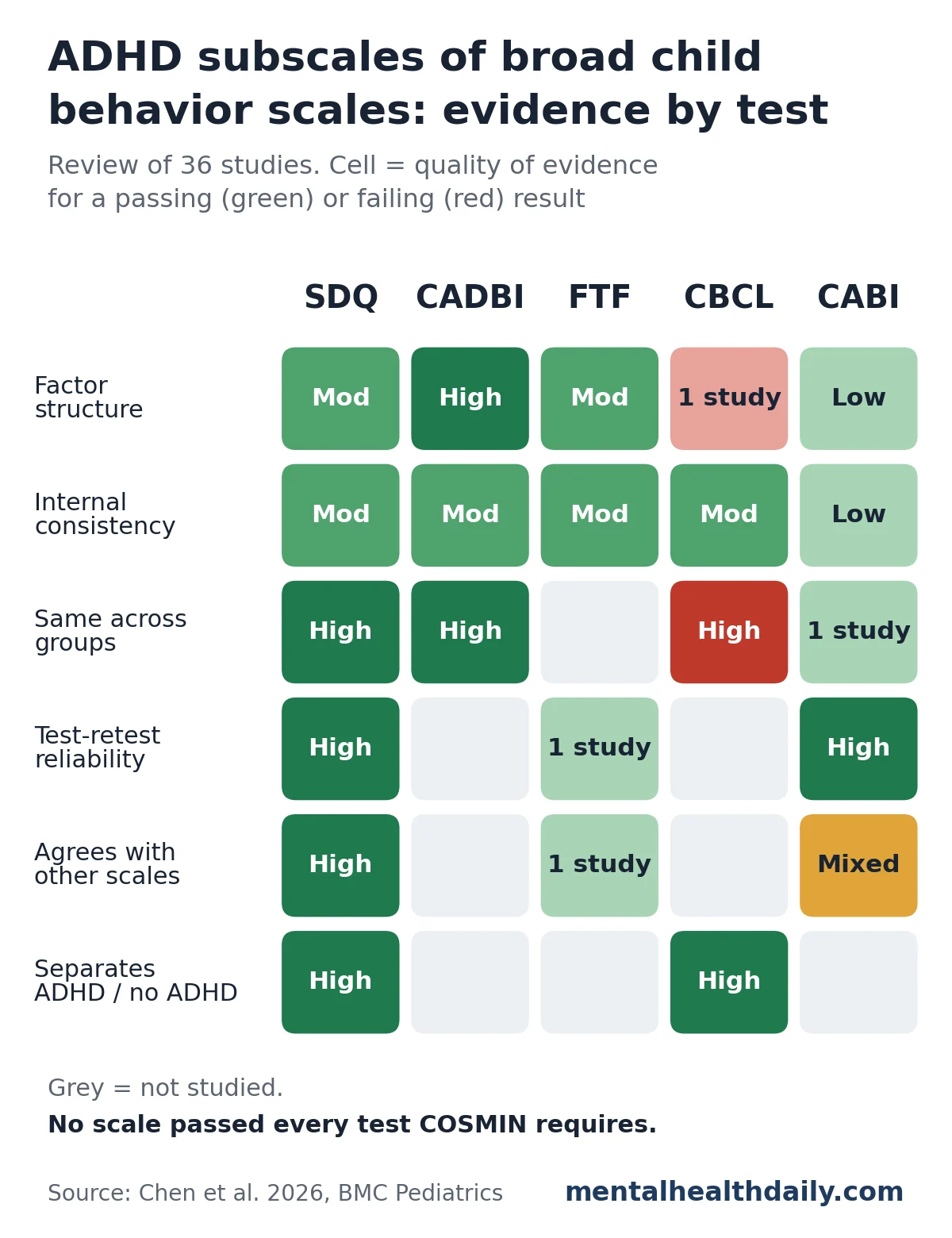
A comprehensive 2026 review of 36 studies has identified the short hyperactivity-inattention subscale of the Strengths and Difficulties Questionnaire (SDQ) as possessing the strongest measurement evidence among broad child behavior questionnaires utilized for Attention-Deficit/Hyperactivity Disorder (ADHD) screening. This significant finding, while highlighting the SDQ’s relative robustness, comes with a crucial caveat: none of the 12 broad-band scales subjected to rigorous review managed to satisfy every established quality standard for measurement properties. The implications of this extensive analysis are profound for clinicians, researchers, and families navigating the complex landscape of ADHD diagnosis.
The Critical Role of Behavioral Questionnaires in ADHD Diagnosis
The diagnosis of ADHD presents unique challenges due to the absence of a definitive biological test. Unlike many medical conditions, ADHD relies heavily on a thorough clinical assessment that integrates qualitative descriptions of behavior from multiple informants—parents, teachers, and often the children themselves—with quantitative data derived from standardized rating scales. These scales translate subjective behavioral observations into measurable scores, providing a structured framework for identifying potential symptoms and assessing their severity and pervasiveness.
Behavioral rating scales are generally categorized into two broad types: narrow-band and broad-band. Narrow-band scales are specifically designed to assess symptoms related to a single disorder, such as ADHD, offering in-depth evaluation of specific symptom clusters. Broad-band scales, conversely, are designed to screen for a wider range of emotional, behavioral, and social difficulties, often comprising multiple subscales that target different problem areas. For a broad-band scale to be useful in ADHD screening, its specific attention and hyperactivity items must demonstrate strong measurement properties independently, rather than relying on the overall strength of the entire questionnaire. The SDQ, for instance, is a 25-item instrument divided into five subscales, with only five of these items pertaining to hyperactivity and inattention.
The importance of evaluating subscales separately is underscored by the latest COSMIN (Consensus-Based Standards for the Selection of Health Measurement Instruments) guidance. This internationally recognized framework stresses that each subscale within a broader questionnaire must be individually scrutinized for its psychometric properties. This nuanced approach, meticulously adopted by Chen and colleagues in their 2026 review, ensures that the assessment of ADHD-related subscales is precise and avoids conflating the quality of a specific subscale with the overall quality of the parent questionnaire.
A Rigorous Methodology: Unpacking the 2026 Review
The methodology employed by the research team was exhaustive and aligned with the highest standards for systematic reviews. The team conducted an extensive search across major scientific databases including PubMed, Web of Science, Scopus, and ProQuest, with the search cut-off date set at December 1, 2025. From an initial pool of 17,361 records, a stringent screening process led to the inclusion of 36 English-language studies focusing on children aged 18 or younger diagnosed with ADHD. These studies collectively covered 12 broad-band instruments.
Each subscale identified within these instruments was then meticulously judged against a predefined set of measurement properties, designed to assess its scientific rigor and practical utility. These properties included:
- Internal Consistency: Whether items within a subscale measure the same underlying construct.
- Reliability: The consistency of a measure over time and across different observers.
- Content Validity: The extent to which the items adequately represent the construct being measured.
- Structural Validity: Whether the scale’s underlying structure (e.g., number of factors) aligns with theoretical models.
- Cross-Cultural Validity: Whether the scale performs consistently across different cultural or linguistic groups.
- Construct Validity: Whether the scale measures the intended theoretical construct (e.g., convergent, divergent, known-groups validity).
- Criterion Validity: How well the scale correlates with an external "gold standard" measure.
- Responsiveness: The ability of the scale to detect changes over time, particularly in response to intervention.
- Interpretability: The clarity and ease of understanding scores.
Each outcome for these properties was rated as either "sufficient" or "insufficient," further categorized by the quality of the supporting evidence as "high," "moderate," "low," or "very low." Following strict COSMIN rules, a subscale could only earn a full recommendation if it demonstrated high-quality evidence of good results on every relevant property. Conversely, high-quality evidence of a poor result on even a single property was sufficient to warrant a recommendation against its use. This rigorous framework ensured that only the most robustly validated subscales received endorsement.
SDQ Hyperactivity-Inattention Subscale: A Beacon of Evidence
The SDQ’s hyperactivity-inattention subscale emerged from this stringent review with the strongest overall evidence. Seven studies, encompassing a combined total of 19,477 children, provided extensive data on the SDQ. Critically, its hyperactivity-inattention subscale received an overall "sufficient" rating on every measurement property for which it was tested. While individual study findings sometimes varied, the cumulative evidence pointed to its consistent performance. For instance, it demonstrated robust internal consistency, indicating that its items reliably measure the same underlying construct. Its construct validity was also well-supported, showing appropriate correlations with other measures and differentiations between groups.
Beyond its psychometric strengths, the SDQ boasts significant practical advantages that contribute to its widespread adoption. It is notably short, making it time-efficient for busy clinicians and less burdensome for respondents. Furthermore, it offers matching versions for parents, teachers, and self-report (for older children), allowing for multi-informant data collection—a cornerstone of comprehensive ADHD assessment. Its free availability in numerous languages further enhances its accessibility and utility across diverse global populations.
However, the authors of the review were careful to contextualize these strengths, emphasizing that the SDQ, including its hyperactivity-inattention subscale, remains a general screening tool. It is not designed as a dedicated ADHD diagnostic measure nor should it be considered a substitute for a comprehensive clinical evaluation by a qualified professional. The review also clarified that it did not involve head-to-head comparisons of instruments, meaning it does not definitively proclaim the SDQ as the "best" tool for ADHD overall, but rather the one with the strongest documented measurement evidence within the broad-band category.
A pertinent illustration of these limitations comes from an included study by Hall and colleagues. This research involved 250 children aged 6 to 17 referred for an ADHD assessment. The study found that a "probable" hyperactivity rating on the SDQ correctly ruled out ADHD in approximately 75% to 85% of children who did not have the disorder. However, its sensitivity was lower, flagging only about 43% to 45% of children who did have ADHD. This highlights that a low score on the SDQ does not reliably rule out ADHD, reinforcing its role as a screening instrument that identifies individuals warranting further investigation, rather than a definitive diagnostic test.
CBCL Attention Problems Subscale: The Challenge of Cultural Context
In stark contrast to the SDQ’s strong showing, the Child Behavior Checklist (CBCL) Attention Problems subscale, a widely used instrument within the Achenbach System of Empirically Based Assessment (ASEBA), encountered significant challenges related to cross-cultural validity. While its 11-item subscale demonstrated adequate internal consistency (supported by moderate-quality evidence) and successfully differentiated children with ADHD from control groups in Brazilian and German samples (backed by high-quality evidence), its performance faltered when cultural contexts shifted.
The critical issue arose from two well-conducted studies that revealed the subscale did not behave consistently across different cultural samples. Specifically, its measurement properties were found to vary between US and Australian samples, and similarly between Dutch and Israeli samples. Given that this evidence was rated as "high quality," the strict COSMIN rules dictate a recommendation against the use of this subscale, particularly in diverse cultural contexts, unless specific local validation studies confirm its applicability.
One of these studies meticulously examined the CBCL’s structural integrity across approximately 6,700 clinic-referred children from the US, the Netherlands, and Australia. While around 90% of the CBCL’s items held up consistently across different models and countries, the attention factor, and especially the social problems factor, showed the least cross-cultural support. The review authors suggest that this issue may be linked to the CBCL’s original development, which was primarily based on a North American sample. They strongly advise clinicians using the Attention Problems subscale outside of North America to exercise considerable caution in interpreting scores. It is important to note that this verdict pertains exclusively to the Attention Problems syndrome scale and does not encompass the CBCL’s separate DSM-oriented ADHD scale or the questionnaire as a whole.
Emerging Tools and Limited Evidence: CADBI, FTF, CABI, and Others
Beyond the SDQ and CBCL, the review also assessed other broad-band instruments. The Child and Adolescent Disruptive Behavior Inventory (CADBI), the Five-to-Fifteen (FTF) questionnaire, and the Child and Adolescent Behavior Inventory (CABI) showed some promise but were ultimately characterized by limited or unsatisfactory evidence for their ADHD subscales. While initial findings for these tools might suggest utility, the paucity of comprehensive validation studies means they do not yet meet the rigorous standards for widespread recommendation.
The remaining seven instruments — ANSER-PQ, CBAI, YI-4, DSMD, ABC, and CSI-4 — presented even more constrained evidence. Four of these relied on a single study each, indicating a severe lack of independent replication and validation. The ABC and CSI-4 each had two studies, but both were from the same research group and were published more than a decade ago, raising concerns about the recency and breadth of their evidence base. This highlights a significant disparity in the research investment and validation efforts across different broad-band screening tools.
Systemic Gaps in ADHD Scale Validation Research
The review not only evaluated individual scales but also shed light on broader trends and systemic gaps in how ADHD rating scales have been tested. Researchers have historically favored certain measurement properties over others, often those that are easier or less resource-intensive to measure. Across the 36 included studies, there was a disproportionate focus on:
- Internal Consistency: The most frequently evaluated property.
- Structural Validity: Also commonly assessed.
- Construct Validity: Received considerable attention.
Conversely, several crucial measurement properties were significantly under-researched or completely neglected:
- Responsiveness: This property, vital for tracking the effectiveness of interventions and treatment outcomes, was not tested for any of the subscales reviewed. This represents a major void, as clinicians often rely on these scales to monitor progress.
- Criterion Validity: This assesses how well a scale correlates with a "gold standard" measure. The challenge here is the absence of a universally accepted, objective gold standard for ADHD diagnosis, making this property inherently difficult to evaluate comprehensively.
- Content Validity: This relates to whether the items on a scale adequately cover the full scope of the construct. The review found that most scales provided only vague descriptions of how their items were developed. For several older instruments, the original development manuals, which would detail content validation processes, could not even be located. This lack of transparency undermines confidence in whether the scales are truly measuring what they intend to.
These significant gaps underscore a critical need for more comprehensive and methodologically diverse research in the field of ADHD assessment. Without robust evidence across all key measurement properties, the utility and interpretability of these screening tools remain limited.
Navigating Diagnosis: Guidance for Clinicians and Families
The findings of this 2026 review offer invaluable guidance for clinicians, researchers, and families grappling with ADHD. The overarching message is clear: a broad behavior questionnaire serves as an initial screening tool, a starting point in a much larger diagnostic journey. It can effectively flag potential attention problems and other behavioral or emotional difficulties that warrant a closer, more in-depth clinical look. However, an ADHD diagnosis must ultimately rest upon a full clinical assessment conducted by a qualified professional, typically involving ADHD-specific scales, detailed developmental history, observation in multiple settings (e.g., home, school), and multi-informant reports.
Among the broad-band options currently available, the SDQ hyperactivity-inattention subscale stands out due to its superior documented measurement properties. Its strengths make it a valuable initial screening tool for identifying children who may benefit from further evaluation. However, clinicians must remain mindful of its screening nature and limitations, as illustrated by its moderate sensitivity.
For clinicians who utilize the CBCL Attention Problems subscale, particularly with children from diverse cultural or linguistic backgrounds, the review’s findings necessitate heightened caution. The documented issues with cross-cultural validity mean that scores should be interpreted carefully, and potentially supplemented with culturally validated measures or more extensive qualitative data.
The authors of the review also noted that a separate, complementary review of narrow-band ADHD scales is currently underway. This forthcoming research promises to further refine the landscape of ADHD assessment tools, offering more specific insights into instruments designed purely for ADHD diagnosis and symptom monitoring. This ongoing research underscores the dynamic nature of psychometric evaluation and the continuous effort to improve diagnostic accuracy and clinical utility.
Limitations of the Review
While comprehensive, the 2026 review acknowledged several limitations. Its scope was confined to broad-band questionnaires and specifically their ADHD-related subscales, meaning it did not evaluate narrow-band, ADHD-specific diagnostic tools. The exclusion of non-English language studies, while necessary for methodological consistency, might limit the generalizability of findings to non-English speaking populations, especially given the cross-cultural validity issues observed with the CBCL. Furthermore, the heterogeneity of study designs, populations, and reporting standards across the included 36 studies posed challenges for direct comparison and synthesis. Finally, like all systematic reviews, it is inherently reliant on the quality and availability of published research, potentially being influenced by publication bias where studies with positive or significant findings are more likely to be published. Despite these limitations, the 2026 review provides a critical, evidence-based assessment that will undoubtedly influence clinical practice and future research directions in ADHD screening.

