

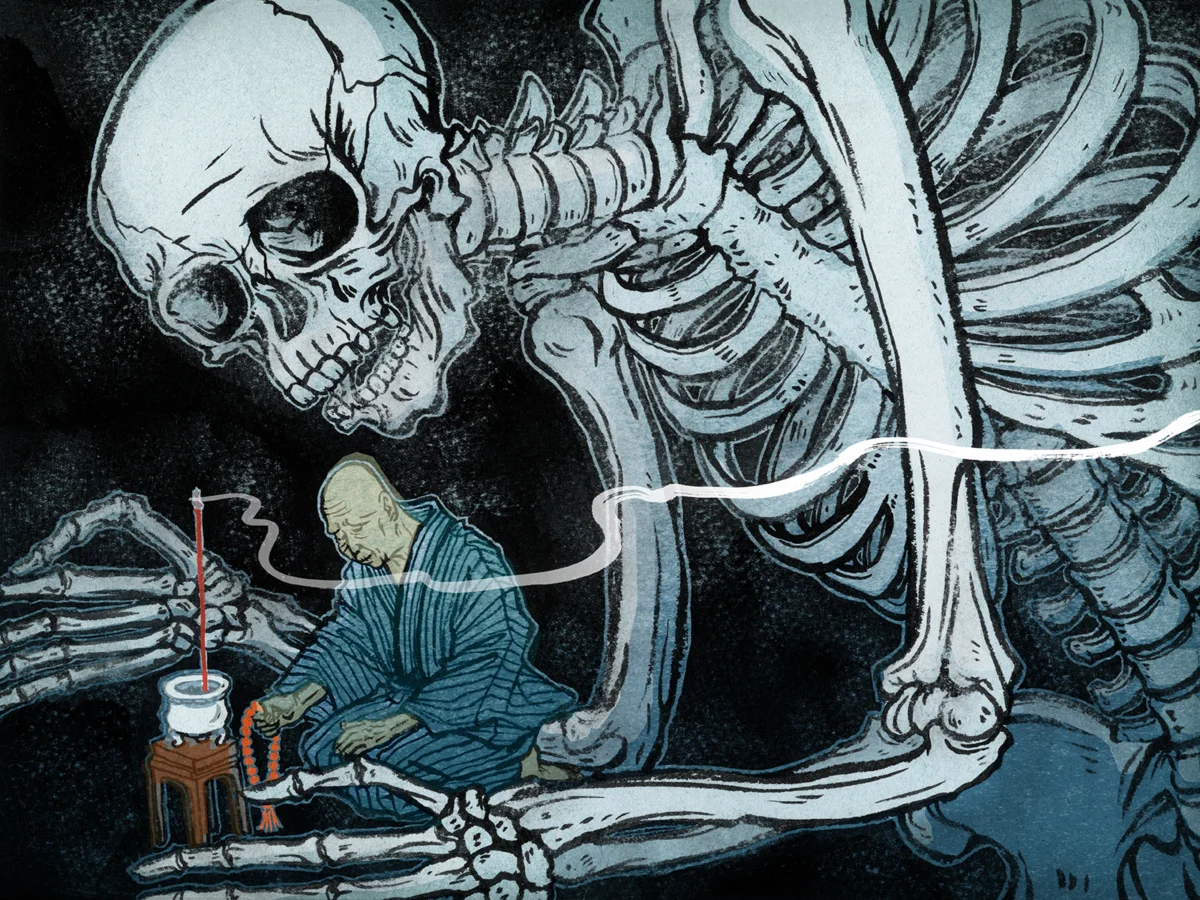
In a poignant serial publication, Tricycle: The Buddhist Review is presenting the first English translation of Hiromi Ito’s Reading the Heart Sutra, translated by Jeffrey Angles. This deeply personal exploration, originally published in Japanese in 2010, delves into Buddhist texts through the lens of Ito’s own life experiences, navigating the complexities of motherhood, the profound grief of loss, and the tender, often challenging, duty of caring for aging parents. The magazine will release one chapter each month over the course of a year, offering readers an intimate glimpse into Ito’s philosophical and emotional journey. The initial chapters have already been published, setting a tone of introspection and vulnerability.
The current excerpt, drawn from the heart of Ito’s reflections, begins with a profound sense of urgency: "There’s something I want to get done before it’s too late." This sentiment is inextricably linked to the presence and capability of her father. "Something I want to get done while my father is still alive. Something I want to get done while he’s still able to read." This is not a simple statement of familial duty, but a poignant recognition of the temporal nature of life and the fleeting opportunities it presents. Ito grapples with the ambiguous state of her parents’ lives, observing, "Dad is alive, but maybe he’s dead." He himself voices this paradox, stating, "I’m alive, but maybe I’m really dead—all I do the whole day is sleep." This is not an accusation, but an observation of a life that feels suspended, awaiting an inevitable end that has yet to fully arrive. The same sentiment applies to her mother, whose life, though physically present, feels as though it has already concluded, with death’s embrace delayed.
Ito’s father, living alone, represents a generation where traditional gender roles were deeply entrenched. For years, his wife, Ito’s mother, managed all household responsibilities, while he, the husband, remained largely uninvolved in domestic affairs. This dynamic shifted dramatically three years prior when Ito’s mother began experiencing a progressive loss of sensation and mobility in her limbs. The exact cause remained elusive, with medical professionals offering a range of possibilities from strokes to neuropathy and varicosis. Ultimately, her condition led to hospitalization, from which she has never returned. She now spends her days confined to a bed.
The author’s relationship with her mother has historically been fraught. Ito describes her mother as "difficult to be around," a woman whose life was marked by unmet expectations and a pervasive sense of dissatisfaction with her relationships, her daily life, and even her own thoughts. This frustration often manifested as irritability directed towards those closest to her. However, a significant transformation has occurred since her mother became bedridden. The very limitations that might have amplified her frustrations have, paradoxically, led to a certain peace. Unable to control her external circumstances, she has found a measure of solace in accepting her situation. This acceptance has, in turn, made her a more receptive listener, and occasionally, she offers advice, albeit often tangential. Ito observes this evolution during her visits from California every few months, noting a gradual calming, a deepening detachment, and a sense of purification in her mother.
During these visits, Ito finds herself confiding in her mother, sharing anxieties about her husband, her daughters, and her father, who, since her mother’s hospitalization, has begun exhibiting childlike behaviors, seeking affection and reassurance. These conversations, occurring at her mother’s bedside, represent a rare outlet for Ito, who often feels isolated in managing family matters. Initially, Ito sought to stimulate her mother’s engagement with the world, but she discovered that her mother’s primary interest lay in stories about family. These narratives became the focal point of their exchanges, with her mother listening with an attentiveness that surpassed even her husband or Ito’s own spouse. Though her mother’s advice might miss the mark, the act of communication itself, the silent absorption and subsequent response, held profound significance. It was only in this state of profound physical limitation that her mother, Ito reflects, became capable of offering a unique form of support, revealing the potential of a mother’s presence even when confined to bed.
The Unfolding of Impermanence
Yet, as Ito observes, "Everything is impermanent." Her mother’s dementia has advanced, diminishing her ability to grasp the nuances of her daughter’s and granddaughter’s lives. Consequently, Ito now shares less detailed information, focusing on general well-being. Regardless of the topic, her mother’s responses have become predictable, often devolving into a familiar litany of complaints about relatives. These grievances frequently dredge up long-past conflicts: a sister-in-law’s words from thirty years ago, a dispute with her mother-in-law from thirty-five years prior, a quarrel with her elder sister from half a century ago. Ito finds herself increasingly agitated by these repetitive recriminations, often interjecting with pleas for perspective or a reminder of past kindnesses. However, her mother persists, recounting perceived wrongs with vivid detail. This emotional toll, coupled with the ever-present awareness of her mother’s impending death, heightens Ito’s own sense of precariousness. Her irritation escalates, leading to sharp interjections like, "Mom, gimme a break. It’s time to forget all that."
The hospital environment itself underscores the themes of mortality and the protracted nature of dying in contemporary society. Ito describes the other elderly women surrounding her mother, some of whom exhibit extreme agitation, flailing and shouting incessantly. Her mother, in turn, complains about the noise. The adjacent room houses individuals in even more incapacitated states, lying motionless, eyes closed, mouths agape, sustained by an array of tubes. This scene prompts a somber reflection: "People are slow to die in our day and age." Ito anticipates her mother will eventually join this state of prolonged decline. While her mother occasionally expresses a desire to "just die," she quickly retracts, concerned about her father’s reaction. She recalls her younger sisters’ past pronouncements about not dying before their husbands, a sentiment now rendered moot by the passing of their spouses. Her mother’s own siblings—two younger sisters and an older sister—are all frail and have lost their husbands, yet they, too, continue to live, underscoring the persistent, often inexplicable, grip of life.
Echoes of the Past, Bonds of Kinship
The author’s oldest aunt, her mother’s elder sister, represents a profound connection from Ito’s childhood. Having no children of her own, this aunt showered Ito with affection. Their visits were marked by a deep bond, and the pain of separation upon departure was acute. The aunt’s tender gesture of "lending" a stuffed animal, a cherished companion until the next visit, provided solace and a tangible link to her aunt’s love. Ito’s mother, however, viewed this act critically, deeming it childish and lacking in maturity. Yet, for young Ito, the stuffed animal, imbued with her aunt’s scent and presence, was a vital comfort, a substitute that allowed her to endure the separation. This beloved aunt and her husband eventually moved to Osaka, severing their direct connection with Ito, an event Ito now views through the lens of karmic repercussions.
Decades later, Ito visited her aunt, now living alone following her husband’s prolonged illness and subsequent institutionalization. The familiar scent of her aunt’s apartment, reminiscent of her childhood home, greeted Ito. Her aunt, visibly aged and frail, emerged to greet her. Accompanying her to the hospital to visit her uncle, Ito encountered her younger cousin, who was already present. Her uncle, suffering from advanced Alzheimer’s, remained unresponsive. This cousin, whose mother is another of Ito’s aunts, had taken on the responsibility of caring for both his mother’s older sister (Ito’s aunt) and her husband due to their proximity. This realization caused Ito considerable distress, a sense of guilt for her own detachment and the potential for accumulating negative karma, as the sutra states, "all through my own beginningless greed, anger, and delusion."
The medical discussions surrounding her uncle’s care, specifically the recommendation for a gastrostomy tube for nutrition, sparked an internal debate within Ito. Her immediate thought was to let nature take its course: "If he’s going to die, let him die. Dying is the natural course of things." However, she recognized her limited role as a niece and deferred to those closer to him. The procedure was performed, prolonging his life by a few months. This experience prompted Ito to resume contact with her aunt, albeit with difficulty. The challenge of finding common ground with an aunt she hadn’t spoken to in decades, compounded by her father’s own conversational struggles, was significant. Yet, her aunt’s voice would brighten at the sound of Ito’s call, expressing immense joy at the contact.
The Weight of Years and the Blur of Memory
The passage of time is further highlighted by a birthday anecdote. Both Ito’s father and aunt were born in the same month and year. When Ito inquired about her aunt’s age on her birthday, she stated 87. A few days later, her father reported being 85. Ito’s mathematical calculation revealed they were both 86. She corrected her aunt, who responded with a mild "Oh, really?" Her father’s reaction was a distant, "Is that so?" This subtle discrepancy underscores a broader theme: as individuals approach extreme old age, precise numbers become less significant, the distinction between 85, 87, or even 127 blurring. The looming question of "How long is Dad going to last? How long does my aunt have left? How many more long years will they spend in their loneliness?" weighs heavily on Ito, leading to profound despondency.
Ito’s father now lives alone, receiving assistance from a home helper for an hour and a half each morning. The remainder of his day is spent in solitude. Each visit to Kumamoto reveals his increasing frailty: difficulty in conversation, unsteadiness on his feet. During her stays, he gradually warms up, his conversational abilities improving, his spirits lifting. His days are often occupied by historical samurai dramas, easily digestible narratives that seem to hold him captive. He supplements this with samurai novels, sumo wrestling, baseball, and the news. The constant flux of the news cycle serves as a stark reminder of impermanence.
Ito’s previous book, The Thorn Puller, which chronicled the challenges of managing her family in California while caring for her elderly parents across the Pacific, was read by her father. He reported finding parts difficult but ultimately felt a "ray of hope," a sense that "we might be able to go on living forever." Ito acknowledges the ambiguity of his interpretation, recognizing the book’s exploration of aging’s difficulties, yet also validating his perception of continued existence. Her father’s initial engagement with her life and work, though it has waned, offered a sign of his enduring presence and connection.
The subsequent literary success of The Thorn Puller, winning two major prizes, failed to elicit a significant response from her father. Despite Ito’s repeated, shouted attempts to convey the magnitude of these awards, including the prestigious Murasaki Shikibu Prize and the Hagiwara Sakutaro Prize, he remained unresponsive. His attention was only captured when she shifted the subject to Hasegawa Heizo, a historical police official and the protagonist of his favorite samurai novel series. This stark contrast highlights the selective nature of his memory and engagement. A more unsettling observation is her father’s occasional misidentification of his wife as "Mom" and his daughters as "Hiromi." This blurring of identities, while unnerving, leads Ito to a poignant realization: even if he forgets his adult daughter, he will never forget the "3-year-old he once held so lovingly in his lap." This enduring image of her childhood self, she concludes, is "enough."
Contemplating the Inevitable
Ito’s reflections have increasingly turned towards the subject of death. She notes the shift from the more common, simpler deaths of previous generations in their 40s and 50s to the prolonged, drawn-out decline that characterizes contemporary mortality. This raises the question: "Why put up with this?" The general avoidance of serious contemplation about death, its nature, and its proper passage, leaves individuals unprepared. Ito likens the prevailing attitude to the "Margaritaville" ethos of the 1960s and 70s—a deliberate embrace of "bad stuff" despite knowing better, a despondency that filled the void previously occupied by religion. This resonates with lyrical expressions of resignation from artists like Frank Sinatra and the Rolling Stones.
Growing up, Ito was immersed in an atmosphere of resignation and desperation, yet she was never taught the Buddhist expressions that might offer solace in such moments. She never learned the nenbutsu ("I place my trust in Amitābha"), the invocation of Kannon, or the passages from the Dhammapada and the Heart Sutra. However, by "tracing back" through these sacred texts, she feels a growing understanding. She describes this process as fumbling through them, akin to following a poorly marked trail. The sutras, she believes, have served as guides for eons, and by studying them, she hopes to confront death directly. Her initial engagement with Buddhist literature proved disappointing, failing to provide enlightenment or a lasting connection. The author’s hard-won sense of self posed a barrier; the idea of letting it go felt like an erasure of identity.
However, her father’s deteriorating condition, a state of "dying but unable to die completely," mirrors the experiences of her mother and aunt. These individuals, who once provided love and care, now face death with uncertainty. Ito perceives them as wandering through the bardo, the intermediate state between death and rebirth, suspended in a state of being neither fully alive nor fully deceased. This suspension offers a measure of life, but it also prompts the question of what preparation is needed for the ultimate transition.
The Vow Verse and the Sunset Impermanence Verse
In her search for understanding, Ito discovered a "Vow Verse," typically associated with generating aspiration for enlightenment and rebirth in the Pure Land. This verse, originally from Shandao’s Liturgy for Rebirth, a foundational text of Chinese Pure Land Buddhism, exerted significant influence on Japanese Pure Land philosophy. The historical context of Shandao’s life (613-681) overlaps with that of Xuanzang (602-664), the translator of the Heart Sutra, placing them within the era of Chinese legends and early Japanese history. This temporal proximity, for Ito, imbues these ancient texts with a greater sense of connection, particularly given her enjoyment of manga adaptations of Chinese legends and Japanese history.
The Vow Verse, a Sanskrit gāthā or "poem," possesses a distinctly poetic quality that resonates with Ito’s profession. She also encountered Shandao’s "Sunset Impermanence Verse," which struck her profoundly. This verse offers a stark meditation on the fleeting nature of life, comparing it to a lamp in the wind, and the ceaseless cycle of existence through the six realms of suffering. It serves as a powerful exhortation to self-awareness and diligence: "All of you listening, while still strong and energetic, Spur and rouse yourselves so you may dwell in the eternal." Ito paraphrases this with her own interpretation: "The Verse of Impermanence, the Setting of the Sun," urging listeners to recognize the transient nature of life, the karmic journey through death and rebirth, and the imperative to awaken from complacency while still possessing strength and clarity.
Facing the End with Peace
Ito’s contemplation of her father’s end leads her to consult his doctor. The prognosis is grim but medically plausible: continued decline in mobility, increased reliance on home assistance, and a heightened risk of common ailments like colds, flu, or pneumonia, or even a fatal choking incident. The doctor confirms the likelihood of her father being found deceased by his helper. This grim prospect prompts Ito to reformulate the Vow Verse, imbuing it with her personal hopes for her father’s final moments: "May it be that when the time of my father’s death approaches… May it be that his mind does not fall into confusion nor lose its composure, may there be no pain, may his heart be at ease so that he does not suffer all alone in death…" She envisions his final thoughts, acknowledging the loneliness of his final years, the blessings of a good life and a loving wife, and the perceived unreliability of his daughter, yet finding acceptance in the fact that she "tried her best."
Ito acknowledges that the formal aspects of the Vow Verse, particularly references to Buddha’s original vow and the Pure Land, would hold little meaning for her father, who has not engaged with such concepts. She allows herself a brief, limousine-like vision of his peaceful passage to paradise, but ultimately concludes that "it will be enough if he can die relaxed, collected, at ease, and at peace." She reflects on his life—his wartime experiences, his role in protecting his wife and raising his daughter in the post-war era—and deems him to have done a "great job." It is this acknowledgment of his efforts and his inherent goodness that fuels her desire to guide him toward a peaceful end.
In a final act of love and remembrance, Ito presents a rewritten version of the Vow Verse, a personal "A Vow Verse, to Arouse Aspiration," intended to offer comfort and clarity in his final moments. This reimagined verse expresses a humble request for a peaceful transition, free from confusion or distress, with body and mind at ease. It speaks of the wish to see Buddha, to be taken away with his help, and to eventually return to help others. The ultimate aspiration is for salvation through unwavering belief. This act of reinterpreting ancient wisdom through the lens of personal experience underscores Ito’s profound engagement with Buddhist philosophy as she navigates the universal challenges of life, loss, and the acceptance of impermanence.

