

The recent findings from a collaborative German-Austrian study, published in 2026, have shed new light on the potential cognitive benefits associated with quetiapine use in individuals diagnosed with schizophrenia. This large-scale cohort analysis observed a statistically significant, albeit modest, improvement in performance on challenging working-memory tasks among patients prescribed quetiapine, a widely used second-generation antipsychotic. Crucially, this advantage was most pronounced in patients receiving lower daily doses of the medication, specifically 300 mg or less. The observational nature of the study, however, underscores that this represents an association rather than a direct causal link, with researchers noting that the cognitive advantage was already evident at the participants’ initial visits and could not be explained by genetic markers related to myelin repair.
Understanding Schizophrenia and its Cognitive Burden
Schizophrenia is a severe and chronic mental illness affecting approximately 1% of the global population. It is characterized by a complex array of symptoms broadly categorized into positive, negative, and cognitive domains. While positive symptoms like hallucinations and delusions often receive the most clinical attention due to their acute and distressing nature, and negative symptoms such as apathy and social withdrawal significantly impair quality of life, it is the cognitive deficits that are frequently cited as the most disabling and least treatable aspects of the disorder.
These cognitive impairments are pervasive, impacting various executive functions, attention, processing speed, and, critically, working memory. Individuals with schizophrenia often struggle with tasks that require holding and manipulating information in mind, such as remembering a phone number, following multi-step instructions, or learning new material essential for employment or education. These difficulties profoundly hinder functional recovery, even when psychotic symptoms are well-controlled by medication. For many patients, the inability to effectively manage daily tasks due to cognitive issues represents a significant barrier to independent living, social integration, and vocational success. Traditional antipsychotics primarily target the positive symptoms of psychosis by modulating dopamine pathways, with their impact on cognitive function often being limited or even detrimental in some cases. Therefore, the identification of any pharmacological agent that could positively influence cognition would represent a substantial advancement in patient care.
Quetiapine: A Second-Generation Antipsychotic with Unique Properties
Quetiapine, marketed under the brand name Seroquel, belongs to the class of second-generation antipsychotics (SGAs), also known as atypical antipsychotics. Introduced in the late 20th century, SGAs revolutionized the treatment of schizophrenia by offering an improved side effect profile compared to older, first-generation antipsychotics (FGAs) and, in some cases, greater efficacy against negative and cognitive symptoms. Unlike FGAs, which primarily block dopamine D2 receptors, SGAs like quetiapine exhibit a broader pharmacological profile, often blocking serotonin 5-HT2A receptors in addition to dopamine D2 receptors.
Quetiapine is particularly notable for its relatively "loose" binding to dopamine D2 receptors, meaning it dissociates quickly from these receptors. This characteristic is hypothesized to contribute to its lower incidence of extrapyramidal side effects (e.g., tremors, rigidity) compared to many other antipsychotics. Beyond its primary role in schizophrenia, quetiapine is also approved for the treatment of bipolar disorder and as an adjunctive treatment for major depressive disorder, highlighting its versatility in psychiatric care. However, its potential to address cognitive deficits, particularly working memory, has been a recurring area of interest and investigation, spurred by preclinical findings.
The Remyelination Hypothesis: Connecting Quetiapine to Brain Structure
A key theoretical framework underpinning the expectation that quetiapine might aid working memory is the "remyelination hypothesis." This hypothesis posits a critical role for myelin, the fatty insulation that wraps around nerve fibers (axons) in the brain. Myelin is essential for the rapid and efficient transmission of electrical signals between neurons. It is laid down by specialized support cells called oligodendrocytes. When nerve fibers are well-insulated, signals travel quickly and synchronously, a process crucial for complex cognitive functions that require the coordinated activity of multiple brain regions, such as the intricate information processing involved in working memory.
Postmortem studies of individuals with schizophrenia have consistently revealed structural abnormalities in the brain, including reduced numbers of oligodendrocytes, particularly in regions like the hippocampus, which is vital for memory formation and retrieval. The research group behind the 2026 study, Ising et al., has previously proposed that impaired oligodendrocyte maturation and subsequent myelin dysfunction contribute significantly to the cognitive deficits observed in schizophrenia.
Quetiapine entered this theoretical picture through compelling animal research. A seminal 2012 study by Zhang et al. provided crucial preclinical evidence. In this study, mice were exposed to cuprizone, a neurotoxin known to induce demyelination (stripping of myelin) over a 12-week period. When quetiapine was administered during the subsequent recovery phase, researchers observed several key effects: it enhanced the proliferation and maturation of oligodendrocyte progenitor cells (OPCs), leading to increased myelination in the corpus callosum and improved cognitive performance in behavioral tasks. This robust evidence suggested that quetiapine possessed direct neurotrophic properties, specifically promoting myelin repair.
This chain of evidence – from disturbed oligodendrocytes and myelin in schizophrenia patients, to preclinical evidence of quetiapine promoting remyelination and improving cognition in animal models – formed the core of the remyelination hypothesis that Ising et al. sought to investigate in a human cohort. This hypothesis led to two specific predictions: firstly, that quetiapine users would perform better specifically on tests heavily reliant on working memory; and secondly, that individuals with genetic predispositions favoring healthier white matter or robust oligodendrocyte function would derive greater cognitive benefits from quetiapine.
The PsyCourse Study: A Real-World Observational Comparison
To test their hypothesis, Ising et al. leveraged data from PsyCourse, a large-scale, naturalistic observational study conducted across 20 psychiatric clinics in Germany and Austria. The PsyCourse study design is distinct from a randomized controlled trial (RCT) in that it reflects real-world clinical practice. Doctors in participating clinics prescribed medications based on their clinical judgment and patient needs, without intervention from the research team. The researchers then retrospectively compared outcomes between patients who happened to be on quetiapine and those who were not. Participants were assessed every six months, allowing for the observation of changes over time.
For the 2026 analysis, the researchers carefully matched quetiapine users with non-users based on critical demographic and clinical factors, including sex and age, to minimize confounding variables. The two groups were found to be largely comparable across several important metrics, including severity of symptoms (measured by the PANSS, a standard 30-item psychosis rating scale), levels of depression, daily functioning, duration of illness, and educational attainment. While symptom scores on the PANSS were slightly lower in the quetiapine group (53.7 vs. 58.3), this difference did not reach statistical significance (p = 0.069), suggesting similar illness severity profiles between the matched cohorts.
To assess cognitive function, the study employed a battery of six tests, which were then categorized into two groups:
- Low-Working-Memory Demand Tests: These included simpler tasks designed to measure basic attention and processing speed.
- High-Working-Memory Demand Tests: These were more complex tasks requiring active manipulation and retention of information, such as the Digit Span Backward test (recalling numbers in reverse order) and the Trail Making Test Part B (alternating between numbers and letters in sequence).
Study Findings: A Glimmer of Hope for Working Memory
The results of the PsyCourse analysis largely aligned with the researchers’ first prediction regarding working memory. On the simpler, low-working-memory demand tests, there was no significant difference in performance between quetiapine users and non-users. However, a distinct pattern emerged on the more challenging, high-working-memory demand tests. Quetiapine users consistently scored better on each of these demanding tasks across both the initial and subsequent visits. While some individual tests, like Trail Making B, only achieved statistical significance at the second visit, the overall trend was clear.
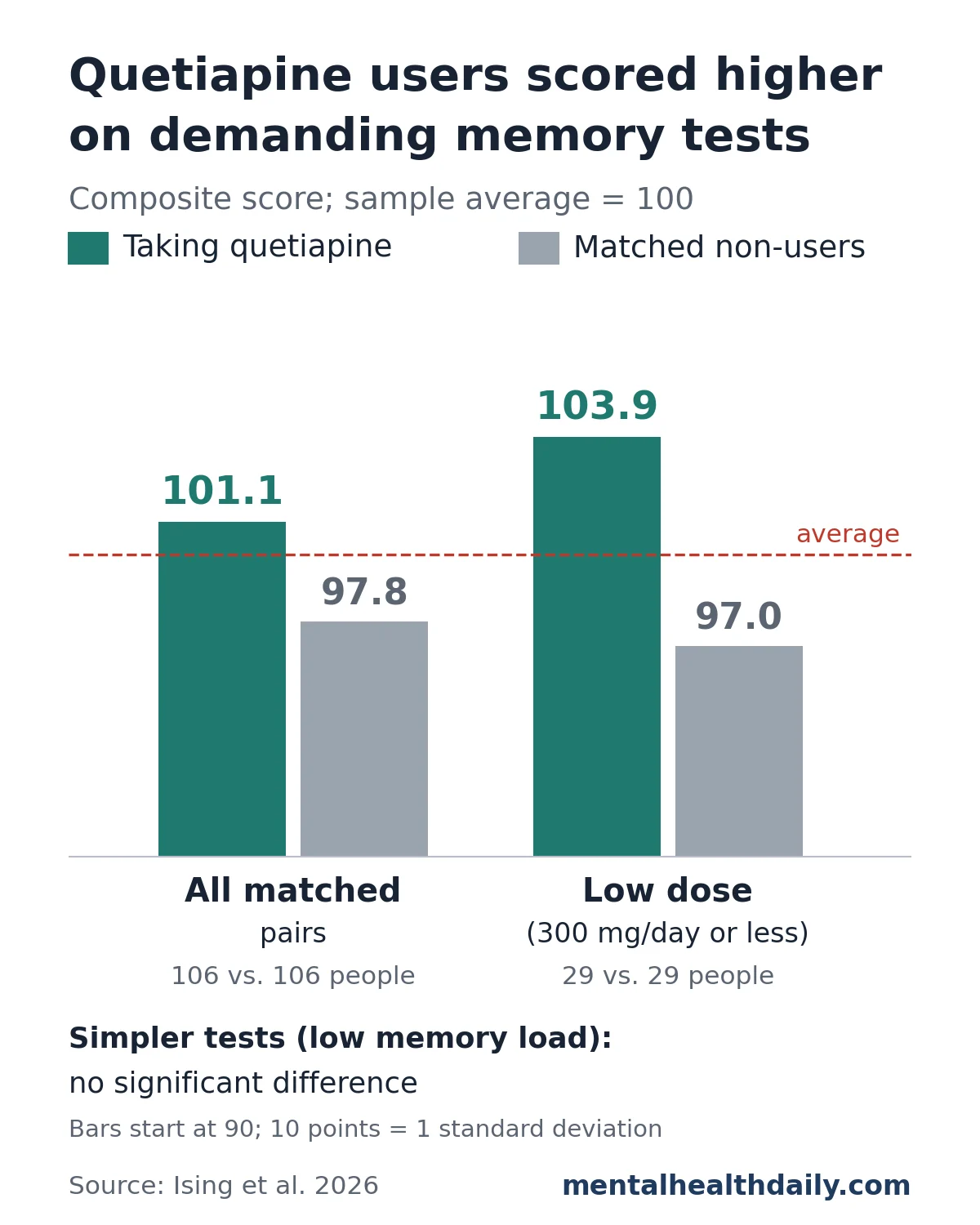
To provide a more comprehensive picture, the researchers created a composite score for the high-working-memory tests. This composite was scaled such that the sample average was 100 points, with a standard deviation (SD) of 10 points, representing the typical spread of scores around the average. On this composite score, quetiapine users averaged 101.1 points, compared to 97.8 points for their matched non-user counterparts. This difference of 3.3 points, roughly one-third of a standard deviation, is generally considered a small-to-medium effect size in psychological research.
Further statistical adjustments, accounting for potential confounding factors such as age, sex, education, illness duration, symptom severity, daily functioning, use of older antipsychotics, and total antipsychotic dose, did not substantially alter these results. The Digit Symbol test was a minor exception, where its group difference weakened below significance across both visits (p = 0.104) but remained significant at visit 2 alone.
One of the study’s key observations, however, contradicted a specific prediction of the remyelination hypothesis: the cognitive advantage did not progressively increase over time. Quetiapine users were already performing better at the first assessment and maintained a similar level of advantage six months later. If quetiapine were indeed slowly rebuilding myelin, one might expect a widening gap in cognitive performance as remyelination progressed. The researchers acknowledged that most patients had likely been on their current medication regimen for an extended period prior to the first visit, suggesting that any gradual remyelination effects might have occurred before the study’s observation window began. However, the available data could not definitively confirm this.
The Intriguing Low-Dose Link
Perhaps one of the most intriguing and novel findings of the study was the inverse relationship between quetiapine dose and high-working-memory scores within the quetiapine-treated group. Contrary to a simple "more drug, more benefit" model, higher daily doses of quetiapine were associated with lower scores on the demanding working-memory tests (Spearman rho = -0.23, p = 0.016).
When the quetiapine group was stratified by dose, the 29 patients taking 300 mg per day or less showed a significantly greater advantage. This low-dose subgroup averaged 103.9 on the composite score, compared to 97.0 for their matched partners, yielding a larger effect size (Cohen’s f = 0.46), which is considered substantial. As with the overall quetiapine group, no difference was observed on the simpler cognitive tests for this low-dose cohort.
Two primary interpretations could explain this unexpected dose-response pattern:
- Direct Pharmacological Effect: Lower doses of quetiapine might be more conducive to cognitive function. Higher doses might introduce side effects (e.g., sedation) that counteract any potential cognitive benefits, or they might engage dopamine receptors more robustly in ways that are less favorable for cognition.
- Confounding by Indication: Patients prescribed lower doses of quetiapine might inherently represent a less severely ill population. They might have milder symptoms, better overall functioning, or fewer comorbidities, allowing them to perform better on cognitive tests regardless of the medication’s direct effect. This "healthy user bias" is a common challenge in observational studies.
The study’s design could not definitively disentangle these two possibilities. Furthermore, the subgroup analysis involved a relatively small sample of 29 matched pairs, rendering the low-dose finding a promising lead that warrants rigorous investigation in future randomized controlled trials, rather than a basis for immediate dosing recommendations in clinical practice.
Myelin-Related Genes and Unanswered Questions
The second prediction of the remyelination hypothesis – that individuals with more favorable myelin-related genetics would benefit more from quetiapine – was not supported by the study’s data. Lacking direct brain imaging data for this specific cohort, the researchers employed polygenic scores. These are single numerical values derived from combining many small genetic variants identified in large population studies to predict traits such as hippocampal volume or white matter integrity. Three families of polygenic scores were tested in the 332-person genetic subsample:
- Scores derived from genome-wide association studies (GWAS) for white matter integrity.
- Scores related to hippocampal volume.
- Scores representing genetic risk for schizophrenia, specifically focusing on genes active in human oligodendrocytes.
In all statistical models, quetiapine use consistently predicted higher composite scores on working-memory tests. However, none of the polygenic scores altered this association, meaning all interaction tests were non-significant. This suggests that genetic predispositions related to myelin or hippocampal health, as captured by these polygenic proxies, did not modify the observed link between quetiapine and better working memory. People with a genetically more robust myelin system did not appear to derive greater cognitive benefits from quetiapine than those with less favorable genetic profiles.
An unexpected, albeit weak, signal did emerge: lower genetic risk for schizophrenia, specifically concentrated in genes active in human oligodendrocytes, was linked to better working-memory scores irrespective of medication (β = -0.110, p = 0.043). However, a corresponding mouse-derived score showed no such link, and no correction was applied for the numerous tests performed, indicating this is a preliminary finding. This suggests that oligodendrocyte biology might indeed play a role in cognition in schizophrenia, independent of quetiapine’s potential effects.
The researchers’ own conclusion regarding the genetic analysis was forthright: their findings did not provide evidence that polygenic estimates of hippocampal remyelination capacity influenced the quetiapine-cognition association. They acknowledged that polygenic scores are blunt instruments, often constructed from general-population brain scans rather than specific schizophrenia samples, implying that a null result here does not entirely rule out the remyelination mechanism but simply means this study offered no direct genetic support for it.
Comparing with Existing Evidence: A Broader Context
The findings from the 2026 PsyCourse study contribute to a broader body of literature on quetiapine and cognition in schizophrenia, which has often presented a somewhat consistent, though not always definitive, pattern. Older reviews and meta-analyses have frequently suggested that quetiapine performs relatively well on cognitive measures compared to other antipsychotics, particularly when contrasted with first-generation drugs.
- Meta-analyses of Trials: A 2005 meta-analysis by Woodward et al. pooling studies of four newer antipsychotics found a small overall cognitive advantage over older drugs (effect size 0.24), with specific differences in attention and verbal fluency between the newer agents. More recently, a 2021 network meta-analysis of 54 trials by Baldez et al. also placed quetiapine among the more favorable antipsychotics across several cognitive domains.
- Head-to-Head Randomized Trial (CATIE): The Clinical Antipsychotic Trials of Intervention Effectiveness (CATIE) study, a large U.S. trial, randomly assigned patients with chronic schizophrenia to one of five antipsychotics. Cognitive function improved slightly on all tested drugs (including quetiapine, olanzapine, risperidone, ziprasidone, and the older drug perphenazine) after two months. Quetiapine’s composite cognitive gain (z = 0.18) was comparable to other SGAs like olanzapine (0.13) and risperidone (0.26), and no pair of drugs showed a statistically significant difference in cognitive improvement, even when compared to the FGA perphenazine. This suggests a general "class effect" of antipsychotics on cognition, rather than a unique advantage for one specific drug.
- Largest Placebo-Anchored Network Analysis: A comprehensive analysis by Feber et al. encompassing 68 randomized trials and 9,525 participants found that no individual antipsychotic was clearly superior to placebo on overall cognition. Antipsychotics as a group showed small benefits, but some drugs, notably haloperidol, fluphenazine (both FGAs), and clozapine (an SGA with unique properties), ranked low in terms of cognitive impact. According to Ising et al.’s interpretation of this network, quetiapine generally outperformed haloperidol and clozapine but did not show a clear advantage over other second-generation antipsychotics. It is important to note that the quetiapine trials included in this network analysis typically used higher average daily doses (around 500 mg), with only a minority allowing doses below 300 mg.
Taken together, the 2026 cohort study’s result – indicating a cognitive advantage for quetiapine users – is directionally consistent with the existing signal that quetiapine is among the less cognitively burdensome antipsychotics. The observed difference of approximately one-third of a standard deviation in a matched comparison group, predominantly using other second-generation drugs, is somewhat noteworthy given the lack of significant differences between SGAs in trials like CATIE. The discovery of a potential benefit at lower doses is the most novel aspect of this recent study, but it is also the least validated by previous research.
Navigating the Evidence: Association vs. Causation
It is paramount to reiterate the inherent limitations of an observational, naturalistic cohort study. While the PsyCourse study demonstrates a clear association between quetiapine use and better performance on demanding working-memory tests in a real-world clinical population, it cannot definitively prove that quetiapine caused these improvements.
- Confounding by Indication: Patients prescribed quetiapine might differ from non-users in unmeasured ways. For instance, clinicians might preferentially prescribe quetiapine to patients with less severe cognitive deficits, or those with a better overall prognosis, based on their clinical experience.
- Healthy User Effect: Individuals who adhere to their medication regimens (including quetiapine) might generally have better health-seeking behaviors, better social support, or less severe illness, contributing to better cognitive outcomes irrespective of the specific drug.
- No Randomization: The absence of randomization means that baseline differences, even subtle ones not captured by matching variables, could account for the observed effects.
- Mechanism Unproven: The study found no evidence that myelin-related genetics mediated the association, and it did not directly measure myelin changes in the brain. Therefore, the remyelination hypothesis, while biologically plausible, remains unproven in humans by this study.
The researchers themselves acknowledged these limitations and emphasized the need for more robust evidence. They called for future randomized controlled trials that would incorporate repeated brain imaging, including measures of hippocampal myelination, to definitively ascertain whether quetiapine directly influences both cognition and myelin repair within the same individuals.
Future Directions and Clinical Implications
The 2026 PsyCourse study offers valuable insights and poses critical questions for future research and clinical practice.
- Randomized Controlled Trials: The most pressing need is for well-designed RCTs that directly compare quetiapine to placebo or other active antipsychotics, with a specific focus on cognitive outcomes, particularly at varying dose ranges. These trials should ideally incorporate neuroimaging techniques (e.g., MRI sequences sensitive to myelin integrity) to investigate the remyelination hypothesis directly in humans.
- Mechanism Elucidation: Further mechanistic studies are required to understand how quetiapine might influence cognitive function. Is it through direct effects on neuronal circuits, modulation of neurotransmitter systems beyond dopamine and serotonin, or indeed, through subtle effects on glial cells and myelin?
- Clinical Relevance: Even a "modest" improvement of one-third of a standard deviation, while statistically significant, needs to be evaluated for its clinical meaningfulness. Does this translate into tangible benefits in daily functioning, employment, or academic performance for patients? Future studies should incorporate functional outcome measures alongside neuropsychological tests.
For patients and prescribers, the implications are cautious. This study, while promising, is not a basis for switching antipsychotic medications solely for cognitive problems. The choice of antipsychotic remains a complex clinical decision, factoring in symptom control, individual tolerability, relapse history, metabolic risks, sedation profile, and prior treatment response. Current evidence from randomized trials mainly suggests avoiding drugs known to rank poorly on cognition, such as haloperidol, when cognitive impairment is a significant concern.
Regarding the intriguing low-dose finding, while it suggests a potential avenue for optimizing quetiapine’s cognitive profile, it is critical to remember that dose was not randomized in this study. Patients on lower doses might be inherently less ill, or the lower dose might be associated with fewer side effects that impede cognitive performance. Any dose adjustments should be made in close consultation with a prescribing clinician, as underdosing an antipsychotic carries the significant risk of symptom relapse.
In conclusion, the 2026 German-Austrian cohort analysis provides compelling observational data suggesting that quetiapine use is associated with better performance on demanding working-memory tasks in patients with schizophrenia, with a notable signal at lower doses. While it does not prove causation or confirm the remyelination hypothesis in humans, it reinforces quetiapine’s generally favorable cognitive profile among antipsychotics and highlights the urgent need for targeted, randomized research to unlock more effective strategies for addressing the debilitating cognitive deficits of schizophrenia.

