

A groundbreaking 2026 PLOS Biology study has unveiled a complex relationship between the conscious experiences during NREM2 sleep and an individual’s perception of sleep depth, fundamentally challenging the long-held notion that dreaming invariably signifies lighter sleep. The research, spearheaded by Michalak et al., utilized advanced 256-electrode electroencephalography (EEG) and a meticulous protocol of 1,024 NREM2 awakenings, demonstrating that immersive dreaming predicted a significantly deeper subjective sleep experience, with a beta coefficient of 0.277. Conversely, episodes dominated by reflective thought were found to correlate with shallower subjective sleep, indicated by a beta of -0.195. This revelation suggests that the quality and form of conscious mentation during sleep, rather than its mere presence, are crucial determinants of how restorative and deep sleep feels upon waking.
Unpacking the Study: Methodology and Definitions
The Michalak et al. study involved 44 healthy adult participants over 196 overnight recording sessions, employing high-density 256-electrode EEG to capture intricate brain activity. This extensive setup allowed researchers to monitor sleep stages with high precision and to awaken participants specifically from NREM2 sleep—a non-rapid-eye-movement stage that constitutes a significant portion of typical sleep, bridging the gap between lighter NREM1 and deeper slow-wave NREM3. Traditionally, NREM2 has not been considered a primary dream-rich stage like REM sleep, yet prior research has shown that mental experiences can indeed be reported when individuals are roused from it.
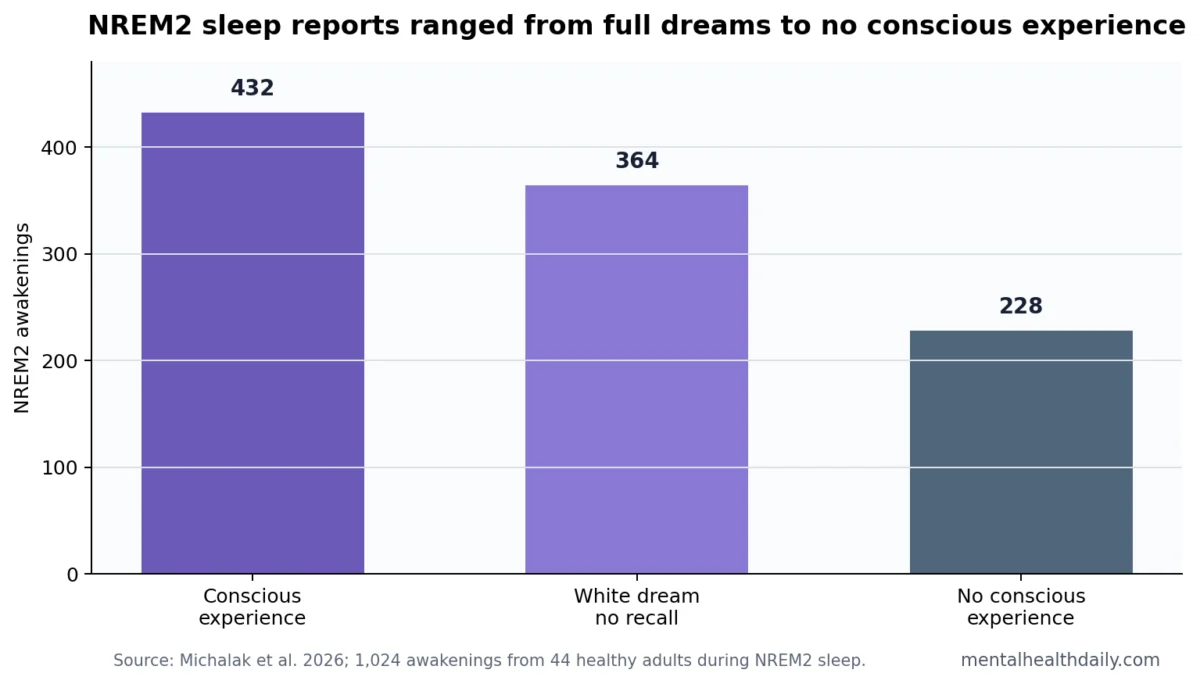
Upon each awakening, participants were immediately asked to report on their mental activity preceding the awakening, their perceived sleep depth, and their level of sleepiness. This rigorous design yielded 1,024 subjective reports, offering an unparalleled dataset for analyzing the relationship between conscious experience and perceived sleep quality. The reports were categorized into three broad groups: 432 awakenings involved conscious experiences with recalled content; 364 described conscious experiences without specific content recall, often termed "white dreams" (where a person senses an experience but cannot detail it); and 228 reported no conscious experience at all. This distinction is critical, as the absence of recall does not equate to an absence of consciousness.
A key concept investigated was "subjective sleep depth," which refers to how deep sleep felt to the sleeper after awakening, a crucial distinction from "physiological sleep depth." Physiological depth is typically inferred from objective measures like EEG frequency patterns, arousal thresholds, the presence of slow waves, or standard sleep-stage scoring. The study aimed to bridge this gap between objective physiological markers and the lived, subjective experience of sleep.
The Nuance of NREM2 Experience: Immersion vs. Reflection
The most compelling findings emerged from the qualitative analysis of the reported experiences. Researchers employed principal component analysis to distil the diverse dream ratings into two primary dimensions: "perceptual immersion" and "reflective thought."
Perceptual immersion encompassed elements such as vividness, sensory richness, duration, emotional intensity, bizarreness, and overall REM-like dream quality. This dimension strongly predicted deeper subjective sleep (beta = 0.277, 95% CI 0.208 to 0.346, p < 0.00001). This indicates that when NREM2 sleep involved rich, engaging, and emotionally charged experiences, participants consistently rated their sleep as profoundly deep.
In stark contrast, "reflective thought" captured more abstract, thinking-like mentation, characterized by internal monologue, problem-solving, or general cognitive activity without vivid sensory details. This dimension was a significant predictor of shallower subjective sleep (beta = -0.195, 95% CI -0.287 to -0.102, p = 0.00004). This finding directly challenges the simplistic "dreaming means light sleep" adage, demonstrating that the type of mental activity, rather than its mere presence, dictates the perceived depth. Vivid, immersive dreaming can, in fact, feel deep, while minimal conscious presence or fragmented thought can lead to the lowest depth ratings. Interestingly, complete unconsciousness also contributed to a sense of deep sleep, but it was not the sole pathway to achieving this perception.
Beyond EEG: The Subjective-Objective Divide
The study also delved into the relationship between high-density EEG patterns and subjective sleep depth. High-density EEG, with its multitude of electrodes, allows for a more detailed mapping of brain electrical activity across the scalp. Generally, higher gamma activity and an elevated gamma-to-delta ratio are associated with lighter perceived sleep. However, the presence of conscious experience, particularly dreaming, modulated this relationship.
When participants reported dreaming, the typical inverse correlation between high-frequency cortical activation (often indicative of wakefulness) and deep-feeling sleep was attenuated. This suggests that during dreaming, wake-like brain activity might not be as disruptive to the subjective experience of sleep depth as it would be in a non-dreaming state. This finding aligns with previous research by Nir et al., who showed that dream reports could be predicted by local EEG patterns within specific posterior cortical "hot zones," rather than being solely dependent on global sleep stages. Siclari et al. further extended this understanding with high-density EEG work, demonstrating that NREM dreaming is linked to local sleep dynamics, implying that consciousness during sleep is not a simple global on/off switch but rather a localized phenomenon. The Michalak study further refines this by showing how these localized conscious experiences directly influence the perception of sleep quality.
The Overnight Trajectory: Sleep Depth vs. Sleepiness
Another intriguing discovery concerned the progression of subjective sleep depth and sleepiness across the night. The study revealed that subjective sleep depth generally increased as the night progressed (beta = 0.127, 95% CI 0.103 to 0.151, p < 0.00001). This contrasts with the trajectory of subjective sleepiness, which increased less steeply than perceived sleep depth, as evidenced by an interaction between time and measure (beta = -0.166, 95% CI -0.277 to -0.056, p = 0.00325).
This observation is counterintuitive given the conventional understanding of physiological sleep pressure, which typically declines overnight. As the homeostatic need for sleep dissipates, one might expect a sleeper to feel lighter. However, the study found that perceived sleep depth rose, paralleling an increase in immersive dream experiences. This suggests that the brain’s internal mechanisms for regulating sleep quality are more intricate than previously thought, with conscious experience playing a significant role independent of physiological sleep drive.
Broader Implications for Sleep Science and Clinical Practice
The findings from Michalak et al. carry profound implications for how sleep is understood, measured, and treated, particularly in clinical contexts.
Redefining Sleep Quality: The study highlights that "sleep architecture"—the objective distribution of sleep stages across the night (NREM1, NREM2, NREM3, and REM)—while useful, does not fully capture the subjective experience of sleep. The direct pairing of EEG-defined NREM2 awakenings with immediate reports demonstrates that two individuals with identical objective sleep stage summaries can report vastly different sleep qualities. One might emerge from NREM2 with an immersive dream and perceive deep, restorative sleep, while another, experiencing vague presence or fragmented thought in the same stage, might rate their sleep as shallow. This necessitates a more comprehensive model of sleep perception that integrates objective physiology, the timing of awakenings, and the immediate conscious or near-conscious experiences.
Insights for Insomnia: The research offers a plausible mechanism for the common mismatch between objective sleep measures and perceived sleep in individuals with insomnia. While the study was conducted on healthy adults, it lays the groundwork for future research to investigate whether thought-like, less immersive mentation during sleep contributes to the feeling of shallow or unrefreshing sleep, even when objective sleep metrics appear adequate. Complaints about "light sleep" may not solely map onto stage scoring or sleep duration but could also reflect the quality of conscious mentation, frequent awakenings, or memory for unpleasant experiences.
Limitations of Sleep Trackers: The study also points to a fundamental limitation of consumer sleep trackers. While these devices can estimate movement, heart rate, breathing, or even EEG-like signals, they currently cannot discern the qualitative nature of a sleeper’s conscious experience—whether it was an immersive dream, abstract thought, minimal presence, or true unconsciousness. Consequently, a device’s "sleep score" can diverge significantly from an individual’s subjective perception of their sleep quality.
Measurement Evolution: The serial-awakening method employed in the study is particularly strong for investigating sleep perception, as it minimizes memory delay and distortions that can occur with morning dream recall. By asking immediately after NREM2 awakenings, researchers gained a closer, more accurate read on the experiences preceding sleep-depth ratings. While repeated awakenings do fragment sleep, making it less natural, the method provides a controlled and detailed map of sleep perception, offering invaluable insights into its construction.
Methodological Considerations and Future Research
It is crucial to acknowledge that the Michalak et al. study is correlational, meaning it demonstrates associations rather than direct causation. While immersive NREM2 dreaming was linked to deeper perceived sleep, it does not definitively prove that dreams cause better sleep quality. Further experimental designs, perhaps manipulating dream immersion or sensory input during sleep, would be required to establish causality. The inherent nature of serial awakenings, which fragment sleep by design, also means that the findings represent a controlled observation rather than a perfect replica of an uninterrupted night’s sleep.
Despite these limitations, the study’s "best inference" remains robust: subjective sleep depth is partly constructed, influenced not only by the brain’s electrical state but also by the specific form of conscious experience occurring within that state. This does not render subjective reports unreliable; rather, it indicates they measure a distinct, yet equally important, layer of sleep experience. Polysomnography excels at classifying stages and arousal, while immediate awakening reports capture the qualitative content of consciousness. The most fruitful approach, particularly for insomnia and sleep-quality research, lies in understanding how these different layers combine and interact.
Future research directions include applying this refined methodology to individuals who report poor sleep despite objectively adequate sleep, focusing on how immediate reports of mentation, especially after brief awakenings and memory gaps, contribute to their overall dissatisfaction. Investigating whether specific interventions can alter the quality of NREM2 mentation to improve subjective sleep depth would be another critical step in translating these findings into clinical applications.
In conclusion, the 2026 PLOS Biology study by Michalak et al. profoundly enriches our understanding of sleep, moving beyond a purely physiological definition to embrace the crucial role of conscious experience. It mandates a careful re-evaluation of how sleep depth is discussed, measured, and interpreted, particularly in clinical settings where a person’s feeling of having "slept lightly" may encompass a complex interplay of stage structure, awakenings, arousal threshold, and, critically, the immersive or reflective nature of their mental world during sleep.

