

A groundbreaking 2026 study published in PLOS Biology has unveiled a complex interplay between conscious experience during sleep and an individual’s perception of sleep depth. Utilizing an advanced 256-electrode EEG system and meticulously analyzing 1,024 awakenings from NREM2 sleep, researchers Michalak et al. discovered that immersive dreaming strongly correlated with deeper subjective sleep (beta = 0.277), while instances of reflective, thought-like mentation predicted shallower subjective sleep (beta = −0.195). This finding challenges the long-held simplistic notion that any form of dreaming necessarily signifies light sleep, suggesting instead that the quality of mental experience profoundly shapes how restorative and deep sleep feels to the sleeper.
Revolutionizing Our Understanding of NREM2 Sleep
NREM2 sleep, a non-rapid-eye-movement stage, constitutes a significant portion of an average night’s sleep, positioned physiologically between the lighter NREM1 and the deeper slow-wave NREM3 stages. Historically, NREM2 has not been considered a primary "dream stage" compared to REM sleep, which is renowned for its vivid, narrative dreams. However, prior research has increasingly demonstrated that mental activity, including dream-like experiences, can indeed occur during NREM2. The Michalak et al. study significantly advances this understanding by directly linking these NREM2 experiences to subjective sleep depth.
The distinction between "subjective sleep depth" and "physiological sleep depth" is crucial here. Physiological depth is typically inferred from objective measures such as EEG frequency patterns, arousal thresholds, the presence of slow waves, or standard sleep-stage scoring. In contrast, subjective sleep depth refers to the individual’s retrospective feeling of how deep their sleep was upon awakening. This study directly measured this subjective perception, offering an unprecedented look into the internal experience of sleep.
Unprecedented Methodology: 1,024 NREM2 Awakenings
The study’s robust methodology involved 44 healthy adult participants undergoing 196 overnight recordings, each equipped with a high-density 256-electrode EEG system. This advanced neuroimaging technique allowed for a detailed mapping of brain electrical activity across the scalp, providing far greater spatial resolution than standard clinical EEGs. Throughout the night, participants were repeatedly awakened from NREM2 sleep—a critical design choice that minimized memory decay and post-sleep confabulation—and immediately asked about their mental activity, perceived sleep depth, and current level of sleepiness. This rigorous approach yielded a remarkable dataset of 1,024 subjective reports linked precisely to their preceding brain states.
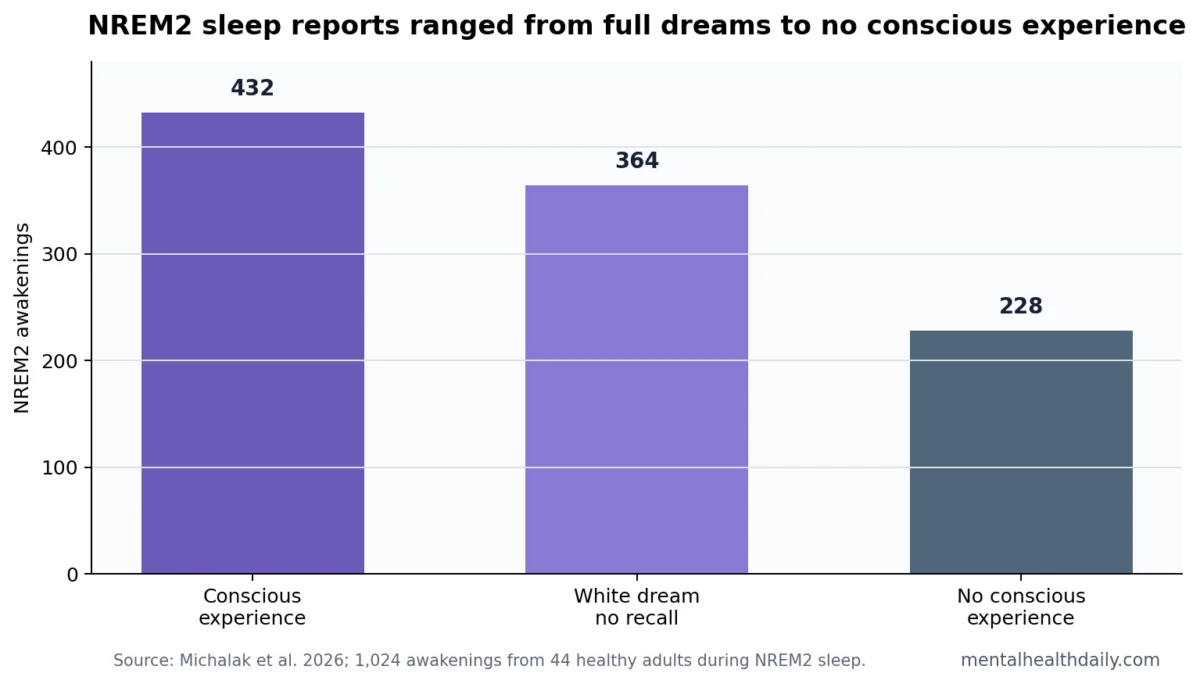
The qualitative analysis of these reports categorized conscious experiences into three broad groups:
- Conscious experiences with recalled content (432 awakenings): These were typical dream reports where participants could describe specific events, imagery, or narratives.
- Conscious experiences without recall of content (364 awakenings): Often referred to as "white dreams," these reports indicated an impression of having experienced something during sleep without the ability to articulate specific details. This category is vital as it acknowledges the presence of consciousness even in the absence of explicit memory.
- No conscious experience (228 awakenings): Participants reported no mental activity whatsoever prior to awakening.
The inclusion of "white dreams" underscores a sophisticated understanding of consciousness during sleep, moving beyond a simple binary of "dreaming" or "not dreaming." It highlights that the absence of recall does not equate to an absence of conscious experience, a nuanced point often overlooked in traditional dream research.
The Divergent Impact of Immersive Dreams and Reflective Thought
The most compelling finding emerged from a principal component analysis, which distilled the diverse dream ratings into two primary dimensions: "Perceptual Immersion" and "Reflective Thought."
- Perceptual Immersion: This dimension encompassed the vividness, sensory richness, duration, emotional intensity, bizarreness, and overall "REM-like" quality of the dream experience. The study found a strong positive correlation: higher perceptual immersion significantly predicted deeper subjective sleep (beta = 0.277, 95% CI 0.208 to 0.346, p < 0.00001). This statistical significance, indicated by the extremely low p-value, suggests a very high confidence in this relationship.
- Reflective Thought: In contrast, this dimension captured more abstract, thinking-like mentation—experiences akin to pondering or internal monologue. This type of experience showed a significant negative correlation, predicting shallower subjective sleep (beta = −0.195, 95% CI −0.287 to −0.102, p = 0.00004).
These results elegantly explain why the simplistic "dreaming means light sleep" adage often proves inaccurate. Vivid, engaging, and immersive dreams, even during NREM2, can contribute to a profound sense of deep, restorative sleep. Conversely, a state of minimal conscious presence or fragmented, thought-like mentation, rather than unconsciousness, was associated with the lowest subjective depth ratings. It is crucial to note that complete unconsciousness also felt deep, but it was not the exclusive pathway to deep-feeling sleep.
EEG Activation: A Re-evaluation of Brain States and Consciousness
The study also delved into the complex relationship between high-density EEG patterns and subjective sleep depth. Traditionally, higher gamma activity and a higher gamma-to-delta ratio in EEG signals are associated with increased cortical activation, typically indicative of lighter sleep or wakefulness. However, the Michalak et al. study revealed a fascinating modification of this relationship when conscious experience was reported.
When participants reported dreaming, the presence of wake-like cortical activation (higher gamma activity) appeared less disruptive to their subjective sleep depth. The researchers described this phenomenon as an "attenuation of the usual inverse relationship" between high-frequency brain activity and the feeling of deep sleep. This suggests that the brain can sustain certain levels of activation during sleep, and if that activation manifests as an immersive dream, it does not necessarily translate into a feeling of light sleep.
This finding aligns with and extends previous seminal work in sleep neuroscience. For instance, Nir et al. (2010) demonstrated that dream reports could be predicted by local EEG patterns within a "posterior cortical hot zone" rather than merely by global sleep stage, challenging the idea of a uniform "on/off" switch for consciousness. Building on this, Siclari et al. (2017), using high-density EEG, further showed that NREM dreaming is dependent on local sleep dynamics, reinforcing the notion that consciousness during sleep is not a global state but can arise from specific, localized brain activity. The Michalak study adds a critical subjective dimension to these objective observations, demonstrating how these localized activations, when forming immersive experiences, are perceived as deep sleep.
The Divergence of Sleep Depth and Sleepiness Overnight
Another counter-intuitive yet significant finding concerned the trajectory of subjective sleep depth and sleepiness across the night. The study revealed that subjective sleep depth increased as the night progressed (beta = 0.127, 95% CI 0.103 to 0.151, p < 0.00001). This is contrary to the expected physiological pattern, where homeostatic sleep pressure typically declines overnight, leading one to anticipate feeling lighter as the need for sleep dissipates.
However, subjective sleepiness followed a different trajectory. The interaction between time and measure indicated that sleepiness increased less steeply than perceived sleep depth (beta = −0.166, 95% CI −0.277 to −0.056, p = 0.00325). This suggests a decoupling of these two subjective experiences. As the night wore on, and participants likely experienced more immersive NREM2 dreams, their perception of sleep deepened, even if their objective physiological need for sleep was diminishing. This complex relationship highlights that subjective experience is not a simple readout of physiological state.
Bridging the Chasm: Sleep Perception vs. Sleep Architecture
The Michalak et al. study provides a crucial lens through which to understand the persistent "gap" between objective sleep metrics and an individual’s subjective experience. Sleep architecture—the objective distribution of sleep stages (NREM1, NREM2, NREM3, and REM) across the night—has long been the gold standard for assessing sleep quality. While undeniably useful, this study demonstrates that architecture alone cannot fully capture what sleep felt like to the person who experienced it.
This research helps explain a common clinical conundrum: why two individuals with seemingly identical sleep-stage summaries can report vastly different sleep quality. For example, one sleeper might awaken from NREM2 after an immersive dream experience and rate their sleep as profoundly deep and restorative. Another, despite spending the same amount of time in NREM2, might report a vague sense of presence, fragmented thoughts, or partial awareness, leading them to perceive their sleep as shallow and unrefreshing.
This disparity necessitates a more comprehensive model for understanding sleep perception. The authors suggest that a complete model requires at least three integrated layers:
- Objective physiology: The traditional EEG-defined sleep stages and other physiological markers.
- Timing of awakenings: Whether the awakening is spontaneous or forced, and at what point in the sleep cycle it occurs.
- Conscious or near-conscious experience immediately before awakening: The qualitative content and form of mentation, as explored in this study.
Implications for Sleep Trackers, Insomnia, and Clinical Practice
The findings carry significant implications across various domains:
-
Sleep Tracking Technology: The study sheds light on why consumer sleep trackers, despite their increasing sophistication in estimating movement, heart rate, breathing, or even EEG-like signals, often "feel wrong" to users. These devices, by their nature, cannot currently discern whether a sleeper was experiencing an immersive dream, fragmented thought, minimal presence, or true unconsciousness. Consequently, the device’s "score" can diverge substantially from the user’s felt experience, leading to frustration and distrust. Future iterations of sleep technology might need to incorporate more sophisticated, perhaps AI-driven, proxies for subjective experience to improve accuracy and user satisfaction.
-
Insomnia Research and Treatment: Insomnia is frequently characterized by a significant mismatch between objective sleep (often appearing relatively normal on polysomnography) and perceived sleep (patients reporting severe sleep deprivation, light sleep, or no sleep at all). While the Michalak study focused on healthy adults, it provides a plausible mechanism for this mismatch. If thought-like, less immersive mentation during NREM2 consistently makes sleep feel shallow, even when objective sleep stages are present, it could explain a crucial aspect of the insomniac’s experience. This opens new avenues for cognitive behavioral therapy for insomnia (CBT-I), suggesting that interventions might benefit from addressing the quality of near-awakening mentation, not just sleep-onset or maintenance issues.
-
Clinical Interpretation of Patient Complaints: Clinicians are routinely faced with patients complaining of "light sleep" or "unrestorative sleep." This study underscores that such complaints are multifaceted. A patient reporting "light sleep" could be describing anything from fragmented sleep architecture, frequent awakenings, a low arousal threshold, unpleasant thought-like mentation, or even a persistent memory of being partly aware. The 2026 data strongly suggest that the latter two possibilities—the content and form of near-awakening experience—are critical factors that should no longer be ignored in clinical assessment.
Methodological Strengths, Limitations, and Future Directions
The serial-awakening method employed in this study is an exceptionally powerful tool for investigating sleep perception because it drastically reduces memory delay. Unlike morning dream recall, which can be affected by later sleep stages, waking interpretation, or outright forgetting, immediate reports after NREM2 awakenings offer a closer, more veridical read on the experience that directly preceded the sleep-depth rating.
However, this strength also implies a trade-off. Repeated awakenings, by their very design, fragment sleep, making it less natural than an uninterrupted night. Therefore, the results are best interpreted as a controlled, high-resolution map of sleep perception under specific experimental conditions, rather than a perfect replication of natural, continuous sleep. Furthermore, the study is correlational, demonstrating associations between dream content and subjective depth, but not proving causality. It cannot definitively state that immersive dreams cause deeper sleep perception. Future research would need to employ experimental manipulations, perhaps by altering sensory input during sleep to influence dream content, to establish causal links.
Despite these considerations, the study’s "best inference" remains robust: subjective sleep depth is not a purely objective physiological phenomenon; it is partly constructed. The brain’s electrical state matters, but so too does the specific form of conscious experience unfolding within that state. This does not render subjective reports unreliable; instead, it reframes them as measuring a distinct, crucial layer of sleep experience. Polysomnography effectively classifies stages and arousal, while an immediate awakening report captures the nuances of immersion, thought-like content, vague presence, or total unconsciousness. The most fruitful approach, particularly for insomnia and sleep-quality research, lies in understanding how these diverse sources of information combine to shape the overall experience of sleep.
Looking Ahead: The Future of Sleep Science
This landmark study paves the way for exciting new research directions. The most immediate and useful next step involves applying this rigorous method to clinical populations, particularly individuals who consistently complain of poor sleep quality despite adequate measured sleep. By pairing objective sleep measurements with rich, immediate subjective reports in these individuals, researchers can begin to uncover the specific qualitative experiences that contribute to their perception of fragmented, shallow, or unrefreshing sleep. This could involve exploring the prevalence of thought-like mentation or minimal conscious presence in insomniacs during NREM2, and how these experiences might be targeted therapeutically.
The Michalak et al. study represents a significant step forward in integrating the subjective phenomenology of sleep with its objective neurophysiological underpinnings. It underscores that understanding sleep is not merely about measuring brain waves or sleep cycles, but also about deciphering the intricate tapestry of consciousness that unfolds within the sleeping mind. As our understanding deepens, the promise of more personalized and effective interventions for sleep disorders, and a more profound appreciation for the restorative power of sleep, draws closer.

