

A groundbreaking 2026 study published in PLOS Biology has unveiled a complex relationship between the nature of conscious experience during NREM2 sleep and an individual’s perception of sleep depth. Utilizing a sophisticated 256-electrode EEG system and analyzing an unprecedented 1,024 awakenings from NREM2 sleep, researchers found that immersive dreaming strongly correlated with a subjective feeling of deeper sleep (beta = 0.277). Conversely, instances of more abstract, reflective thought during this sleep stage were associated with a perception of shallower sleep (beta = -0.195). These findings challenge conventional wisdom that often equates any form of mental activity during sleep with lighter, less restorative rest, suggesting that the quality of consciousness, rather than its mere presence, profoundly shapes our perception of sleep.
Unraveling the Enigma of NREM2 Sleep
NREM2 sleep, or Stage 2 Non-Rapid Eye Movement sleep, constitutes a significant portion of an average night’s rest, typically making up 45-55% of total sleep time in adults. Positioned between the lighter NREM1 stage and the deeper, slow-wave NREM3 sleep, it has historically not been considered a primary stage for vivid dreaming, a phenomenon more commonly associated with REM sleep. However, extensive research over the past few decades has increasingly demonstrated that mental activity, including dream-like experiences, can and does occur across all sleep stages. The Michalak et al. study specifically targeted NREM2, a stage often characterized by K-complexes and sleep spindles in EEG readings, to explore the nuances of consciousness within its boundaries.
Subjective sleep depth, a critical variable in this study, refers to how profound or restorative sleep felt to the sleeper upon awakening. This personal assessment stands distinct from physiological sleep depth, which is objectively measured through various electrophysiological markers such as EEG frequency patterns, arousal thresholds, the presence of slow waves, and standardized sleep stage scoring. The disconnect between these two forms of measurement is a long-standing challenge in sleep medicine, particularly relevant in conditions like insomnia where objective sleep parameters may appear normal while the patient reports highly disturbed sleep. By directly correlating reported mental experiences with subjective depth, this research offers a novel lens through which to understand this critical gap.
A Thousand Glimpses into the Sleeping Mind: The Michalak et al. Methodology
The research, led by Michalak and colleagues, involved 44 healthy adult participants over 196 overnight recording sessions. Each session employed high-density 256-electrode EEG, a technique that captures electrical brain activity with superior spatial resolution compared to standard clinical setups. Participants were subjected to a rigorous protocol of repeated awakenings specifically from NREM2 sleep. Immediately upon awakening, they were prompted to provide detailed reports on their prior mental activity, their perceived depth of sleep, and their current level of sleepiness. This meticulous design yielded a robust dataset of 1,024 subjective reports, offering an unparalleled window into the conscious and near-conscious states preceding awakening.
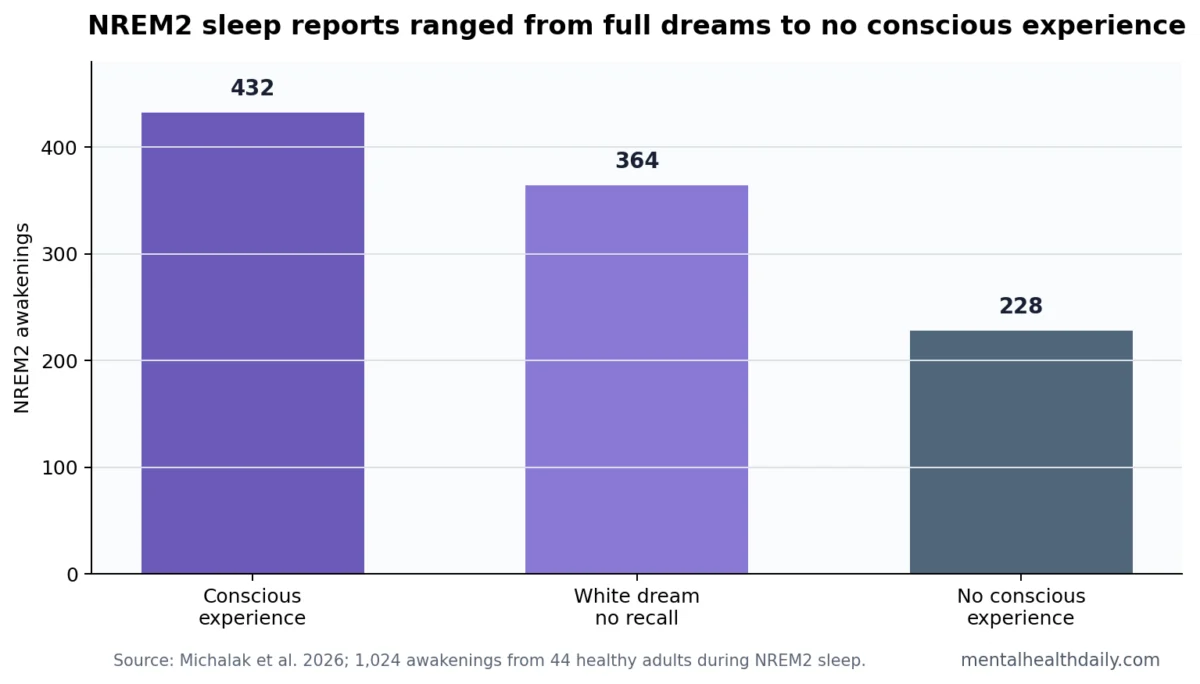
The mental activity reports were categorized into three broad groups, providing a quantitative breakdown of NREM2 experiences:
- Conscious experiences with recalled content: Reported in 432 awakenings, these were instances where participants could vividly describe specific dream narratives, images, or thoughts.
- Conscious experiences without recall of content (White Dreams): Occurring in 364 awakenings, these reports indicated a feeling of having experienced something during sleep, but without the ability to retrieve any specific details. This category is crucial as it highlights that the absence of recall does not equate to an absence of consciousness.
- No conscious experience: Reported in 228 awakenings, representing periods where participants recalled no mental activity whatsoever prior to waking.
The inclusion of "white dreams" as a distinct category is a significant methodological strength. It acknowledges the complexity of conscious experience during sleep, recognizing that a vague sense of presence or an impression of mentation, even without specific recall, is a form of consciousness that can influence subjective experience. This nuanced approach moves beyond a simplistic "dreaming vs. no dreaming" dichotomy, paving the way for a more sophisticated understanding of the sleeping mind.
The Quality of Experience: Immersive Dreams vs. Reflective Thought
The core revelation of the study emerged from a sophisticated analysis of the reported experiences. Researchers employed principal component analysis to distil the multifaceted dream ratings into two primary dimensions:
- Perceptual Immersion: This dimension encompassed various qualities associated with vivid, sensory-rich, and emotionally intense experiences. It captured aspects such as vividness, sensory richness, perceived duration, emotional intensity, bizarreness, and overall REM-like dream quality.
- Reflective Thought: This dimension characterized more abstract, cognitive, or thinking-like mentation, often lacking the vivid sensory details of immersive dreams.
The statistical results were stark: Perceptual immersion emerged as a powerful predictor of deeper subjective sleep (beta = 0.277, 95% CI: 0.208 to 0.346, p < 0.00001). This indicates that the more immersive and vivid the dream experience, the deeper the sleep felt to the individual. Conversely, reflective thought significantly predicted shallower subjective sleep (beta = -0.195, 95% CI: -0.287 to -0.102, p = 0.00004). This suggests that experiences characterized by abstract thinking or fragmented thoughts tend to make sleep feel lighter and less restorative.
These findings directly challenge the pervasive "dreaming means light sleep" adage. Instead, the study posits that it is not the presence of conscious experience, but its form, that dictates perceived sleep depth. Vivid, immersive dreams, even in NREM2, can induce a feeling of profound rest, aligning with the subjective experience of deep sleep. In contrast, minimal conscious presence or fragmented, thought-like mentation leads to the lowest depth ratings. Interestingly, complete unconsciousness also contributed to a feeling of deep sleep, demonstrating that immersive dreaming is not the sole pathway to a subjectively profound rest.
EEG Activation and the Attenuation of Conventional Mapping
The study also delved into the relationship between high-density EEG patterns and subjective sleep depth. High-density EEG, by recording electrical activity from a large array of electrodes across the scalp, provides a more detailed spatial map of brain activity compared to conventional few-electrode setups. Generally, higher gamma activity (associated with active cortical processing) and a higher gamma-to-delta ratio (indicating a shift towards wake-like brain states) are typically linked to lighter perceived sleep. However, the Michalak et al. study uncovered a crucial nuance: the presence of conscious experience altered this mapping.
When participants reported dreaming, wake-like cortical activation, as indicated by higher gamma activity, appeared less disruptive to subjective sleep depth. The researchers described this phenomenon as an "attenuation of the usual inverse relationship between high-frequency activity and deep-feeling sleep." This suggests that during immersive dreaming, the brain might be generating patterns that, while resembling wakefulness in some aspects, are integrated into an experience that feels deep, rather than signaling disruption.
This observation aligns with previous landmark research in NREM dreaming. Nir et al. (2010) demonstrated that dream reports could be predicted by local EEG patterns within a specific "posterior cortical hot zone," rather than being solely dependent on global sleep stage. Building on this, Siclari et al. (2017) extended these findings using high-density EEG, showing that NREM dreaming is linked to local sleep dynamics rather than a global "on/off" consciousness switch. The Michalak study further refines this understanding by demonstrating how these local activations, when manifesting as immersive dreams, can paradoxically contribute to a feeling of deeper sleep, challenging simplistic interpretations of EEG data.
The Diverging Paths of Sleep Depth and Sleepiness Overnight
Another intriguing finding concerned the temporal dynamics of subjective sleep depth and sleepiness across the night. The study revealed that subjective sleep depth consistently increased as the night progressed (beta = 0.127, 95% CI: 0.103 to 0.151, p < 0.00001). This pattern is counterintuitive when viewed through the lens of physiological sleep pressure, which typically declines as the homeostatic need for sleep dissipates overnight. One might expect to feel lighter sleep as the night wears on.
However, subjective sleepiness followed a different, less steep trajectory. The interaction between time and measure indicated that sleepiness increased less steeply than perceived sleep depth (beta = -0.166, 95% CI: -0.277 to -0.056, p = 0.00325). This divergence suggests that as the night advanced, participants felt increasingly deeper sleep, which coincided with the prevalence of more immersive dream experiences, even as the physiological drive for sleep waned.
This finding carries significant clinical implications. Complaints from patients about "light sleep" may not be directly reflective of standard sleep stage scoring or total sleep duration. Instead, factors such as the quality and content of dream experiences, the frequency of brief awakenings, the degree of sleep inertia upon waking, and the memory of mentation preceding arousal may collectively shape an individual’s perception of sleep restorativeness. The study underscores that a comprehensive understanding of sleep quality requires moving beyond purely physiological metrics to incorporate the rich landscape of conscious experience.
Bridging the Chasm: Sleep Perception vs. Sleep Architecture
The Michalak et al. study directly addressed the persistent gap between "sleep architecture" – the objective distribution of sleep stages (NREM1, NREM2, NREM3, REM) throughout the night – and the lived experience of sleep. By pairing EEG-defined NREM2 awakenings with immediate, unfiltered subjective reports, the research illuminated why two individuals with seemingly identical sleep-stage summaries can report vastly different sleep quality.
Consider two hypothetical sleepers: Both spend an adequate amount of time in NREM2. One might wake from an NREM2 period filled with a vivid, immersive dream and consequently rate their sleep as deep and satisfying. The other, however, might awaken from NREM2 recalling only a vague sense of presence, fragmented thoughts, or partial awareness, leading them to rate their sleep as shallow and unrefreshing. The objective sleep architecture remains the same, but the subjective experience diverges dramatically based on the nature of their conscious experience.
This highlights a critical "measurement consequence" for sleep research and clinical practice. Subjective sleep quality cannot be adequately reduced to total sleep time or the percentage of time spent in any given sleep stage. A truly comprehensive model of sleep perception, as suggested by this study, requires at least three integrated layers of information:
- Objective Physiology: Measured through EEG, polysomnography, etc.
- Timing of Awakenings: How and when an individual transitions from sleep to wakefulness.
- Conscious or Near-Conscious Experience: The specific mental content immediately preceding awakening.
This multi-layered approach also helps explain why consumer sleep trackers, despite their technological advancements, often "feel wrong" to users. While these devices can estimate movement, heart rate, breathing, or even EEG-like signals, they inherently lack the capacity to discern whether a sleeper was immersed in a vivid dream, grappling with fragmented thoughts, experiencing a minimal presence, or truly unconscious. Without access to this crucial subjective layer, their "sleep scores" can diverge significantly from the user’s actual perceived quality of rest.
Implications for Insomnia Research and Future Directions
The study carries profound implications for understanding insomnia, a condition often characterized by a profound mismatch between objective sleep measurements and subjective sleep complaints. While the Michalak study focused on healthy adults, its findings offer a plausible mechanism for this mismatch: the content and form of near-awakening experiences may profoundly shape whether sleep is perceived as deep, fragmented, or even absent.
For individuals with insomnia who report "light" or "unrefreshing" sleep despite objectively adequate sleep duration, it is conceivable that their NREM2 periods are dominated by thought-like, less immersive mentation rather than vivid dreams. This could lead to a persistent feeling of inadequate rest, even if their brain activity and sleep stages appear normal. Future research is critically needed to test this hypothesis in clinical populations.
The serial-awakening method employed in this study is particularly powerful for investigating these questions because it minimizes memory delay. Morning dream recall is notoriously prone to distortion, forgetting, or confabulation, where later waking interpretations can alter earlier sleep experiences. By asking participants for immediate reports directly after NREM2 awakenings, the researchers obtained a much closer, more accurate read on the conscious experience that directly preceded the sleep-depth rating.
However, this methodological strength also presents a trade-off: repeated awakenings inherently fragment sleep, making it less natural. Therefore, the results are best interpreted as a controlled, precise map of sleep perception under specific experimental conditions, rather than a perfect replica of an uninterrupted night’s sleep.
The study compels us to use sleep-depth language with greater precision. When someone states, "I slept lightly," they might be referring to their sleep stage structure, frequent awakenings, a low arousal threshold, unpleasant thought-like mentation, or a vivid memory of being partly aware. These are overlapping but distinct problems. The 2026 data emphatically underscore the importance of considering the last two possibilities, which have often been overlooked in purely physiological assessments.
Looking ahead, a crucial research direction involves pairing objective sleep measurements with richer, immediate subjective reports in individuals who consistently complain of poor sleep despite seemingly adequate objective sleep. This is particularly relevant for those experiencing repeated brief awakenings or gaps in morning recall, as these phenomena may be linked to the quality of their NREM mentation.
Causality and the Complex Tapestry of Sleep Perception
It is crucial to emphasize that the Michalak et al. study is correlational. While it clearly demonstrates a strong association between immersive NREM2 dreaming and deeper perceived sleep, it does not definitively prove that dreams cause better sleep quality. The intricate relationship between brain states, conscious experience, and subjective perception is multi-directional and complex. Experiments designed to directly manipulate dream immersion or sensory input during sleep, while measuring subsequent sleep perception, would be required to establish causality. Furthermore, the very act of serial awakenings and repeated questioning could subtly influence subsequent sleep perception.
As Windt et al. (2016) have argued, minimal conscious experience can exist without full narrative content. This concept helps interpret the lowest-depth category in the Michalak study: a vague sense of presence, a feeling of being "partly there," may be neither the restful unconsciousness of deep sleep nor the immersive narrative of a dream. This liminal state could very well contribute to sleep feeling shallow and unrefreshing.
The most robust inference from this study is that subjective sleep depth is, at least in part, a construct of conscious experience. The brain’s underlying electrical state certainly matters, but so does the form and quality of the conscious experience occurring within that state. This does not render subjective reports unreliable; rather, it indicates that they measure a distinct, yet equally vital, layer of sleep experience. Polysomnography can classify stages and arousal, but only an immediate awakening report can capture whether a person experienced immersion, thought-like content, vague presence, or nothing remembered. To treat these sources as competing rather than complementary misses the profound point: the useful question is how they combine to create the overall sleep experience.
For both insomnia diagnosis and broader sleep-quality research, this combination is the practical target. A person can register adequate NREM2 time on an EEG but still recall shallow, fragmented, or semi-aware experiences that profoundly impact their sense of rest. Conversely, immersive mentation can paradoxically make sleep feel deeper, even as conventional physiological sleep pressure dissipates across the night. The PLOS Biology study provides a powerful framework for understanding this intricate interplay, pushing the boundaries of sleep science beyond mere brain waves into the rich realm of subjective experience.

