

A landmark 2026 PROTECT study, involving 174 older adults, has demonstrated the promising potential of self-administered fingerprick blood tests for remotely assessing Alzheimer’s disease risk. The research found significant correlations between capillary blood levels of p-tau217 and episodic memory (r = 0.299, p < 0.001), and between glial fibrillary acidic protein (GFAP) and working memory (r = 0.183, p = 0.034). These findings strongly support the use of such remote testing for Alzheimer’s risk triage, offering a scalable method to prioritize individuals for formal evaluation rather than serving as a definitive, stand-alone dementia diagnosis. This innovative approach could dramatically enhance accessibility to early risk assessment, particularly for populations facing geographical or logistical barriers to traditional clinical pathways.
The Growing Challenge of Alzheimer’s Disease and Diagnostic Hurdles
Alzheimer’s disease (AD) remains the most common cause of dementia, affecting millions worldwide and posing an immense global public health challenge. With aging populations, the prevalence of AD is projected to rise significantly, increasing the strain on healthcare systems and families. Early and accurate diagnosis is crucial for several reasons: it allows individuals to access potential disease-modifying therapies earlier, participate in clinical trials, plan for the future, and manage symptoms effectively. However, current diagnostic pathways often involve multiple clinic visits, specialized cognitive assessments, expensive neuroimaging (PET scans, MRI), and sometimes invasive cerebrospinal fluid (CSF) analysis. These methods can be costly, time-consuming, and geographically inaccessible for many, leading to delays in diagnosis or even missed opportunities for intervention. The lack of easily accessible, non-invasive, and scalable screening tools has been a persistent barrier, making the PROTECT study’s exploration of remote capillary sampling particularly pertinent. The development of blood-based biomarkers in recent years has been a game-changer, offering less invasive alternatives to CSF and PET, but even these typically require a venous blood draw performed in a clinical setting.
Unpacking the PROTECT Study: Design and Methodology
The 2026 PROTECT study, a pivotal component of the UK PROTECT research program, aimed to address this accessibility gap by investigating whether older adults could effectively collect capillary blood samples at home. The study initially recruited 226 participants, with 174 completing the at-home blood-test kits and forming the final analysis group. This cohort comprised individuals with a mean age of 66.03 years, 54% of whom were female, and included 146 people with normal cognition alongside 28 diagnosed with dementia. This diverse representation allowed researchers to assess the biomarkers’ utility across a spectrum of cognitive states.
The workflow for participants was intentionally designed to be "low-friction," emphasizing ease of use and minimizing technical complexity for self-administration. Participants received mailed kits containing all necessary components for a fingerprick blood collection. Detailed instructions, often supplemented by video tutorials, guided them through the process of obtaining a small blood sample from a fingertip, typically using a lancet and a specialized collection device. The collected samples were then returned via mail to a central laboratory for analysis. This streamlined process was critical to the study’s operational question: could older adults, without direct clinical supervision, reliably produce biomarker values from capillary blood that aligned with their cognitive status, functional abilities, and established venous blood measurements, while also receiving positive user feedback? The success of this low-friction approach is a testament to the potential for widespread adoption of such methods in the future.
Key Biomarkers Under the Microscope: p-tau217 and GFAP
Central to the PROTECT study were two key blood-based biomarkers: p-tau217 and GFAP. Understanding their biological significance is crucial for appreciating the study’s findings.
p-tau217 (phosphorylated tau at amino acid 217) is a specific and highly sensitive blood marker for Alzheimer’s disease pathology. Tau proteins are abundant in neurons, and in AD, they become abnormally phosphorylated and aggregate into neurofibrillary tangles, a hallmark of the disease alongside amyloid plaques. The specific phosphorylation at amino acid 217 has emerged as an exceptionally precise indicator, rising significantly when both Alzheimer’s-type tau and amyloid biology are present in the brain. Its specificity allows it to discriminate AD from other neurodegenerative disorders with high accuracy, often outperforming many older, less specific dementia-screening tools. The advent of p-tau217 as a plasma biomarker, validated in numerous studies, has been hailed as a breakthrough, offering a relatively non-invasive way to detect underlying AD pathology. Its strong association with the earliest stages of AD pathology makes it an ideal candidate for early risk assessment.
GFAP (glial fibrillary acidic protein) is a marker of astrocyte activation. Astrocytes are star-shaped glial cells in the brain that play vital roles in supporting neurons, maintaining the blood-brain barrier, and responding to injury. When the brain experiences various forms of stress, injury, or inflammation, astrocytes become activated, and their GFAP levels increase. While GFAP can reflect neuroinflammation, vascular injury, or a general glial response, it is also elevated in Alzheimer’s disease due to the brain’s inflammatory response to amyloid and tau pathology. However, its broader utility means it is less specific to AD than p-tau217; elevated GFAP can also be seen in conditions like stroke, traumatic brain injury, multiple sclerosis, and other forms of neurodegeneration. This distinction in specificity is a key takeaway from the PROTECT study, highlighting the complementary roles these markers might play in a comprehensive risk assessment. Both markers, even when measured from venous blood, have already demonstrated superior diagnostic capabilities compared to many traditional cognitive screening tests. The PROTECT study’s innovation lies in validating their utility even when collected via capillary sampling.
Study’s Core Findings: Biomarker-Cognition Correlations
The PROTECT study yielded compelling evidence for the utility of these remote biomarkers. Capillary p-tau217 exhibited its strongest cognitive association with episodic memory, a memory system responsible for personal experiences and events. This finding is particularly significant because episodic memory impairment is often one of the earliest and most visible cognitive deficits in typical Alzheimer’s disease. The correlation of r = 0.299 (p < 0.001) indicates a statistically significant relationship, suggesting that higher p-tau217 levels were associated with poorer episodic memory performance. Beyond episodic memory, p-tau217 also correlated with other crucial cognitive domains, including attention and executive function, as well as both functional measures assessed in the study (which gauge daily living abilities). This pattern of associations reinforces p-tau217’s role as a robust indicator of underlying Alzheimer’s pathology impacting key cognitive processes.
In contrast, GFAP demonstrated a broader but less Alzheimer’s-specific pattern of associations. It correlated with working memory, the system involved in holding and manipulating information over short periods, as well as executive function and instrumental activities of daily living (IADLs), which are complex tasks necessary for independent living (e.g., managing finances, medication). However, GFAP did not show a significant correlation with the IQCODE functional informant measure, which relies on reports from caregivers about a person’s everyday functional changes. Furthermore, the researchers reported a noteworthy relationship between elevated GFAP and a history of heart disease, lending credence to the interpretation that GFAP’s elevation could reflect vascular injury or broader inflammatory processes in addition to or instead of specific Alzheimer’s-related glial responses. This aligns with existing biomarker work: studies by Palmqvist et al. have shown plasma p-tau217’s ability to discriminate Alzheimer’s disease from other neurodegenerative disorders with high precision, while Ashton et al. have reported strong diagnostic accuracy for p-tau217 immunoassays against confirmed Alzheimer’s pathology. While GFAP is undoubtedly clinically useful as a general marker of brain health or injury, its lack of direct Alzheimer’s specificity means astrocyte activation can arise from various injury pathways, making it a less precise "Alzheimer label" when used in isolation.
Establishing Risk Thresholds: Identifying Higher-Risk Subgroups
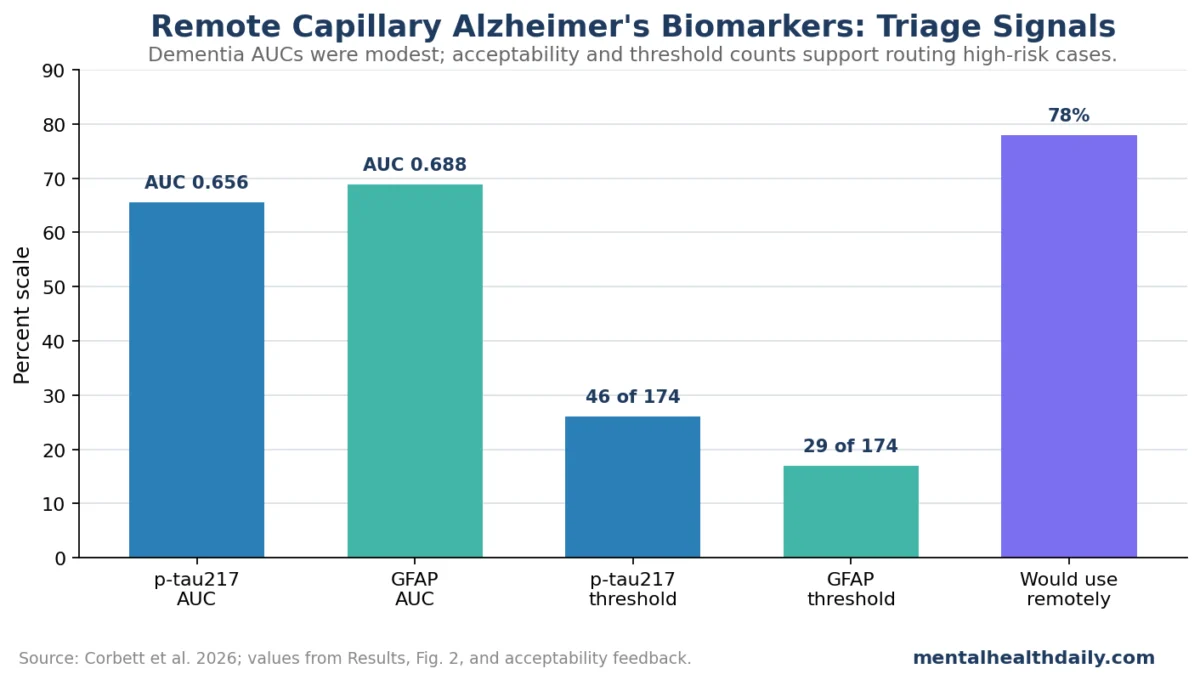
To translate these correlations into practical risk stratification, Corbett et al. employed prespecified 85% specificity thresholds for both capillary biomarkers. These thresholds were set at 0.016 pg/ml for capillary p-tau217 and 12.45 pg/ml for capillary GFAP. Applying these thresholds allowed the researchers to identify subgroups of participants with elevated biomarker levels: 46 individuals (26% of the cohort) showed elevated p-tau217, and 29 participants (17%) had elevated GFAP.
Crucially, individuals exceeding these thresholds performed demonstrably worse across several cognitive and functional measures. For those with elevated p-tau217, the memory difference had a Cohen’s d of 0.548 (p = 0.020), indicating a moderate effect size. Similarly, IADL performance showed a d = 0.542 (p = 0.017), and the IQCODE functional informant measure revealed an even stronger difference with d = 0.657 (p = 0.001). For participants with elevated GFAP, the IADL difference was larger, at d = 0.754 (p = 0.004), and executive function showed a difference of d = 0.541 (p = 0.016). These Cohen’s d values represent clinically meaningful differences in performance between the elevated and non-elevated biomarker groups, reinforcing the utility of these thresholds for identifying individuals at higher cognitive and functional risk.
A critical aspect of validating any remote testing method is ensuring its results are consistent with established clinical measures. The PROTECT study addressed this by comparing capillary biomarker results to those from venous plasma. The same thresholds used for capillary blood were recognizably reflected in venous plasma. Plasma p-tau217 successfully discriminated the capillary p-tau217 threshold group with an Area Under the Curve (AUC) of 0.785, while plasma GFAP discriminated the capillary GFAP threshold group with an even higher AUC of 0.895. These strong AUC values confirm that the remote capillary kit does not produce a separate artifact but rather maps onto established blood chemistry, making its results clinically meaningful and congruent with traditional laboratory measurements. This validation is paramount for the trust and adoption of self-administered tests in healthcare.
The Distinction: Triage Versus Definitive Diagnosis
Despite the promising correlations and risk stratification capabilities, the PROTECT study emphatically underscores a crucial distinction: these remote capillary biomarkers are tools for triage, not for definitive diagnosis of Alzheimer’s disease. The AUC values for separating dementia from non-dementia status were 0.656 for capillary p-tau217 and 0.688 for GFAP. While these values are better than chance, they are not high enough to be considered diagnostic-grade. An AUC of 1.0 represents perfect discrimination, while 0.5 is no better than a coin toss. Values in the 0.6-0.7 range, while indicative of a signal, mean that a significant number of dementia and non-dementia cases still overlap on these biomarker measures. This overlap signifies that relying solely on a single fingerprick result could lead to misdiagnosis or missed diagnoses.
Therefore, the clinical role of remote p-tau217 and GFAP is primarily to sort risk, reduce screen failures in clinical trials, and direct scarce specialist appointments towards individuals with a higher biological signal for underlying pathology. As the researchers explicitly state, "They should not tell a person at home that they have Alzheimer’s disease." A normal result from these remote tests also cannot rule out non-Alzheimer causes of cognitive decline, early pathology below the detection threshold, or future conversion to dementia. The distinction between risk sorting and diagnosis is not merely semantic; it dictates the responsible application of these technologies. GFAP, in particular, is less disease-specific, as astrocyte activation can be elevated due to various factors including vascular injury, inflammation, other neurodegenerative processes, and mixed pathologies. Flattening the distinction between these markers and treating both as interchangeable "Alzheimer positive" signals would obscure the most useful insights provided by the study.
Building a Confirmatory Pathway: Essential for Responsible Implementation
The clinical utility of capillary biomarkers becomes fully realized only when integrated into a well-defined confirmatory pathway. A remote positive result should never leave a patient with a speculative label and no clear route forward. Instead, it must trigger a defined sequence of follow-up steps. A workable pathway would logically separate three key jobs: first, the remote collection and initial processing of the sample; second, the sophisticated laboratory analysis of the biomarkers; and third, the most critical step, comprehensive clinical interpretation and follow-up.
This third step is paramount. The paper’s strongest clinical idea is a combined triage profile: identifying individuals with p-tau217 levels above the 85% specificity threshold and memory performance low enough to meet age-associated cognitive decline criteria. This combination can effectively prioritize individuals for faster formal dementia evaluation than a symptom questionnaire alone. However, this evaluation must be holistic. The remote blood result must be combined with a thorough clinical history, detailed cognitive testing, functional assessment, medication review, depression screening, sensory assessment (e.g., hearing, vision), and a comprehensive vascular-risk history. Only after considering this broader clinical context can a clinician decide who needs confirmatory neuroimaging (MRI, PET), cerebrospinal fluid (CSF) testing, or specialist neurological or geriatric evaluation.
This integrated approach is also vital for false-positive management. For instance, a person with elevated GFAP and known vascular disease may primarily require aggressive vascular-risk management (e.g., for hypertension, diabetes, hyperlipidemia) more urgently than an Alzheimer’s specific label. Conversely, a person with elevated p-tau217 and objectively declining memory would more strongly warrant a confirmatory Alzheimer’s workup. Keeping these diagnostic and management routes separate, rather than conflating all biomarker elevations into a single "Alzheimer’s" category, is what makes this biomarker pair clinically useful and avoids unnecessary patient anxiety or misdirected interventions.
Revolutionizing Access and Equity in Dementia Care
One of the most profound potential impacts of remote capillary testing is its ability to revolutionize access and promote equity in dementia care. Many individuals with early cognitive impairment never enter specialist pathways due to a multitude of barriers: long travel distances to memory clinics, particularly in rural areas; limited clinic capacity and lengthy waiting lists; and the sheer burden of navigating complex healthcare systems or participating in research trials. A mailed capillary kit can significantly lower these barriers, reaching individuals who might otherwise be underserved or completely missed by the current system.
This "access effect" has the potential to democratize early risk assessment, ensuring that socioeconomic status or geographical location does not dictate one’s ability to receive timely evaluation. However, lowering the barrier to initial screening also increases the responsibility to avoid overdiagnosis and ensure that increased access to testing is matched by increased access to appropriate, high-quality follow-up care. The equity argument is strongest when remote testing expands access to a planned, comprehensive follow-up pathway, rather than merely replacing it. A mailed kit can certainly reach people living far from memory clinics, but the result absolutely still requires careful interpretation by a clinician who can consider the full spectrum of factors influencing cognitive health, including medications, alcohol use, sleep patterns, depression, sensory impairments, vascular risk factors, educational attainment, and day-to-day functional abilities.
Immediate Applications and Future Trajectories
The PROTECT study suggests that clinical trials may be the most immediate and impactful early use case for remote fingerprick testing. Alzheimer’s prevention and early-intervention trials often face immense challenges in recruitment, requiring the screening of thousands of individuals to identify a much smaller group with specific biomarker profiles (e.g., amyloid positivity or elevated tau) necessary for trial eligibility. This screening process is often expensive, resource-intensive, and results in a high rate of "screen failures." Fingerprick p-tau217 could dramatically streamline this process by identifying people who are more likely to have confirmatory amyloid or tau evidence, thereby reducing expensive screen failures and accelerating trial recruitment. This targeted approach could significantly lower the cost and increase the efficiency of clinical research in Alzheimer’s disease.
Routine population screening, however, presents a harder claim and requires more extensive validation. Implementing any population-wide screening program demands robust evidence that testing demonstrably improves patient outcomes, reduces harms (e.g., anxiety, unnecessary procedures), and is cost-effective. A cross-sectional correlation study, while foundational, cannot fully answer these complex implementation questions. The practical threshold for routine screening is not yet met. The current evidence is strong enough to justify further validation of remote triage, particularly in the context of trial recruitment and enriching specialist referrals. It is not, however, strong enough to support the marketing of home fingerprick testing as a direct-to-consumer Alzheimer’s diagnosis.
The missing link for broader primary-care integration is longitudinal follow-up. The most useful future outcome is not merely whether a capillary marker correlates with memory on the same date, but whether the marker reliably predicts future cognitive decline, conversion to dementia, or eligibility for specific treatment trials over several years. This type of longitudinal evidence is essential before remote screening can transition from promising triage research into routine primary-care pathways. Furthermore, implementation plans must also address low-signal results. A low capillary biomarker result should never dismiss a caregiver’s report of worsening memory, medication errors, falls, hallucinations, or financial mistakes. Instead, it should narrow the immediate probability of Alzheimer’s-specific biomarker pathology while keeping the broader differential diagnosis open. This is especially crucial in primary care, where common conditions like depression, sleep apnea, anticholinergic medications, alcohol exposure, hearing loss, and cerebrovascular disease can all mimic symptoms of early dementia, necessitating a comprehensive clinical approach.
Expert Perspectives and Outlook
Leading researchers and clinicians acknowledge the transformative potential of these remote biomarker tests. Dr. Fiona Corbett, lead author of the PROTECT study, emphasized the profound implications: "This study marks a significant step towards making early Alzheimer’s risk assessment more accessible. We’re not talking about a home diagnosis, but a powerful new tool for identifying individuals who most urgently need a comprehensive clinical evaluation. It’s about smart triage, ensuring those with the clearest biological signals get to specialists faster." A representative from the Alzheimer’s Society UK highlighted the patient perspective: "For too long, geographical barriers and long waiting lists have delayed crucial assessments. This self-administered test could be a game-changer for equity, empowering individuals to take an initial step from their own homes. However, it’s vital that clear, empathetic guidance and guaranteed follow-up pathways are in place to support people through this process."
The long-term vision involves integrating these tools into primary care as part of a multi-faceted assessment. This would allow primary care physicians to combine remote biomarker results with other clinical information, guiding referral decisions more effectively. The careful differentiation between p-tau217 (more Alzheimer-specific) and GFAP (broader neuroinflammatory/vascular risk) is critical. A triage algorithm that properly utilizes both markers can lead to more tailored next steps – whether it’s an Alzheimer’s workup or aggressive vascular risk management.
In conclusion, the 2026 PROTECT study offers a compelling glimpse into the future of Alzheimer’s disease risk assessment. By validating the use of remote, self-administered fingerprick blood tests for p-tau217 and GFAP, it opens new avenues for accessible and scalable triage. While these tests are not yet diagnostic, their capacity to identify higher-risk individuals and streamline clinical trial recruitment is undeniable. The journey from triage research to routine primary-care integration will require ongoing longitudinal validation and the careful establishment of robust, ethical confirmatory pathways, ensuring that enhanced access translates into improved patient outcomes without compromising diagnostic accuracy or patient well-being.

