

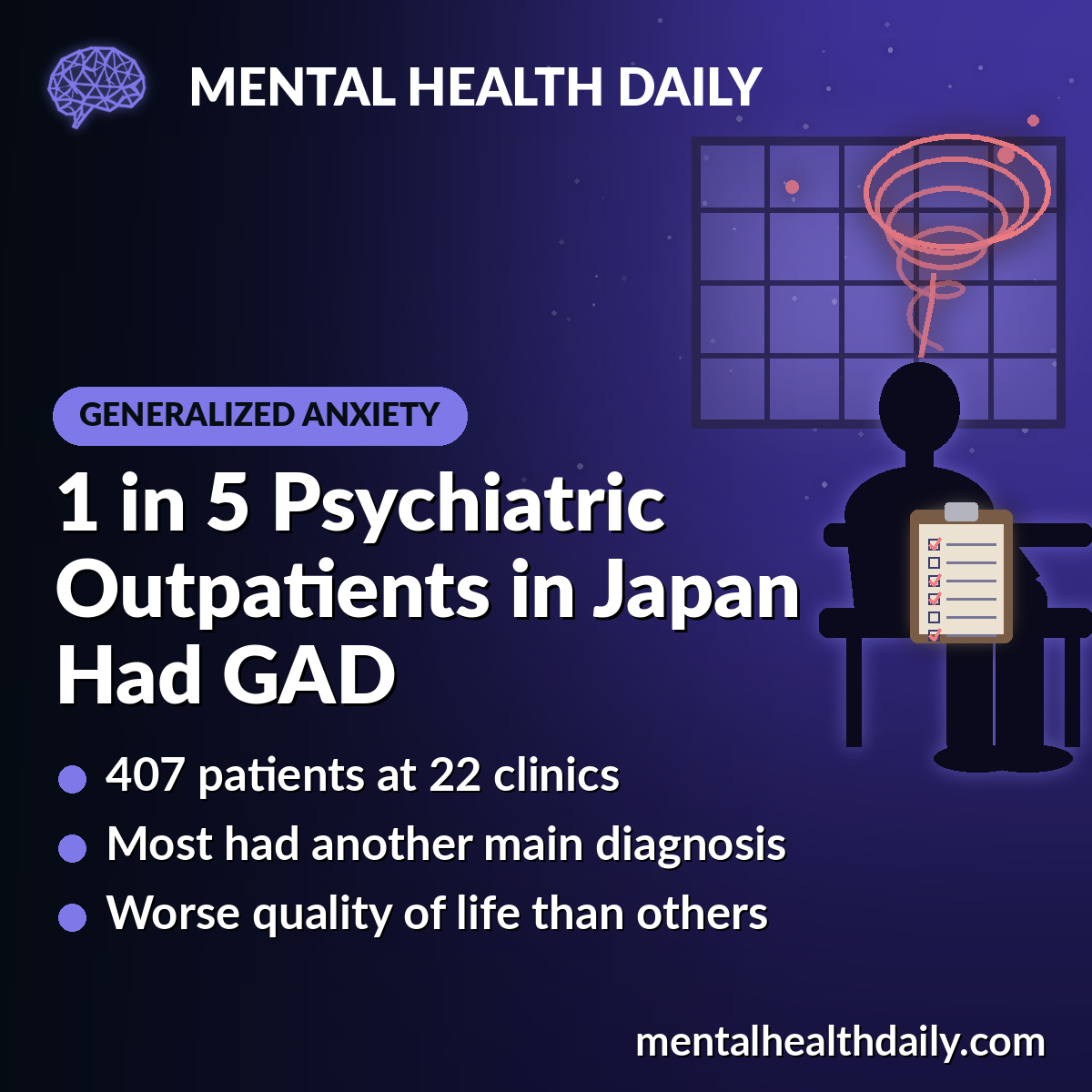
A comprehensive 2026 study conducted across 22 psychiatric clinics in Japan has unveiled a critical issue in mental healthcare: approximately one in five adults already receiving outpatient psychiatric care for mood or anxiety-related conditions met the full diagnostic criteria for Generalized Anxiety Disorder (GAD). Strikingly, the vast majority of these individuals were being treated for a different primary diagnosis, most commonly depression, suggesting a substantial underrecognition of GAD within routine clinical practice. This finding carries profound implications for patient outcomes, treatment efficacy, and public health strategies in Japan, a nation grappling with evolving mental health awareness and service delivery.
Understanding Generalized Anxiety Disorder: A Persistent Challenge
Generalized Anxiety Disorder is characterized by persistent, excessive, and often uncontrollable worry about various everyday events or activities, such as work performance, health, family well-being, or financial stability. This pervasive worry typically occurs on most days for at least six months and is accompanied by a range of debilitating physical and mental symptoms. These include restlessness, fatigue, difficulty concentrating, irritability, muscle tension, and significant sleep disturbances. Unlike specific phobias or panic disorder, the anxiety in GAD is not confined to particular situations or triggers but is diffuse and generalized, affecting multiple facets of a person’s life.
The insidious nature of GAD’s symptoms often leads to diagnostic challenges. Its manifestations frequently overlap with those of other common mental health conditions, particularly major depressive disorder, other anxiety disorders like social anxiety disorder or panic disorder, and even certain physical ailments. This symptomatic overlap can cause GAD to be overlooked, misdiagnosed, or subsumed into another, more prominent diagnosis. Globally, community surveys across 26 countries have indicated that approximately 3.7% of adults meet the DSM-5 criteria for GAD at some point in their lives, highlighting its significant population prevalence. However, the true burden in clinical settings, especially in specific cultural contexts, often remains less understood.
The PRADO Study: Unveiling Hidden Diagnoses in Japan
Recognizing this potential diagnostic gap, a team led by Keisuke Nomoto embarked on the PRADO study (Prevalence of Anxiety Disorder in Outpatients), aiming to ascertain the true prevalence of GAD among individuals already engaged in psychiatric care in Japan. The study enrolled adult outpatients from the psychiatric departments of 22 diverse medical facilities across the country. This multi-site approach ensured a representative sample of patients actively seeking mental health support.
A cornerstone of the PRADO study’s methodology was the use of the Structured Clinical Interview for DSM-5 (SCID). The SCID is a highly standardized, semi-structured diagnostic interview in which a trained clinician meticulously guides the patient through the official diagnostic criteria question by question. This method is considered the gold standard for psychiatric diagnosis in research settings because it minimizes reliance on a clinician’s subjective impression from brief visits, instead systematically assessing the presence and severity of symptoms against established criteria. Beyond the SCID, patients also completed a battery of self-report questionnaires assessing anxiety levels (such as the GAD-7), depressive symptoms (like the PHQ-9), overall distress, quality of life, and daily functioning. The research team also cross-referenced these findings with prior diagnoses documented in the patients’ medical records, providing a comprehensive picture of their mental health landscape.
Striking Findings: High GAD Prevalence and Persistent Co-occurrence
The PRADO study’s findings were notably stark. At the time of the study visit, a significant 83 out of 407 participating patients (20.4%) met the diagnostic criteria for current GAD. When considering anyone who had ever met the criteria, the lifetime prevalence figure rose to 28.3%. To put this in perspective, only major depressive disorder exhibited a higher prevalence within the sample, affecting 33.9% of the patients.
The observed 20.4% prevalence figure for current GAD was substantially higher than the 6.5% the researchers had initially anticipated when designing the study. This figure also surpassed estimates cited from similar studies involving psychiatric outpatients in other countries, such as Turkey (10.3%) and Spain (13.7%). The researchers partly attributed these differences to methodological variations between studies and the PRADO study’s exclusion of patients with psychotic disorders, which naturally skewed the sample towards mood and anxiety conditions, where GAD is more likely to be found.
A crucial insight from the study was that GAD rarely presented as an isolated condition. Among the 83 patients diagnosed with GAD:
- Over 80% also met criteria for at least one other current psychiatric diagnosis.
- Major depressive disorder was particularly common, co-occurring in approximately 60% of GAD cases.
- Other common co-occurring conditions included social anxiety disorder, panic disorder, and specific phobias. This high rate of comorbidity underscores the complexity of diagnosing and treating GAD, especially in a clinical population already struggling with mental health challenges.
The Challenge of Underdiagnosis: GAD in the Shadow of Depression
Perhaps one of the most significant revelations was the extent to which GAD goes unrecognized in routine clinical care. For the majority of patients with GAD, it was not considered their primary or "headline" diagnosis. When investigators were asked to name each patient’s single most significant current condition, GAD was identified as the primary issue for only 33.7% of those who met its criteria. In stark contrast, a depressive disorder was listed as the primary condition for 51.8% of GAD patients, even though they also met the full criteria for GAD.
This pattern was further reinforced by an examination of prior diagnoses recorded in medical records. Only 22 patients in the entire sample had GAD formally documented as their diagnosis before the study, and of these, 17 were confirmed by the SCID interview. More tellingly, among the 175 patients who had been previously diagnosed with a depressive episode, a substantial 37 individuals (21.1%) were found to also meet the full criteria for GAD during the study’s detailed assessment.
The researchers interpreted these discrepancies as strong evidence of GAD being under-recognized within the Japanese healthcare system. While the study was not explicitly designed to directly compare interview results with everyday clinical diagnostic practices, and thus cannot definitively measure underdiagnosis rates, the observed gaps strongly suggest a systemic tendency to either miss GAD or subsume its symptoms under a more broadly recognized diagnosis like depression. This tendency can have significant implications for targeted treatment and patient outcomes.
Profound Impact on Patient Outcomes: A Deeper Look
The study also meticulously compared the 83 patients with GAD against a control group of 225 outpatients who had another current psychiatric diagnosis but not GAD. The findings consistently demonstrated that the GAD group experienced significantly worse overall outcomes across almost every measured dimension.
- Quality of Life: Patients with GAD reported a considerably lower quality of life, indicating that their persistent worry profoundly affected their overall well-being and satisfaction with life.
- Distress and Symptom Severity: They exhibited higher levels of general psychological distress, as well as more severe anxiety and depressive symptoms, suggesting a greater burden of mental health challenges.
- Daily Functioning: Impairment in daily functioning was also notably higher in the GAD group, affecting their ability to manage routine tasks and engage in productive activities.
- Suicidal Ideation: Worryingly, patients with GAD reported a higher prevalence of suicidal ideation, highlighting the severe psychological toll this disorder can take and the urgent need for its recognition and effective treatment.
While work or school impairment and days missed from these activities did not differ significantly between the groups, patients with GAD did report a slightly higher number of "underproductive" days (3.3 days per month compared to 2.6 days for the non-GAD group), indicating a subtle but persistent impact on their occupational or academic effectiveness.
Other demographic differences also emerged: patients with GAD were somewhat younger (average age 41.3 vs. 44.6 years), more frequently women (68.7% vs. 59.0%), more often belonged to households earning under 4 million yen a year (67.5% vs. 53.1%), and reported a greater number of adverse childhood experiences. However, age and sex differences lost statistical significance once other factors were adjusted for, suggesting that the core impact was driven by the GAD itself and its associated symptoms.
Evaluating Screening Tools: The Limitations of GAD-7 and K6
The PRADO study also investigated the utility of two widely used self-report questionnaires – the GAD-7 and the K6 – as potential screening tools for GAD in a psychiatric outpatient population. These tools are often employed in primary care settings due to their ease of administration.
The GAD-7 (Generalized Anxiety Disorder 7-item scale) is a brief questionnaire designed to screen for GAD and measure its severity. The K6 (Kessler Psychological Distress Scale) is a 6-item scale used to screen for general psychological distress and common mental disorders.
The effectiveness of a screening tool is typically described by two key metrics:
- Sensitivity: The proportion of individuals with the condition that the tool correctly identifies as positive. A high sensitivity means fewer false negatives.
- Specificity: The proportion of individuals without the condition that the tool correctly identifies as negative. A high specificity means fewer false positives.
The study’s findings regarding these screening tools were illuminating but also cautionary.
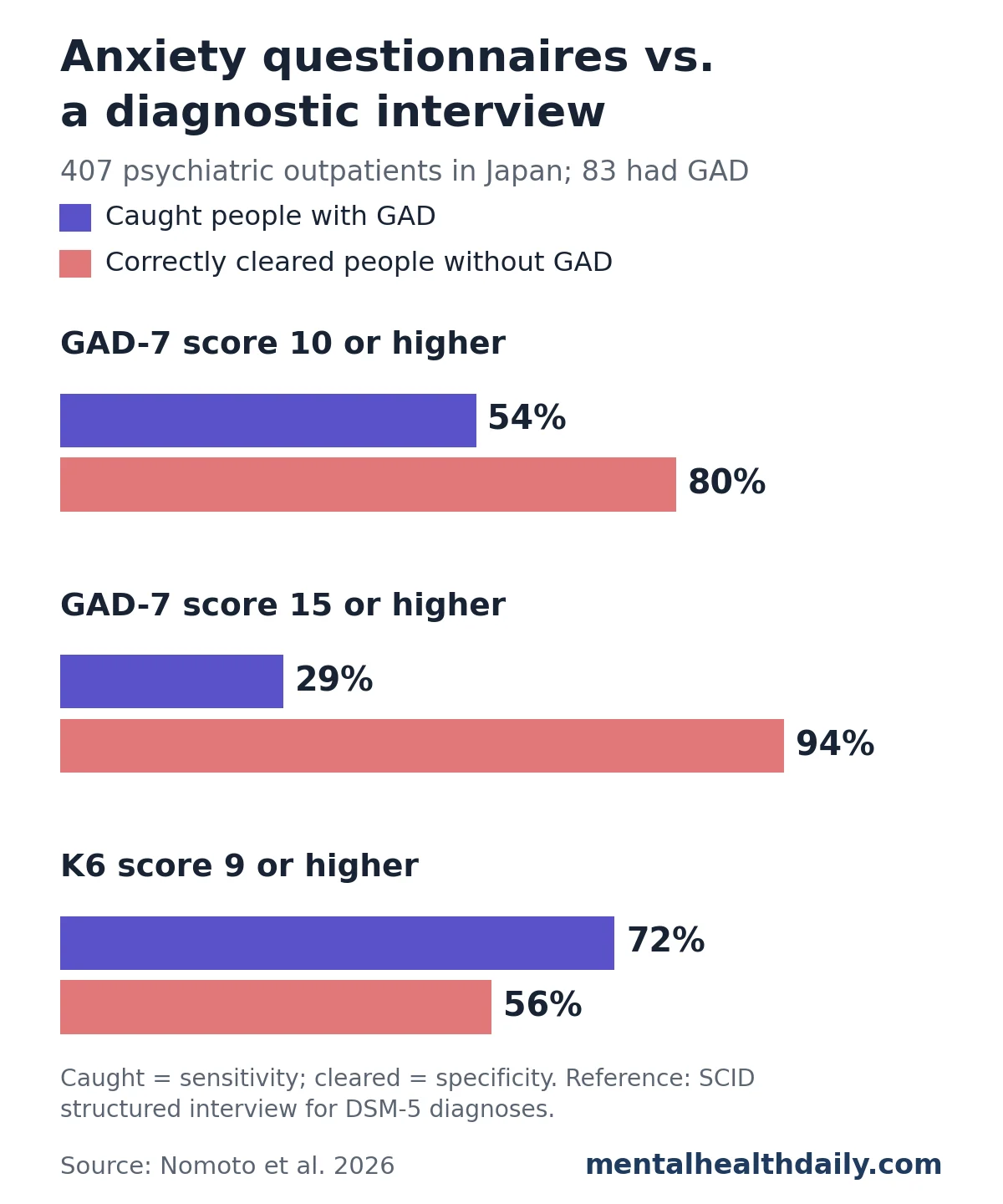
- GAD-7 Performance: Using the commonly accepted cutoff score of 10 or higher, the GAD-7 correctly identified only 45 of the 83 patients with GAD (a sensitivity of 54%). While it correctly cleared 80% of those without GAD (specificity), this meant a substantial number of actual GAD cases were missed. Raising the cutoff to 15 improved specificity to 94% but drastically reduced sensitivity to just 29%, meaning it missed even more cases.
- K6 Performance: A K6 score of 9 or higher caught 72% of GAD cases (higher sensitivity than GAD-7) but cleared only 56% of everyone else (lower specificity). This low specificity implies that approximately seven out of ten positive results from the K6 were "false alarms," flagging individuals who did not actually have GAD according to the gold-standard SCID interview.
Overall agreement with the structured interview was only fair for the GAD-7 (kappa 0.31, where 1 represents perfect agreement) and even weaker for the K6 (kappa 0.19). Interestingly, a negative result from either questionnaire was generally more reliable than a positive one: at every cutoff, between 82% and 89% of people who screened negative truly did not have GAD.
Why Screening Tools Struggle in Specialized Settings
The observed performance of the GAD-7 in the PRADO study stands in contrast to its effectiveness in primary care settings. In its original 2006 validation study involving 2,740 primary care patients, a GAD-7 score of 10 or higher demonstrated a sensitivity of 89% and a specificity of 82% for GAD. A 2016 meta-analysis further supported its acceptable accuracy at cutoffs ranging from 7 to 10.
However, specialty psychiatric clinics present a much harder testing ground for such screening tools. In these settings, nearly all patients are seeking care for some form of anxiety or low mood. This high baseline of symptomatology makes it inherently difficult for general symptom checklists like the GAD-7 or K6 to precisely differentiate GAD from overlapping conditions such as depression, panic disorder, or social anxiety disorder. As Rutter and Brown concluded in their 2018 study of 536 outpatients at a US anxiety and mood disorders clinic, the GAD-7 functions more effectively as a measure of GAD symptom severity rather than a definitive "yes-or-no" diagnostic screener.
The Japan results align with this pattern. Patients diagnosed with GAD in the PRADO study averaged a GAD-7 score of 10.6, which is right at the usual cutoff, and a significant 38 of the 83 GAD patients scored below 10, further illustrating how the tool missed many genuine cases in this specialized population.
Broader Implications for Japanese Mental Healthcare and Policy
The PRADO study’s findings resonate deeply within the context of Japanese mental healthcare. In their 2026 report, the researchers highlighted a significant systemic gap: Japan currently lacks an insurance-covered GAD-specific treatment pathway. This absence means that when GAD is either missed or subsumed under another diagnosis, care may inadvertently default to treating the recorded condition (e.g., depression) rather than the underlying GAD itself. This could lead to suboptimal treatment outcomes, prolonged suffering, and increased healthcare costs in the long run.
Japan has made strides in mental health awareness in recent years, but societal stigma and a historical emphasis on somatic complaints can still influence how mental health conditions are perceived and diagnosed. An earlier survey of the Japanese general population by the same research group, using GAD-7 and DSM-5-based questions, estimated GAD prevalence at 7.6% and 6.0% respectively, noting lower quality of life among probable cases. The new outpatient figure of 20.4% is, as expected, much higher, reflecting the concentration of individuals seeking psychiatric care.
The implications for policy are clear: there is an urgent need to establish clear diagnostic guidelines and develop GAD-specific treatment protocols that are recognized and covered by national health insurance. Public health campaigns could also play a role in increasing awareness of GAD symptoms among both the general population and healthcare providers, encouraging individuals to seek help and clinicians to look beyond the most obvious diagnoses. The findings also suggest a need for enhanced training for psychiatric clinicians in Japan on the nuanced differential diagnosis of anxiety disorders, particularly in distinguishing GAD from its comorbid counterparts.
Funding and Study Limitations: A Transparent View
It is important to note the funding context of the PRADO study. Viatris Pharmaceuticals Japan funded and sponsored the research. Three of the study authors are Viatris employees, while the other two reported receiving fees or advisory roles with Viatris and other pharmaceutical companies. IQVIA, a contract research organization, handled the statistical analysis and medical writing. As Viatris markets psychiatric medicines, it has a commercial interest in the recognition and treatment of GAD in Japan. While the interview-based design using the SCID is a significant strength that lends credibility to the diagnostic accuracy, the commercial funding aspect is a factor worth considering in the broader interpretation of the findings, as is standard practice in medical journalism.
The study itself acknowledged several limitations:
- The cross-sectional design means it captures a snapshot in time and cannot establish cause-and-effect relationships or track long-term diagnostic trajectories.
- The sample was drawn from psychiatric outpatients, limiting generalizability to primary care or general population settings.
- The exclusion of patients with psychotic disorders or those unable to complete interviews might have skewed the results towards a more homogenous sample.
- The study did not directly measure the rate of underdiagnosis in routine clinical practice but inferred it from the discrepancies between SCID results and medical records/primary diagnoses.
Despite these limitations, the PRADO study stands as a crucial piece of research, shedding light on a significant and previously underappreciated mental health challenge in Japan.
Global Context and Future Directions
The PRADO study’s findings resonate with broader international discussions about the complexity of diagnosing mental health conditions, especially anxiety disorders, which frequently co-occur with depression. While the prevalence rates may differ across cultures due to varying expressions of distress, healthcare seeking behaviors, and diagnostic practices, the core challenge of distinguishing GAD from other conditions remains universal. The study provides valuable data for cross-cultural comparisons and underscores the importance of using robust diagnostic tools like the SCID, particularly in research settings, to accurately map the landscape of mental illness.
Future research in Japan could build on these findings by exploring longitudinal outcomes of patients with undiagnosed GAD, investigating the effectiveness of GAD-specific interventions, and examining the economic burden associated with underrecognition. Efforts to integrate more comprehensive screening and diagnostic protocols into routine psychiatric care could significantly improve patient outcomes and alleviate the hidden suffering of many individuals.
Recommendations for Patients and Clinicians
The findings of the PRADO study offer tangible insights for both individuals seeking mental healthcare and the clinicians providing it:
- Ongoing Worry Deserves Recognition: For individuals experiencing persistent, hard-to-control worry that significantly impacts their daily life, even if they have received a diagnosis of depression or another condition, it is entirely reasonable and important to discuss the possibility of GAD with their clinician. The study clearly demonstrated that a significant portion of people previously diagnosed with a depressive episode also met the criteria for GAD. Advocating for a thorough assessment of all symptoms can lead to a more accurate diagnosis and, consequently, more targeted and effective treatment.
- Screening Scores are a Starting Point, Not a Definitive Diagnosis: Patients and clinicians should understand that while self-report questionnaires like the GAD-7 and K6 can be useful initial screening tools, a score below the usual cutoff (e.g., GAD-7 below 10) does not definitively rule out GAD in someone already in psychiatric care. Conversely, a high score on a general distress screener like the K6 does not automatically confirm GAD. The study emphasizes that a careful, structured diagnostic interview, such as the SCID, remains the most reliable method for distinguishing and sorting out overlapping psychiatric conditions and arriving at a precise diagnosis. Clinicians should be encouraged to utilize more comprehensive diagnostic evaluations when initial screenings suggest complexity or when treatment for an existing diagnosis is not yielding expected results.
By recognizing the pervasive nature of GAD, addressing its diagnostic challenges, and advocating for GAD-specific treatment pathways, Japan can significantly enhance the quality of mental healthcare for its population, ultimately reducing suffering and improving the lives of countless individuals.

