

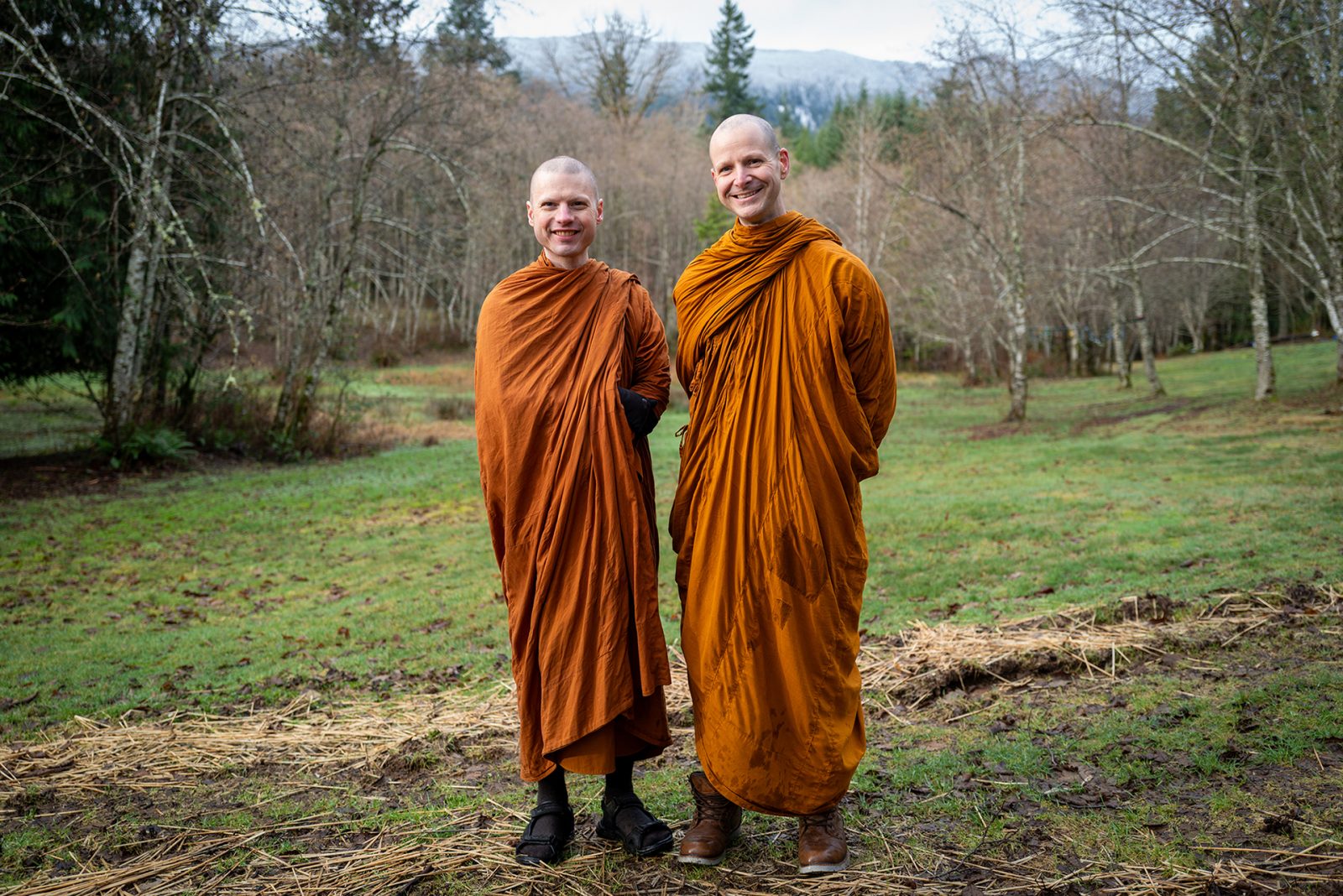
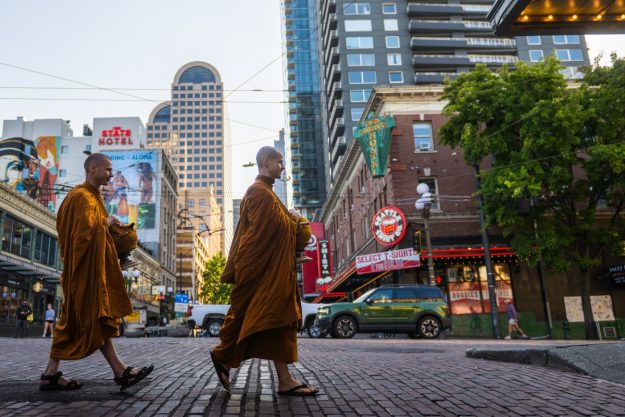
On a typical weekday morning, two saffron-robed monks, Ajahn Kovilo and Ajahn Nisabho, emerge into the bustling Pike Place Market in Seattle, their alms bowls held open. They move with quiet grace, accepting gifts of food for their singular meal of the day, their practice deeply rooted in the ancient tradition of dana, or generosity. In the five years since they began this daily ritual, they have never gone hungry, a testament to the unexpected wellspring of kindness they have encountered in this famously secular city.
These monks are the co-founders of Clear Mountain Monastery, a nascent Theravada Buddhist forest monastery established on ninety acres of forested land in North Bend, Washington, approximately forty minutes east of Seattle. Their journey to this moment has been long and varied, spanning formative experiences in Thailand, India, and Myanmar, immersion in Goenka meditation halls, and a remarkably warm and ongoing partnership with Saint Mark’s Episcopal Cathedral in downtown Seattle. This unlikely alliance serves as a foundational pillar for Clear Mountain’s burgeoning community.
From Humble Beginnings to a Growing Sangha
The initial foray into the urban landscape of Seattle was met with cautious optimism. "The first day we went downtown, seven people offered food in thirty minutes," Ajahn Nisabho recounted. The generosity of the city’s residents has consistently surprised them, often arriving at precisely the right moment. In one particularly poignant instance, just as the monks faced the prospect of a day without sustenance, a homeless individual emerged from an alleyway offering a box of protein bars, a gesture of profound compassion.
Even within their own monastic circles, the practice of alms rounds in a Western urban setting initially sparked some gentle skepticism. Ajahn Kovilo recalled a Thai monk friend, Ajahn Gai, humorously expressing concern. "He said, ‘I am worried about Ajahn Nisabho going for alms at Pike Place Market.’ I said, ‘Why? There are generous people in America too.’ ‘Because they sell fish,’ he deadpanned," Ajahn Kovilo shared, eliciting a chuckle at the well-intentioned jest.
However, the skepticism proved unfounded. Despite Seattle’s reputation as one of the most secular cities in the United States, the monks discovered a profound hunger for spiritual community, particularly among younger demographics, a trend that diverges from the more age-traditional Buddhist convert communities often dominated by baby boomers. Their Saturday gatherings, hosted at Saint Mark’s Cathedral, now attract an average of 120 attendees in person, with another 100 participating online. This reach extends to daily Zoom meditation sittings, demonstrating a modern adaptation of ancient teachings. "The Buddha taught in the vernacular, and the vernacular of this age is social media," Ajahn Nisabho observed. "We’ve found a way of rippling the teachings out through YouTube and other platforms, and people are so hungry for community."
This desire for connection addresses what Ajahn Nisabho identifies as "the siloed existence that is the endemic problem of convert Buddhism in the US." Clear Mountain Monastery is envisioned not merely as a place of meditation but as a hub for constructing the "social architecture of practice," a framework that integrates communal meals and interfaith dialogue. "These last five years have been building up that architecture of faith," Ajahn Nisabho stated. "Everything’s offered freely, and support has really come from inspiration."
A Growing Network of Monastic Communities
Ajahn Kovilo highlights the emergence of a constellation of new Theravada monastic communities along the West Coast in recent years. This network includes institutions like Pacific Hermitage in White Salmon, Passaddhi Vihara in Olympia, Parayana in Port Townsend, Dhammadharini in Penngrove, California, and Karuna Vihara in Santa Cruz. These newer foundations join established centers such as Sitavana Monastery in British Columbia and Abhayagiri Monastery in Ukiah, California, as well as Metta Forest Monastery near San Diego.
This burgeoning monastic presence has led to a significant development in the landscape of Buddhism in North America. Ajahn Sona, the abbot of Sitavana Monastery, has aptly dubbed the region "the New Gandhara," a reference to the ancient Indian region that was a crucial hub for the spread of Buddhism. This moniker reflects the increasing density of Theravada monasteries for both bhikkhus (monks) and bhikkhunis (nuns) in the Pacific Northwest. The Buddha’s teachings emphasized the importance of the "fourfold assembly"—monks, nuns, laymen, and laywomen—as essential for the completeness of his dispensation, or sasana. By the count of Clear Mountain monks, only two regions globally currently support such a comprehensive convergence of Theravada monks and nuns in close proximity: Western Australia and, now, the Pacific Northwest.
Establishing a Forest Monastery
After a three-year search, the community secured its ninety-acre forested site in North Bend six months ago. The location is strategically situated within an elk migration corridor and remains within a manageable forty-minute drive of Seattle, allowing for the continuation of their vital alms practice. This proximity to an urban center is a departure from the typical model for forest monasteries in North America, which are often situated two or more hours away from any major city. "In Asia, the model depends on being close enough to the city for alms round," Ajahn Nisabho explained. "So it’s not novel—but it is quite novel for forest monasteries in North America."
The acquisition of the land was made possible by a $5 million fundraising effort. The long-term vision for Clear Mountain Monastery includes accommodations for up to twenty monastics, a dedicated quarter for visiting bhikkhunis, a lay sala for daily chanting and meditation, a temple open to day visitors, and a designated forested area for monastics pursuing solitary practice. "We don’t want to lose that side of things," Ajahn Nisabho emphasized, referring to the importance of deep, individual contemplation within the monastic life.
The Personal Journeys of the Founders
The paths of Ajahn Nisabho and Ajahn Kovilo to monastic life are as diverse as their backgrounds, yet both are rooted in a deep commitment to the Dharma.
Ajahn Nisabho’s spiritual journey began in his hometown of Spokane, Washington. Raised by Buddhist parents who had studied with prominent teachers like Jack Kornfield, he found an early resonance with spiritual inquiry. At fifteen, his reading of Hermann Hesse’s Siddhartha ignited a profound aspiration. "The vision of the Buddha just shone gold in my heart," he recalled. "There are a few moments in your life where you step into a footprint that feels like it was made for you—and that was one of them." He continued his meditation practice through college, exploring social work with a year-long stint in Calcutta assisting a doctor in the slums. The decisive turn towards monasticism came after a visit to Abhayagiri Monastery in California. "I stepped into the silence, and realized I really needed that container to face my suffering," he stated. This led him to Thailand, where he ordained under Ajahn Anan at Wat Maphrao.
Ajahn Kovilo’s introduction to Buddhism came through ten-day Goenka Vipassana retreats, which revealed a need for a more profound engagement with the teachings. His exploration led him to the Pali canon and, by 2003, to the extensive online resources of Access to Insight, particularly the work of American-born Thai forest monk Thanissaro Bhikkhu (Ajaan Geoff). Upon learning that Ajaan Geoff led a monastery in Southern California, Ajahn Kovilo relinquished his possessions and hitchhiked north with a tent and a rucksack, intending a ten-day visit. He stayed for eighteen months. His ordination took place at Abhayagiri in 2010 under Ajahn Pasanno and Ajahn Amaro. He subsequently spent six years alternating between Thailand and the U.S., training at a Pa Auk monastery, studying Thai and Pali, and undertaking four years of study in Mahayana traditions at Dharma Realm Buddhist University. Both monks identify with the Ajaan Chah lineage, a prominent tradition within Thai forest Buddhism. Ajahn Nisabho is currently working on a biography of Luang Por Pasanno, while Ajahn Kovilo edited Stillness Flowing, the biography of Ajaan Chah by Ajahn Jayasaro.
Forging Interfaith Bonds: A Unique Partnership
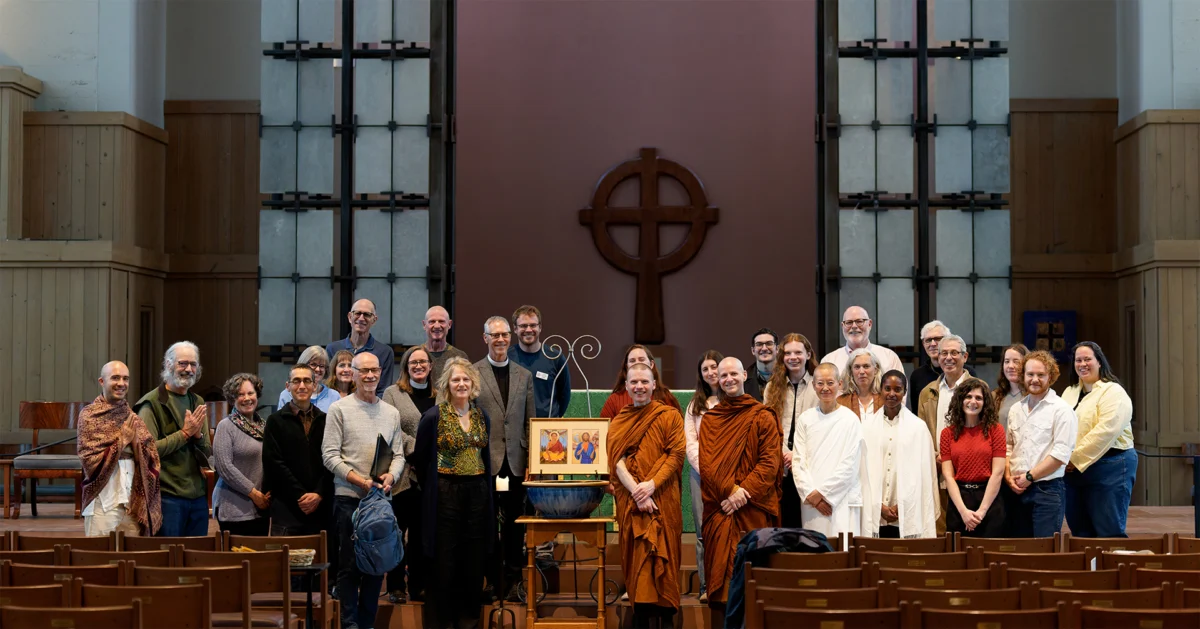
The establishment of Clear Mountain Monastery would have been significantly more challenging without the crucial support of Saint Mark’s Episcopal Cathedral. For five years, the cathedral has generously hosted Clear Mountain’s community gatherings. The initial outreach to the cathedral’s leadership was marked by humility. "We laid out our situation without asking for anything, just saying we wanted to exist in a space of giving if we could," Ajahn Kovilo recalled. The response was immediate and welcoming: a granola bar was offered on the spot, accompanied by the simple invitation, "Yeah, just meet here." Adding a poignant layer to this connection, Ajahn Kovilo noted that Luang Por Sumedho, a senior monastic disciple of Ajaan Chah and a key figure in bringing the Thai forest tradition to the West, had served as an altar boy at Saint Mark’s at the age of eleven, creating an unexpected thread linking the two traditions before Clear Mountain’s inception.
This relationship has deepened over time. The two communities now hold an annual January lunch, where Clear Mountain members bring a meal to the cathedral staff as an expression of gratitude. This ongoing dialogue has also given rise to a unique interfaith worship service, inspired by Thich Nhat Hanh, titled "Living Buddha, Living Christ, Living Spirit."
The Reverend Canon Emily Griffin, canon vicar of Saint Mark’s since October 2024, traces the genesis of this service to a conversation in mid-2023 when Ajahn Nisabho expressed a desire to deepen the interfaith connection through shared prayer. A collaborative effort involving cathedral staff and lay volunteers exploring this possibility revealed profound resonances between Buddhist perfections of character related to enlightenment and the Christian "Fruits of the Spirit" found in the New Testament. Coinciding with the cathedral’s introduction of Taizé services—a contemplative, ecumenical form of worship—the "Living Buddha, Living Christ, Living Spirit" service found its natural expression.
The inaugural service in the summer of 2024, followed by subsequent services, has drawn approximately 150 participants. "What’s beautiful about it is that folks from both traditions walk away feeling their own faith enriched," Griffin stated. "Not only are you appreciating a tradition that’s not your own and valuing the other, but you’re seeing your own tradition in greater depth, which is just a gift."
The exchange extends beyond these interfaith services. Ajahn Nisabho and members of the Clear Mountain community occasionally participate in Sunday worship at Saint Mark’s, while cathedral members have been invited to join the monks for meditation sessions. "There’s a wonderful spirit of openness, curiosity, and respect," Griffin observed. "Our relationship has been life-giving and enriching."
Griffin identified a profound gift that the monks bring to her congregation: a heightened awareness of presence. "I think one of the real gifts they bring is the reminder that being fully present is a gift," she said. "As Episcopalians, we can be a little task-oriented. . . . The emphasis on quality of time and relationship-building has been a real gift to us, and has helped us lean into that—because it’s part of our tradition, too, but in the rush to get things done, we sometimes lose it. The way they embody presence inspires us to do the same."
The emergent theme from conversations with the ajahns is the power of skillful relationship and community building. As the Buddha famously remarked to Ananda, "Beautiful friendship is half of the holy life." The Buddha’s profound response, "Oh no, beautiful friendship is the whole of the holy life," resonates deeply with the foundation being laid by Clear Mountain Monastery, a testament to the transformative potential of connection, compassion, and shared spiritual aspiration in the heart of the Pacific Northwest.

