

Unpacking the Diagnostic Dilemma in Adult ADHD Research
The core issue highlighted by the review centers on the quality and transparency of diagnostic procedures within RCTs. Differential diagnosis, the process of systematically checking whether symptoms are better explained by another condition before assigning a diagnosis, is not merely an optional step in adult ADHD assessment; it is fundamental. This is due to the considerable overlap of ADHD symptoms with a myriad of other mental health conditions and medical issues. Inattention, restlessness, impulsivity, sleep disruption, anxiety, depression, trauma, substance use disorders, and various personality pathologies can all manifest in ways that mimic or coexist with ADHD, making a thorough, multi-faceted assessment indispensable.
The Studart et al. review, slated for publication in 2025, meticulously examined the diagnostic methodologies employed across nearly 300 adult ADHD RCTs. Their analysis revealed a concerning trend: many trials failed to document diagnostic procedures that were robust enough to ensure the clinical interpretability of their study samples. While the researchers did not assert that every participant in these trials was misdiagnosed, their findings make a narrower, yet profound, methodological claim: the documented diagnostic practices were often insufficient to reliably distinguish ADHD from other conditions that present with similar symptoms. This methodological ambiguity significantly compromises the ability of clinicians and policymakers to confidently apply trial findings to real-world patient populations.
The Evolution and Challenges of Adult ADHD Diagnosis
ADHD was historically conceptualized primarily as a childhood disorder. Its recognition and diagnosis in adulthood have presented unique challenges. Adult diagnosis necessitates translating childhood-observed signs into retrospective adult symptom reports, documenting a history of childhood symptoms, assessing current functional impairment, and critically, excluding other conditions that could better explain the presentation. This translation is inherently more complex than merely tallying items on a checklist, requiring nuanced clinical judgment and a comprehensive understanding of psychopathology.
The review categorized diagnostic methods into several groups: reliance on clinical diagnosis alone, use of ADHD-specific scales, or structured/semi-structured interviews that included a broader assessment of general psychopathology. The critical distinction, according to the researchers, was not whether the diagnostic paperwork was structured or unstructured, but whether the method incorporated sufficient general psychopathology assessment to effectively rule out competing explanations. This distinction is paramount, as the utility and validity of an adult ADHD trial sample depend directly on the quality of its diagnostic workup.
Alarming Statistics: The Pervasive Absence of General Psychopathology Assessment
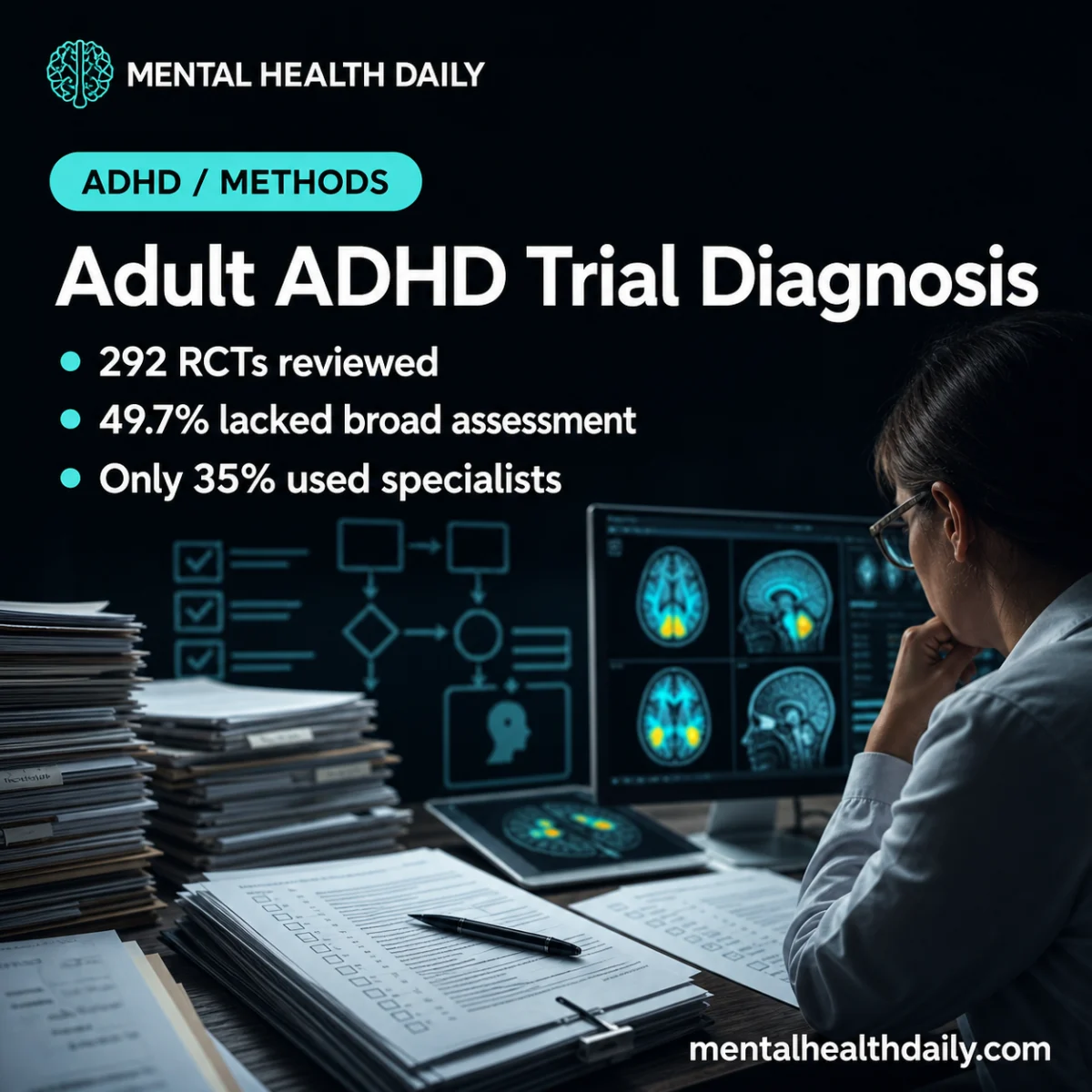
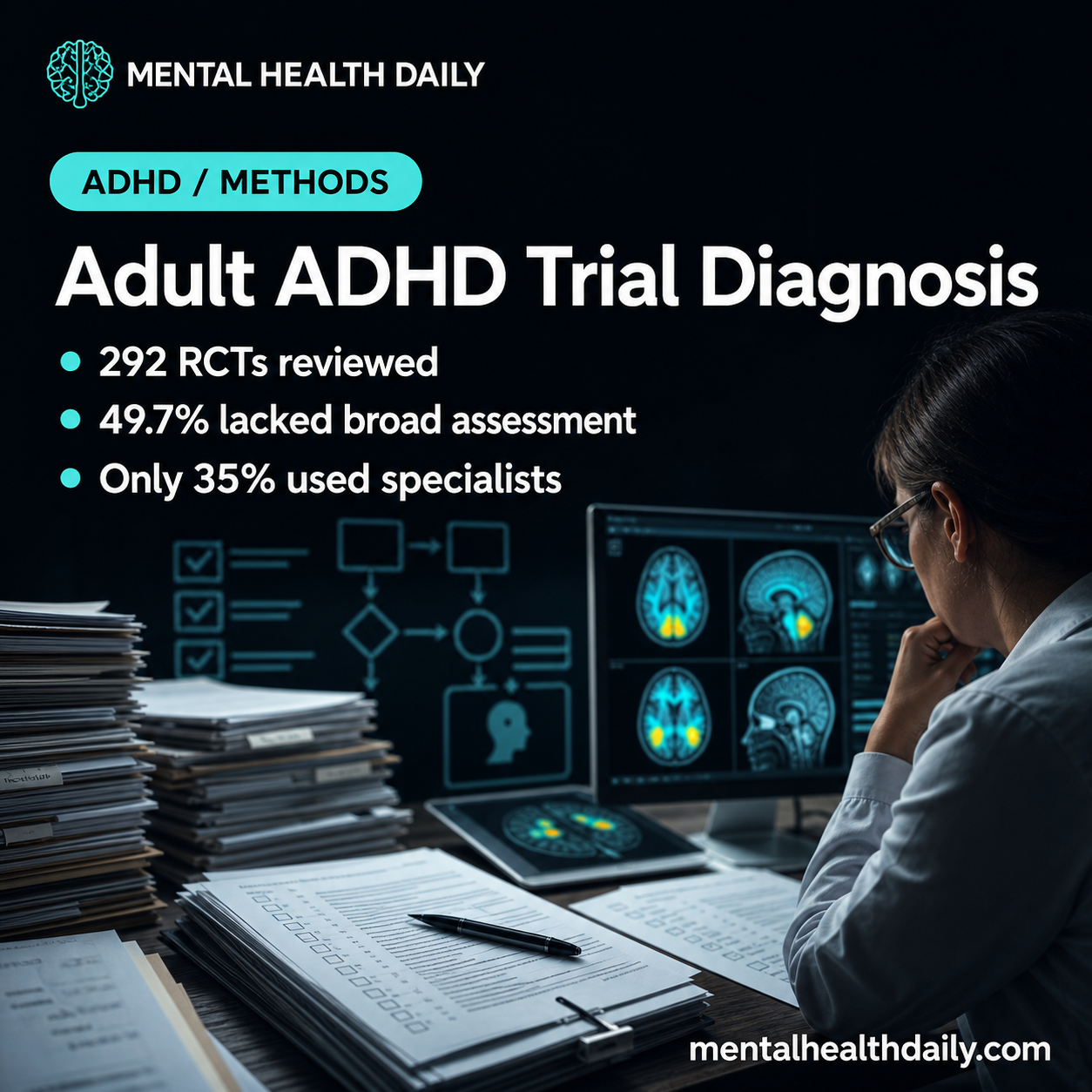
Perhaps the most striking finding from the review was that 49.7% of the adult ADHD RCTs did not include a general psychopathology assessment. This figure encompasses studies that used only clinical diagnoses, clinical diagnoses supplemented with ADHD-specific rating scales, or ADHD-specific interviews/scales without any broader psychiatric evaluation. While these methods might identify individuals who exhibit "ADHD-like" symptoms, they fundamentally lack the capacity to fully ascertain whether the observed presentation is, in fact, better explained by another mental disorder or comorbidity.
This limitation is further exacerbated by the high rates of comorbidity commonly observed in adult ADHD populations. It is not uncommon for individuals with ADHD to also experience anxiety disorders, depression, substance use disorders, or personality pathology. A trial that includes patients with these comorbidities can still yield clinically useful results, provided that the researchers clearly demonstrate how they meticulously distinguished ADHD from these overlapping presentations. The problem arises when trials accept comorbidity without transparently documenting the rigorous diagnostic process used to differentiate ADHD from other conditions, thereby blurring the lines and making it difficult to interpret the specific effects of an ADHD-targeted intervention.
The clinical implication of this widespread diagnostic weakness is profound: when an adult ADHD RCT reports the effects of a medication or psychotherapy, readers must critically evaluate the diagnostic "gate" through which participants entered the trial. A weak diagnostic process can significantly undermine the generalizability of treatment effects to the careful and comprehensive psychiatric practices seen in clinical settings.
The Specialist Gap: A Question of Expertise
Adding another layer of concern, the review found that only 35% of studies explicitly reported that psychiatrists or psychologists were responsible for assigning the ADHD diagnosis. A staggering 190 studies (65%) either failed to report who conducted the diagnostic assessment, relied on someone other than a psychiatrist or psychologist, or used automated computer-based diagnostic tools. While this does not automatically invalidate every study, it undeniably weakens confidence in the comparability and reliability of diagnoses across trials.
Psychiatric diagnosis is an intricate process that transcends mere symptom counting. A skilled and experienced clinician can identify a wide array of conditions that can mimic or modify ADHD symptoms, including mania, psychosis, various sleep disorders, effects of substance use, traumatic stress, autism spectrum disorder, specific learning disorders, medication side effects, and cognitive problems stemming from other neurological conditions. These conditions require nuanced clinical judgment, often involving detailed histories, collateral information, and careful differential reasoning.
The importance of this diagnostic standard is underscored by adjacent prevalence data. The World Federation consensus statement estimated the global prevalence of adult ADHD at 2.5%, while a separate global meta-analysis estimated symptomatic adult ADHD at 6.75% in 2020. This disparity highlights the critical distinction between experiencing symptoms that resemble ADHD and receiving a formal, carefully considered diagnosis. Trial methods must uphold this distinction to ensure the integrity of their findings.
The Rising Tide of Adult ADHD Awareness and its Implications for Research
The landscape of adult ADHD has undergone a dramatic transformation in recent years, largely propelled by increased public awareness and the pervasive influence of social media. Platforms like TikTok have played a dual role: empowering many adults to recognize genuine impairment and seek professional help, but also circulating broad, often oversimplified, symptom lists that can resonate with individuals experiencing a wide range of problems. Research by Yeung et al. (2022), for instance, found highly variable quality in ADHD-related content on TikTok, with a significant portion lacking scientific accuracy. In such an environment, the imperative for careful, rigorous research diagnosis becomes even more critical, not less.
Historically, adult ADHD was often overlooked or misdiagnosed. The inclusion of adult criteria in diagnostic manuals like the DSM-IV and subsequent updates in DSM-5 (which lowered the age of onset for diagnostic criteria and refined symptom descriptions) significantly increased its recognition. This chronological shift has led to a greater number of adults presenting for evaluation, making the quality of diagnostic assessment in research paramount.
The Studart et al. review serves as a scoping review of published trial methods, meaning it identifies reporting gaps and variations in methodology. It cannot definitively prove how many participants were misdiagnosed. However, the practical implications are undeniably serious, given that RCTs form the bedrock of evidence-based medicine, influencing clinical guidelines, treatment protocols, and prescribing practices worldwide.
Moreover, the adult ADHD diagnosis carries substantial weight in contemporary society. It can influence access to stimulant medications, eligibility for workplace accommodations, academic support services, disability claims, and profoundly shape a patient’s self-identity. If research trials fail to transparently demonstrate how they distinguished ADHD from a complex web of anxiety, depression, bipolar disorder, substance use, sleep debt, trauma, and autism, the resulting evidence base becomes significantly harder to apply with confidence to the diverse and complex adults who present for evaluation in clinical settings today.
A Blueprint for Transparency: Reconstructing the Diagnostic Gate
To address these critical shortcomings, adult ADHD trial reports must evolve to provide sufficient detail for readers to reconstruct the diagnostic "gate" through which participants were admitted. The minimum standard is not merely a perfect diagnostic label, but rather enough specific information to understand how researchers handled overlapping conditions and who ultimately made the diagnostic call.
For adult ADHD research, transparent reporting should explicitly name:
- The specific diagnostic criteria used (e.g., DSM-5, ICD-11).
- The diagnostic instruments employed (e.g., structured interviews like the DIVA-5 or semi-structured interviews assessing broader psychopathology).
- The methodology for assessing retrospective childhood history of ADHD symptoms.
- The process for evaluating functional impairment across different life domains.
- The detailed procedures for differential diagnosis, including how other potential conditions were ruled out.
- The professional qualifications and experience of the individuals who conducted the diagnostic assessments.
These granular details directly affect how a trial’s findings should be interpreted and utilized. For instance, a stimulant trial conducted with a robust diagnostic workup, including specialist assessment and comprehensive differential diagnosis, may be highly generalizable to specialist ADHD clinics. Conversely, a trial relying predominantly on scale-based entry with limited assessment of comorbidity may still estimate medication response in a symptom-defined population, but its clinical meaning and generalizability would be considerably narrower.
Diagnostic Weakness: Distorting Treatment Effect Estimates
The impact of loose diagnostic entry criteria can manifest as distortions in treatment effect estimates, potentially pulling them in either direction. If a trial inadvertently includes individuals whose attention problems are primarily driven by sleep deprivation, undiagnosed depression, anxiety disorders, stimulant misuse, or bipolar symptoms, the perceived effects of an ADHD-specific treatment may appear smaller. This occurs because the intervention is targeting the wrong underlying mechanism for a subset of the study population, diluting the true effect for those with actual ADHD.
Conversely, the opposite distortion is also possible. A trial sample that is rigorously filtered to include only "uncomplicated," highly treatment-responsive, and checklist-positive patients may inadvertently overstate the benefits of an intervention compared to its effectiveness in a real-world clinical setting. In actual clinics, ADHD frequently overlaps with complex trauma, mood disorders, learning disabilities, and substance use disorders, making treatment outcomes often less straightforward than in highly controlled, "clean" research samples.
From a clinical perspective, this underscores the necessity of grading adult ADHD evidence partly by its diagnostic rigor. Treatment effect sizes, reported adverse events, and dropout rates become significantly easier to interpret and apply when the study sample truly resembles the patients clinicians are striving to treat. Diagnostic rigor also critically impacts the interpretation of adverse events. If a sample includes undetected bipolar disorder, substance use disorder, sleep disorders, or trauma-related hyperarousal, observed stimulant tolerability issues or discontinuation rates might reflect mixed pathology rather than solely an ADHD treatment response.
This does not imply that strict exclusion of complex patients is always the answer. Indeed, some trials should explicitly aim to study complicated, real-world ADHD presentations with significant comorbidity. The crucial reporting standard, however, remains consistent: researchers must clearly state what comorbidities were present, what conditions were excluded, and how any diagnostic uncertainty was handled.
For clinicians and patients alike, this translates into a vital understanding: when two adult ADHD RCTs appear to disagree on treatment outcomes, differences in their diagnostic entry criteria may explain a substantial part of the conflict. A sample recruited based solely on a symptom scale and a sample diagnosed by a specialist after a comprehensive differential assessment are not automatically measuring the same clinical population. The review also highlights a broader transparency problem: a research paper that states participants "met DSM criteria" without detailing who assessed them and how competing disorders were evaluated provides a conclusion without the essential methodological basis for trust.
Adult ADHD research does not need to exclude every complicated patient to be valid or clinically useful. What it critically needs is to cease obscuring complexity behind overly simplistic or thinly described diagnostic labels. A pragmatic trial that includes comorbidity can still be of high quality if it transparently reports what conditions were present, what was excluded, and how diagnostic uncertainty was managed. This standard of reporting is also a matter of fairness to patients. An individual seeking ADHD care should not have to guess whether the trial results guiding their treatment came from people with the same diagnostic complexity, medication history, and comorbidity burden they present in the clinic. Trial evidence becomes genuinely useful and applicable only when this "match" is visibly articulated in clear, ordinary methodological language, before clinicians attempt to extrapolate its findings.
Ultimately, this critique is not an argument for gatekeeping adults out of ADHD treatment. Instead, it is a forceful plea for cleaner, more precise evidence labels. A trial can be immensely valuable whether it studies narrowly defined ADHD, broadly comorbid ADHD, ADHD managed in primary care settings, or even symptom-screen-positive attention problems. The fundamental failure occurs when these distinct populations are blurred together under a single, undifferentiated diagnostic heading, and then the treatment estimates are subsequently applied as if they uniformly pertain to every adult experiencing concentration difficulties.
Addressing Key Questions About Adult ADHD Trial Diagnosis
Does this review suggest adult ADHD is not a real condition?
Absolutely not. Adult ADHD is a valid and recognized clinical diagnosis when assessed carefully and thoroughly by qualified professionals. The review’s criticisms are directed squarely at the inconsistencies and lack of rigor in diagnostic methods employed within some research trials, not at the existence or legitimacy of adult ADHD as a clinical entity.
Why is a general psychopathology assessment so critically important?
A general psychopathology assessment is vital because symptoms commonly associated with ADHD, such as inattention, impulsivity, and restlessness, can stem from a multitude of other underlying causes. Without a broad and comprehensive assessment that evaluates the entire spectrum of mental health, a trial risks inadvertently studying a heterogeneous group of individuals with diverse conditions, all labeled under the umbrella of "adult ADHD." This can obscure true treatment effects and lead to misinterpretations.
Should existing adult ADHD treatment trials now be ignored?
No, existing adult ADHD treatment trials should not be ignored. Instead, they should be read and interpreted with a critical understanding of their diagnostic methodology. Trials that document specialist assessment, comprehensive differential diagnosis, and transparent reporting deserve significantly more confidence and clinical weight than trials relying primarily on symptom checklists or vague clinical labels. Clinicians and researchers must adopt a nuanced approach, prioritizing evidence derived from studies with robust diagnostic rigor.

