

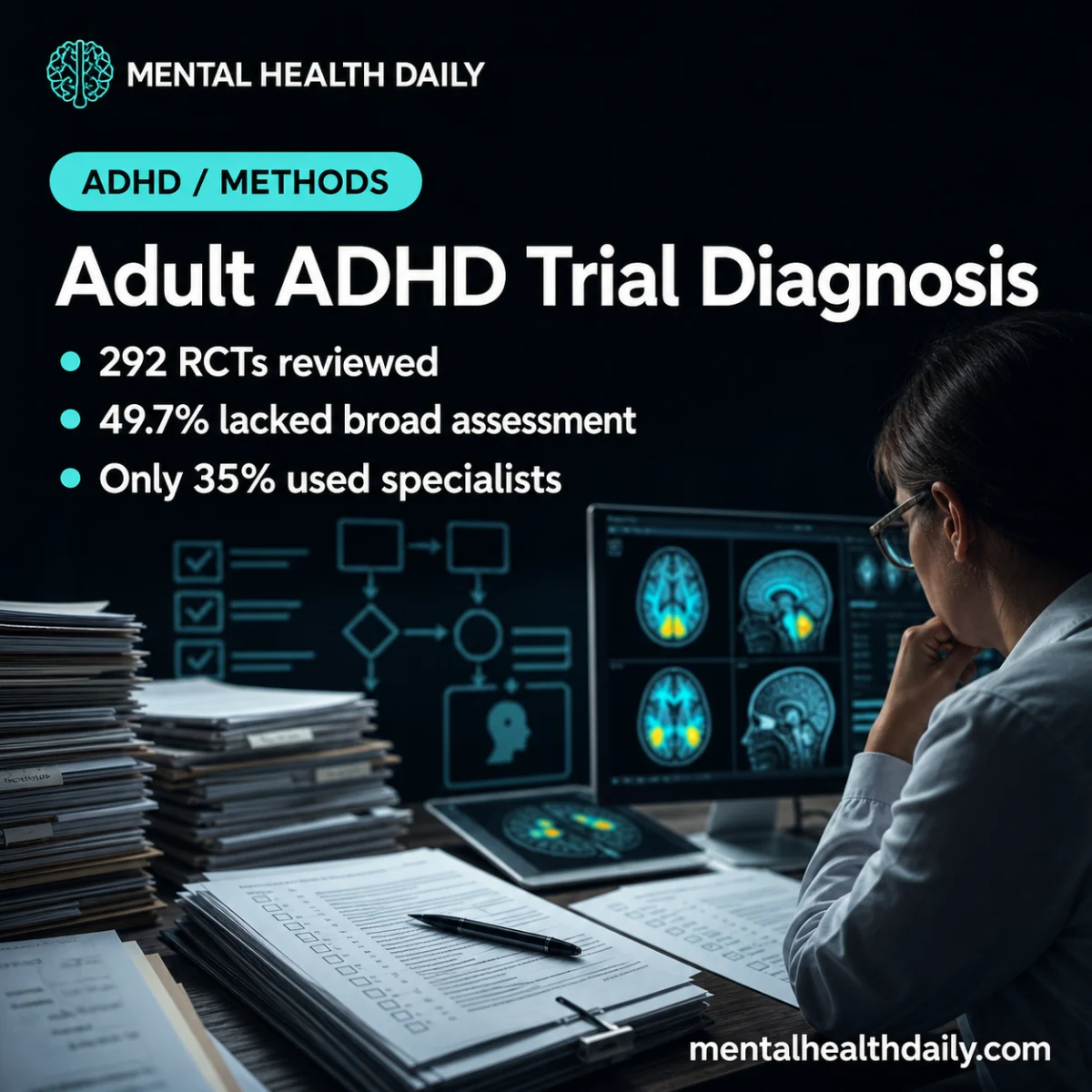
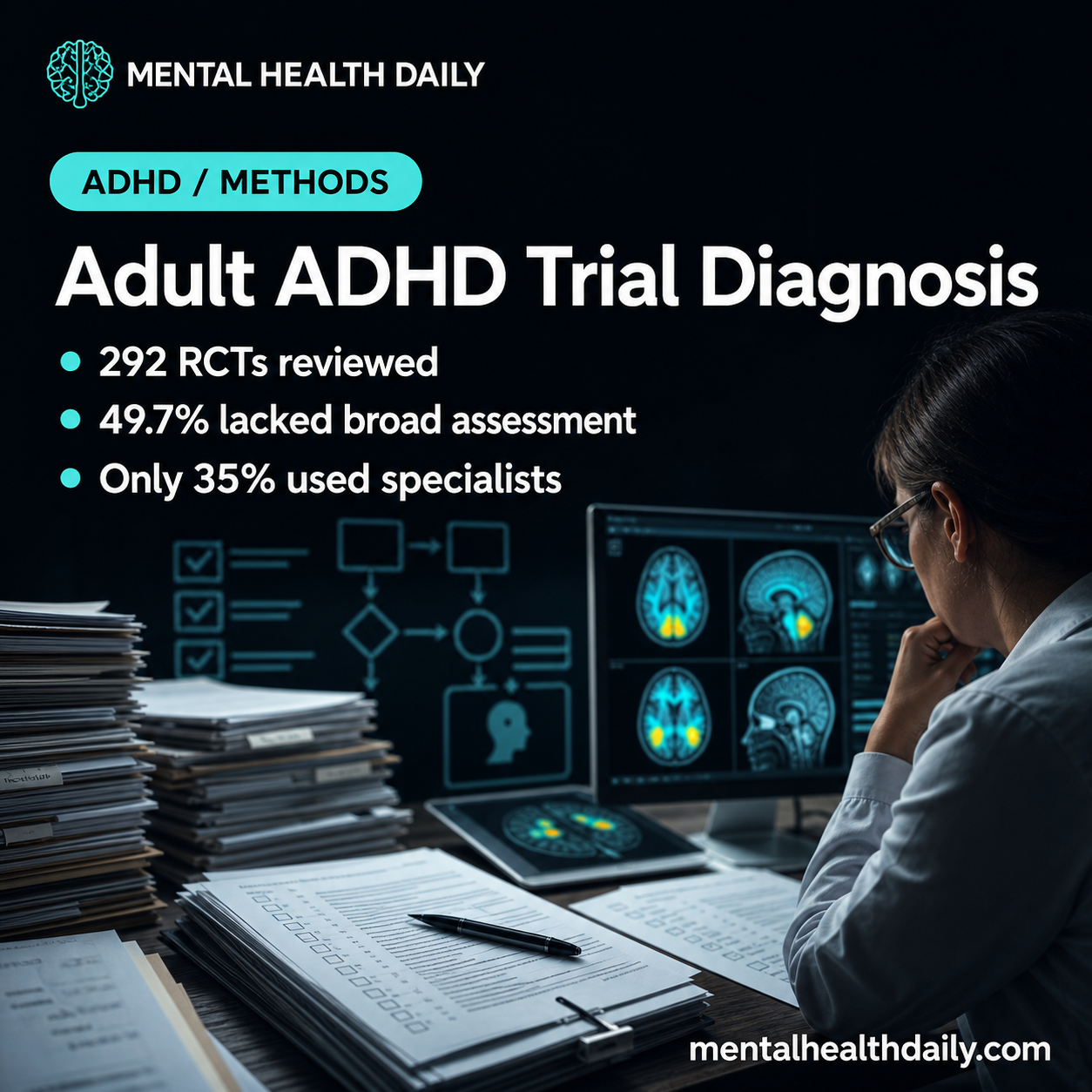
A comprehensive 2025 scoping review of 292 adult Attention-Deficit/Hyperactivity Disorder (ADHD) randomized controlled trials (RCTs) has cast a critical light on the diagnostic methodologies employed, revealing that nearly half of these pivotal studies failed to include a general psychopathology assessment when allocating diagnoses, and a mere 35% reported that the ADHD diagnosis was assigned by a psychiatrist or psychologist. These findings, published by Studart et al., underscore significant concerns regarding the clinical interpretability and generalizability of the existing evidence base for adult ADHD treatments, raising important questions for clinicians, researchers, and patients alike.
The Imperative of Differential Diagnosis in Adult ADHD
The core issue highlighted by the review revolves around the concept of differential diagnosis – the rigorous process of systematically ruling out other conditions that might better explain a patient’s symptoms before assigning a specific diagnosis. For adult ADHD, this step is not merely a best practice; it is considered indispensable due to the extensive symptomatic overlap with numerous other psychiatric and medical conditions. Symptoms such as inattention, restlessness, impulsivity, sleep disruption, anxiety, depression, trauma, substance use, and various personality pathologies can strikingly mimic or co-occur with ADHD, making a thorough, multi-faceted assessment crucial.
Historically, ADHD was primarily conceptualized and diagnosed in childhood, focusing on observable behavioral patterns. However, the recognition of adult ADHD has surged in recent decades, requiring a more nuanced diagnostic approach. Diagnosing ADHD in adults necessitates translating childhood-observed signs into retrospective symptom reports, confirming persistent impairment, and critically, excluding alternative explanations. This "translation" is inherently more complex than merely tallying items on a checklist and demands a deep understanding of developmental trajectories and differential diagnostic considerations.
The Studart et al. review does not contend that a majority of adult ADHD trial participants were definitively misdiagnosed. Instead, its more precise methodological claim is that a substantial proportion of RCTs fail to adequately document diagnostic procedures robust enough to ensure their study samples are clinically interpretable and representative. This lack of transparency and rigor can severely impede the applicability of trial results to real-world clinical practice, where patients often present with complex symptom profiles and comorbidities.
Methodological Gaps: A Deeper Dive into the Review’s Findings
The review categorized diagnostic methods used in the trials, ranging from reliance on clinical diagnoses and ADHD-specific scales to structured or semi-structured interviews that incorporated broader psychopathology assessments. The critical distinction, according to the researchers, was not merely the format of the assessment (e.g., structured vs. unstructured paperwork) but whether the method included a sufficiently comprehensive general psychopathology assessment capable of ruling out competing explanations for symptoms.
49.7% of RCTs Lacked General Psychopathology Assessment: A staggering 49.7% of the reviewed RCTs fell into a category where diagnostic methods were insufficient to properly assess general psychopathology. This figure encompasses studies that relied solely on clinical diagnoses, those combining clinical diagnoses with ADHD-specific rating scales, or studies using ADHD-specific interviews/scales without a broader assessment of mental health. While these methods might identify individuals who exhibit ADHD-like symptoms, they inherently lack the capacity to definitively determine whether the presentation is better explained by another mental disorder. This limitation is particularly concerning given the high rates of comorbidity in adult ADHD populations. Many trials accept patients with co-occurring anxiety, depression, substance use, or personality pathology, which can be clinically useful. However, the problem arises when trials include such comorbidities without adequately documenting how researchers differentiated ADHD from these overlapping presentations, thus obscuring the true target population of the intervention.
Only 35% Reported Specialist Diagnosis: Another significant finding was that only 35% of the studies explicitly reported that a psychiatrist or psychologist conducted the diagnostic assessment. This means that 190 studies (65%) either did not specify who made the diagnosis, used non-specialist personnel, or even relied on automated computer algorithms. While this does not automatically invalidate every study, it profoundly weakens confidence in the comparability and reliability of the diagnostic process across trials. Psychiatric diagnosis is a nuanced process that transcends simple symptom counting. A skilled clinician possesses the expertise to identify conditions such as mania, psychosis, various sleep disorders, effects of substance use, traumatic stress, autism spectrum disorder, learning disabilities, medication side effects, and cognitive impairments, all of which can mimic or significantly modify ADHD symptoms. The absence of specialist oversight in diagnosis introduces a critical variable that can undermine the foundational integrity of the research.
The Evolving Landscape of Adult ADHD and Its Impact on Research
The urgency of these findings is amplified by the rapid increase in adult ADHD awareness and diagnoses globally. Public visibility, often driven by social media platforms, has empowered many adults to recognize potential impairments and seek professional help. However, this increased visibility also brings challenges, as social media can circulate broad symptom lists that may inadvertently fit a wide array of problems. Research by Yeung et al. on TikTok content, for instance, revealed variable quality in ADHD-related information, underscoring why careful, robust diagnostic procedures in research are more crucial than ever.
The prevalence of adult ADHD itself is a subject of ongoing discussion, with estimates varying significantly. The World Federation consensus statement, for example, estimated adult ADHD prevalence at 2.5%, whereas a global meta-analysis estimated symptomatic adult ADHD at 6.75% in 2020. This discrepancy highlights the critical distinction between symptom prevalence and a formal clinical diagnosis, a line that robust trial methods must uphold. The current clinical environment sees adult ADHD diagnosis carrying substantial weight, influencing access to stimulant medications, workplace accommodations, academic support, disability claims, and even an individual’s self-identity. If trials fail to demonstrate how they meticulously separated ADHD from conditions like anxiety, depression, bipolar disorder, substance use disorders, chronic sleep deprivation, trauma, and autism, the resulting evidence base becomes inherently more difficult to apply reliably to the diverse adults presenting for evaluation today.
Implications for Clinical Practice and Research Standards
The findings of the Studart et al. review carry significant implications for how adult ADHD treatment trials are conducted, interpreted, and ultimately, how their results translate into clinical practice guidelines and patient care.
Distortion of Treatment Effect Estimates: A loose diagnostic entry criterion can significantly distort treatment effect estimates. If a trial inadvertently includes individuals whose attention problems are primarily driven by conditions such as sleep deprivation, undiagnosed depression, anxiety, stimulant misuse, or bipolar symptoms, the perceived efficacy of ADHD-specific treatments (e.g., stimulants, psychotherapy) may appear artificially smaller. This occurs because the intervention is targeting the wrong underlying mechanism for a subset of the participants. Conversely, a trial sample that is overly filtered for "uncomplicated," highly treatment-responsive patients (perhaps those who simply meet checklist criteria without extensive differential diagnosis) might inadvertently overstate treatment benefits compared to the complex reality of a typical clinical population, where ADHD often co-occurs with trauma, mood disorders, learning disabilities, and substance use.
Generalizability and Adverse Events: The generalizability of trial results to routine psychiatric practice is directly linked to diagnostic rigor. A stimulant trial underpinned by a strong diagnostic workup, including comprehensive differential diagnosis by specialists, is far more likely to yield results that are applicable to specialist ADHD clinics. In contrast, a trial relying primarily on scale-based entry with limited comorbidity assessment may still provide valuable insights into medication response within a symptom-defined population, but its clinical meaning and applicability to diverse patient groups are considerably narrower. Diagnostic rigor also profoundly impacts the interpretation of adverse events. If a trial sample includes undetected bipolar disorder, substance use disorder, sleep disorder, or trauma-related hyperarousal, observed stimulant tolerability issues or discontinuation rates may reflect mixed pathology rather than solely an ADHD treatment response.
Ensuring Robust Evidence: A Path Forward
The review advocates for enhanced transparency in reporting diagnostic procedures within adult ADHD RCTs. A useful trial report should provide sufficient detail for readers to reconstruct the "diagnostic gate" – the process by which participants were selected and diagnosed. This minimum standard is not about achieving a "perfect" interview label but about offering enough clarity to understand how researchers addressed overlapping conditions and who made the final diagnostic determination.
For adult ADHD trials, transparent reporting should explicitly name:
- The specific diagnostic criteria used (e.g., DSM-5).
- The diagnostic instruments employed (e.g., structured interviews like the MINI or SCID, ADHD-specific scales).
- The specific methods used for assessing and ruling out general psychopathology and comorbidity.
- The qualifications of the professionals who conducted the diagnostic assessments.
- The approach taken to manage diagnostic uncertainty or complex presentations.
These details are crucial for clinicians attempting to extrapolate trial findings to their own patient populations. The review highlights a significant "transparency problem" where papers merely state that participants "met DSM criteria" without elaborating on who conducted the assessment or how competing disorders were evaluated. Such reports provide a conclusion without the necessary methodological context to establish trust and confidence.
Addressing Common Misconceptions
It is vital to clarify that the Studart et al. review does not imply that adult ADHD is not a real or valid condition. On the contrary, adult ADHD is a clinically valid diagnosis when assessed carefully and thoroughly. The criticism is directed squarely at inconsistent and insufficient diagnostic methodologies within research trials, not at the existence or legitimacy of the disorder itself.
Furthermore, the review does not suggest that existing adult ADHD treatment trials should be disregarded entirely. Instead, it argues that they should be interpreted with a critical eye, weighing the diagnostic methods employed. Trials featuring specialist assessment and comprehensive differential diagnosis warrant greater confidence and clinical applicability than those relying predominantly on checklists or ambiguous clinical labels.
The ultimate goal of this critique is not to "gatekeep" adults from receiving appropriate ADHD treatment. Rather, it is to advocate for clearer, more robust evidence labels. A trial can be highly valuable whether it studies narrowly defined ADHD, broadly comorbid ADHD, ADHD within a primary care setting, or symptom-screen-positive attention problems. The fundamental failure occurs when these distinct populations are blurred under a single diagnostic heading, and treatment estimates are then applied indiscriminately to every adult presenting with concentration difficulties. High-quality adult ADHD research should embrace complexity, clearly stating what comorbidities were present, what conditions were excluded, and how diagnostic uncertainty was managed. This level of transparency is not only crucial for scientific rigor but also fair to patients, who deserve to know whether trial results are truly applicable to their unique diagnostic complexity and comorbidity burden.

