

A comprehensive 2026 survey of 975 mothers from German-speaking countries has delivered a compelling insight into the primary drivers of postpartum depression (PPD), pinpointing stress, low social support, loneliness, and depression during pregnancy as the most significant contributing factors. Crucially, the study found no significant link between medical factors such as cesarean delivery and gestational diabetes and the incidence of PPD, challenging some long-held assumptions and redirecting focus towards the profound impact of a mother’s mental and social well-being. This research, conducted by Ricarda Volz et al. at the University of Freiburg, underscores the urgent need for enhanced psychosocial support and routine mental health screening during pregnancy.
Unpacking Postpartum Depression: A Widespread Yet Underrecognized Challenge
Postpartum depression is a serious mood disorder that affects women after childbirth, characterized by persistent sadness, a profound loss of pleasure, overwhelming fatigue, and anxiety that can severely impede a mother’s ability to function or care for her newborn. Affecting an estimated 10% to 20% of new mothers globally, PPD remains a significant public health concern, with approximately half of all cases going unrecognized and untreated. The consequences of untreated PPD can be far-reaching, impacting not only the mother’s well-being but also her relationship with her baby, her partner, and the entire family dynamic. Early detection and intervention are paramount for mitigating these adverse effects and ensuring healthier outcomes for both mother and child.
The University of Freiburg’s study, published in 2026, aimed to provide a detailed, contemporary understanding of PPD’s risk factors, particularly within the cultural and healthcare context of German-speaking nations (Germany, Austria, Switzerland). While previous research has explored various facets of PPD, this survey sought to differentiate between psychological, social, and medical influences with a robust methodology. The researchers recognized the inherent challenge in PPD diagnosis, given its often-stigmatized nature and the tendency for mothers to internalize their struggles. To counteract the problem of underdiagnosis, the study employed a dual approach to identify cases: direct self-reporting and the widely respected Edinburgh Postnatal Depression Scale (EPDS).
Methodology and Participant Demographics
The anonymous online survey was meticulously conducted from May to July 2024, utilizing a broad recruitment strategy designed to reach a diverse cross-section of new mothers. Participants were primarily engaged through popular parenting applications, active social media groups dedicated to new mothers, and newsletters from various mother-support organizations across German-speaking regions. This recruitment method, while effective in gathering a substantial sample size, also carries an inherent limitation: the potential for self-selection bias, as mothers actively engaged with online parenting communities or support groups might already be more attuned to mental health issues or more willing to participate in such studies. The researchers openly acknowledged this limitation in their findings.
Out of the 975 mothers who completed the survey, the research team meticulously categorized participants into case and control groups. The case group, representing mothers experiencing PPD, comprised 284 women who explicitly reported having experienced a diagnosis of PPD. To capture the often-unrecognized cases, an additional 186 women who scored 13 or higher on the Edinburgh Postnatal Depression Scale (EPDS) were added. The EPDS is a validated 10-item screening tool widely used to identify depressive symptoms in the postnatal period. For the purpose of this survey, the questionnaire was carefully reworded to specifically inquire about experiences in the weeks following childbirth. This comprehensive approach resulted in a total of 470 cases of PPD. The control group consisted of 505 women who scored below 13 on the EPDS, indicating an absence of significant depressive symptoms.
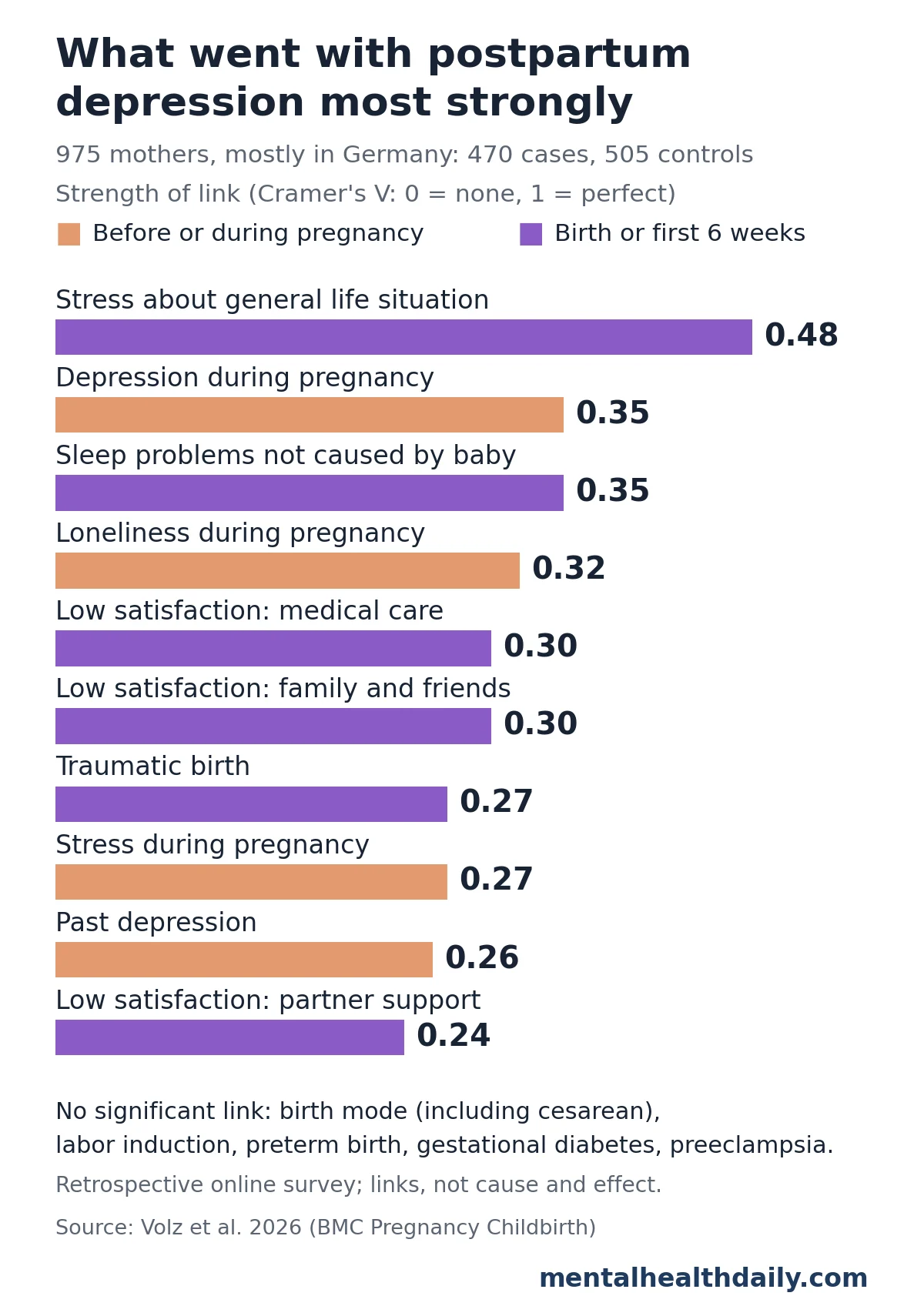
To quantify the strength of the links between various factors and PPD, the researchers employed Cramer’s V, a statistical measure ranging from 0 (indicating no link) to 1 (representing a perfect link). The study also applied a stringent cutoff for statistical significance to account for the extensive number of factors—a total of 53—being evaluated, ensuring that only truly robust associations were highlighted.
Key Findings: The Overwhelming Influence of Psychosocial Stressors
The results of the University of Freiburg study painted a clear picture: psychosocial stressors, rather than physical birth complications, emerged as the most potent predictors of postpartum depression.
Stress as the Foremost Predictor:
The strongest link identified in the study was "stress about one’s general life situation" in the first six weeks after birth, registering a Cramer’s V of 0.48. This overwhelming finding suggests that the broader context of a mother’s life—encompassing financial stability, relationship dynamics, work pressures, and daily demands—plays a more critical role in PPD onset than previously emphasized. Beyond general life stress, other related stressors also showed significant associations: stress stemming from one’s immediate surroundings (V = 0.30), financial worries (V = 0.19), and stress related to medical reasons (V = 0.19) were all considerably higher within the PPD case group. This multi-faceted understanding of stress underscores the need for a holistic approach to maternal mental health, extending beyond purely medical assessments.
The Echo of Prenatal Depression and Past Mental Health:
A mother’s mental health trajectory leading up to and during pregnancy proved to be another critical indicator. Depression during pregnancy exhibited a strong link to PPD (V = 0.35). In the case group, a striking 7.4% reported a clinical diagnosis of prenatal depression, with an additional 16.8% self-recognizing depressive symptoms during their pregnancy. These figures sharply contrast with the control group, where only 0.8% had a clinical diagnosis and 2.4% recognized symptoms. Furthermore, a past history of depression emerged as a significant risk factor, with 44.3% of mothers in the PPD group reporting a previous depressive episode, compared to 21.0% in the control group (V = 0.26). These findings reinforce the concept of a mental health continuum, where prior vulnerabilities significantly increase the risk of postnatal mood disorders.
Sleep Disturbances Unrelated to Infant Care:
Sleep problems, specifically those unrelated to the baby’s sleep patterns, were also strongly linked to PPD (V = 0.35). Nearly 35% of mothers in the PPD group experienced such sleep disturbances in the first six weeks, compared to only 6.5% of controls. While poor sleep is a recognized symptom of depression, it can also act as a trigger, creating a complex, bidirectional relationship. The study’s design, as an observational survey, could not definitively establish causality, highlighting an area for future longitudinal research.
Loneliness and Insufficient Support: A Cry for Connection:
During pregnancy, mothers who later developed PPD reported feeling significantly lonelier (V = 0.32) and more generally stressed (V = 0.27). They also expressed less confidence in the availability of support should they need it (V = 0.19) and rated their overall happiness during pregnancy lower (an average of 3.46 out of 5, compared to 3.99 for the control group).
The period following birth further amplified these support deficits. Mothers in the PPD group consistently reported lower satisfaction with support received across all sources, including partners, family and friends, and medical staff. While the study acknowledged that a mother experiencing depression might perceive the same level of help as less adequate, the consistent pattern across various support networks suggests a genuine gap in perceived assistance. The Cramer’s V values for low satisfaction with partner support (0.24), family and friend support (0.30), and medical care after birth (0.30) underscore the critical importance of a robust, reliable support system for new mothers.
The Psychological Impact of Traumatic Birth Experiences:
While medical birth factors themselves did not show a significant link, the experience of birth, particularly if perceived as traumatic, emerged as a substantial predictor. A significant 41.5% of mothers in the PPD group described their birth as traumatic, in stark contrast to 17.7% in the control group (V = 0.27). Furthermore, women with PPD reported lower satisfaction with how the birth unfolded (V = 0.23) and with their perceived control over crucial decisions during labor and delivery (V = 0.24). This finding highlights that the psychological and emotional experience of childbirth, rather than specific medical procedures, is a key determinant of postnatal mental well-being.
Dispelling Medical Myths: The Non-Link of Birth Mode and Other Factors
One of the most striking revelations of the Freiburg study was the absence of a significant statistical link between several common medical and biological factors and postpartum depression. Birth mode, including cesarean delivery (C-section), labor induction, preterm birth, gestational diabetes, and preeclampsia, showed no significant association with PPD in this large cohort. This finding offers crucial clarity, especially regarding C-sections, which are sometimes anecdotally or erroneously linked to increased PPD risk. The study suggests that while a C-section might be a challenging physical recovery, it is the psychological experience surrounding it, rather than the procedure itself, that might indirectly influence mental health.
Other factors like a family history of PPD, premenstrual syndrome (PMS), epidural use, and various breastfeeding factors showed only weak or non-significant links. It is important to note, however, that the survey did not measure biological markers such as hormones or inflammation, which are known to play a role in mood regulation, thus leaving open avenues for future research into the full biological underpinnings of PPD.
Consistency with Global Research and Study Limitations
The findings from the University of Freiburg largely align with a growing body of international research that emphasizes the psychosocial dimensions of PPD. Larger, longitudinal studies, such as the extensive Swedish registry study, have also pointed to the critical roles of past depression and inadequate social support. While the Swedish study did observe modest increases in PPD risk with gestational diabetes and, in women without a history of depression, with cesarean and instrument-assisted deliveries, the Freiburg team noted that their sample size of 975 mothers, while substantial, might not be large enough to detect such modest effects definitively. This nuance underscores the complex interplay of risk factors and the need for diverse research methodologies.
The researchers were candid about the inherent limitations of their study. As an anonymous online survey, it was susceptible to self-selection bias, meaning that participants might not be fully representative of the general population of new mothers in German-speaking countries. The reliance on long-term recall for some aspects of the survey also introduced potential for memory bias. Furthermore, as an observational study, it could establish correlations but not direct causation. However, the study’s innovative approach to identifying PPD cases—combining self-report with EPDS screening—helped to mitigate the issue of underdiagnosis, strengthening the validity of its findings regarding the prevalence of PPD. When the cases were split into self-reported PPD and EPDS-identified PPD, most of the main links held true for both groups, although they were generally stronger in the self-reported cohort.
Implications for Clinical Practice and Public Health Policy
The robust findings from this 2026 survey carry significant implications for healthcare providers, policymakers, and society at large. The revelation that approximately one in four mothers in the PPD case group experienced depressive symptoms before their baby arrived serves as a powerful call to action: routine depression screening during pregnancy should become standard practice. Tools like the EPDS can be effectively utilized during prenatal appointments, allowing for early identification and the initiation of crucial support mechanisms before symptoms potentially deepen and manifest as full-blown PPD after birth.
From a clinical perspective, midwives, obstetricians, and general practitioners should be equipped with the knowledge and resources to identify and address these psychosocial risk factors proactively. This involves not only asking about a woman’s mood but also inquiring about her support network, perceived loneliness, and general life stressors. Training healthcare professionals to recognize practical signals such as persistent low mood, loss of interest, anxiety, frequent crying spells, sudden bursts of anger, or difficulties bonding with the baby—even if not meeting full diagnostic criteria—is essential. These signals, while not definitive predictors for any single individual, warrant further investigation and professional guidance.
For public health policy, the study’s emphasis on support and loneliness suggests a need for enhanced community-based initiatives. This could include increased funding for postnatal support groups, mental health resources tailored for new parents, and educational programs aimed at partners, family members, and friends to better equip them to offer meaningful and effective support. Destigmatizing mental health issues in the perinatal period is also paramount, fostering an environment where mothers feel safe and empowered to seek help without fear of judgment.
Looking Ahead: A Holistic Approach to Maternal Well-being
The University of Freiburg’s 2026 survey marks a pivotal moment in understanding postpartum depression. By clearly demonstrating the overwhelming influence of psychosocial factors over medical interventions, it redirects the conversation towards a more holistic model of maternal well-being. While continued research into biological markers and other nuanced factors is undoubtedly necessary, the immediate takeaway is clear: supporting a mother’s mental health, fostering her social connections, and mitigating her life stressors during pregnancy and the postnatal period are not merely beneficial, but critically important in preventing and alleviating the burden of postpartum depression. This study serves as a powerful reminder that while the miracle of birth is a physical event, the journey of motherhood is profoundly psychological and social, demanding comprehensive support from conception through the crucial early months of a child’s life.

