

The proliferation of artificial intelligence tools, such as advanced chatbots like ChatGPT, into the daily lives of children has far outpaced the foundational research needed to guide parents, educators, and policymakers effectively. A pivotal review published in September 2026 in Frontiers in Psychology by Yaoyao Fan et al. exposes a critical deficit in the scientific understanding of AI’s impact on young learners, revealing that advice on managing children’s engagement with these powerful technologies is running well ahead of the available evidence. This comprehensive mini-review, which examined 46 studies concerning generative AI and learning, found a stark demographic imbalance: a mere eight of these studies included participants under the age of 18, and not a single one concurrently measured the influence of guidance from both home and school environments on the same students. This glaring gap highlights a pressing need for a concerted, multidisciplinary research effort to safeguard and optimize the developmental trajectories of a generation growing up immersed in AI.
The AI Tsunami and the Evidence Gap
The landscape of education and childhood development has been irrevocably altered by the meteoric rise of generative AI. Since the public unveiling of tools like OpenAI’s ChatGPT in late 2022, these sophisticated algorithms capable of generating human-like text, answering complex questions, and solving intricate problems on demand, rapidly permeated homes and classrooms worldwide. Initial reactions ranged from alarm and calls for outright bans, driven by concerns over plagiarism and the erosion of critical thinking, to enthusiastic advocacy for integration, promising personalized learning and enhanced creativity. This period of intense debate and rapid adoption, unfolding between 2022 and 2025, saw numerous educational institutions, parent associations, and technology advocacy groups scrambling to issue guidelines and best practices. Yet, as the Fan et al. review now firmly establishes, much of this guidance was necessarily speculative, built on anecdotal evidence, theoretical frameworks, or extrapolations from adult populations, rather than robust, child-specific empirical data. The speed of technological advancement created an unprecedented challenge for researchers, struggling to keep pace with real-world deployment and its complex implications for developmental psychology and pedagogical practice.
Unpacking the 2026 Review: A Scarcity of Child-Centric Data
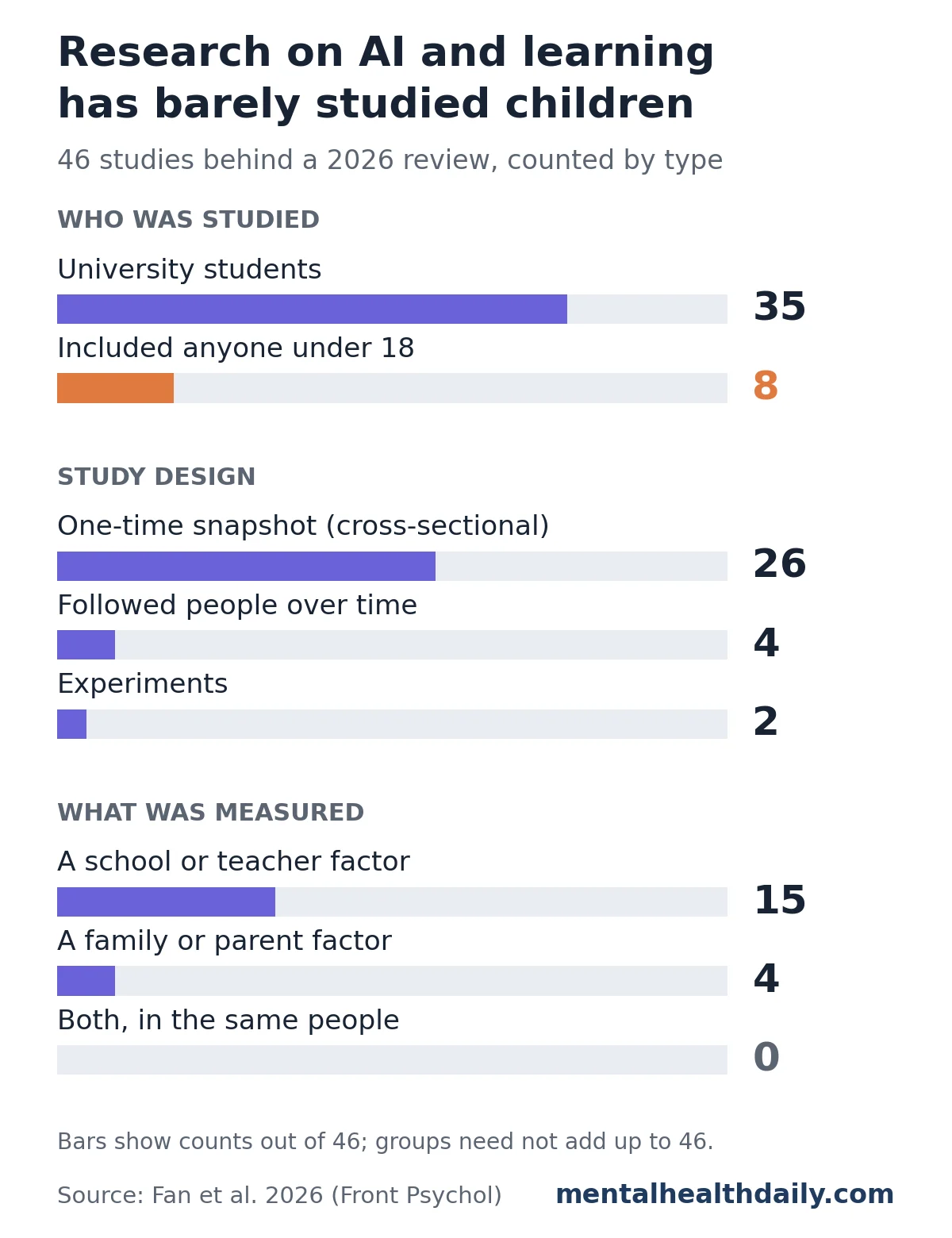
The mini-review conducted by Fan, et al., stands out not only for its timely focus but also for its meticulous methodology. Unlike many narrative reviews that synthesize findings without deep structural analysis, the researchers undertook a unique audit of the primary-data studies they cited. They systematically coded each of the 46 included studies based on crucial criteria: who was studied, how they were studied, and whether family or school factors were measured. This detailed audit yielded the most concrete and concerning results of the paper, vividly illustrating the current research chasm.
The demographic breakdown was particularly stark. Of the 46 studies reviewed, an overwhelming 35 sampled university students, rendering most existing insights applicable primarily to an adult or late-adolescent demographic already possessing developed cognitive and self-regulatory skills. The inclusion of only eight studies with participants under 18 means that the vast majority of recommendations pertaining to younger children, from primary school to early secondary, are extrapolations. Furthermore, the methodologies employed in these studies often lacked the rigor needed to establish causality or track developmental trajectories. A significant 26 studies were cross-sectional, capturing data at a single point in time, which can identify correlations but not definitively prove cause-and-effect relationships. Only four studies employed two or more waves of data collection, offering a glimpse into change over time, and a mere two were experimental designs, the gold standard for inferring causality.
Perhaps most critically, the audit revealed a profound segmentation in the study of influencing factors. While 15 studies measured aspects related to school or teachers (e.g., pedagogical approaches, classroom integration, teacher support), and four measured family or parent factors (e.g., parental attitudes, home guidance), not a single study measured both in the same participants. This absence means that researchers currently lack any empirical basis to understand if, how, or to what extent home and school guidance interact, reinforce, or even counteract each other in shaping a child’s interaction with AI. As the authors plainly state, any claim about children within their proposed framework is currently an untested hypothesis, and their integrated home-school model remains a blueprint awaiting empirical validation.
A Foundation for Understanding: Self-Determination Theory
To bridge the theoretical gap in AI guidance, Fan et al. grounded their review in self-determination theory (SDT), a venerable and widely supported framework in motivational psychology. SDT posits that individuals thrive and maintain intrinsic motivation when three fundamental psychological needs are met: competence (feeling effective and capable), autonomy (feeling a sense of ownership and choice over one’s actions), and relatedness (feeling connected and belonging to others).
Central to SDT is the concept of "autonomy support," a style of guidance designed to nurture these needs. An autonomy-supportive parent or teacher offers meaningful choices, genuinely considers the child’s perspective, and provides clear rationales for rules and expectations, rather than simply imposing them. This approach is distinct from permissive parenting or teaching; it is typically paired with "structure," which involves setting clear expectations, providing explicit help for skill development, and establishing firm, consistent limits. A landmark study involving 1,036 high school students powerfully demonstrated the efficacy of this combined approach: students whose teachers were perceived as both autonomy-supportive and clear about expectations exhibited the highest levels of motivation and self-regulated learning. Conversely, students with teachers rated low on both dimensions showed the poorest outcomes. Applying this robust framework to the context of AI, Fan et al. propose that a balanced approach, transcending mere detection and punishment, is essential. Their model advocates for transparent boundaries, coupled with comprehensive training in AI literacy, fostering critical reflection, verifying AI-generated output, and promoting ethical disclosure when AI assistance has been utilized. This nuanced strategy aims to cultivate judgment and responsible AI engagement, rather than just compliance.
Beyond Quantity: The Quality of AI Interaction
While the overall amount of AI use often sparks public concern, research, predominantly from studies involving older students and working adults, consistently indicates that the pattern or quality of AI interaction is far more consequential than mere quantity. These studies suggest a critical distinction between using AI as an active helper and passively delegating thinking processes to it. For instance, learners who leverage AI as a tool for brainstorming, refining ideas, or editing drafts tend to engage in deeper cognitive processing, leading to enhanced learning outcomes. They actively interrogate AI suggestions, integrate them into their own understanding, and thus strengthen their critical thinking and problem-solving skills. Conversely, individuals who rely on AI to generate complete texts, summarize complex information without critical engagement, or solve problems entirely for them, tend to exhibit superficial learning and reduced cognitive effort. This passive delegation can hinder the development of essential intellectual muscles, potentially fostering a dependency that undermines genuine understanding and skill acquisition. While these insights offer valuable hypotheses, the review underscores that their direct applicability to children, with their developing cognitive architectures and distinct learning needs, remains an open question, urgently requiring direct empirical validation within younger populations.
Fragmented Insights: School and Home Perspectives
The existing research, limited as it is, offers fragmented insights into AI guidance from the perspectives of schools and families, but crucially, never in concert.
On the School Side: Studies focusing on teacher-led initiatives or school environments were more prevalent, and a few did involve children. For example, research among German secondary students utilizing ChatGPT indicated that perceived teacher support was the strongest predictor of a healthy motivational and emotional profile in relation to AI use. Separately, primary-school learners participating in AI self-study rooms showed measurable gains in motivation, self-regulation, enjoyment, and engagement. These findings suggest that supportive pedagogical frameworks and structured AI integration can yield positive educational benefits. However, a significant limitation across all these school-focused studies was the complete absence of data regarding children’s experiences or guidance within their home environments, leaving a crucial piece of the puzzle unaddressed.
On the Family Side: Evidence is considerably thinner and largely descriptive. The four identified family-focused studies were primarily qualitative, cross-sectional, or mixed-method in design. Notably, three of these four studies surveyed or interviewed parents rather than directly engaging children, offering an indirect perspective. These studies revealed several themes: parents frequently expressed a desire for clear guidance from schools regarding AI use; many viewed AI tools as potential educational tutors or homework helpers; concurrently, they voiced concerns about plagiarism, misinformation, and the potential for AI to undermine genuine learning. Some parents also reported using AI to assist with their children’s schoolwork or to facilitate creative tasks. Despite these valuable insights into parental perceptions and practices, none of these four family studies gathered any data pertaining to school or teacher factors, creating a parallel blind spot. The consequence is a research landscape divided, with separate silos of understanding that cannot yet inform a holistic strategy for child development in the AI era.
The Untested Synergy: Home and School Guidance
A pervasive assumption underpinning many contemporary guidelines for children’s AI use is that guidance from home and school environments operates in a mutually reinforcing, synergistic manner. This idea, while intuitively plausible, remains entirely untested in the context of AI. General educational research offers some supportive evidence; a meta-analysis of 117 studies, for instance, demonstrated that family-school partnership programs significantly improved children’s social-behavioral skills and mental health, with effective communication and strong parent-teacher relationships identified as key ingredients. However, as the Fan et al. review unequivocally states, no comparable body of evidence exists specifically for AI use, rendering current assumptions about coordinated guidance speculative at best.
The researchers articulate three competing models for how home and school support might combine to influence children’s AI engagement:
- Independent Effects: Home and school guidance each exert their own distinct influence, but do not significantly interact.
- Compensatory Effects: Strong guidance in one domain (e.g., school) can compensate for weaker guidance in the other (e.g., home), or vice-versa.
- Synergistic Effects: Home and school guidance reinforce and amplify each other, leading to outcomes greater than the sum of their individual parts.
Distinguishing between these models is not merely an academic exercise; it has profound implications for policy and practice. Achieving such clarity would necessitate robust research designs that measure the same children’s experiences and behaviors with AI in both home and school settings. Furthermore, such studies should move beyond self-report data, incorporating observational or behavioral measures of actual AI usage. The most rigorous test would involve a randomized controlled trial comparing different intervention strategies: family-only guidance, school-only guidance, truly coordinated home-school guidance, and a business-as-usual control group. Without such targeted investigations, efforts to foster responsible and beneficial AI use among children will continue to operate in an evidence vacuum.
The Path Forward: Urgent Calls for Robust Research
The findings of the 2026 Fan et al. review are a clarion call for an immediate and significant redirection of research efforts. The current state of knowledge is insufficient to inform the vital decisions being made daily by parents, educators, and policymakers. The researchers outline several critical avenues for future investigation:
- Longitudinal Studies: To understand the long-term developmental impacts of AI use, tracking children over extended periods is essential. This would allow researchers to observe how different patterns of AI engagement correlate with academic achievement, socio-emotional development, and skill acquisition over time.
- Experimental Designs: Rigorous experimental studies are urgently needed to establish causal links between specific guidance strategies (e.g., autonomy-supportive approaches, AI literacy training) and children’s learning outcomes, motivation, and responsible AI use.
- Inclusion of Children Across Age Groups: Future research must prioritize the direct study of children and adolescents across a broad age spectrum, rather than extrapolating from adult populations. This includes early primary, middle school, and early high school students, recognizing their distinct cognitive and emotional developmental stages.
- Concurrent Measurement of Home and School Factors: To understand the interplay between environments, studies must be designed to simultaneously collect data on guidance, attitudes, and behaviors within both family and school contexts for the same participants.
- Behavioral Data Collection: Moving beyond self-report surveys, researchers should incorporate direct observation, digital ethnography, and logging of actual AI usage patterns to provide a more objective and nuanced understanding of how children interact with these tools.
- Interdisciplinary Collaboration: Addressing this complex challenge will require collaboration across fields, including educational psychology, computer science, developmental psychology, sociology, and public policy, to develop holistic research designs and solutions.
Navigating the Unknown: Practical Advice for Stakeholders
Despite the significant research gaps, the Fan et al. review offers crucial, evidence-informed guidance for parents and teachers based on existing motivational theories and the limited findings available:
- Focus on How Children Use AI, Not Just How Much: The review’s central practical goal is to foster "calibrated delegation." This means guiding children to understand when AI can effectively support their thinking (e.g., as a brainstorming partner, an editor), when they should tackle problems independently to develop their own skills, and how to critically check AI output for accuracy and bias. Crucially, it involves teaching them the importance of transparently disclosing when AI assistance has been utilized.
- Pair Choice with Clear Limits: Drawing on decades of motivation research, even if not yet specifically tested for AI, the principles of self-determination theory are highly relevant. Parents and educators should explain the reasoning behind AI-related rules, offer children meaningful choices within those boundaries (e.g., choosing which AI tool to use for a specific task, or how to phrase a prompt), and consistently teach them to verify AI-generated information. This approach cultivates intrinsic motivation and fosters responsible autonomy, rather than mere compliance.
- Treat Confident Advice with Care: Acknowledge that any guidance claiming definitive knowledge about how home and school should coordinate their AI strategies for children is currently operating ahead of the research. While many guidelines are well-intentioned, the studies required to validate these integrated approaches simply have not yet been conducted. Parents and educators should remain critical consumers of advice, prioritizing principles of critical thinking, responsible use, and open communication over rigid, untested prescriptions.
Limitations and the Road Ahead
It is important to acknowledge the inherent limitations of the Fan et al. review itself. As a "mini review" or narrative synthesis, it did not undergo the exhaustive, systematic search and rigorous meta-analysis typically associated with a full systematic review. This means that while comprehensive within its scope, it may not have captured every single relevant study. However, this limitation does not diminish the profound significance of its core finding: the glaring and dangerous deficit in child-centric, integrated research on AI use.
The rapid evolution of AI demands an equally rapid, yet scientifically sound, response from the research community. Without robust, longitudinal, and interdisciplinary studies that specifically focus on children, their developmental needs, and the complex interplay of home and school environments, the societal and educational implications of AI will continue to unfold largely unmonitored and unguided. The 2026 review serves as an urgent call to action, reminding us that the future of a generation’s learning and well-being hinges on our collective commitment to evidence-based understanding in the age of artificial intelligence.

