

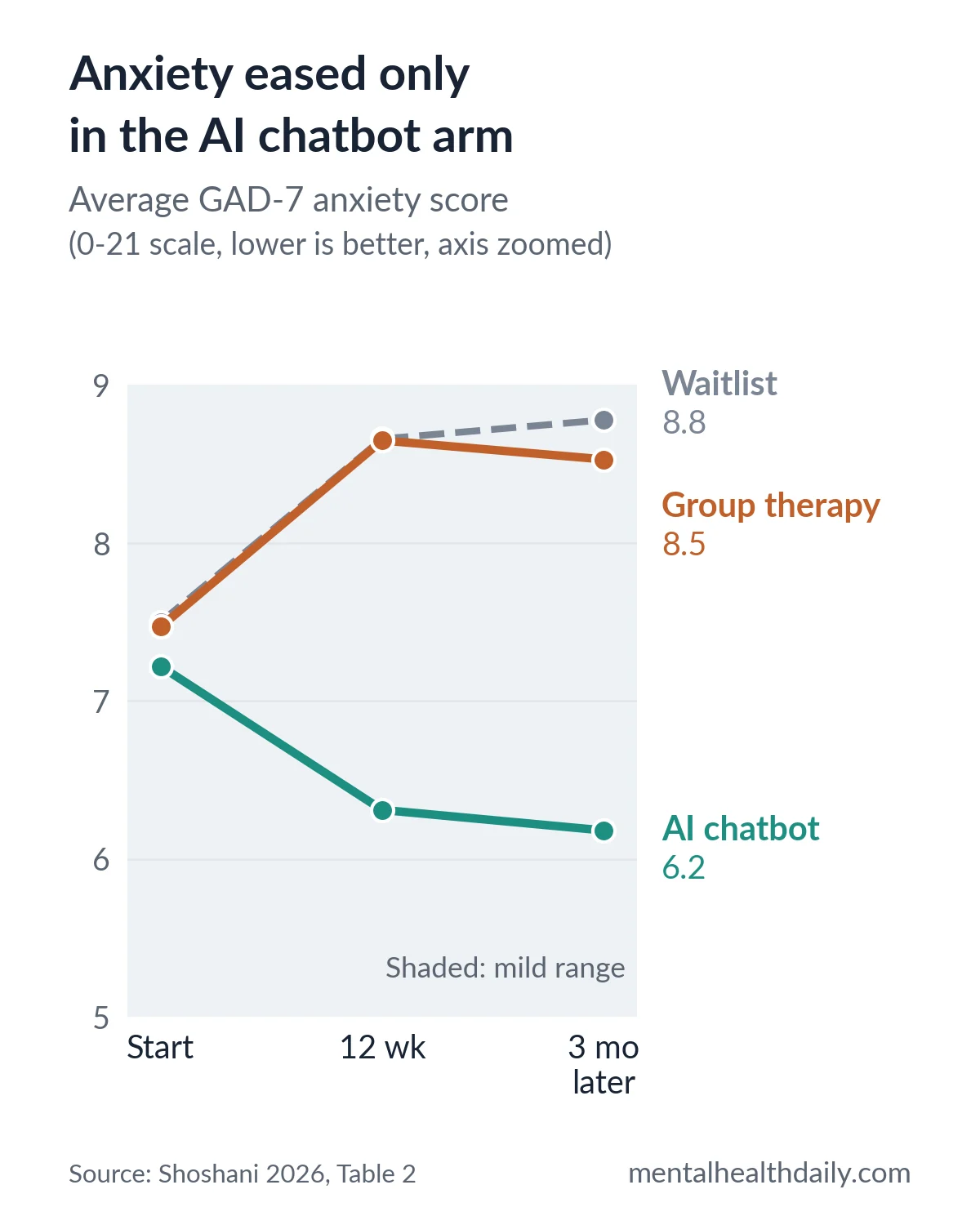
A groundbreaking randomized trial involving 977 university students in Israel has revealed that participants using an AI chatbot for 12 weeks experienced anxiety scores approximately two points lower than those attending weekly group therapy sessions. This significant gap persisted three months post-intervention, largely because anxiety levels tended to rise in both the group therapy and waitlist arms, while chatbot users maintained or slightly improved their scores. This study marks a pivotal moment in the discourse surrounding digital mental health solutions, directly comparing an AI-driven tool against an active, human-led therapeutic intervention rather than the more common comparison against passive control groups.
Addressing a Growing Crisis: Mental Health on Campuses
The landscape of mental health among university students globally presents an escalating challenge. Decades of research and contemporary surveys consistently highlight a significant rise in reported anxiety, depression, and stress among young adults pursuing higher education. Factors such as academic pressure, financial strain, social adjustments, and future uncertainties contribute to this pervasive issue. According to various national mental health organizations, a substantial percentage of university students experience mental health conditions, with many not receiving adequate support due to barriers like stigma, cost, lack of access to qualified professionals, and long waiting lists for services. In this context, innovative and scalable solutions are urgently needed to bridge the treatment gap and provide timely support to a vulnerable population. The Israeli study, conducted amidst a backdrop of chronic sociopolitical conflict, further underscores the heightened distress levels that students may experience, making the search for effective interventions even more critical.
The Trial Design: A Direct Comparison of Digital vs. Human Support
Unlike many previous studies that pit AI chatbots against minimal interventions like waitlists or self-help reading assignments, the Israeli trial, led by Shoshani et al., adopted a more rigorous approach. It included a human-led arm consisting of 12 weeks of group therapy facilitated by licensed clinical psychologists. This design positioned the study as a direct, large-scale test of an AI therapy chatbot’s efficacy against active, human-delivered treatment, offering more robust insights into its potential role in mental healthcare. Data collection for this comprehensive study commenced in April 2025 and concluded in early 2026, positioning the reported findings as highly current.
The study stratified students into three distinct groups:
- AI Chatbot Arm: Participants engaged with Kai, a commercial emotional-support system developed by Kai.AI. This specialized chatbot operates within popular messaging platforms like WhatsApp or iMessage. It is distinct from general-purpose AI models like ChatGPT, featuring dedicated components for emotion detection, user intent classification, structured therapeutic exercises, and open conversation generation. Kai’s architecture is built upon fine-tuning, controlled prompts, and a curated library of evidence-based therapy exercises, ensuring a focused and guided user experience. Students in this arm received daily check-ins, weekly therapy modules, and 24/7 on-demand support.
- Group Therapy Arm: This group participated in 12 weekly 90-minute in-person sessions. Each group comprised approximately 20 students and was led by a licensed clinical psychologist. The therapeutic approach was described as "integrative," drawing from various established modalities including Cognitive Behavioral Therapy (CBT)-style thought challenging, Acceptance and Commitment Therapy (ACT) and Dialectical Behavior Therapy (DBT) skills, relaxation and breathing techniques, gratitude exercises, and peer-to-peer open sharing.
- Waitlist Arm: This served as a control group, receiving no active intervention during the trial period but granted access to either the chatbot or group therapy program afterward.
Crucially, both the Kai chatbot and the group therapy program incorporated similar therapeutic toolkits. The fundamental difference lay in the delivery mechanism: the omnipresent, personalized access of a smartphone-based chatbot versus the fixed, weekly, group-oriented setting requiring physical attendance.
Anxiety Reduction: A Clear Advantage for the Chatbot
The primary outcome measured was anxiety, assessed using the Generalized Anxiety Disorder-7 (GAD-7) scale, a 7-question survey scored from 0 to 21. Scores between 5 and 9 indicate mild anxiety, while 10 or higher typically warrants further clinical evaluation.
Following the 12-week intervention period, students utilizing the Kai chatbot demonstrated an average GAD-7 score 2.10 points lower than those in the group therapy arm (95% CI 1.60 to 2.59 points). This advantage was mirrored when compared to the waitlist group, with chatbot users scoring 2.08 points lower. Interestingly, the group therapy and waitlist arms showed no statistically significant difference in anxiety scores (p = 1.00), suggesting the group therapy in this specific format did not prevent anxiety from increasing, unlike the chatbot. The positive trend for chatbot users was sustained at the three-month follow-up, with their anxiety scores remaining 1.58 points lower than the group therapy arm and 2.01 points lower than the waitlist.
A deeper analysis revealed the nuanced source of this 2-point disparity. Chatbot users experienced a modest improvement, with their average anxiety scores decreasing by 0.9 points (a small within-group effect size, d = 0.20). In stark contrast, participants in both the group therapy and waitlist arms saw their anxiety levels worsen, increasing by approximately 1.2 points on average. This finding suggests that the chatbot’s primary benefit was not a dramatic reduction in anxiety for its users, but rather its capacity to prevent the upward drift of anxiety observed in the comparison groups during the study period. While the paper does not definitively explain this rise in anxiety among the comparison arms, the authors acknowledge the potential influence of chronic sociopolitical conflict in Israel on general distress levels during the data collection period.
For students who began the trial with clinically elevated anxiety (a GAD-7 score of 10 or higher), the chatbot’s impact was even more pronounced. By week 12, 50.9% of chatbot users who started above this threshold had dropped below it, compared to 19.8% in the group therapy arm and 17.0% in the waitlist group. This translates to a significantly higher rate of individuals moving out of a clinically concerning anxiety range. At the three-month follow-up, the chatbot maintained its lead, with 50.9% still below the threshold, versus 20.6% for group therapy and 14.5% for the waitlist, although approximately one-third of participants in each arm had ceased responding to surveys by this point. It’s important to note that "crossing a cutoff" could mean a small shift (e.g., from 10 to 9), so these percentages may slightly overstate the magnitude of individual change.
Mixed Results for Other Mental Health Outcomes
While the chatbot demonstrated a clear advantage in reducing anxiety, its effectiveness across other mental health measures was not uniform:
- Depression: Using the PHQ-9 scale, the chatbot group showed a slight improvement over the waitlist at 12 weeks, but no significant difference compared to the group therapy arm. The average depression score for chatbot users decreased by 0.9 points, a modest shift given that a drop of 5 or more points is typically considered clinically meaningful.
- Post-Traumatic Stress Disorder (PTSD): No significant differences were observed across any of the three study arms for PTSD symptoms.
- Well-being: The chatbot users reported higher levels of well-being compared to the waitlist group at 12 weeks. This advantage extended to the group therapy arm at the three-month follow-up, indicating a sustained positive impact on overall well-being.
These varied outcomes highlight that AI chatbots may offer targeted benefits for specific conditions or aspects of mental health, rather than a universal panacea. For mildly distressed students, the observed shifts were generally modest, suggesting prevention of worsening rather than dramatic recovery.
Contextualizing the "Beat Group Therapy" Claim
While the findings are compelling, it is crucial to interpret the claim that the chatbot "beat group therapy" with appropriate context and nuance. Several design features and inherent limitations of the trial constrain the generalizability of this result:
- Group Size and Format: The group therapy arm comprised large groups (around 20 students), which may dilute individual attention and engagement compared to a one-on-one interaction with a chatbot. Smaller, more intensive group therapy models might yield different results.
- Program Specificity: The group therapy was described as "integrative" and "brief," suggesting a broad approach rather than a highly specialized or intensive program tailored to specific anxiety disorders. The chatbot, while also drawing from various techniques, offered personalized, on-demand support.
- Mild Distress Levels: The student population in the study was generally mildly distressed. The efficacy of chatbots versus human therapy might differ significantly for individuals with severe or complex mental health conditions.
- Fidelity of Group Therapy: The study did not report on the fidelity or adherence of the group therapy delivery, meaning it’s unclear how consistently the therapeutic protocols were applied.
- Trial Design Limitations: No equivalence or non-inferiority tests were conducted. These specific statistical designs are necessary to formally claim that two treatments are equally effective or that one is not worse than the other. Thus, the most accurate summary is that for mildly distressed, previously untreated students, this particular chatbot reduced anxiety relative to both a large, brief group program and no treatment.
- Financial Interests: Kai.AI, the developer of the chatbot, had a financial incentive in the study’s outcome, as one of the authors was associated with the company. While this does not invalidate the findings, it is a common point of scrutiny in industry-sponsored research.
Notably, the trial did not compare the chatbot against individual therapy, which is often considered the gold standard for many mental health conditions. Such a comparison would be a vital next step in understanding the full therapeutic landscape.
Who Benefits Most? The Role of Relational Traits and Engagement
A key question addressed by the researchers was who stood to benefit most from the AI chatbot. They examined three baseline relational traits: loneliness, anxious attachment, and avoidant attachment.
- Loneliness: This proved to be the most significant predictor. For students reporting high levels of loneliness, the chatbot’s estimated anxiety benefit over the comparison arms was 2.92 GAD-7 points, substantially higher than the 1.14 points for those with low loneliness. Loneliness also amplified the chatbot’s effects on depression (2.11 vs. 1.23 points) and overall well-being.
- Attachment Styles: The chatbot also showed greater efficacy for individuals with high anxious attachment (2.60 vs. 1.55 points) and high avoidant attachment (2.41 vs. 1.99 points) in reducing anxiety. This finding for avoidant attachment was particularly noteworthy, as it ran counter to initial expectations that individuals who tend to keep others at a distance might distrust AI. The authors hypothesized that the inherent anonymity and non-judgmental nature of a chatbot could lower barriers to engagement for those with avoidant tendencies.
- Social Support: Similarly, students with low social support benefited more from the chatbot (2.65 vs. 2.11 points for anxiety reduction).
The link between these relational traits and improved outcomes appeared to be mediated by user engagement. Lonelier students, for instance, used the Kai chatbot considerably more: the 51 most lonely participants wrote approximately 2,490 words per week and spent 124 minutes interacting with it, compared to 1,217 words and 61 minutes for the 71 least lonely. Within the chatbot arm, a higher number of messages sent directly correlated with greater anxiety reduction. Once message count was factored in, loneliness and attachment styles no longer independently predicted outcomes, suggesting that the level of engagement was a key driver of the therapeutic effect. However, the researchers caution that this is a correlational finding, not proof of causation. It is possible that students who were already beginning to feel better engaged more, or that heavy users possessed other unmeasured characteristics that contributed to their improvement. Furthermore, this mediation model was a post-hoc analysis, not preregistered, and exhibited only borderline statistical fit, necessitating further validation.
These findings also invite comparison with other research. For example, an MIT/OpenAI study on general-purpose chatbots found that heavier voluntary use was associated with worse loneliness and dependence outcomes. This contrast might be attributed to the specific design of the tools: Kai is purpose-built for emotional support with structured therapy exercises and prompts encouraging real-world relationship engagement, whereas the MIT/OpenAI study explored a general conversational AI. The long-term implications of heavy chatbot use on human connection remain an open question, as Kai’s trial concluded after three months.
Benchmarking Against the Broader Chatbot Landscape
The results of the Kai trial can be contextualized by comparing them to the broader literature on AI chatbots in mental health:
- Typical Effects: A 2026 meta-analysis encompassing 48 randomized trials and 28,071 participants found that conversational agents generally produce small effects, reducing depression by a standardized mean difference of 0.27 and anxiety by 0.20. Kai’s 2.1-point anxiety gap translates to roughly 0.4 standard deviations, placing it on the higher end of these reported effects, albeit largely due to the worsening of comparison groups.
- Earlier Student Data (Woebot, 2017): A 2017 trial of Woebot, a scripted CBT chatbot, involving 70 students, showed a reduction in depression compared to a depression e-book, but no clear difference in anxiety. This highlights how different chatbots, even with similar therapeutic underpinnings, can yield varied results. It’s worth noting that one of Woebot’s authors also had a conflict of interest with the developer.
- Sicker Samples (Therabot, 2025): The 2025 Therabot trial, which included 210 adults with clinical-level depression, anxiety, or eating disorder risk, demonstrated larger effects. PHQ-9 depression scores fell by 6.1 points with Therabot versus 2.6 points on the waitlist, yielding substantial effect sizes (d = 0.85-0.90 for depression, 0.79-0.84 for anxiety). However, Therabot was compared against a waitlist, and its authors specifically called for trials against active treatments, a challenge the Kai study has now partially addressed.
Collectively, the research suggests that chatbots tend to produce small effects against weak comparators in mildly symptomatic individuals, larger effects in more symptomatic populations, and, in the case of Kai, a significant anxiety advantage over a human-led group. The absence of a large-scale trial comparing AI chatbots to individual human therapy remains a critical gap in the evidence base.
Safety Protocols and a Critical Reporting Gap
Safety is paramount when deploying AI in mental health, particularly given the vulnerability of individuals seeking support. The Kai trial proactively addressed this by excluding acutely suicidal individuals at baseline. Furthermore, Kai implemented several layers of protection:
- Screening: Initial screening to identify high-risk individuals.
- Crisis Team: A human crisis intervention team on standby.
- Keyword Detection: AI-driven detection of crisis-related keywords.
- Proactive Outreach: Automated and human-initiated outreach when potential crisis situations were identified.
However, a significant omission in the published paper is the complete lack of quantitative data regarding these safety measures. The report does not specify how many conversations were flagged, how frequently clinicians intervened, or whether any adverse events occurred. This absence of data leaves a critical gap in understanding the practical implementation and effectiveness of Kai’s safety protocols.
For context, the Therabot trial, which involved 106 users over four weeks, reported that clinicians reviewed every chatbot reply and intervened 15 times for safety concerns (such as suicidal ideation) and 13 times to correct inappropriate chatbot responses. Given that the Kai arm involved 329 users over 12 weeks, it is highly probable that at least some conversations would have triggered safety flags or required human intervention. The failure to report these numbers is a serious oversight that limits transparency and raises questions about the full safety profile of the system.
Implications and Future Outlook
The Israeli trial offers valuable insights for students seeking mental health support and for the broader mental healthcare ecosystem:
For Students:
- A Viable Option for Mild Anxiety: For university students experiencing mild anxiety, particularly those who identify as lonely or struggle with anxious or avoidant attachment, AI chatbots like Kai may offer an accessible and effective first line of support.
- Not a Replacement for Severe Conditions: It is crucial to understand that these chatbots are not a substitute for professional individual therapy, especially for severe mental health conditions, complex trauma, or acute suicidal ideation.
- Engagement Matters: The findings suggest that active and consistent engagement with the chatbot correlates with better outcomes.
Broader Impact and Implications:
- Increased Accessibility and Scalability: AI chatbots hold immense potential to democratize mental health support. They offer 24/7 availability, discreet access, and can be scaled to reach large populations, potentially overcoming barriers of cost, stigma, and therapist shortages. This could be particularly impactful in regions with limited mental health infrastructure.
- Cost-Effectiveness: While initial development costs can be high, the per-user cost of an AI chatbot is likely significantly lower than traditional human-led therapy, making it an attractive option for public health initiatives and university wellness programs.
- Hybrid Models of Care: The future of mental health may increasingly involve hybrid models where AI chatbots serve as an initial screening tool, a supplementary support system alongside human therapy, or a stepping stone for those hesitant to engage with traditional services.
- Ethical Considerations and Regulation: The rise of AI in mental health necessitates robust ethical frameworks and regulatory oversight. Concerns about data privacy, algorithmic bias, the potential for emotional over-reliance on non-human entities, and the limitations of AI empathy must be carefully addressed. Clear guidelines for development, deployment, and monitoring of these tools are essential to ensure patient safety and efficacy.
- Need for Further Research: Despite its strengths, this trial highlights the need for continued rigorous research. Future studies should focus on:
- Direct comparisons with individual human therapy.
- Longer-term follow-up periods to assess sustained effects and potential for dependency.
- Trials involving more diverse and severely symptomatic populations.
- Transparent reporting of safety data, including all flagged conversations, human interventions, and adverse events.
- Exploration of optimal group therapy formats and sizes for comparison.
In conclusion, the Israeli study represents a significant step forward in validating the potential of AI chatbots in mental health. While it does not declare AI superior to all forms of human therapy, it strongly suggests that well-designed, specialized chatbots can offer meaningful anxiety relief, particularly for vulnerable student populations, and can even outperform certain group-based interventions. The nuanced findings underscore the complexity of mental health treatment and point towards a future where technology plays an increasingly integrated and carefully considered role in supporting well-being.

