

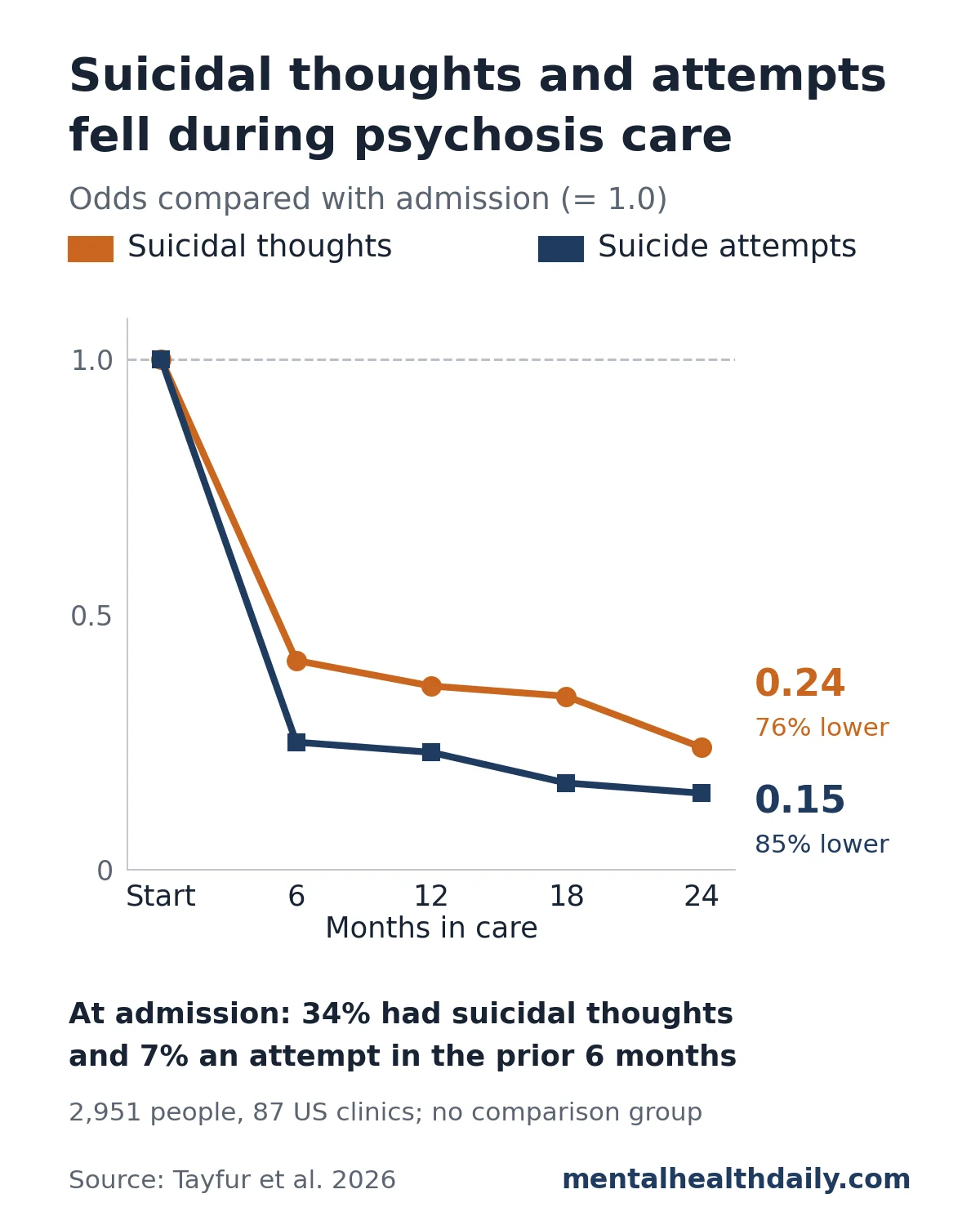
A comprehensive analysis from the Early Psychosis Intervention Network (EPINET) reveals a substantial reduction in suicidal thoughts and attempts among young people experiencing their first episode of psychosis within two years of receiving coordinated specialty care (CSC). The study, which gathered data from 2,951 individuals across 87 community clinics in 15 U.S. states between 2019 and 2024, found that the odds of reporting suicidal thoughts plummeted by 76% and suicide attempts by 85% over a two-year period of care. While these declines are significant, researchers caution that without a comparison group, the improvements cannot be solely attributed to the care provided, suggesting a combination of treatment efficacy and the natural easing of acute symptoms. The findings, published in 2026, underscore the critical importance of early intervention but also highlight ongoing challenges in understanding and mitigating suicide risk in this vulnerable population.
Understanding First-Episode Psychosis and Its Urgent Risks
Psychosis is a severe mental disorder characterized by a loss of contact with reality, manifesting through hallucinations, delusions, and disorganized thinking or behavior. A "first-episode psychosis" (FEP) marks the initial presentation of these symptoms, often occurring in adolescence or early adulthood, a critical developmental period. The onset of FEP is a profoundly distressing and disorienting experience, not only for the individual but also for their families. It can disrupt education, employment, and social relationships, leading to immense psychological distress.
The period immediately following the onset of psychosis is recognized as one of the highest-risk times for suicide. Individuals may grapple with terrifying hallucinations, intense paranoia, or the traumatic experience of hospitalization. They are also often trying to comprehend the implications of a diagnosis like schizophrenia for their future. Research consistently shows that the suicide rate after FEP is alarmingly high, with the first year post-presentation being particularly dangerous. A large, long-term cohort study cited by the researchers confirmed this, emphasizing the urgency of effective interventions during this vulnerable phase. The profound fear, confusion, and social isolation that can accompany FEP contribute to a heightened sense of hopelessness, making targeted support crucial.
The Emergence of Coordinated Specialty Care (CSC)
In response to the critical need for effective interventions during FEP, Coordinated Specialty Care (CSC) emerged as a gold-standard treatment model in the United States. CSC is a team-based, recovery-oriented program typically lasting around two years. Its multidisciplinary approach integrates several evidence-based components:
- Medication Management: Careful prescribing and monitoring of antipsychotic medications to manage symptoms, often at the lowest effective doses.
- Individual Resiliency Training (Psychotherapy): Cognitive Behavioral Therapy (CBT) and other psychotherapeutic approaches to help individuals develop coping skills, manage symptoms, and improve social functioning.
- Family Education and Support: Providing families with information about psychosis, helping them understand the illness, and offering strategies for support and communication. This component is vital, as family involvement significantly impacts recovery outcomes.
- Supported Employment and Education (SEE): Practical assistance to help individuals return to school or work, fostering a sense of purpose and social reintegration.
- Case Management: A central point of contact who helps coordinate all aspects of care, navigate services, and address practical needs.
The underlying philosophy of CSC is that by addressing multiple facets of an individual’s life—biological, psychological, social, and functional—it can facilitate recovery, improve quality of life, and prevent long-term disability. CSC programs are designed to be patient-centered, empowering individuals to take an active role in their treatment decisions and recovery journey. The development and implementation of CSC represent a significant shift from traditional, often fragmented, mental health services towards a more holistic and integrated approach, aiming to catch and treat psychosis early before it can cause more profound and lasting damage.
EPINET: A National Learning Health System for Early Psychosis
The Early Psychosis Intervention Network (EPINET), launched in 2019, represents a landmark effort to standardize and improve CSC across the United States. EPINET is designed as a national learning health system, linking CSC programs across various states into a unified network. The core innovation of EPINET is its commitment to collecting routine clinical data in a standardized format across all participating clinics. This uniform data collection allows programs to systematically learn from their collective outcomes, identify best practices, and continuously refine their approaches.
Every EPINET clinic utilizes a shared core assessment battery at admission and then every six months thereafter. This consistent data capture is crucial for understanding treatment trajectories, identifying effective interventions, and recognizing areas for improvement. The study by Tayfur et al. analyzed consecutive admissions from 2019 to 2024 within 87 community clinics across 15 states, describing this as the largest real-world, multisite U.S. CSC cohort. The sheer scale and standardized nature of the EPINET data provide an unprecedented opportunity to examine outcomes for young people with FEP receiving CSC in real-world settings. This contrasts with earlier, smaller studies or randomized controlled trials, offering insights into the effectiveness of CSC as it is actually delivered.
A critical clinical variable tracked in the study was the duration of untreated psychosis (DUP), defined as the time between the first clear psychotic symptoms and entry into specialty care. Clinicians estimated DUP based on patient and family reports and medical records. The median DUP in the cohort was six months, but a concerning quarter of participants had waited 16 months or longer before receiving specialized care. This prolonged delay in accessing treatment is a significant concern, as earlier intervention is generally associated with better outcomes, and longer DUP has been identified as a major risk factor for poorer prognosis and increased suicidal behavior.
Key Findings: A Significant Decline in Suicidal Ideation and Attempts
The EPINET study meticulously tracked changes in suicidal thoughts and attempts over two years of CSC. At each visit, clinicians inquired whether the person had experienced suicidal thoughts or made a suicide attempt since the last assessment (or in the preceding six months at admission). The results demonstrated a dramatic and statistically significant reduction in both indicators:
- Suicidal Thoughts: Compared with admission, the adjusted odds of reporting suicidal thoughts were 59% lower at 6 months (odds ratio 0.41) and approximately 76% lower at 24 months (odds ratio 0.24).
- Suicide Attempts: For attempts, the adjusted odds were 75% lower at 6 months (odds ratio 0.25) and about 85% lower at 24 months (odds ratio 0.15).
Every time point assessed (6, 12, 18, and 24 months) showed a significant difference from admission (p < 0.001), indicating a consistent pattern of improvement. The study utilized odds ratios to quantify these changes. An odds ratio of 0.24 for suicidal thoughts at 24 months, for instance, means that the odds of an individual reporting suicidal thoughts at that point were roughly one-quarter of what they were at the time of admission.
Crucially, the "shape of the curve" for these declines is highly informative. Most of the reduction in suicidal thoughts and attempts occurred rapidly within the first six months of care, with a slower but continued decline thereafter. This pattern has been corroborated by findings from two other prominent U.S. CSC networks, indicating a consistent trajectory of early stabilization and improvement across different programs. While admission rates for suicidal thoughts and attempts can vary between networks due to differences in how questions are posed (e.g., clinician-rated vs. self-reported), the consistent direction of positive change over time across all three networks lends strong support to the general efficacy of early intervention.
Nuance and Limitations: Attributing the Decline
Despite the compelling decline in suicidal ideation and attempts, the researchers were careful to state that these reductions "cannot be causally attributed to CSC" alone. This critical caveat stems from the study’s design:
- Lack of a Comparison Group: All participants in the EPINET cohort received CSC. There was no control group receiving standard care or no care to serve as a baseline for comparison.
- Natural Course of Illness: The acute phase of psychosis often involves intense distress, including suicidal ideation. It is possible that some of the observed decline reflects a natural easing of acute symptoms as individuals stabilize, regardless of the specific treatment received.
- Selection Bias: Individuals who enter and remain in CSC programs may represent a subgroup that is more motivated for treatment, has better social support, or is experiencing a less severe form of illness, all of which could independently contribute to better outcomes.
- Regression to the Mean: Suicidal thoughts and attempts are often at their peak during the crisis phase that leads to seeking care. Over time, these elevated rates might naturally trend downwards.
However, comparison-group evidence from other studies helps to fill this analytical gap. A meta-analysis pooling studies that compared early-intervention programs with other forms of care found a roughly one-third lower odds of suicide death (adjusted odds ratio 0.66) and suicide attempts (0.66) in those receiving early intervention. For example, in a Hong Kong study, patients followed for 12 years after a 2-year early-intervention program had a suicide death rate of 4.4% compared to 7.5% in those receiving standard psychiatric care, with the difference concentrated in the initial three years.
These external findings suggest that while CSC undoubtedly contributes to reducing suicide risk, the dramatic 76-85% drop observed within EPINET likely represents a combination of the therapeutic benefits of CSC and the natural course of recovery from an acute psychotic episode. The true "treatment effect" of CSC on suicide risk, while significant, is likely closer to the one-third reduction seen in controlled comparison studies. This nuanced understanding is vital for setting realistic expectations and for guiding future research into the specific mechanisms through which CSC impacts suicidal behavior.
Identifying High-Risk Populations and Tailoring Interventions
The EPINET study also identified specific factors associated with persistently higher risk for suicidal thoughts and attempts across the two-year follow-up period, offering crucial insights for clinical practice:
- Longer Duration of Untreated Psychosis (DUP): Each additional year of DUP was linked to an 11% higher odds of suicidal thoughts and an 8% higher odds of an attempt. This reinforces the urgent need for early detection and rapid access to care, as prolonged DUP is a known risk factor for poorer outcomes, including suicidal behavior. The RAISE-ETP trial further supports this, showing that individuals with a DUP under 74 weeks gained more in quality of life and symptom improvement from CSC.
- Prior Psychiatric Hospitalization: Individuals who had been hospitalized before entering CSC had a 72% higher odds of an attempt during follow-up and approximately four times the rate of attempts. This suggests greater illness severity in this subgroup, underscoring the need for intensive support.
- Previous Suicide Attempt: A history of a suicide attempt before admission was the strongest predictor of future attempts, with those individuals having about seven times the rate of attempts during follow-up. This finding is consistent with broader suicide research, where a past attempt is a powerful indicator of future risk.
- Younger Age: Each additional year of age was associated with a 4% lower odds of suicidal thoughts and an 8% lower odds of an attempt. This highlights that younger individuals entering FEP care may be at particularly elevated risk and require specialized attention.
- Sex Differences: Men had 36% lower odds of suicidal thoughts than women and about one-third the rate of attempts. However, all six suicide deaths in the cohort were men. This stark disparity aligns with global epidemiological data: women tend to report suicidal thoughts and attempts more frequently, while men more often die by suicide, possibly due to differences in methods chosen or willingness to seek help. The dataset’s lack of information on method or lethality of attempts prevents deeper explanation of this gap.
- Race and Ethnicity: White participants had 73% higher odds of suicidal thoughts than Black participants, and non-Hispanic participants 50% higher odds than Hispanic participants. Neither difference was significant for attempts. These findings are complex and may reflect variations in symptom reporting, pathways to care, cultural expressions of distress, or differences in clinician-patient interactions, which the current data could not fully elucidate. Other studies, like OnTrackNY, have shown different patterns, suggesting the need for more culturally nuanced research.
The Broader Picture: Six Deaths and Risk Beyond the 2-Year Window
Despite the significant reductions in suicidal ideation and attempts, the study recorded six suicide deaths (0.2%) among the participants during follow-up. While this rate is lower than some earlier first-episode cohorts, it is likely an undercount, as EPINET identifies deaths from discharge records, and many discharges occur because individuals simply lose contact with programs. Five of the six individuals who died by suicide had been hospitalized before entering CSC, reinforcing the "prior hospitalization" risk factor.
The 2-year care window characteristic of most CSC programs also leaves the longer-term suicide risk unmeasured within EPINET. An inception cohort study of 2,723 people followed from their first episode of psychosis found that 1.9% died by suicide, with the rate highest in the first year but a median time to suicide of 5.6 years. Crucially, risk remained almost four times the general-population rate a decade after initial contact. This long-term risk profile underscores that the completion of a 2-year CSC program is not a "finish line" but rather a crucial transition point. The handoff from intensive CSC to ordinary outpatient care requires careful planning and robust support to ensure continuity of care and ongoing risk mitigation.
Implications for Policy, Practice, and Families
The EPINET findings carry profound implications for various stakeholders:
- For Families: The most reassuring message is that suicidal thoughts are common at the outset of treatment for first-episode psychosis but tend to ease significantly in the months that follow. Families are encouraged to be vigilant for warning signs and to seek help immediately. Open communication with the care team about any suicidal ideation or distress is paramount. The study validates the importance of family involvement, a core component of CSC, in supporting recovery and safety.
- For Clinicians and Providers: The study highlights the effectiveness of CSC in reducing acute suicide risk. Clinicians should prioritize early engagement, especially for those with longer DUP, a history of prior hospitalization, or previous suicide attempts. Tailored interventions for younger individuals and an awareness of sex differences in risk presentation are also crucial. The rapid decline in risk within the first six months suggests that this period is a critical window for intervention and stabilization. Continuous monitoring for suicidal ideation and behavior is essential throughout the treatment trajectory and particularly during transitions of care.
- For Policy Makers and Healthcare Systems: The success of EPINET in standardizing data collection and demonstrating positive outcomes reinforces the value of national learning health systems. Continued funding and expansion of CSC programs are warranted, with an emphasis on reducing DUP through public awareness campaigns and improved referral pathways. Policies should also address the long-term support needs of individuals with FEP, ensuring that robust outpatient services are available beyond the initial 2-year CSC window to mitigate enduring suicide risk. Investing in mental health infrastructure that supports early identification and rapid access to integrated care models like CSC can significantly reduce individual suffering and societal burden.
Looking Ahead: The Future of Early Psychosis Intervention
The EPINET study represents a vital step forward in understanding and improving care for young people with first-episode psychosis. By establishing a national framework for data collection and analysis, it provides an invaluable platform for continuous learning and quality improvement. Future research should aim to conduct randomized controlled trials within this network to more definitively attribute causal effects to CSC. Further investigation into the specific mechanisms through which CSC reduces suicide risk, as well as culturally sensitive approaches to care, will also be crucial. Ultimately, the goal is to ensure that every young person experiencing psychosis receives timely, comprehensive, and compassionate care that empowers them toward recovery and a life free from the profound burden of suicidal distress.
If you or someone you know is thinking about suicide, call or text 988 in the U.S. to reach the 988 Suicide & Crisis Lifeline, or contact local emergency services.

