

The persistent criticism leveled by corporate interests against the scientific literature on nutrition, particularly the assertion that observational studies lack credibility, warrants a closer examination. While randomized controlled trials (RCTs) are undeniably the gold standard for evaluating interventions like pharmaceuticals, their application to dietary research presents significant practical and ethical challenges, necessitating a reliance on observational methodologies. The argument that observational data is inherently inferior often serves to undermine public health recommendations, particularly when those recommendations conflict with industry interests.
The Limitations of Randomized Controlled Trials in Dietary Research
Randomized controlled trials excel at establishing cause-and-effect relationships in controlled settings. For instance, when assessing a new medication, researchers can randomly assign participants to receive either the drug or a placebo, meticulously control other variables, and observe outcomes over a defined period. This rigorous approach minimizes bias and provides high-certainty evidence regarding efficacy and safety.
However, when it comes to diet, implementing such trials becomes exceedingly complex. Many diet-related diseases, such as cardiovascular disease and certain cancers, develop over decades. This necessitates exceptionally long-term studies, which are difficult and expensive to conduct. Furthermore, ethical considerations and practical realities preclude the use of placebo foods, as it is virtually impossible to create a truly inert dietary substitute that perfectly mimics the sensory experience of real food. Adherence to assigned diets over extended periods is also a significant hurdle; participants may struggle to maintain specific dietary regimens for years, especially when those regimens deviate substantially from their usual eating habits. The logistical and financial burden of conducting RCTs with dietary interventions that track hard endpoints like cancer incidence or mortality over decades is often prohibitive.
The Indispensable Role of Observational Studies
Given these limitations, observational studies have become a cornerstone of nutritional science. These studies involve monitoring large populations over extended periods, meticulously collecting data on their dietary habits and health outcomes. Researchers then analyze this data to identify associations between specific foods or dietary patterns and the incidence of various diseases. While observational studies cannot definitively prove causation, they can reveal strong correlations that serve as crucial signals for further investigation and inform public health policy.
Compelling evidence suggests that the findings from well-conducted observational studies often align remarkably with those from RCTs when direct comparisons are possible. A meta-analysis comparing data from observational population studies and randomized trials found little evidence of significant discrepancies in their findings. In approximately 90% of the treatments examined, the effects were not only in the same direction but also of the same general magnitude. This suggests that, despite their methodological differences, observational studies can offer reliable insights into the relationship between diet and health.
A notable historical example illustrating the interplay between observational and interventional research, and the importance of nuanced interpretation, is the case of hormone replacement therapy (HRT). Early observational studies suggested that women taking Premarin experienced fewer heart attacks. However, subsequent randomized controlled trials, such as the Women’s Health Initiative (WHI), revealed an increased risk of heart disease and stroke associated with HRT. A closer examination of the data revealed that the discrepancies were often rooted in the timing of HRT initiation relative to menopause. When this crucial factor was accounted for, the findings from observational studies and RCTs became more congruent, highlighting the importance of considering specific contextual factors in interpreting epidemiological data.
A Differentiated Standard of Evidence: Diet vs. Drugs
The argument for the questionable credibility of observational studies in nutrition is often amplified by industries whose products may be implicated by such research. However, a critical distinction exists between the level of certainty required for dietary recommendations and that for pharmaceutical interventions.
Prescription drugs are a leading cause of morbidity and mortality in developed nations. In the United States and Europe, iatrogenic causes, including adverse drug reactions, rank among the top causes of death. For instance, it is estimated that around 100,000 Americans die annually from the side effects of prescription drugs, even when taken as directed. Given these substantial risks, the demand for exceptionally high-quality, randomized, double-blind, placebo-controlled trials for pharmaceuticals is entirely justified. The potential benefits of a drug must demonstrably outweigh its significant risks, necessitating the most robust evidence available.
Conversely, recommending increased consumption of broccoli or reduced intake of soda does not carry the same inherent risks. While dietary advice aims to improve health and prevent disease, the potential for harm from such general recommendations is considerably lower than from potent pharmaceutical agents. Therefore, a less stringent standard of certainty, while still demanding rigorous scientific evidence, may be appropriate for informing dietary guidelines. The principle of "letting the perfect be the enemy of the good" is particularly relevant here; an overemphasis on unattainable levels of certainty for dietary advice could paralyze public health efforts and prevent beneficial recommendations from being implemented.
Corporate Influence and Methodological Misapplication
The critique of observational studies is often advanced by industries that benefit from the sale of products that may be linked to negative health outcomes. A notable instance involved a paper funded by the sugar industry, which concluded that dietary guidelines advising reduced sugar consumption were untrustworthy due to their reliance on "low-quality evidence." This approach represents a deliberate "inappropriate use of the drug trial paradigm in nutrition research."

The authors of such critiques often leverage established evidence-grading systems, such as the GRADE (Grading of Recommendations Assessment, Development and Evaluation) working group, which is primarily designed for evaluating evidence related to clinical interventions, particularly pharmaceuticals. While GRADE is a valuable tool, its strict application to nutritional science can be problematic, especially when it fails to account for the unique challenges of dietary research and potential funding biases.
Specialized tools have been developed to address these specific needs. NutriGrade, for example, is a scoring system designed to assess and rank the quality of evidence in nutrition research. A key feature of NutriGrade is its explicit consideration of funding bias, whereby industry-funded studies are down-rated. This highlights a potential conflict of interest: when industry-funded research employs methodologies that inherently disadvantage nutritional evidence, it raises questions about the objectivity of their criticisms.
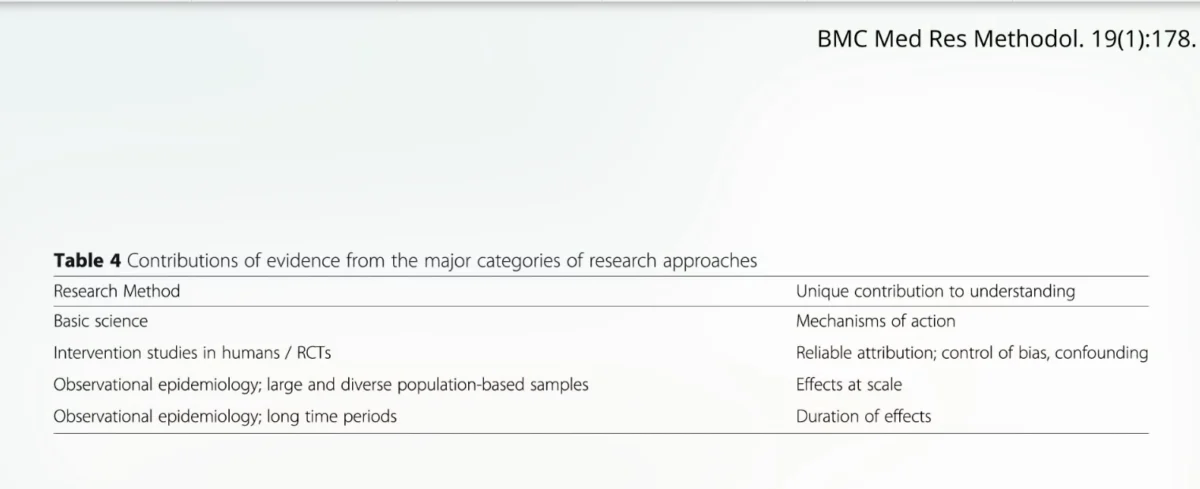
Another framework, HEALM (Hierarchies of Evidence Applied to Lifestyle Medicine), was created to address the limitations of existing tools like GRADE when dealing with research questions that cannot be fully answered by RCTs. HEALM acknowledges that each research methodology, from mechanistic laboratory studies to large-scale observational cohorts, contributes uniquely to our understanding of health and disease.
The Trans Fat Case Study: A Triumph of Combined Evidence
The success in addressing the public health threat of trans fats serves as a powerful testament to the value of integrating evidence from various research methodologies, including observational studies. Decades of research, encompassing both randomized controlled trials and extensive population-based observational studies, established a robust case for the detrimental effects of trans fat consumption on cardiovascular health. RCTs demonstrated that trans fats could negatively impact key risk factors for heart disease, such as cholesterol levels. Concurrently, large-scale epidemiological studies revealed a clear correlation: individuals who consumed higher amounts of trans fats exhibited a greater incidence of heart disease.
The cumulative weight of this evidence led to significant public health interventions. In the United States, trans fats were largely phased out of the food supply, a move credited with preventing an estimated 200,000 heart attacks annually. It is crucial to recognize that achieving this public health victory did not hinge on the availability of decades-long RCTs tracking hard endpoints like heart attacks from daily consumption of trans fat-laden products – an ethically and practically unfeasible scenario. Instead, it was the synthesis of diverse, albeit sometimes imperfect, scientific evidence that enabled decisive action.
Navigating Evidence in Complex Public Health Scenarios
Public health officials are routinely tasked with making critical decisions based on the best available balance of evidence, even when that evidence is not perfectly conclusive. This principle is evident in the establishment of tolerable upper limits for exposure to environmental toxins. For instance, determining safe levels of lead exposure or polychlorinated biphenyls (PCBs) does not rely on randomized trials where children are intentionally exposed to varying doses of lead to observe the precise effects on cognitive development. Such experiments are unethical and impossible to conduct. Instead, public health authorities must synthesize evidence from a multitude of sources, including animal studies, occupational exposure data, and observational human studies, to make the most informed approximations of safety thresholds.
Similarly, observational studies provide substantial evidence regarding the contribution of dietary factors to various cancers. For example, research consistently indicates that red meat consumption is associated with an increased risk of colorectal cancer. If dietary guidelines aimed at cancer prevention were to be assessed using the same rigid, drug-centric GRADE approach employed by industry-funded critiques, they might be similarly dismissed as based on "low-quality evidence."
This pattern has been observed with critiques of red and processed meat consumption guidelines. A meat industry-funded institution reportedly hired the same individual who helped conceive the sugar industry-funded study to lead a paper that questioned the evidence base for limiting red and processed meat intake. This paper, utilizing GRADE methodology, concluded that the evidence supporting such dietary recommendations was of "low quality," despite established guidelines recommending such limitations. Such tactics exemplify how established scientific frameworks can be selectively applied to serve specific industry agendas.
The Irony of Industry-Funded Critiques
An ironic facet of the sugar industry’s critique of dietary guidelines lies in its use of the inconsistency of recommendations over time to question their validity. The authors highlighted variations in sugar guideline recommendations over a 20-year period. However, the evolution of scientific understanding and guidelines is a natural and necessary process. What the critique conveniently overlooks is the influence of industry funding on outlier recommendations. For example, a 2002 Institute of Medicine guideline that suggested a quarter of the diet could consist of sugar without risking nutrient deficiencies was partly funded by an institute with ties to major sugar-producing and confectionery companies. This same industry-backed institute later contributed to the narrative that inconsistent recommendations undermine trustworthiness, a circular argument that conveniently ignores its own role in shaping some of those inconsistencies.
Broader Implications for Public Health and Trust
The concerted efforts by various industries to discredit nutritional science, particularly by challenging the validity of observational studies, have significant implications. They can sow public confusion, erode trust in scientific institutions and public health advice, and ultimately hinder progress in addressing diet-related chronic diseases. The sophisticated deployment of methodological critiques, often leveraging established scientific frameworks in a selective manner, represents a potent form of corporate influence on public health policy.
The ongoing discourse surrounding the reliability of nutritional evidence underscores the critical need for transparency in research funding and for the development and application of evidence-grading systems specifically tailored to the complexities of dietary science. As this series of articles continues, further examination will be given to the recent publications in the Annals of Internal Medicine concerning meat consumption, revealing the intricate interplay between industry interests, scientific interpretation, and the formation of public health guidance. The battle over dietary guidelines is not merely an academic debate; it is a critical struggle for public health, where the integrity of scientific evidence and the transparency of its interpretation are paramount.

