

A groundbreaking 2026 study published in PLOS Biology has unveiled a significant link between the quality of conscious experience during NREM2 sleep and an individual’s subjective perception of sleep depth. Researchers, led by Michalak et al., conducted an extensive investigation involving 1,024 awakenings from NREM2 sleep, demonstrating that immersive dreaming predicted a feeling of deeper sleep, while reflective thought was associated with shallower perceived sleep. This finding fundamentally challenges the long-held simplification that dreaming inherently signifies lighter sleep and provides crucial insights into the complex interplay between brain states and subjective experience during slumber.
Unpacking the Methodology: A Deep Dive into NREM2 Sleep
The study meticulously examined 44 healthy adults over 196 overnight recordings, employing advanced 256-electrode electroencephalography (EEG) to precisely monitor brain activity. Participants were repeatedly awakened from NREM2 sleep – a non-rapid-eye-movement stage that constitutes a substantial portion of typical sleep, bridging the gap between lighter NREM1 and deeper slow-wave NREM3. While NREM2 is not traditionally recognized as a dream-rich stage compared to REM sleep, previous research has established that individuals can still report mental experiences when aroused from it.
Upon each awakening, participants were immediately asked about their prior mental activity, their perceived sleep depth, and their level of sleepiness. This rigorous design yielded 1,024 subjective reports, offering an unprecedented granular view into the immediate conscious experience preceding an awakening from NREM2. This direct approach aimed to circumvent the inherent biases and memory decay often associated with morning dream recall, providing a more accurate snapshot of the mentation that truly shaped the perception of sleep depth.
Categorizing the Landscape of NREM2 Consciousness
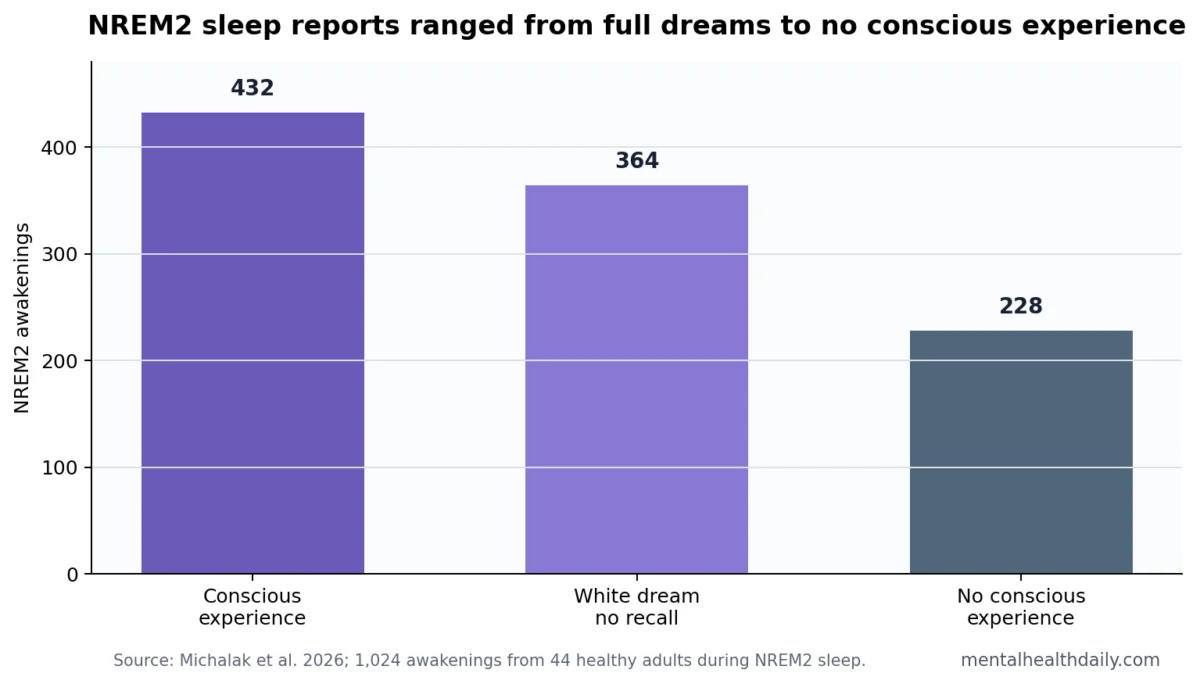
The diverse reports from the awakenings were systematically categorized into three broad groups, illuminating the varied nature of consciousness during NREM2. In 432 instances, participants described conscious experiences with clearly recalled content, akin to conventional dreams. A substantial 364 awakenings resulted in reports of conscious experiences without specific content recall, often referred to as "white dreams." This category is particularly significant as it highlights that the absence of vivid memory does not equate to an absence of consciousness. Finally, 228 awakenings were met with reports of no conscious experience whatsoever.
The inclusion of "white dreams" in the analysis underscores a critical distinction in sleep research: a person may have the impression of having experienced something during sleep but be unable to retrieve specific details. This subtle but important form of awareness can still influence subjective perceptions of sleep, even without a full narrative or sensory recollection.
The Quality of Experience: Immersive Dreams vs. Reflective Thought
The most compelling revelations from the study emerged when researchers analyzed the quality of these reported experiences. Utilizing principal component analysis, dream ratings were distilled into two primary dimensions: "perceptual immersion" and "reflective thought."
- Perceptual Immersion: This dimension encapsulated vividness, sensory richness, duration, emotional intensity, bizarreness, and overall REM-like dream quality. The study found a strong positive correlation, with perceptual immersion significantly predicting deeper subjective sleep (beta = 0.277, 95% CI 0.208 to 0.346, p < 0.00001). This suggests that the more vivid, emotionally charged, and sensory-rich a dream felt, the deeper the individual perceived their sleep to have been.
- Reflective Thought: In contrast, this dimension captured more abstract, thinking-like mentation, characterized by thoughts, internal monologues, or problem-solving. Strikingly, reflective thought predicted shallower subjective sleep (beta = -0.195, 95% CI -0.287 to -0.102, p = 0.00004). This implies that sleep punctuated by abstract, cognitive processes was perceived as less restful and profound.
This nuanced distinction offers a powerful explanation for why the simplistic adage "dreaming means light sleep" often proves inaccurate. While some forms of mentation may indeed align with a feeling of shallow sleep, vivid and immersive dreaming, even within NREM2, can contribute to a profound sense of restful slumber. Conversely, minimal conscious presence, characterized by vague awareness or fragmented thoughts, yielded the lowest depth ratings, indicating that complete unconsciousness was not the sole pathway to deeply perceived sleep.
EEG Activation and the Attenuation of Disruption
The study also leveraged high-density EEG, which records electrical activity from numerous scalp electrodes, allowing for detailed mapping of frequency patterns across the brain. Generally, higher gamma activity and a higher gamma-to-delta ratio are associated with lighter perceived sleep, reflecting more wake-like cortical activation. However, the Michalak et al. study uncovered a fascinating exception: when participants reported dreaming, this usual inverse relationship between high-frequency activity and deep-feeling sleep was attenuated.
In essence, wake-like cortical activation appeared less disruptive to subjective sleep depth when it was accompanied by conscious dream experience. The paper described this as a significant moderation of the typical mapping, suggesting that the brain’s electrical state interacts dynamically with the content of consciousness. This finding resonates with earlier work by Nir et al. (2010), which demonstrated that dream reports can be predicted by local EEG patterns within a posterior cortical "hot zone," rather than being solely dependent on global sleep stages. Siclari et al. (2017) further extended this concept with high-density EEG, showing that NREM dreaming relies on local sleep dynamics, challenging the notion of a simple global on/off switch for consciousness during sleep. The Michalak study builds upon this foundation, showing how these localized activations, when tied to immersive experience, don’t necessarily translate to a feeling of light sleep.
The Divergent Paths of Sleep Depth and Sleepiness Over Time
Another counter-intuitive finding concerned the temporal trajectory of subjective sleep metrics across the night. The study revealed that subjective sleep depth consistently increased as the night progressed (beta = 0.127, 95% CI 0.103 to 0.151, p < 0.00001). However, subjective sleepiness followed a distinctly different path; the interaction between time and measure indicated that sleepiness increased less steeply than perceived sleep depth (beta = -0.166, 95% CI -0.277 to -0.056, p = 0.00325).
This observation stands in contrast to conventional understanding of physiological sleep pressure, which typically declines overnight as the homeostatic need for sleep dissipates, leading one to expect a feeling of lighter sleep. Instead, participants reported feeling progressively deeper sleep, a perception that aligned with increasingly immersive dream experiences. This suggests that the subjective experience of sleep quality is not merely a reflection of physiological sleep pressure but is profoundly shaped by the nature of conscious content.
Bridging the Gap: Sleep Perception vs. Sleep Architecture
The Michalak et al. study directly addressed a critical gap in sleep science: the disparity between objective "sleep architecture" and subjective "sleep perception." Sleep architecture refers to the measurable distribution of sleep stages (NREM1, NREM2, NREM3, REM) across the night, typically assessed via polysomnography. While invaluable, sleep architecture alone often fails to fully explain how sleep felt to the individual.
This research illuminates why two individuals with objectively similar sleep-stage summaries can report vastly different sleep quality. One sleeper might awaken from NREM2 with a vivid, immersive dream and rate their sleep as deep and restorative. Another, despite experiencing the same NREM2 duration, might report a vague sense of presence, fragmented thoughts, or partial awareness, leading them to rate their sleep as shallow and unrefreshing. The study unequivocally demonstrates that subjective sleep quality cannot be reduced to total sleep time or the percentage of any single sleep stage. A comprehensive model of sleep perception, therefore, necessitates at least three integrated layers: objective physiological measurements, the precise timing of awakenings, and the immediate conscious or near-conscious experience that precedes those awakenings.
Implications for Clinical Practice and Sleep Technology
The findings carry significant implications for both clinical sleep medicine and the burgeoning field of sleep technology.
- Clinical Relevance: Complaints of "light sleep" are common in clinical settings, but their underlying causes are often multifaceted. This study suggests that such complaints may not solely map onto objective stage scoring or sleep duration. Instead, the quality of dream experience, the presence of thought-like mentation, or even fragmented awareness during NREM2 could profoundly shape whether sleep is perceived as restorative. For clinicians, this underscores the importance of inquiring beyond simple sleep duration or stage percentages, delving into the patient’s subjective experience of their sleep mentation.
- Sleep Tracking Technology: The research also sheds light on why consumer sleep trackers, despite their increasing sophistication, can sometimes feel inaccurate to users. While these devices can estimate movement, heart rate, breathing, or even EEG-like signals, they are currently incapable of discerning the content of a sleeper’s conscious experience – whether it’s an immersive dream, abstract thought, minimal presence, or true unconsciousness. This inherent limitation explains why a device’s "sleep score" can diverge significantly from an individual’s lived perception of their sleep quality.
Relevance for Insomnia Research
While the Michalak study focused on healthy adults, its insights offer a plausible mechanism for the perplexing mismatch between objective sleep and perceived sleep often observed in insomnia. Insomnia frequently involves individuals reporting poor, fragmented, or insufficient sleep despite objective measures showing adequate sleep duration or architecture. The study suggests that thought-like, less immersive mentation during NREM2, or even a vague sense of presence, could make sleep feel shallow and unrefreshing, even when physiological sleep is present. Future research extending this serial-awakening method to individuals with insomnia could provide crucial data to confirm this hypothesis and develop more targeted interventions.
Methodological Strengths and Cautions
The serial-awakening method employed in this study represents a significant strength, as it minimizes memory delay and potential distortion of dream recall. By asking participants immediately after NREM2 awakenings, researchers obtained a much closer approximation of the actual experience that preceded the sleep-depth rating. However, this methodological advantage comes with a inherent trade-off: repeated awakenings, by design, fragment sleep, making it less natural than an uninterrupted night. Therefore, the results are best interpreted as a controlled map of sleep perception under specific experimental conditions, rather than a perfect replica of typical, undisturbed sleep.
Furthermore, it is crucial to emphasize that this study is correlational. It effectively demonstrates that immersive NREM2 dreaming is associated with deeper perceived sleep, but it does not definitively prove that dreams cause better sleep quality. Establishing causality would necessitate further experiments designed to actively manipulate dream immersion or sensory input during sleep while measuring subsequent sleep perception. The study’s findings also align with previous arguments by Windt et al. (2016) that minimal conscious experience can exist without full narrative content, which helps interpret the lowest-depth category in Michalak et al. as a state that is neither restful unconsciousness nor immersive dreaming, thus contributing to a feeling of shallow sleep.
Future Directions and the Evolving Understanding of Sleep
The Michalak et al. study marks a pivotal step in understanding the subjective dimension of sleep. It underscores that sleep depth language must be used with care, as a person’s complaint of "light sleep" could describe a multitude of issues: stage structure, frequent awakenings, low arousal threshold, unpleasant thought-like mentation, or even a memory of being partly aware. The 2026 data make the latter two possibilities particularly difficult to ignore.
The next critical research step involves pairing these objective sleep measurements with rich, immediate subjective reports in populations who specifically complain of poor sleep despite objectively adequate sleep, particularly after repeated brief awakenings and reported morning recall gaps. This would bridge the gap between basic neuroscience and clinical applications, ultimately aiming to improve diagnostics and interventions for sleep disorders. The best inference from this comprehensive study is that subjective sleep depth is a complex construct, influenced not only by the brain’s electrical state but also, crucially, by the form and content of conscious experience occurring within that state. Treating objective and subjective measures as competitors misses the point; the truly useful question is how these diverse layers of sleep interact and combine to shape our overall perception of rest and restoration.

