

The Narrow Road to Oku, a seminal travelogue by the revered Japanese poet Matsuo Bashō, offers a profound glimpse into a pivotal journey that reshaped the landscape of Japanese literature. Composed of impressionistic prose interspersed with evocative poetry, the work chronicles Bashō’s arduous five-month pilgrimage in 1689 through the remote northern regions of Japan’s main island, Honshu, accompanied by his disciple Kawai Sora. What appears as a simple account of travel is, in fact, a masterclass in literary artistry, refined over four years of meticulous revision by Bashō himself, and only published posthumously in 1694, the year of his death at the age of fifty.
At the heart of The Narrow Road to Oku lies haibun, a literary form that Bashō championed and elevated to an art. Haibun is characterized by the seamless fusion of haikai poetry and prose. While the practice of pairing poetry with prose for contextualization had existed for centuries, Bashō’s innovation lay in his unique development and distillation of this hybrid form. Although the term "haiku" to specifically denote seventeen-syllable poems was coined much later, in the late 19th century, Bashō was a master of haikai, a broader category of Japanese linked verse. In haibun, the prose sections serve not merely as narrative illustrations for the poems, but rather, the poems are the intrinsic core, crystallizing the essence of the experience.
Bashō’s engagement with haibun predates The Narrow Road to Oku. His earlier works reveal a consistent experimentation with short, often quirky prose passages that set the scene for one or more haikai poems. These passages might describe mundane events like sharing a dish of water parsley, a friend’s visit on a snowy evening, or the creation of a makeshift rain hat. In the four travel journals he penned before his most celebrated work, Bashō began weaving these elements into loosely connected narratives, presenting the highlights of his journeys through intense, haiku-like glimpses, each often punctuated by a poem or two that encapsulated the moment. This evolutionary process culminated in The Narrow Road to Oku, by which time Bashō had a profound understanding of the form’s potential.
The structure of The Narrow Road to Oku itself reflects this evolution. While some translations render it as continuous prose, the original text is fundamentally a collection of distinct episodes of varying lengths, each typically concluding with a poem. These episodes function as self-contained "little worlds," each possessing its unique character. The overarching sense of continuity is derived solely from the progression of Bashō’s journey. The work invites the reader to savor each segment individually, rather than consuming it as a linear narrative. This deliberate pacing, mirroring the contemplative nature of a haiku, encourages readers to slow down and focus. The constant interplay of styles, tones, and moods, juxtaposing light and shadow, the playful and the solemn, the mundane and the spiritual, ensures a continuous sense of surprise and engagement.
Unveiling the Artifice: Sora’s Diary and Literary Revision
A significant revelation regarding the composition of The Narrow Road to Oku emerged in 1943 with the discovery of the diary kept by Bashō’s traveling companion, Sora. This document starkly illustrated the extent to which Bashō had artfully manipulated factual accounts in his final compilation. Details such as dates, locations, weather conditions, the sequence of events, and, crucially, the poems composed during the journey, were found to have been altered or entirely invented. This discovery initially caused considerable shock among scholars and readers alike, prompting a deeper examination of Bashō’s creative process and the underlying literary principles at play. The revelations underscored that Bashō was not merely a recorder of experience but a sophisticated literary architect, weaving personal observation with artistic intention.
Scholars began to scrutinize the influences and techniques that informed Bashō’s revisions. Particular attention was paid to the echoes of renku, the complex art of Japanese linked verse, a communal poetic practice deeply ingrained in Bashō and his circle. The poems featured in The Narrow Road to Oku are specifically hokku, the opening seventeen-syllable verse that traditionally initiates a renku session. The realization that the seemingly simple travel journal was built upon multiple layers of intricate craft transformed the perception of the work from a straightforward travelogue to a profound literary construct.
The Journey Begins: A Yearning for the Road
The narrative opens with a philosophical reflection on the transient nature of time and life, comparing the ceaseless movement of days and years to the perpetual journeys of travelers. Bashō identifies himself with this spirit of wanderlust, stating, "Those who float their lives away on boats, or greet old age walking before a horse, spend their days in travel and travel is their home." He confesses to a long-held "lure of drifting wind-torn clouds," a metaphor for his desire for unanchored existence. This urge to wander, ignited by the autumn preceding his journey, propelled him to clear his humble riverside dwelling and prepare for an expedition north of the Shirakawa Barrier as spring mists began to dissipate. Driven by an almost spiritual restlessness, he readied himself, mending his worn leggings and traveler’s hat, and undergoing a moxa treatment to invigorate his legs, all while the iconic moon of Matsushima, a celebrated scenic spot, remained a potent image in his mind. He entrusted his home to a young family and took up temporary residence at the home of his friend Sanpū to finalize his preparations.
The first entry into his journal is accompanied by a haiku, reflecting his departure from his familiar abode:
Time for my hermit’s hut
to change too—
now a home for dolls
This poem captures the poignant moment of transition, the familiar solitude of his hut giving way to the unknown as it becomes a temporary sanctuary for inanimate objects, symbolizing his own imminent departure.
The Parting at Senju: Tears and Reluctance
As the third month drew to a close, under a hazy dawn sky and a pale moon, with Mount Fuji a distant silhouette, Bashō felt a pang of nostalgia for the renowned cherry blossoms of Ueno and Yanaka. Friends had gathered the previous evening and saw him and Sora off from the boat. Upon disembarking at Senju, the daunting prospect of the miles ahead overwhelmed him. He reflects on the ephemeral nature of life, where "each moment is a parting of ways in this phantom world of ours," yet he found himself weeping as he bid farewell.
The first recorded poem of the journey expresses this profound reluctance to depart:
Spring passes—
birds cry, fishes’
eyes swim with tears
This poignant verse conveys a deep sadness, an unwillingness to leave behind the beauty and familiarity of home, even as the natural world signals the progression of seasons. The journey commenced with a heavy heart, observed by many who lined the road, watching their retreating figures until they vanished from sight.
An Encounter with Honesty: Buddha Gozaemon
On the thirtieth day of their travels, Bashō and Sora lodged at the foot of Mount Nikko. Their innkeeper introduced himself as "Buddha Gozaemon," explaining that his name stemmed from his unwavering commitment to honesty, which assured travelers of their safety. Bashō, intrigued, mused on the manifestation of such a virtuous being in a world he perceived as flawed, particularly for humble pilgrim monks. Upon observing him, Bashō found the innkeeper to be genuinely guileless and exceptionally honest, embodying the Confucian ideal of "near to virtue in his unaffected integrity." This encounter highlights Bashō’s appreciation for inherent purity of heart and the profound impact of simple, unadorned virtue.
The Enchantment of Matsushima: A Divine Landscape
Around noon on an unspecified date, Bashō and Sora borrowed a boat to visit the famed Matsushima, a scenic cluster of islands renowned throughout Japan. Arriving at the small island of Ojima, Bashō was immediately captivated by the breathtaking panorama. He described Matsushima as surpassing even the celebrated landscapes of China’s Dongting Lake and West Lake, a sheltered bay of seven miles width, evoking the grandeur of China’s Zhejiang River. The scene was adorned with countless islets, some reaching skyward, others nestled low on the waves, appearing in layered formations, singly or in groups, as if embracing one another. The dark green pines, their branches artfully twisted by the sea breeze, added to the enchantment, creating a scene "as captivating as a beauty’s painted face," which Bashō attributed to the work of ancient mountain gods. He questioned whether any artist or poet could truly capture such divine artistry.
On Ojima, they found the remnants of Zen Master Ungo’s hut and his meditation rock. A few hermits resided in simple brushwood huts beneath the pines, their fires sending up smoke. Bashō felt drawn to approach them, but the scene was suddenly transformed by the rising moon, casting its ethereal glow over the sea and eclipsing the daylight beauty.

Seeking lodgings upon their return to the shore, they found a room on the upper floor with open windows, creating a sensation of sleeping "among the wind and clouds." Sora composed a haiku, expressing his awe:
Ah, Matsushima!
Cuckoo you must borrow
the crane’s elegance here
Bashō, deeply moved, found himself speechless with wonder. Unable to sleep, he found solace in reviewing parting poems gifted to him by friends, including a Chinese poem from Sodo and a Japanese poem from Hara Anteki, both on the subject of Matsushima, alongside hokku from Sanpū and Jokushi.
Zuigan-ji Temple: A Legacy of Devotion
On the eleventh day, they paid their respects at Zuigan-ji Temple. Founded by Makabe no Heishiro, who had traveled to China for Buddhist vows, the temple had undergone magnificent rebuilding over thirty-two generations, thanks to the influence of Zen Master Ungo. The temple’s seven buildings, adorned with gold leaf and resplendent ornamentation, evoked a sense of Buddha’s paradise embodied within its grand hall. Bashō pondered the whereabouts of the temple of the ancient hermit Kenbutsu, reflecting on the enduring legacy of devotion.
Ryushaku-ji Temple: A Sanctuary of Stillness
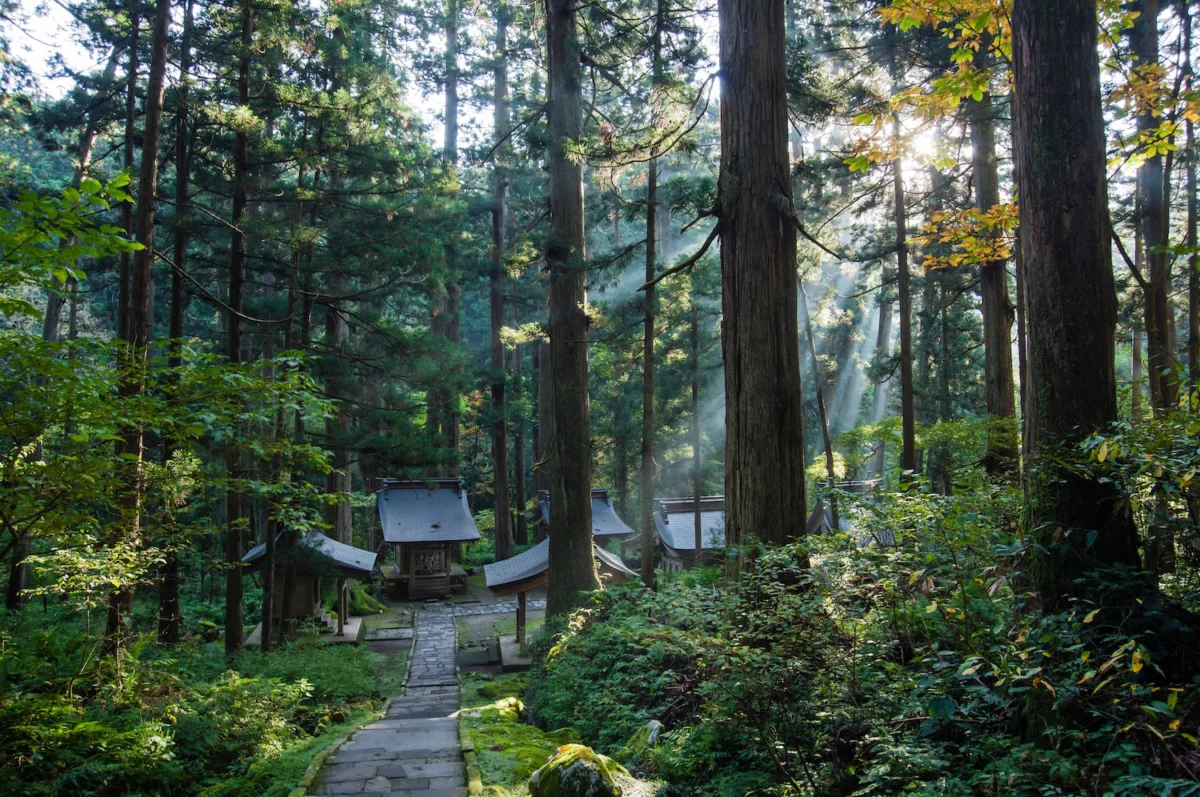
In the Yamagata region, they visited Ryushaku-ji, a mountain temple renowned for its beauty and serenity, founded by the high prelate Jikaku. Approximately seventeen miles from Obanazawa, the temple’s location was described as being perched high on a mountain of boulders, surrounded by ancient pines and cypresses rooted in moss-covered rocks. The temple doors were closed, and an profound silence pervaded the site. As they circled the temple and prayed at the Buddha Hall, the hushed sanctity of the scene deeply awed Bashō. He captured this profound stillness in a memorable haiku:
Stillness—
the cicada’s voice
pierces deep into rock
This poem masterfully juxtaposes the persistent, sharp sound of the cicada with the immobility of the rock, conveying an intense, almost palpable silence that absorbs all sound.
The Sacred Mountains: Haguro, Gassan, and Yudono
On the third day of the sixth month, Bashō and Sora ascended the sacred Mount Haguro. They were welcomed by Zushi Sakichi, who introduced them to Egaku, the Acting Abbot of the mountain sect. They were lodged at the Minamidani lodgings, where they received exceptional care. A haikai gathering was held at the Abbot’s quarters, prompting Bashō to compose a poem expressing his gratitude:
Deep thanks
for this pure waft of snow
at Minamidani
On the fifth, they offered prayers at the Gongen shrine atop Haguro’s summit. Bashō noted the historical references to a shrine called Satoyama in the area, possibly related to the name Haguro. He also delved into the etymology of Dewa, the region’s name, meaning "feathers come from it," linking it to ancient tribute taxes of feathers. Haguro, along with Gassan (Moon Mountain) and Yudono, forms the revered "Three Sacred Mountains." Bashō described Haguro’s temple as a center of Tendai Buddhist teachings, filled with monastic buildings where monks engaged in fervent ascetic practices, all worshipping the divine power of the sacred place with awe and wonder, a glory he believed would endure for eternity.
On the eighth day, they embarked on the challenging ascent of Gassan, a twenty-mile trek through mountain mist and snow, clad in the white paper garlands and head coverings of pilgrims, guided by a rugged porter. Reaching the summit as the sun set and the moon rose, they lay on rough bamboo grass, awaiting the dawn.
The following morning, with the clouds vanished, they descended to Yudono. In the valley below, they encountered the remains of an old swordsmith’s hut. This swordsmith, it was said, used the sacred mountain water to purify himself and forge renowned swords inscribed with the name "Gassan," echoing the legendary Chinese swordsmiths Gan Jiang and Mo Ye. This dedication to craft resonated with Bashō, illustrating the power of deep commitment to one’s calling.
Resting on a rock, Bashō noticed a small, late-blooming cherry tree, its blossoms barely open, buried deep in snow. He likened their perseverance to the fabled plum blossoms flowering in mid-summer heat, and was further moved by the memory of monk Gyoson’s similar encounter with flowering cherry among the peaks of sacred Omine. Bashō noted that the customs of Mount Yudono forbade detailed accounts, and thus, he refrained from further description.
Upon returning to their temple lodgings, the Acting Abbot requested poems from their pilgrimage. Bashō and his companions presented several verses, including Bashō’s own:
Summer coolness—
a faint crescent moon
over Mount Haguro
Towering clouds
dissolving over and over—
Moon Mountain
Yudono—
there is no telling
these tears
These poems, imbued with the profound experiences of their pilgrimage, encapsulate the spiritual and sensory impressions of the sacred mountains, a fitting conclusion to a journey that profoundly shaped Bashō’s literary legacy. The publication of these excerpts from Meredith McKinney’s translation of The Narrow Road to Oku offers a vital opportunity to revisit and appreciate the enduring artistry and spiritual depth of Bashō’s masterpiece.

