

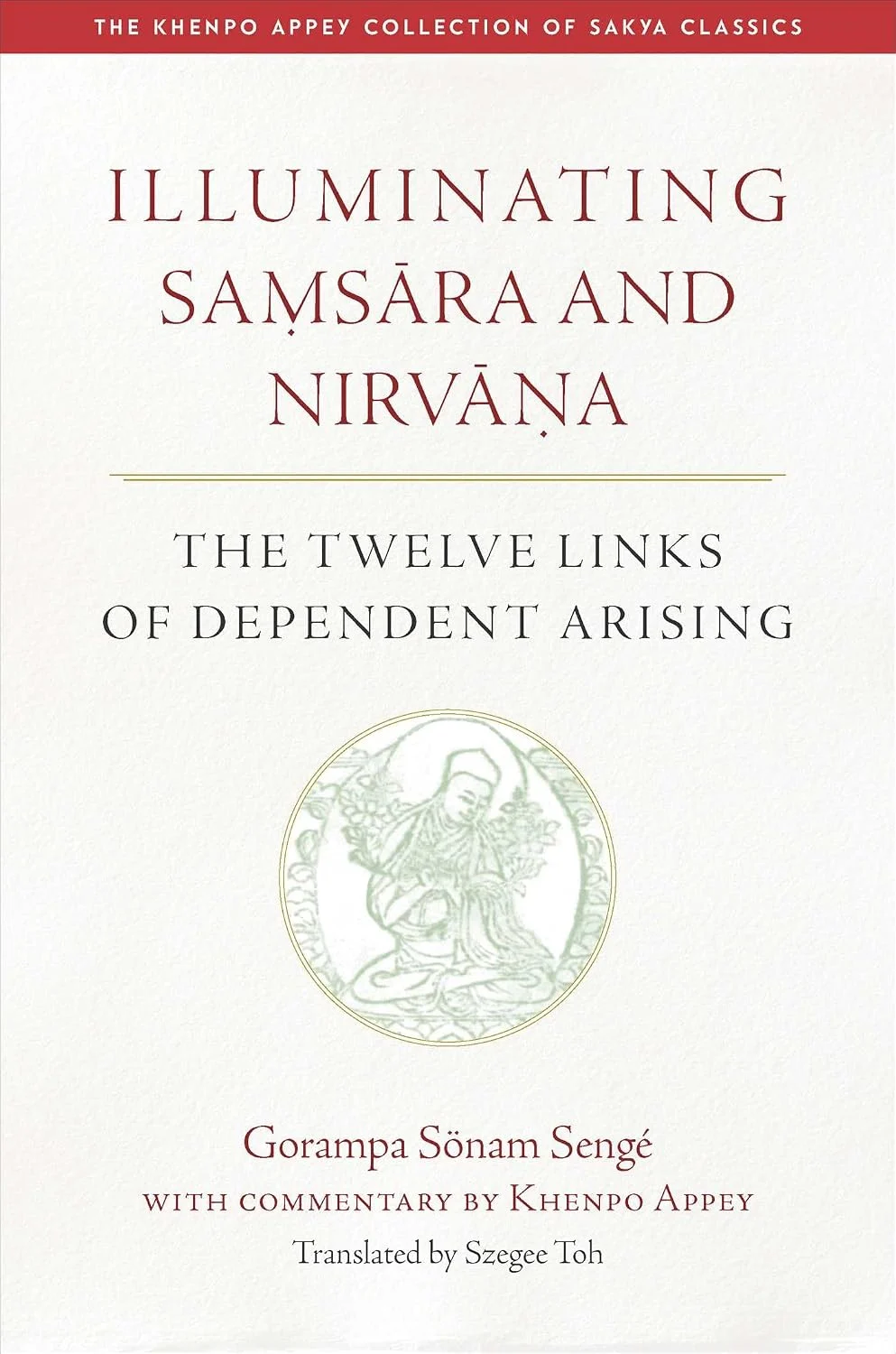
The profound teachings on the Twelve Links of Dependent Arising offer a comprehensive framework for understanding the cyclical nature of existence and the path to liberation, emphasizing the critical importance of spiritual practice. This intricate Buddhist doctrine, elucidated in the recent publication Illuminating Samsara and Nirvana: The Twelve Links of Dependent Arising by Gorampa Sönam Sengé, highlights that true spiritual engagement arises not from coercion, but from a deep appreciation of our human existence and its inherent impermanence. The book, reprinted by arrangement with Wisdom Publications from the Khenpo Appey Foundation, delves into the core principles that underscore the Buddhist understanding of suffering and its cessation.
The Preciousness of Human Rebirth
At the heart of these teachings lies the concept of the precious human rebirth. This state is deemed exceptionally rare and valuable because it provides the optimal conditions for engaging in spiritual practice, often referred to as Dharma. Unlike other forms of life, such as animals, which lack the cognitive capacity, or celestial beings, who are often too engrossed in their own pleasures, humans possess the intelligence and the awareness to comprehend and actively pursue spiritual development. The text stresses that this human form is not to be squandered, but rather utilized to its fullest potential for spiritual growth.
Understanding the Twelve Links of Dependent Arising, a foundational concept in Buddhist philosophy, is presented as a key to realizing the ephemeral nature of this precious human rebirth. This chain of causation, which describes how phenomena arise in dependence on preceding causes and conditions, reveals the interconnectedness of all existence and the inevitable progression through birth, aging, sickness, and death. By comprehending these links, individuals are encouraged to cultivate a sense of urgency and purpose in their spiritual endeavors.
The Fleeting Nature of Life and the Imperative of Practice
The inherent brevity of human life is a recurring theme, underscoring the need for immediate engagement with spiritual practice. The article posits that dedicating time to learning the Dharma, even amidst the demands of daily life, is a praiseworthy endeavor. It cautions that any pursuits focused solely on worldly concerns, often entangled with afflictive emotions and negative actions, will ultimately be left behind at the time of death, becoming burdensome rather than beneficial.
Mindfulness of death is presented as a crucial catalyst for sustaining genuine spiritual practice. The certainty of death, coupled with the uncertainty of its timing, makes spiritual practice the only reliable source of solace and guidance. Repeated contemplation of this reality is said to foster a natural awareness of mortality, leading to the spontaneous arising of the desire to practice. The text highlights that the Twelve Links of Dependent Arising explicitly embed impermanence, particularly through the link of "aging-and-death" that arises in dependence on "birth." This signifies that from the moment of birth, the cessation of life becomes an unavoidable consequence, with the conditions for death already in place. The omission of "abidance" from the four characteristics of conditioned existence—birth, abidance, aging, and death—within the Twelve Links further emphasizes the transient nature of our existence, conveying that we will not remain in this state indefinitely.
Understanding Karmic Causality
The principle of karmic causality, another central tenet explained through the lens of the Twelve Links, is crucial for understanding how our actions shape our experiences. The teachings assert that everyone desires happiness and eschews suffering. However, a misunderstanding of cause and effect can lead individuals to believe that non-virtuous actions can yield positive outcomes. The text clarifies that true happiness stems from cultivating virtue, while suffering arises from abandoning virtue and engaging in non-virtuous deeds.
The Twelve Links provide a detailed exposition of how causes and their results interrelate. Ignorance, as the foundational link, gives rise to karmic formations, which in turn lead to subsequent stages, including sensation. This intricate chain reveals that our experiences of pleasure and pain are direct consequences of our karmic actions and afflictions. Therefore, a thorough understanding of karmic causality empowers individuals to consciously cultivate virtuous actions and abandon non-virtuous ones, thereby actively shaping their future well-being.
The Buddha’s Ultimate Intent
The teachings of the Buddha, while diverse and delivered in stages to accommodate various disciples, ultimately converge on a singular purpose: to guide sentient beings toward liberation and full enlightenment. The article emphasizes that while teachings on attaining happiness in higher realms or favorable rebirths are valuable, they are not the ultimate goal. Present-day practitioners are urged to discern the most essential aspects of the Buddha’s teachings, understanding which serve as preparatory steps and which point directly to the ultimate freedom from suffering.
The gateway to this path of liberation is the genuine aspiration for freedom itself. This aspiration is cultivated through true renunciation, a profound recognition of the inherent flaws and dissatisfactions within samsara (the cycle of birth, death, and rebirth) and a heartfelt resolve to break free from it. This mindset redirects focus decisively towards liberation, transforming spiritual practice from a mere ritual into a purposeful pursuit of ultimate freedom.
The Human Predicament and the Cycle of Suffering
The current predicament of sentient beings is characterized by a mindstream largely dominated by ignorance and afflictions, leading to the creation of karma and subsequent rebirths within samsara. When non-virtuous actions outweigh virtuous ones, the likelihood of a less fortunate rebirth increases, with consequences that are often difficult to escape. The article underscores that rebirths in the lower realms—animal, hungry ghost, and hell realms—are characterized by immense suffering, a reality that can be glimpsed even in the observable hardships faced by humans and animals, such as aging, sickness, and death. The ceaseless cycle of rebirth in these realms, driven by non-virtuous actions, offers no lasting benefit and is ultimately a state to be avoided.
The example of Sakyamuni Buddha, who renounced his royal life upon witnessing the realities of sickness, aging, and death, serves as a powerful illustration of the futility of attachment to worldly pleasures. His renunciation and pursuit of the Dharma were intended to inspire others to relinquish their own attachments to contaminated experiences. The text distinguishes Buddhist practice, which involves turning away from even neutral sensations and abandoning all contaminated phenomena, from the rejection of suffering by animals or the rejection of pleasure by some non-Buddhist traditions. The core of Buddhist practice lies in recognizing the inherent suffering and impermanence of all conditioned existence, as vividly depicted by the Twelve Links.
The Path to Eliminating Suffering
The fundamental question addressed is whether suffering can be entirely eliminated. Worldly perspectives, whether religious or philosophical, often fail to provide a clear path. The article critiques viewpoints that attribute suffering to causelessness or to an unchangeable divine entity or primal substance, as these perspectives leave no room for human agency in alleviating suffering.
In contrast, the Buddha’s teachings identify karma as the direct cause of suffering. The root of karma, in turn, is identified as afflictions, which are ultimately grounded in ignorance. This ignorance is characterized as a misconception of the self—a grasping to an illusory sense of an independent, permanent "I" amidst the constantly changing aggregates that constitute a person. The antidote to this ignorance is wisdom that realizes selflessness, apprehending that these aggregates are devoid of a truly existent, independent self. Through logical analysis, the mistaken conception of a substantial self can be refuted, revealing that the mind adhering to this mistaken view is deluded, while the wisdom realizing selflessness aligns with reality.
The article then delves into the nuances of selfhood as understood in Buddhist philosophy, contrasting it with non-Buddhist views. While non-Buddhists often posit a self as essential for karmic causality and liberation, Madhyamaka proponents assert that while a truly existent self is absent, a conventionally existent self operates and performs functions. This conventionally existent self is imputed in dependence on the five aggregates, much like a house is imputed based on its constituent parts. The argument is made that if a self were truly existent, it would be impossible to abandon the conception of self, and consequently, the afflictions and the cycle of samsara would be inescapable.
The impossibility of a truly existent self is further demonstrated through logical analysis. Such a self would either be identical to or different from the aggregates. The former leads to the absurd conclusion of multiple selves, while the latter is unfeasible as the sense of "I" is invariably associated with the aggregates. Therefore, the self, as asserted by non-Buddhists, is deemed a falsity, an imputed reality rather than an intrinsically existing one. Even the Twelve Links themselves, though not intrinsically existent, function like phenomena in a dream or an illusion, capable of performing their respective roles.
The Antidote: Meditation on Selflessness
The ultimate antidote to ignorance is identified as meditation on selflessness, encompassing both the selflessness of persons and the selflessness of phenomena. By consistently meditating on the aggregates as being devoid of true existence, practitioners can begin to perceive the truth of emptiness and attain the initial stages of spiritual realization, such as the first ground in the Mahayana or the state of a stream-enterer in the Theravada tradition. Direct realization of emptiness serves to dismantle the seeds of ignorance. When ignorance is eradicated, karma ceases, leading to the cessation of all resultant suffering and the achievement of liberation from samsara.
The practice of meditating on the concordant and discordant orders of dependent arising is presented as a method for abandoning ignorance. When dependent arising is used as an object of observation in such meditations, it cultivates calm abiding. However, the direct antidote to ignorance is the contemplation of selflessness. Through this rigorous practice, the cycle of suffering is broken, and beings are guided toward their ultimate potential for enlightenment. The intricate understanding provided by the Twelve Links, coupled with the profound realization of selflessness, forms the cornerstone of the Buddhist path to liberation.

