

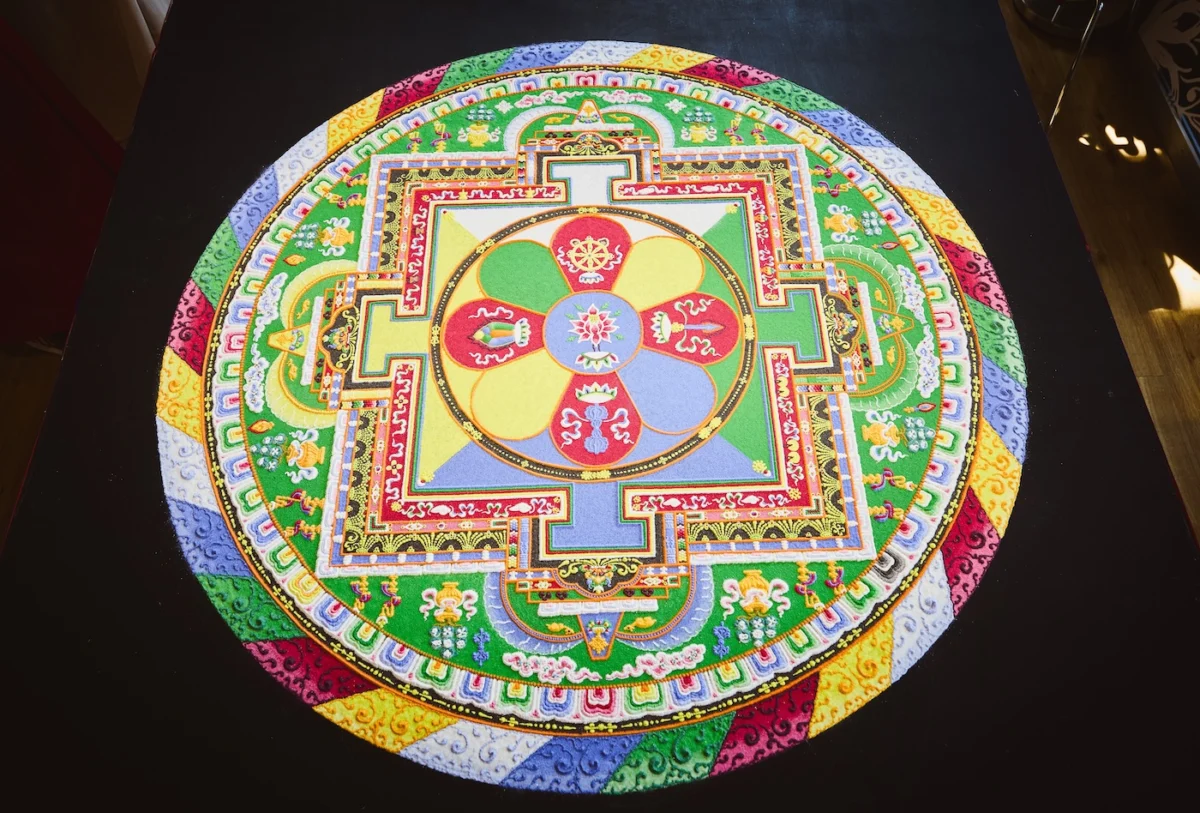
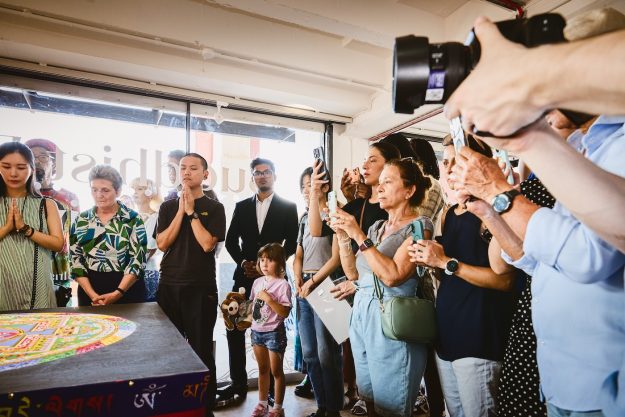
For five days, from Wednesday, June 17, to Sunday, June 21, the Oxo Gallery on London’s South Bank became a sanctuary of stillness, a stark contrast to the city’s relentless pulse. Presented by the Pure Land Foundation in collaboration with Tricycle: The Buddhist Review, a live sand mandala installation unfolded, meticulously crafted by three senior monks. This immersive experience offered a tangible encounter with Buddhist philosophy, demonstrating the profound beauty and transient nature of existence, and its resonance within the contemporary urban landscape.
A Ritual of Patience Amidst Urban Flux
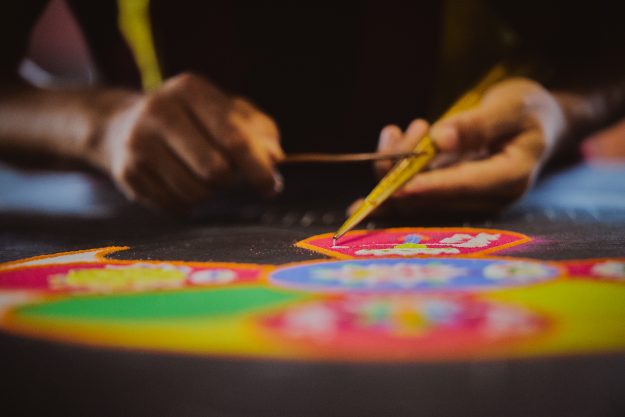
As the bustling energy of London’s South Bank, with its ceaseless flow of traffic and hurried pedestrians, continued unabated outside the gallery’s walls, an atmosphere of profound calm permeated within. Visitors, drawn from the city’s dynamism, stepped into a space where time seemed to decelerate. Here, three senior monks, with an almost unimaginable degree of patience, engaged in the delicate and intricate process of creating a sand mandala. Hunched over a designated space, they employed traditional tools to place finely colored sand, grain by grain, into a complex and precise geometric pattern. This creation, destined for a fleeting existence, served as a powerful counterpoint to the ephemeral nature of much of modern life, which is often characterized by rapid consumption and instant gratification.
The mandala itself is far more than an object of aesthetic appreciation; it is a practice, an invitation to a different mode of perception. It encourages observers to slow down, to engage in careful observation, and to internalize the understanding that beauty’s significance is not diminished by its impermanence. This central tenet of Buddhist philosophy, the understanding of anicca (impermanence), was visually and experientially demonstrated throughout the installation.

The Gradual Unfolding of Sacred Geometry
The creation of the mandala was a day-by-day transformation, a visual narrative of gradual emergence. Initially, only faint outlines and foundational structures would be discernible, suggesting the potential for the intricate design to come. As the days progressed, the image deepened. Shapes became more complex, colors coalesced, and the sacred geometry began to reveal its full splendor. Visitors who returned over the course of the five days witnessed this progression not as a series of abrupt changes, but as the cumulative result of sustained, quiet attention. This iterative process underscored the value of consistent effort and meticulous dedication, qualities often overshadowed in a society that frequently prioritizes immediate results and grand finales.
One of the most impactful aspects of the installation was its non-demanding nature. It did not impose interpretations or prescribe specific reactions. Instead, it offered a simple, yet profound, invitation: to be present. Attendees ranged from those who spent a few brief moments in quiet observation to others who remained for extended periods, absorbed in the meditative rhythm of the monks’ work. Many, arriving from the bustling South Bank with no prior expectation, reported leaving the gallery visibly softened, their inner states subtly altered by the experience.
A Counter-Rhythm to Modern Life’s Pace
In an era dominated by speed, constant connectivity, and an overwhelming barrage of stimuli, the sand mandala installation offered a vital counter-rhythm. It served as a potent reminder that focused attention itself can be an act of profound care and mindfulness. The monks’ work, characterized by its precision, discipline, and unwavering focus, exuded a sense of unhurried dedication. There was no palpable urgency, only the steady accumulation of effort, a testament to the value of process over immediate outcome.
This aspect of the mandala resonates deeply with contemporary challenges. Many personal and societal crises often stem from internal states: unresolved anger, fear, resentment, loneliness, and an aversion to discomfort. While societal action and systemic change are undeniably crucial, the inner life plays an equally significant role in shaping our perception and response to the world. The mandala, through its very creation and dissolution, offered a pathway to understanding this interconnectedness.
The Mandala as a Mirror to Inner and Outer Worlds
The sand mandala does not offer simplistic solutions to suffering, a characteristic common to many Buddhist practices. Instead, it provides a profound shift in perspective. It illuminates the universal truth of impermanence, the pain that arises from attachment, and the foundational role of awareness in cultivating compassion. Witnessing the monks’ dedicated practice served as a potent reminder that peace is not a passive state but an active cultivation, achieved through discipline, patience, and consistent effort.
Beyond the Exhibition: Creating a Space for Contemplation
Over the five days, the Oxo Gallery transformed from a mere exhibition space into a temporary sanctuary. In conjunction with the mandala creation, evening breathwork sessions were offered, allowing visitors to experience stillness not just as an external observation but as an embodied sensation. This holistic programming aimed to create a bridge between ancient contemplative traditions and the lived realities of modern urban life—addressing issues such as stress, overstimulation, grief, uncertainty, and the universal human search for meaning.
The organizers’ intention was not to isolate ancient wisdom behind glass but to create accessible environments where individuals could engage with it directly. Whether through film, cultural events, meditation, dialogue, or public installations, the overarching question driving these initiatives remains: How can these timeless teachings inform and enhance our lives in the present day?
A Collaborative Vision for Contemporary Engagement
The collaboration with Tricycle: The Buddhist Review was particularly significant. The publication’s ongoing commitment to exploring Buddhist themes through various mediums, including its Buddhist Film Festival which delves into impermanence, compassion, identity, suffering, resilience, and transformation, found a powerful extension in this public installation. The Oxo Gallery event expanded this spirit into the public sphere, allowing individuals to encounter Buddhist thought not solely through intellectual discourse but through atmosphere, gesture, and direct experience.
The Art of Letting Go: Dissolution and Transformation
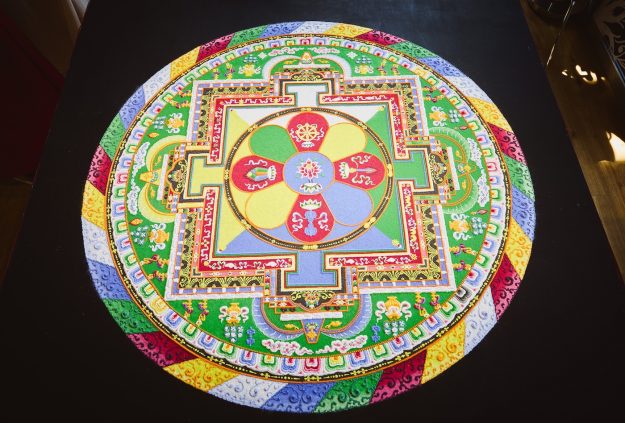
On the final day, Sunday, June 21, the meticulously crafted mandala reached its culmination and then underwent a ceremonial dissolution. After days of painstaking creation, the monks carefully swept the colored sand together, undoing the intricate image. This moment, while beautiful, was also poignant. There is an inherent human inclination to cling to beauty, to seek permanence in what moves us, and to desire tangible proof that effort has not been in vain.
However, it is precisely this act of dissolution that imparts the mandala’s deepest teaching. Nothing is truly wasted because nothing remains static. The care, attention, and intention invested in the mandala did not vanish with the image. They continued to resonate within those who witnessed it, in the conversations it sparked, and in the quiet internal shifts it may have inspired. In a symbolic act of release, the sand was later poured into the River Thames, carrying the blessings of the work beyond the confines of the gallery and into the broader life of the city.
This final gesture held particular significance on the South Bank, a locale intrinsically linked to the symbolism of movement, continuity, and change embodied by the river. Releasing the sand into the Thames acknowledged that the mandala’s meaning transcended its physical form and the space in which it was created.
Bruno Wang, founder of the Pure Land Foundation, reflected on the installation’s impact: "The response to the sand mandala installation shows that London audiences are deeply open to experiences that invite stillness, reflection, and connection. Watching people stop on the South Bank, gather at the gallery window, come inside, return over five days, and then witness the mandala’s dissolution into the Thames was profoundly moving. It showed that ancient contemplative traditions still have real power in contemporary life when they are shared in ways people can encounter directly."
Enduring Lessons from Fleeting Beauty
Throughout the five days, it became evident that many attendees intuitively grasped the profound significance of the event, even without detailed knowledge of Buddhist traditions. They recognized the inherent value of patience, the profound beauty of dedication, and the poignant elegance of creating something with deep intention, only to willingly let it go.
This innate understanding speaks to the enduring power of the mandala’s message. It reminds us that the temporary can indeed be profoundly meaningful. It demonstrates that pockets of peace can be cultivated even within the heart of a bustling metropolis. It underscores that spiritual practice need not be divorced from daily life but can be integrated directly into it. And crucially, it teaches that by learning to let go, we do not diminish the significance of what has passed; rather, we create space for its essence to move through us and ripple outward into the world. The sand mandala, though ephemeral, leaves an indelible mark, a testament to the enduring power of presence, impermanence, and the transformative nature of mindful engagement.

