

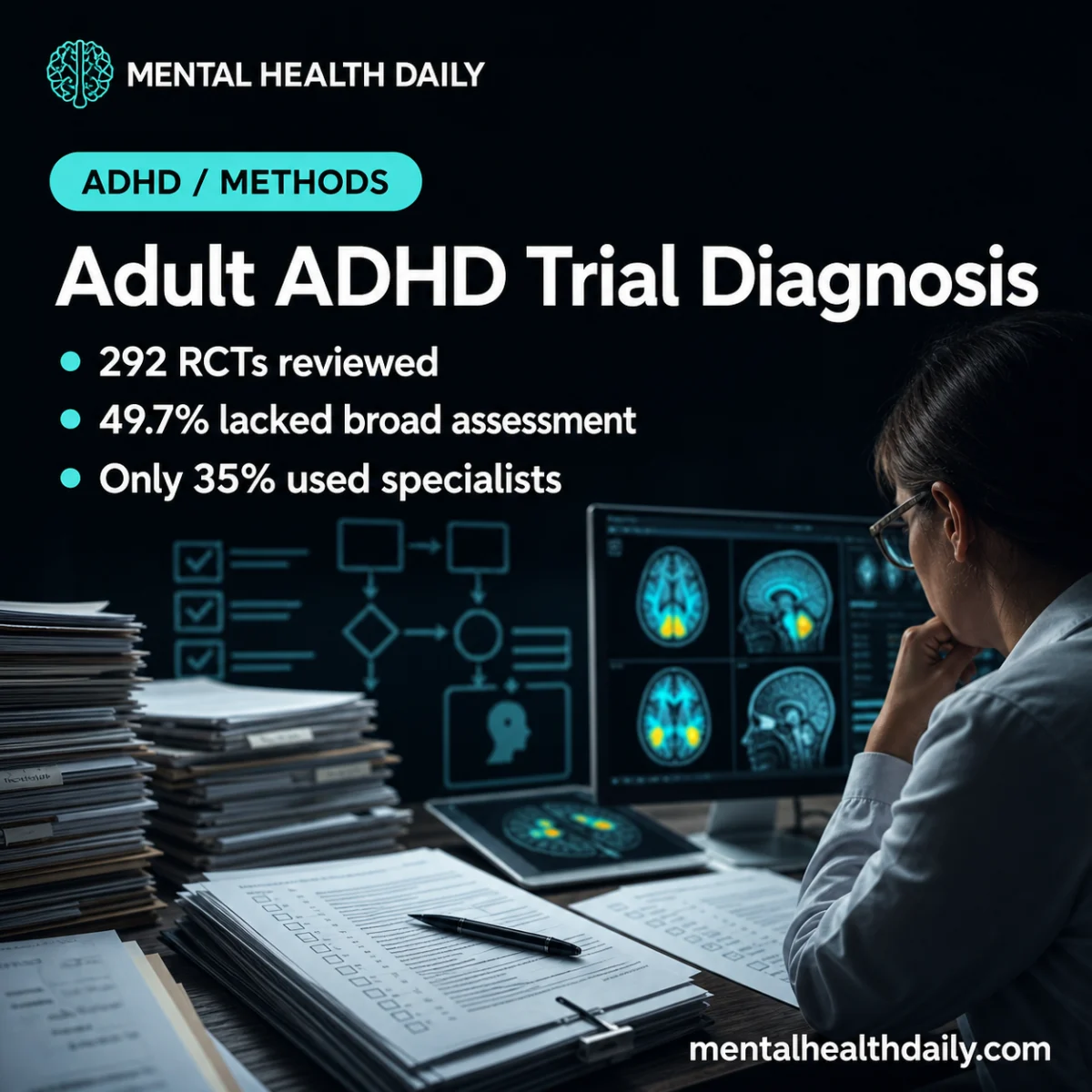
A 2025 scoping review of 292 adult ADHD randomized controlled trials (RCTs) found that nearly half, 49.7%, allocated diagnoses without a comprehensive general psychopathology assessment, and only 35% reported that psychiatrists or psychologists were responsible for assigning the ADHD diagnosis. These findings, published by Studart et al., cast a critical light on the methodological foundations of adult ADHD research, highlighting significant inconsistencies that could undermine the generalizability and reliability of existing treatment evidence. The review does not dispute the validity of adult ADHD as a clinical entity but rather questions the diagnostic transparency and methodological robustness within a substantial portion of the research landscape informing its treatment.
The complexity inherent in diagnosing adult Attention-Deficit/Hyperactivity Disorder necessitates a meticulous approach, primarily due to the considerable overlap of its symptoms with numerous other mental health conditions. Inattention, restlessness, impulsivity, sleep disruption, anxiety, depression, trauma, substance use disorders, and various personality pathologies can all manifest in ways that mimic or co-occur with ADHD. Consequently, differential diagnosis—the process of systematically ruling out alternative explanations for a patient’s symptoms—is not merely an optional step but a fundamental requirement for accurate assessment in adults. The review underscores that many RCTs fail to adequately document diagnostic procedures strong enough to render their participant samples clinically interpretable, raising concerns about the foundational data informing treatment guidelines and clinical practice.
The Evolving Landscape of Adult ADHD Diagnosis and Research
Historically, ADHD was predominantly conceptualized as a disorder of childhood, with diagnostic criteria primarily tailored to pediatric presentations. The expansion of diagnostic focus to adulthood has introduced new challenges, requiring a translation of childhood-observed signs into adult symptom reports, retrospective childhood history, evidence of current impairment across multiple settings, and, critically, the exclusion of better-explained alternative conditions. While this translation can be valid and clinically crucial, it is inherently more complex than merely tallying items on a checklist. The increasing recognition of adult ADHD, partly fueled by rising public awareness and social media discourse, has simultaneously amplified the need for rigorous diagnostic standards in both clinical practice and research.
The Studart et al. review categorized diagnostic methods employed in RCTs, noting variations from reliance on clinical diagnoses alone, to the use of ADHD-specific rating scales, and more comprehensive structured or semi-structured interviews that included broader psychopathology assessments. The critical distinction, the authors argue, is not merely the format of the assessment but whether the method incorporated sufficient general psychopathology assessment to effectively rule out competing explanations for ADHD-like symptoms.
Alarming Gaps in General Psychopathology Assessment
The finding that 49.7% of RCTs did not include a general psychopathology assessment is particularly concerning. This figure encompasses studies that used only clinical diagnoses, clinical diagnoses supplemented by ADHD-specific rating scales, or ADHD-specific interviews/scales without a broader psychiatric evaluation. While these methods might identify individuals presenting with ADHD-like characteristics, they inherently lack the capacity to definitively test whether the clinical presentation is more accurately explained by another mental disorder.
This limitation is further compounded by the high rates of comorbidity observed in adult ADHD populations. It is common for individuals with ADHD to also experience anxiety disorders, depressive disorders, substance use disorders, or personality pathology. While a clinical trial can legitimately include patients with these comorbidities and still yield valuable insights, the problem arises when researchers fail to transparently document how they distinguished ADHD from these overlapping presentations. Without such clarity, the observed treatment effects become difficult to attribute specifically to ADHD or to generalize to careful psychiatric practice, where such distinctions are paramount.
The implications for clinical practice are substantial. When an adult ADHD RCT reports on the efficacy of a medication or psychotherapy, clinicians and patients need to understand the composition of the trial’s sample. A weak diagnostic gate, characterized by a lack of comprehensive differential diagnosis, can lead to skewed results. It risks attributing benefits to an ADHD-specific intervention in individuals whose primary issues might stem from an undiagnosed mood disorder, anxiety disorder, or trauma, thereby rendering the treatment less effective or even potentially harmful. For instance, prescribing stimulants to an individual with undiagnosed bipolar disorder can precipitate manic episodes, highlighting the profound importance of thorough diagnostic workup.
The Imperative of Specialist Involvement in Diagnosis
Another critical revelation from the review was that specialist allocation for diagnosis was reported in only 35% of studies. This means that 190 out of 292 studies (65%) either failed to report who conducted the diagnostic assessment, relied on individuals other than psychiatrists or psychologists, or even utilized computer-based diagnostic tools. While this does not automatically invalidate every study, it significantly weakens confidence in the diagnostic comparability and rigor across trials.
Psychiatric diagnosis, especially for complex neurodevelopmental conditions like ADHD, demands more than a simple symptom checklist. A skilled and experienced psychiatrist or psychologist possesses the expertise to conduct a nuanced assessment, identifying conditions such as mania, psychosis, sleep disorders, substance effects, traumatic stress reactions, autism spectrum disorder, learning disorders, medication side effects, and cognitive problems that can all mimic or significantly modify ADHD symptoms. Their clinical judgment, honed through years of training and practice, is indispensable for navigating the diagnostic complexities and arriving at an accurate and reliable diagnosis.
The discrepancy in prevalence estimates further underscores the importance of this standard. The World Federation consensus statement estimated adult ADHD prevalence at 2.5%, while a global meta-analysis suggested a symptomatic adult ADHD prevalence of 6.75% in 2020. This gap highlights that "symptom prevalence" is not synonymous with a clinical diagnosis. Rigorous trial methods, involving qualified specialists, are crucial for upholding the distinction between self-reported symptoms and a confirmed clinical diagnosis, ensuring that research participants genuinely represent the target population.
The Amplified Stakes in an Age of Increased Visibility
The rapid increase in adult ADHD awareness, partly driven by social media platforms, has brought both benefits and challenges. While social media can empower adults to recognize real impairment and seek professional help, it can also circulate broad symptom lists that may inadvertently fit a multitude of problems. Research by Yeung et al. on TikTok content, for instance, revealed variable quality of ADHD-related information, underscoring that in an environment saturated with potentially misleading information, the precision of research diagnosis becomes even more critical, not less.
This scoping review, while not definitively proving misdiagnosis in individual participants, exposes systemic reporting gaps and methodological variations across published trials. The practical implications, however, remain serious because RCTs directly influence clinical guidelines, prescribing practices, and resource allocation. Moreover, adult ADHD diagnosis now carries significant weight beyond clinical treatment, influencing access to stimulant medications, workplace accommodations, academic supports, disability claims, and even an individual’s self-identity. If trials fail to demonstrate how they meticulously separated ADHD from anxiety, depression, bipolar disorder, substance use, chronic sleep deprivation, trauma, and autism spectrum disorder, the entire evidence base becomes challenging to apply accurately to the diverse and complex adults currently seeking evaluation.
A Call for Transparent Reporting and Methodological Clarity
For adult ADHD research to be truly useful and clinically translatable, trial reports must provide sufficient detail to allow readers to reconstruct the diagnostic "gate" through which participants entered the study. The minimum standard is not necessarily a perfect diagnostic label, but rather enough transparency to understand how researchers addressed overlapping conditions and who ultimately made the diagnostic determination.
Specifically, transparent reporting for adult ADHD trials should explicitly name:
- The specific diagnostic criteria used (e.g., DSM-5, ICD-11).
- The diagnostic instruments employed (e.g., structured interviews, rating scales) and their psychometric properties.
- Details of the general psychopathology assessment conducted, including instruments or procedures for differential diagnosis.
- The qualifications of the professionals who administered the diagnostic assessment and made the final diagnosis.
- How comorbidity was identified, assessed, and handled in the sample (e.g., whether specific comorbidities were allowed or excluded, and how ADHD was differentiated from them).
- A clear statement on how diagnostic uncertainty was managed.
These details are crucial for interpreting how a trial’s findings should be applied. A stimulant trial underpinned by a strong diagnostic workup, involving specialist assessment and broad differential diagnosis, is more likely to generalize to specialist ADHD clinics. Conversely, a trial relying primarily on scale-based entry with limited comorbidity assessment might still provide valuable insights into medication response within a symptom-defined population, but its clinical meaning and generalizability are inherently narrower.
Diagnostic Weakness: Distorting Treatment Effect Estimates
The impact of loose diagnostic entry criteria on treatment effect estimates can be profound and bidirectional. If a trial inadvertently includes participants whose attention problems are primarily driven by sleep deprivation, undiagnosed depression, anxiety, stimulant misuse, or nascent bipolar symptoms, the perceived efficacy of an ADHD-specific treatment may appear artificially smaller. This occurs because the intervention is targeting the wrong underlying mechanism in a subset of the participants.
Conversely, the opposite distortion is also possible. A trial sample meticulously filtered to include only uncomplicated, highly treatment-responsive, checklist-positive patients might overstate the benefits of an intervention compared to its real-world effectiveness in a typical clinical setting. In actual clinics, ADHD frequently overlaps with trauma histories, mood disorders, learning disabilities, and substance use issues, making treatment outcomes often more complex and less straightforward than in highly controlled research environments.
This leads to a critical clinical implication: evidence for adult ADHD treatments should be graded not only by the statistical significance of its findings but also by its diagnostic rigor. Treatment effect sizes, adverse event profiles, and dropout rates are far easier to interpret and apply when the study sample genuinely resembles the complex patients clinicians encounter daily.
Furthermore, diagnostic rigor directly impacts the interpretation of adverse events. If a trial sample includes individuals with undetected bipolar disorder, substance use disorder, sleep disorders, or trauma-related hyperarousal, stimulant tolerability and discontinuation rates may reflect a mixed pathology rather than solely an ADHD treatment response. This is not to suggest that strict exclusion of all comorbidities is always the answer. Indeed, some trials should explicitly study complicated, real-world ADHD with various comorbidities. However, the reporting standard remains the same: transparently name the comorbidities present, document the diagnostic process, and clearly explain whether the trial is designed to test efficacy in a "clean" sample or a pragmatic, clinically representative population.
For clinicians, this means that when two adult ADHD RCTs appear to disagree on treatment efficacy or safety, a significant part of the conflict might be explained by differences in their diagnostic entry criteria. A sample defined solely by symptom scales and one confirmed by specialist diagnosis are unlikely to represent the same clinical population, and their findings should not be directly compared without careful consideration of these methodological differences. The review highlights a fundamental transparency problem: a research paper claiming participants "met DSM criteria" without detailing who assessed them and how competing disorders were evaluated provides a conclusion without the essential methodological context needed to trust it.
Adult ADHD research does not need to exclude every complicated patient to be valid. Instead, it needs to move beyond obscuring complexity behind thin diagnostic labels. A pragmatic trial that includes comorbidity can still be high quality if it transparently states what conditions were present, what was excluded, and how diagnostic uncertainty was managed. This reporting standard is also a matter of fairness to patients. Individuals seeking ADHD care should be able to ascertain whether the trial results guiding their treatment came from people who share similar diagnostic complexity, prior medication exposure, and comorbidity burden. Trial evidence is more useful and applicable when this "match" is visibly articulated in ordinary methodological language, allowing clinicians to make informed extrapolations.
The core argument is not to gatekeep adults from ADHD treatment but to advocate for cleaner evidence labels. A trial can be valuable whether it studies narrowly defined ADHD, broadly comorbid ADHD, ADHD managed in primary care, or attention problems identified via symptom screens. The fundamental failure arises when these distinct populations are blurred under a single diagnostic heading, and the resulting treatment estimates are then applied indiscriminately to every adult experiencing concentration difficulties.
Addressing Common Questions About Adult ADHD Trial Diagnosis
Does this mean adult ADHD is not real?
Absolutely not. Adult ADHD is a valid and debilitating clinical diagnosis when assessed carefully by qualified professionals. This review critically examines inconsistencies in trial diagnostic methods, not the existence or legitimacy of adult ADHD itself.
Why is general psychopathology assessment so important?
General psychopathology assessment is crucial because symptoms resembling ADHD—such as inattention, impulsivity, and restlessness—can stem from a multitude of other causes, including anxiety disorders, depressive disorders, bipolar disorder, trauma-related conditions, sleep disorders, and substance use disorders. Without a broad assessment, a trial risks inadvertently studying a mixed group of individuals with varying primary diagnoses, all labeled as "adult ADHD," thereby diluting the true effect of ADHD-specific interventions.
Should existing adult ADHD treatment trials be ignored?
No, existing trials should not be ignored. However, they should be interpreted with a critical eye, giving appropriate weight to their diagnostic methodology. Trials that involved specialist assessment and thorough differential diagnosis deserve greater confidence and are more generalizable to careful clinical practice than those relying predominantly on checklists or vague clinical labels. This review serves as a vital call to action for improved methodological rigor and transparency in future research, ultimately enhancing the quality of evidence available for effective adult ADHD care.

