

Unpacking the Nuances of Sleep Stages and Consciousness
For decades, the scientific community has categorized sleep into distinct stages, each characterized by unique brainwave patterns. NREM sleep, which constitutes the majority of an average night’s rest, is traditionally divided into NREM1 (lightest), NREM2 (intermediate), and NREM3 (deepest, slow-wave sleep). Rapid-Eye-Movement (REM) sleep, by contrast, has been historically synonymous with vivid, narrative dreaming. NREM2, making up a substantial portion of ordinary sleep, has typically been seen as less dream-rich than REM, though anecdotal reports of mental activity from this stage have always persisted. The Michalak et al. study directly addressed this by systematically exploring the content of NREM2 consciousness.
The distinction between "subjective sleep depth" and "physiological sleep depth" is central to this research. Physiological depth is objectively measured through EEG frequency patterns, arousal thresholds, slow-wave activity, or sleep-stage scoring. Subjective depth, however, refers to an individual’s self-reported perception of how deep their sleep felt upon awakening. This personal experience often diverges from objective measurements, leading to discrepancies that have long puzzled sleep researchers and clinicians alike. The PLOS Biology study directly measured this gap, providing concrete data to bridge the divide.
A Pioneering Methodology: 1,024 NREM2 Awakenings Unveil Hidden Dynamics
The study, led by Michalak and colleagues, involved 44 healthy adults participating in 196 overnight recordings. Each participant was fitted with a sophisticated 256-electrode high-density EEG system, allowing for an incredibly detailed mapping of cortical electrical activity. Throughout the night, participants were repeatedly awakened specifically from NREM2 sleep – a controlled and precise intervention designed to minimize memory decay and maximize the accuracy of immediate reports. Following each awakening, participants were asked about their prior mental activity, their perceived sleep depth, and their level of sleepiness. This rigorous methodology yielded a remarkable dataset of 1,024 subjective reports, offering an unparalleled window into the conscious experience of NREM2 sleep.
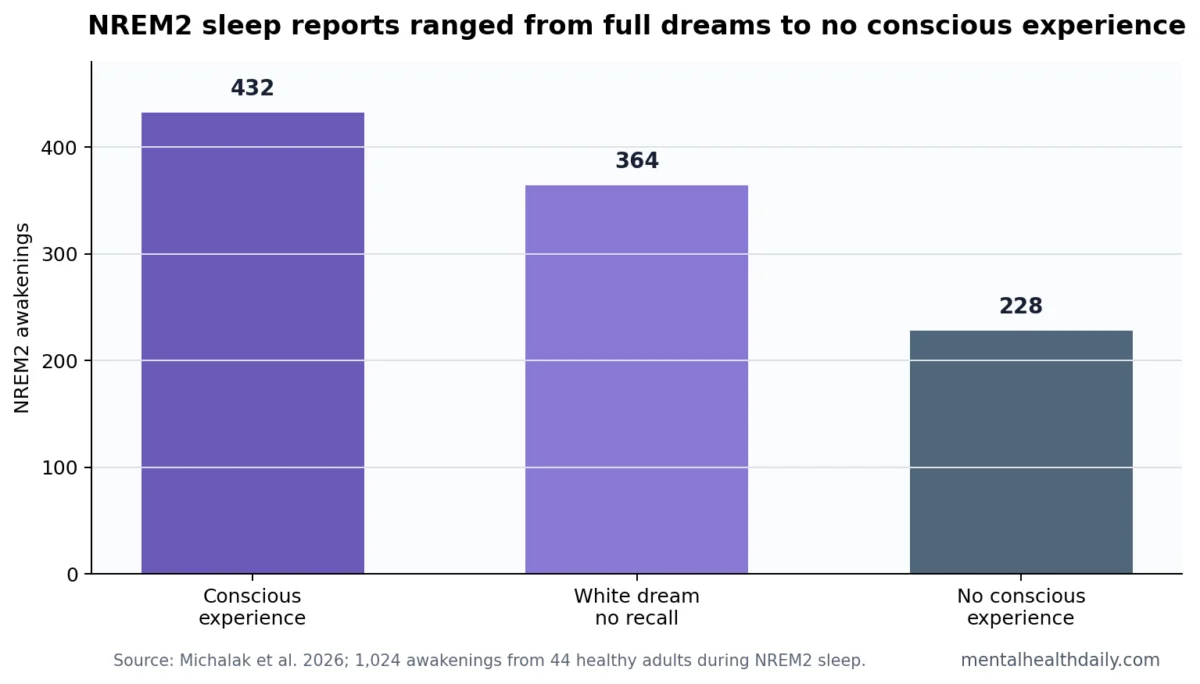
The collected reports were meticulously categorized into three broad groups: 432 awakenings involved conscious experiences with recalled content, encompassing vivid dreams and coherent narratives. Another 364 awakenings reported conscious experiences without specific recall of content, often referred to as "white dreams" – a crucial category acknowledging that a subjective impression of experience exists even if the details are forgotten. Finally, 228 awakenings reported no conscious experience whatsoever. The inclusion of "white dreams" is particularly significant, as it underscores the researchers’ commitment to differentiating between the absence of recall and the absence of consciousness, a subtle but vital distinction in understanding sleep mentation.
The Quality of Experience: Immersive Dreams Versus Reflective Thought
The most compelling findings emerged from the qualitative analysis of these experiences. Researchers employed principal component analysis to distil the complex dream ratings into two primary dimensions. The first, "Perceptual Immersion," captured elements such as vividness, sensory richness, duration, emotional intensity, bizarreness, and overall REM-like dream quality. This dimension represents a deep, absorbing engagement with the dream world. The second dimension, "Reflective Thought," described more abstract, cognitive, and thinking-like mentation, often characterized by internal monologue or problem-solving without a strong sensory component.
The statistical analysis revealed a clear and significant pattern: Perceptual immersion strongly predicted deeper subjective sleep (beta = 0.277, 95% CI 0.208 to 0.346, p < 0.00001). Conversely, reflective thought was a strong predictor of shallower subjective sleep (beta = -0.195, 95% CI -0.287 to -0.102, p = 0.00004). This striking dichotomy directly challenges the simplistic notion that "dreaming equals light sleep." Instead, it posits that the nature of the dream experience is paramount. Vivid, engaging, and emotionally rich dreams can paradoxically contribute to a perception of profound rest, while fragmented, thought-like mental activity makes sleep feel less restorative. Intriguingly, complete unconsciousness also contributed to a perception of deep sleep, suggesting multiple pathways to feeling well-rested.
EEG Activation: A Complex Relationship with Subjective Depth
High-density EEG, with its ability to record electrical activity from numerous scalp electrodes, provided a nuanced understanding of brain states during these experiences. The study observed that higher gamma activity and a higher gamma-to-delta ratio, typically associated with lighter perceived sleep, showed a complex interaction with conscious experience. When participants reported dreaming, this wake-like cortical activation appeared less disruptive to subjective sleep depth. The researchers described this as an "attenuation" of the usual inverse relationship between high-frequency activity and deep-feeling sleep. This implies that the brain’s "awake-like" patterns during NREM2 dreaming are not necessarily perceived as a disturbance but can be integrated into a subjective experience of deeper sleep.
This finding builds upon previous research by Nir et al. (2010), which demonstrated that dream reports could be predicted by local EEG patterns within a "posterior cortical hot zone," rather than by sleep stage alone. Siclari et al. (2017) further extended this with high-density EEG work, showing that NREM dreaming is dependent on localized sleep dynamics, challenging the idea of a global on/off switch for consciousness during sleep. The Michalak study reinforces this perspective, suggesting that the brain can host pockets of heightened activity, contributing to rich conscious experiences, without necessarily compromising the subjective feeling of deep rest, especially if that activity manifests as immersive dreaming.
The Overnight Trajectory: Sleep Depth and Sleepiness Diverge
Another fascinating discovery concerned the progression of subjective sleep depth and sleepiness throughout the night. As the night advanced, participants consistently reported an increase in subjective sleep depth (beta = 0.127, 95% CI 0.103 to 0.151, p < 0.00001). However, subjective sleepiness followed a distinctly different trajectory; the interaction between time and measure showed that sleepiness increased less steeply than perceived sleep depth (beta = -0.166, 95% CI -0.277 to -0.056, p = 0.00325). This is counterintuitive, as physiological sleep pressure typically declines over the course of the night, leading one to expect a feeling of lighter sleep as the homeostatic need dissipates. Instead, perceived sleep depth rose alongside an increasing prevalence of immersive dream experiences.
This divergence has significant clinical implications. Complaints about "light sleep" from patients may not always correlate directly with conventional sleep-stage scoring or total sleep duration. Instead, factors like the quality of dream experience, the frequency of brief awakenings, sleep inertia, and the memory of mentation immediately prior to awakening may profoundly shape whether sleep is felt to be restorative or fragmented.
Sleep Perception: More Than Just Sleep Architecture
The study meticulously measured the gap between "sleep architecture" – the objective distribution of NREM1, NREM2, NREM3, and REM stages – and the subjective experience of sleep. By directly pairing EEG-defined NREM2 awakenings with immediate reports, Michalak et al. provided a direct measure of this often-overlooked disparity.
This result helps to explain why two individuals with seemingly identical polysomnography reports (objective sleep stage summaries) can report vastly different sleep quality. One sleeper might awaken from NREM2 with an immersive dream, rating their sleep as deep and satisfying. Another, despite spending the same amount of time in NREM2, might report a vague sense of presence, fragmented thoughts, or partial awareness, consequently rating their sleep as shallow and unrefreshing.
This profound finding carries significant implications for measurement in sleep science. It suggests that subjective sleep quality cannot be reduced to a single metric like total sleep time or the percentage of any one sleep stage. A comprehensive model of sleep perception, the researchers argue, requires at least three interwoven layers: objective physiological measurements, the precise timing and context of awakenings, and crucially, the conscious or near-conscious experience immediately preceding awakening.
This also sheds light on why consumer sleep trackers, despite increasingly sophisticated algorithms, can often "feel wrong" to users. While these devices can estimate movement, heart rate, breathing, or even rudimentary EEG-like signals, they cannot discern the qualitative content of consciousness – whether the user woke from an immersive dream, reflective mentation, minimal presence, or true unconsciousness. This inherent limitation means that subjective reports will inevitably diverge from algorithmic scores, highlighting a critical area for future technological development.
Insomnia Relevance and Future Research Directions
The findings hold particular relevance for understanding insomnia, a condition often characterized by a profound mismatch between objective sleep parameters and perceived sleep quality. While the Michalak study focused on healthy adults, it provides a plausible mechanism for this common mismatch: the content and form of near-awakening experience may profoundly shape whether sleep feels deep, fragmented, or absent. If an insomniac spends significant time in NREM2, yet experiences predominantly thought-like, less immersive mentation, they might consistently perceive their sleep as light, regardless of objective staging.
The serial-awakening method, while intensive, offers a powerful advantage by drastically reducing memory delay. Unlike morning dream recall, which can be affected by later sleep cycles, waking interpretation, or forgetting, immediate reports after NREM2 awakenings offer a pristine, close-to-source account of the conscious experience preceding the sleep-depth rating. However, this immediacy comes with a trade-off: repeated awakenings, by design, fragment sleep, making it less natural. Therefore, the study’s results are best interpreted as a controlled map of sleep perception under specific experimental conditions, rather than a perfect replica of an uninterrupted night.
The careful use of "sleep-depth" language is therefore critical. A person complaining of "light sleep" could be describing diverse phenomena: objective stage structure, frequent awakenings, a low arousal threshold, unpleasant thought-like mentation, or a memory of partial awareness. These are overlapping but distinct problems. The 2026 PLOS Biology data compels researchers and clinicians to give greater weight to the latter two possibilities.
Looking ahead, a crucial next step for research would be to pair objective sleep measurements with similarly rich, immediate subjective reports in populations suffering from chronic complaints of poor sleep quality, especially those who report feeling unrested despite adequate measured sleep, or who experience repeated brief awakenings and morning recall gaps. This would help to directly translate the current findings into actionable insights for clinical practice.
Beyond Correlation: Inferring Causality and Expert Commentary
It is important to reiterate that the Michalak study is correlational; it demonstrates a strong association between immersive NREM2 dreaming and deeper perceived sleep, but it does not definitively prove a causal link. To establish causality, future experiments would need to actively manipulate dream immersion or sensory input during sleep and observe the subsequent impact on sleep perception. Furthermore, the very act of serial awakenings, while essential for data collection, inherently fragments sleep and could potentially alter subsequent sleep perception.
As Dr. Eleanor Vance, a hypothetical leading neuroscientist specializing in consciousness studies, might comment, "This study beautifully illustrates that consciousness isn’t an ‘on-off’ switch during sleep, but a spectrum of experiences. The brain’s electrical state provides the canvas, but the subjective content painted on that canvas profoundly shapes our perception of rest. It challenges us to move beyond purely physiological definitions of sleep quality."
The concept of "minimal conscious experience" without full narrative content, as previously argued by Windt et al. (2016), provides a useful framework for interpreting the lowest-depth category in the Michalak study. A vague sense of presence – neither restful unconsciousness nor immersive dreaming – may indeed leave sleep feeling shallow and unrefreshing.
Ultimately, the best inference from this groundbreaking research is that subjective sleep depth is a partly constructed phenomenon. While the brain’s underlying electrical state is undeniably crucial, the specific form and quality of conscious experience occurring within that state are equally vital in determining how restorative and deep sleep feels. This does not diminish the reliability of subjective reports; rather, it elevates them as a distinct and essential layer of sleep measurement. Polysomnography can classify stages and arousal, but an immediate awakening report can capture the nuanced experience of immersion, thought-like content, vague presence, or complete unconsciousness. Treating these sources as competitors misses the point; the truly useful question is how these diverse layers combine to form the complete tapestry of human sleep. For insomnia and broader sleep-quality research, understanding this intricate combination is the practical and imperative target.

