

A groundbreaking 2026 PROTECT study involving 174 older adults has unveiled compelling evidence that self-administered fingerprick blood tests for specific biomarkers can effectively correlate with cognitive function, positioning them as a valuable tool for remote Alzheimer’s risk triage rather than a definitive, stand-alone dementia diagnosis. The research highlights the potential for p-tau217 to correlate significantly with episodic memory (r = 0.299, p < 0.001) and GFAP with working memory (r = 0.183, p = 0.034), marking a substantial step forward in accessible, early detection strategies for neurodegenerative conditions.
The Quest for Early Alzheimer’s Detection: A Pressing Need
Alzheimer’s disease, a progressive neurodegenerative disorder, affects millions globally, gradually eroding memory, cognitive function, and the ability to carry out daily activities. The challenge of early diagnosis has long plagued clinicians and researchers, as definitive diagnosis often requires expensive and invasive procedures like cerebrospinal fluid (CSF) analysis or Positron Emission Tomography (PET) scans, which are not widely accessible. Furthermore, symptoms can be subtle in early stages, often overlapping with other age-related cognitive changes or treatable conditions like depression or vitamin deficiencies, leading to delayed or missed diagnoses.
The development of blood-based biomarkers has revolutionized this landscape over the past decade. These less invasive and more cost-effective tests offer a promising avenue for screening and monitoring. Specifically, phosphorylated tau at amino acid 217 (p-tau217) has emerged as a highly specific blood marker that rises in the presence of Alzheimer’s-type tau and amyloid biology, indicating the core pathological processes of the disease. Glial fibrillary acidic protein (GFAP), on the other hand, is a marker of astrocyte activation, reflecting neuroinflammation, vascular injury, or a broader Alzheimer-related glial response. While both are critical, p-tau217 is generally considered more specific to Alzheimer’s pathology, whereas GFAP can indicate a range of brain insults. Previous research has already established that these markers are more robust in venous blood than many traditional dementia-screening tools, paving the way for the PROTECT study’s ambitious exploration of remote, self-administered collection methods.
The PROTECT Study: Pioneering Remote Capillary Blood Sampling
The 2026 PROTECT study sought to answer a crucial operational question: Could older adults successfully collect capillary blood at home, and would the resulting biomarker values still align meaningfully with cognitive performance, functional status, traditional venous blood measurements, and user feedback? This inquiry into the feasibility and utility of remote capillary sampling represents a significant leap towards democratizing access to early Alzheimer’s risk assessment.
The study commenced with the recruitment of 226 participants from the UK PROTECT research program, a well-established cohort focused on understanding cognitive aging. Of these, 174 participants successfully completed the at-home blood-test kits, forming the final analytical group. This cohort had a mean age of 66.03 years, with 54% female representation, and included a mix of 146 individuals with normal cognition and 28 diagnosed with dementia, providing a valuable spectrum for biomarker correlation.
The workflow designed for the study was intentionally "low-friction," aiming to maximize participant compliance and ease of use. This involved mailing comprehensive kits to participants’ homes, complete with detailed, easy-to-follow instructions for self-collection of capillary blood via a fingerprick device. Participants then returned the samples for laboratory analysis. This streamlined process underscored the practical advantage of capillary sampling: it bypasses the need for clinic visits or phlebotomy pathways, which often present logistical and geographical barriers. By pairing this with computerized cognitive testing, the approach opens doors for remote trial screening workflows and broad-scale public health initiatives that might otherwise be unfeasible.
Key Biomarker Insights: p-tau217’s Specificity and GFAP’s Broader Scope
The study’s findings provided distinct insights into the utility of p-tau217 and GFAP in a remote setting. Capillary p-tau217 demonstrated its strongest cognitive association with episodic memory, a cognitive domain critically and visibly affected early in the typical progression of Alzheimer’s disease. Beyond episodic memory, p-tau217 also correlated with attention, executive function, and both functional measures assessed in the study, indicating its relevance across multiple aspects of cognitive and daily living.
GFAP, while also showing significant correlations, presented a broader but less Alzheimer-specific pattern. It correlated with working memory, executive function, and instrumental activities of daily living (IADLs), but notably not with the IQCODE functional informant measure. Intriguingly, researchers also reported a relationship between elevated GFAP and heart disease, which suggests that GFAP’s elevation might also reflect vascular injury or general neuroinflammation, rather than solely Alzheimer-specific pathology. This aligns with adjacent biomarker research, where studies like Palmqvist et al. (referencing the original article’s reference 2) have shown plasma p-tau217’s ability to discriminate Alzheimer’s from other neurodegenerative disorders, and Ashton et al. (referencing the original article’s reference 3) reported strong diagnostic accuracy for plasma p-tau217 immunoassays against Alzheimer pathology. GFAP, while clinically useful, serves as a less direct Alzheimer’s indicator due to the multifaceted origins of astrocyte activation.
Thresholds and Subgroup Identification
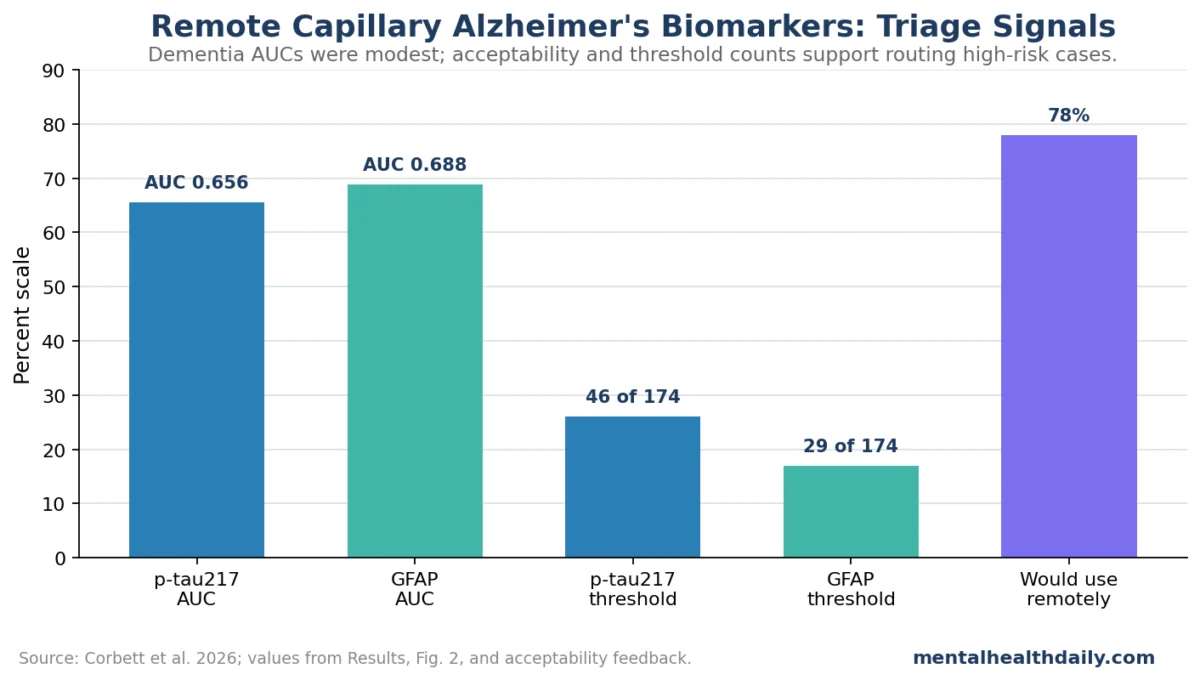
To further explore the clinical utility, Corbett et al. established prespecified 85% specificity thresholds for the biomarkers: 0.016 pg/ml for capillary p-tau217 and 12.45 pg/ml for capillary GFAP. Applying these thresholds, the study identified 46 participants (26%) with elevated p-tau217 and 29 participants (17%) with elevated GFAP, indicating higher-risk subgroups.
Individuals above these thresholds consistently performed worse on several cognitive and functional measures. For those with elevated p-tau217, the memory difference was substantial (Cohen’s d = 0.548, p = 0.020), as were differences in IADLs (d = 0.542, p = 0.017) and IQCODE (d = 0.657, p = 0.001). For GFAP, the IADL difference was even larger (d = 0.754, p = 0.004), and executive function also showed a significant decline (d = 0.541, p = 0.016). These "Cohen’s d" values indicate medium to large effect sizes, suggesting clinically meaningful differences between the groups.
Crucially, the study also validated these capillary results against established venous plasma measurements. Plasma p-tau217 successfully discriminated the capillary p-tau217 threshold group with an Area Under the Curve (AUC) of 0.785, while plasma GFAP discriminated its capillary counterpart with an AUC of 0.895. These strong AUC values confirm that the remote capillary samples produce biomarker values that are consistent with standard venous blood chemistry, ensuring that the remote kit is generating clinically meaningful data rather than an artifact unique to the collection method.
A Triage Tool, Not a Definitive Diagnosis: The Clinical Imperative
The study’s most significant clinical message is that remote capillary sampling for p-tau217 and GFAP serves as an effective triage tool, not a standalone diagnostic instrument. The AUC values for separating dementia from non-dementia status—capillary p-tau217 AUC 0.656 and GFAP AUC 0.688—are better than chance but fall short of the high specificity and sensitivity required for a definitive diagnostic test. A normal result also cannot entirely rule out non-Alzheimer causes of cognitive decline, early pathology below the detection threshold, or future disease conversion.
The paper’s strongest clinical recommendation is for a combined triage profile: identifying individuals with p-tau217 levels above the 85% specificity threshold and memory performance low enough to meet age-associated cognitive decline criteria. This combination can effectively prioritize individuals for faster, more formal dementia evaluation, moving them through the diagnostic pathway more efficiently than symptom questionnaires alone.
This distinction between risk sorting and diagnosis is paramount. An AUC of 0.656 signifies that a substantial overlap exists between biomarker levels in dementia and non-dementia cases. GFAP is even less disease-specific, as astrocyte activation can be triggered by various factors including vascular injury, inflammation, neurodegeneration, and mixed pathologies. Therefore, relying solely on these remote biomarker results for a diagnosis could lead to significant misinterpretations and potentially inappropriate interventions.
Building a Comprehensive Confirmatory Pathway
The clinical utility of capillary biomarkers is contingent upon a well-defined confirmatory pathway. A positive remote result should not leave a patient with an ambiguous label and no clear next steps. Instead, it must trigger a structured sequence of follow-up actions, including comprehensive cognitive testing, medical review, and, when appropriate, confirmatory assessments such as advanced imaging (e.g., amyloid PET, tau PET), cerebrospinal fluid testing, or specialist neurological evaluation.
A workable pathway envisions three distinct roles:
- Risk Identification: Remote capillary biomarkers identify individuals with a higher biological signal for Alzheimer’s or broader neuroinflammatory/vascular risk.
- Clinical Integration: These results are then integrated with a thorough clinical history, medication review, depression screening, sensory assessments, and vascular risk history by a primary care physician or a trained clinician.
- Specialist Referral: Only after this comprehensive initial assessment should patients with persistent concerns and a strong biological signal be referred for specialist evaluation and confirmatory diagnostics.
This approach addresses the "access effect" of remote testing. Many individuals with early cognitive impairment, particularly those in rural areas or facing socioeconomic barriers, never enter specialist pathways due to travel burdens, clinic capacity limitations, or the complexity of trial screening. Mailed capillary kits can significantly lower these barriers, promoting health equity. However, this expanded access also heightens the responsibility to prevent overdiagnosis and ensure appropriate follow-up, underscoring the necessity of a robust confirmatory system.
Implications for Clinical Trials and Routine Screening
Clinical trials represent perhaps the most immediate and impactful use case for remote fingerprick testing. Alzheimer’s prevention and early-intervention trials typically require screening large cohorts to identify a smaller group with specific biomarker profiles. Fingerprick p-tau217 could drastically reduce expensive screen failures by pre-identifying individuals more likely to possess confirmatory amyloid or tau evidence, thereby streamlining recruitment and accelerating drug development.
Routine population screening, however, presents a more complex challenge. For widespread screening programs to be justified, compelling evidence is needed to demonstrate that testing improves patient outcomes, reduces harms, and does not induce avoidable anxiety or unnecessary procedures. A cross-sectional correlation study like PROTECT, while informative, cannot fully answer these complex implementation questions. Longitudinal validation—tracking individuals over several years to see if these markers predict future diagnosis, faster cognitive decline, or treatment eligibility—is the missing link before remote screening can transition into routine primary care pathways.
The "equity argument" for remote testing is strongest when it expands access to follow-up care, rather than replacing it. A mailed kit can reach individuals geographically distant from memory clinics, but the results necessitate interpretation by a clinician who can consider a holistic view of the patient’s health, including lifestyle factors, comorbidities, medications, and psychosocial context.
Furthermore, managing false positives is crucial. A person with elevated GFAP and a history of vascular disease might benefit more from aggressive vascular risk management than an immediate Alzheimer’s label. Conversely, elevated p-tau217 combined with declining memory warrants a focused Alzheimer’s workup. Distinguishing these routes is what makes the biomarker pair clinically valuable. Even low capillary biomarker results should not dismiss a caregiver’s report of worsening memory or functional decline. Instead, a low signal should narrow the immediate Alzheimer’s biomarker probability while keeping a broader differential diagnosis open, which is critical in primary care where numerous conditions can mimic early dementia.
Expert Perspectives and Future Outlook
Experts in neurodegeneration and public health generally commend the PROTECT study for its innovative approach and significant findings. While acknowledging the limitations of a cross-sectional study, they emphasize the transformative potential of remote, less invasive screening methods. "This study represents a crucial step towards making early Alzheimer’s risk assessment more accessible to a wider population," stated a representative from a leading Alzheimer’s research foundation, "but it is imperative that we integrate these tools responsibly within existing healthcare frameworks, ensuring that every positive result leads to appropriate follow-up and comprehensive care, not just a label."
Another neuroscientist specializing in biomarker development added, "The distinction between a triage tool and a diagnostic one is not merely semantic; it’s fundamental to ethical clinical practice. These fingerprick tests can help us prioritize who needs more intensive evaluation, optimizing resource allocation and reducing diagnostic delays. However, they must be part of a carefully constructed pathway that avoids patient anxiety and misdiagnosis."
The PROTECT study undeniably pushes the boundaries of accessible Alzheimer’s risk assessment. By validating self-administered capillary blood tests, it offers a glimpse into a future where early identification is less burdensome and more equitable. However, its ultimate integration into routine healthcare will hinge on continued longitudinal research, robust clinical pathways, and careful consideration of the ethical and practical implications to ensure that these powerful tools genuinely improve patient outcomes and quality of life. The journey from triage research to routine primary care pathways, while promising, demands meticulous validation and thoughtful implementation.

