

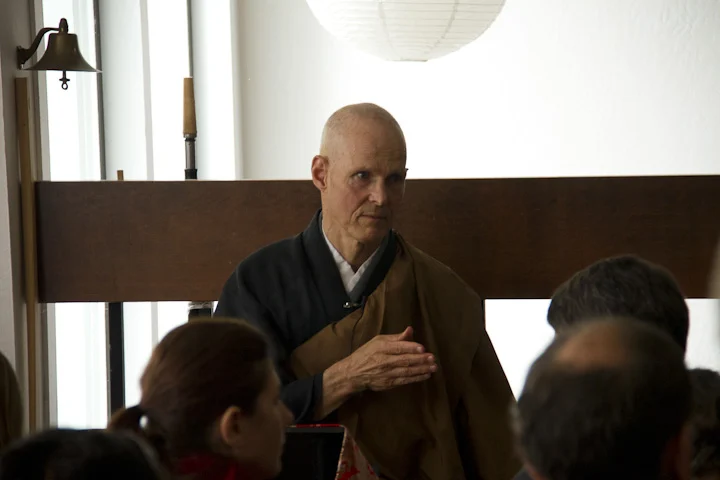
Zen teacher Tenshin Reb Anderson’s latest book, Nothing to Attain: Zen Stories of Faith and Understanding, offers a profound exploration of Buddhist philosophy, weaving together ancient scripture, historical Zen lineage, and personal narrative. The book, published by Shambhala Publications, delves into the core tenets of Zen practice, emphasizing the inherent potential within all beings while acknowledging the journey required to realize it. Anderson, a student of the renowned Shunryu Suzuki and a significant figure in the development of Zen Buddhism in America, presents a nuanced perspective that balances the concept of innate enlightenment with the necessity of diligent spiritual work.
A Foundation in Buddhist Scripture and Parable
At the heart of Anderson’s work lies a fundamental teaching from the Avatamsaka Sutra, also known as the Flower Adornment Scripture. This ancient text states that "all living beings fully possess the wisdom and virtues of the buddhas, but because of misconceptions and attachments, they do not realize it." This assertion forms the bedrock of Nothing to Attain, guiding readers toward an understanding that enlightenment is not an external acquisition but an internal recognition. Anderson posits that the Zen path involves a dual realization: the understanding that "we have nothing to attain" in the sense of gaining something external, and simultaneously, the commitment to the "great work of dropping off misconceptions and attachments."
To illuminate this complex idea, Anderson draws heavily on the parable of the destitute child from the fourth chapter of the Lotus Sutra. This narrative, which shares its theme with the subtitle of Anderson’s book, "Faith and Understanding," depicts a son who wanders away from his wealthy father and spends fifty years in poverty. Upon his eventual return, the son, overwhelmed by his father’s riches and unaware of his familial connection, initially takes on menial tasks, such as shoveling dung. Over time, through gradual exposure and increasing responsibility, he is brought closer to his father and ultimately recognized as his heir. Anderson interprets this parable as a powerful allegory for spiritual practice. The "original home" represents our innate buddha-nature, from which we become estranged through worldly distractions and ignorance. The "expedient practices" and gradual ascent in the parable mirror the steps taken in Zen training, leading eventually to the "real selfless practice of the buddhas, which is our family business." The treasures, Anderson notes, come to the son "without any intention to obtain them," underscoring the idea that true realization arises organically when the self is purified of obscuring attachments.
A Journey Through Zen History and Lineage
Nothing to Attain is not solely a philosophical treatise; it is also a rich historical tapestry, offering readers an accessible introduction to the lineage of Zen masters who have shaped the tradition. The book thoughtfully introduces key figures from early Chinese Buddhism, including the legendary first ancestor Bodhidharma, and prominent masters of the Tang dynasty such as Mazu, Yangshan, Guishan, and Dongshan, who flourished in the 8th and 9th centuries CE. The narrative continues through the influential Japanese Zen masters Dogen and Hakuin, providing context for the development and transmission of Zen teachings across centuries and cultures.
Anderson’s approach to presenting these historical figures is notable. He generally employs the original Chinese transliterations of their names. While this choice reflects a commitment to historical accuracy and may resonate with practitioners familiar with these forms, it could initially present a challenge for some readers who are more accustomed to the Japanese renderings of these same individuals, often encountered in koan study. Figures like Juzhi (Gutei), Zhaozhou (Joshu), and Xuefeng (Seppo), for instance, may require a moment of recognition for those familiar with their more common Japanese appellations. Anderson’s translations and adaptations of Zen scriptures and stories are characterized by a focus on accessibility. He draws upon existing English translations, such as Thomas Cleary’s Book of Serenity, but his own versions are crafted to be readily understandable, suggesting a pedagogical intent to engage newer practitioners with the foundational texts of Zen. This approach prioritizes clarity and immediate relevance over strict linguistic fidelity, aiming to make the profound wisdom of these ancient texts available to a wider audience.
Personal Reflections and Encounters with a Revered Teacher
A significant portion of Nothing to Attain is dedicated to Anderson’s personal journey and his formative experiences within the San Francisco Zen Center. He recounts his early life in Minnesota, where his initial encounter with Zen came through Paul Reps’s seminal work, Zen Flesh, Zen Bones, published in 1957. During his studies in psychology at the University of Minnesota, Anderson developed an intuitive understanding of the profound connection between physical posture and mental state. Sensing that his burgeoning spiritual interests extended beyond the academic realm, he made the pivotal decision to leave graduate school. His destination was the San Francisco Zen Center, a place he had visited previously. This decision was reportedly solidified by observing his graduate advisor eating at McDonald’s, hunched over a hamburger in a posture Anderson described as resembling "a kind of question mark"—an image that seemed to embody a disconnect he sought to transcend.
It was in San Francisco that Anderson’s path converged with that of Shunryu Suzuki, a figure of immeasurable importance in the introduction and establishment of Zen Buddhism in America. Anderson’s deep respect and admiration for Suzuki are palpable throughout the book. He shares anecdotes that illuminate Suzuki’s profound wisdom and his unique teaching style. One particularly memorable story concerns Anderson’s dharma name, Tenshin, which Suzuki initially explained with characteristic simplicity and depth as "Reb is Reb." This seemingly enigmatic pronouncement encapsulates a core Zen principle: the recognition of one’s fundamental nature, free from conceptual adornment. Even decades after Suzuki’s passing in 1971, Anderson’s narrative reveals the enduring impact of his teacher, offering readers a glimpse into the profound mentor-student relationship that shaped his own spiritual trajectory and, by extension, the trajectory of Zen in the West. The inclusion of more stories about Suzuki is presented as a gift to the reader, a testament to the teacher’s enduring legacy.
Navigating Challenges and Controversies
While Nothing to Attain celebrates the transmission of wisdom and the unfolding of spiritual realization, it also implicitly acknowledges that the path is not always smooth, and that even respected teachers navigate complex challenges. The review of Anderson’s book touches upon significant events in his life that have been subjects of public discussion and scrutiny within the Zen community.
One such event, which occurred in 1987, involved Anderson’s arrest for brandishing a firearm. At the time, Anderson was the abbot of the San Francisco Zen Center. He maintained that he retrieved an unloaded gun from his home after being mugged and subsequently confronted the assailant. This incident led to a six-month voluntary leave of absence from his leadership role. Upon his return in 1988, he served as co-abbot with Sojun Mel Weitsman until 1995.
The circumstances surrounding this event are further complicated by Anderson’s own account in his 2001 book, Being Upright: Zen Meditation and the Bodhisattva Precepts. He describes an earlier incident, occurring approximately four years prior to the arrest, shortly after receiving dharma transmission from Zentatsu Richard Baker (though Baker has reportedly disputed the completion of this transmission). Anderson recounts finding a gun alongside the body of a man who appeared to have committed suicide while running in Golden Gate Park. He stated that he sat zazen with the body, intending to return. He claims that after his third visit to the site, he informed a police officer, and on a subsequent visit, he took the gun home.
The reviewer notes that even accepting Anderson’s narrative, elements of "arrogance and inflation" are present, raising questions about integrity. The implausibility of certain aspects of the story, coupled with a lack of corroborating witnesses beyond the eventual arrest for brandishing, leads to speculation about the true sequence of events.
These controversies, alongside the murkiness surrounding his dharma transmission (which itself passed through the controversial figure of Richard Baker), have led some to question Anderson’s suitability as a Zen teacher. Conversely, others point to his continued respect among his peers, evidenced by endorsements from fellow Zen teachers for Nothing to Attain, as indicators of his continued standing and the value of his teachings.
The Paradoxical Nature of Zen
The review thoughtfully frames these challenges within the broader context of Zen philosophy. Zen, it is noted, teaches that existence is inherently paradoxical. Every individual possesses an innate buddha-nature, yet is also fallible and prone to delusion. As Anderson himself expresses, all beings are "living together in a sea of suffering." This understanding suggests that a balanced perspective is essential, one that acknowledges both human shortcomings and the potential for profound wisdom and contribution. Therefore, the review suggests, the most constructive approach may be to recognize Anderson’s imperfections while simultaneously appreciating the valuable teachings he offers.
Conclusion: Practice Over Doctrine
Ultimately, Nothing to Attain is presented as a book that emphasizes the primacy of practice in Zen. While study and intellectual understanding are important, the true essence of Zen lies in the embodied experience of meditation and ethical conduct. To the extent that Anderson’s book serves as a guidepost, leading readers back to the core principles of Zen, introducing them to the lineage of ancestral masters, or offering fresh insights to seasoned practitioners, it is deemed a valuable contribution. The concluding message, as articulated by Anderson in the book’s final paragraph, serves as a powerful reminder: "there is nothing to attain and everything to realize." This encapsulates the transformative potential of Zen practice, urging individuals to look inward and awaken to the inherent fullness of their being. The book’s impact lies not in acquiring something new, but in uncovering what has always been present, obscured by the dust of ordinary existence.

