

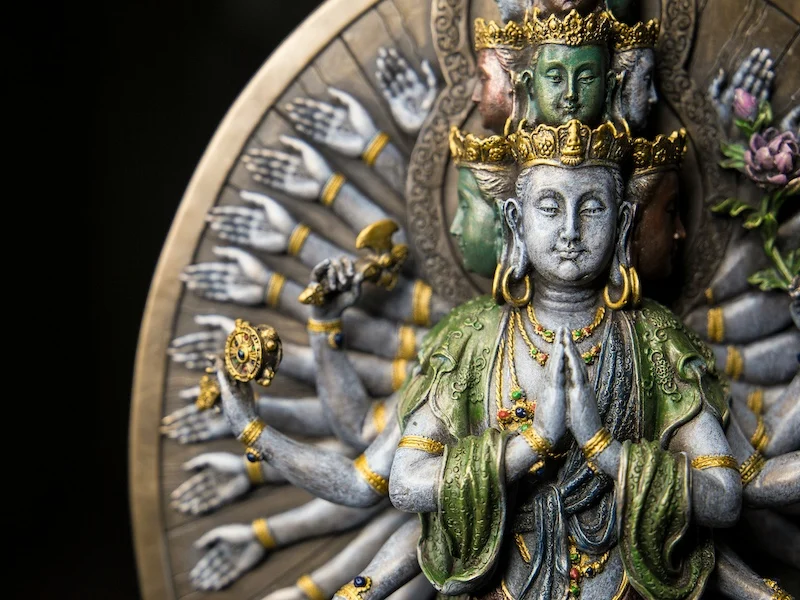
The narrative of Avalokiteshvara, the Bodhisattva of Great Compassion, offers profound insights into navigating the complexities and adversities of our contemporary world. In an era marked by pervasive challenges, often characterized by the Buddhist "three poisons" of greed, hatred, and ignorance—which appear shamelessly rampant across global societies—individuals frequently confront overwhelming circumstances. The persistent influx of difficult news and escalating global crises can foster a sense of despair, leaving many questioning how to move forward. This ancient Buddhist story, however, provides a framework for resilience and renewed purpose, suggesting that turning towards the principle of Great Compassion can offer solace and the realization that one is not isolated in their struggles.
The Buddha’s Awakening and Mission
The story’s context is rooted in the foundational narrative of Siddhartha Gautama, who, over twenty-five centuries ago, attained full and perfect enlightenment, becoming the Buddha, the Awakened One. According to legend, his immediate realization was one of profound unity: "Wonder of Wonders! All beings are already Buddha, fully endowed with wisdom and virtue. Only their unconscious habit of dualistic, self-centered thinking prevents the realization of this!" This transformative experience was so profound that the Buddha remained absorbed in its depths for three weeks. Initially, he contemplated the difficulty of conveying this subtle truth. However, persuaded by divine beings, he embarked on a lifelong mission to share the path to liberation he had discovered with others.
The Buddha’s decision to teach, despite having attained ultimate peace, underscores a core principle of Mahayana Buddhism: the aspiration to benefit all sentient beings. A parable illustrates this dedication: when asked by his disciples about the relative amount of leaves on the ground versus those he had realized through enlightenment, the Buddha held up a small handful of leaves. He explained that his realization was akin to the vast number of leaves on the ground, while his teachings were like the small handful—limited to what was essential for the cessation of suffering. This emphasizes that the ultimate aim of his enlightenment was the alleviation of suffering for all.
Avalokiteshvara: The Embodiment of Boundless Compassion
While the term "love" is not as frequently emphasized in Buddhist discourse, particularly in Zen, its essence permeates the tradition. William Blake, a prominent figure in Western thought, articulated a similar sentiment: "Eternity is in love with the productions of time." Avalokiteshvara, the 1,000-armed Bodhisattva of Great Compassion, is understood as the active manifestation of this immense, selfless, and non-dual love. This is not a superficial sentiment; each of the Bodhisattva’s thousand arms culminates in a hand, within which rests an eye. These eyes symbolize awakened, transcendental, non-dual wisdom, essential for guiding actions effectively. Without this wisdom, even well-intentioned efforts could lead to unintended harm. The Bodhisattva’s eleven heads further signify the capacity to perceive and understand suffering across all realms.
The genesis of Avalokiteshvara’s myriad forms and capacities is rooted in a powerful narrative of commitment and transformative response to suffering.
The Myth of the Empty Hells
According to Buddhist legend, countless eons ago, the great Bodhisattva Avalokiteshvara, typically depicted as male but often recognized as female in East Asian traditions (e.g., Guanyin in China, Kannon in Japan), observed the profound suffering within the various hell realms. A monumental vow arose within the Bodhisattva: "I will liberate all beings from the sufferings of the lower realms." For immeasurable periods, Avalokiteshvara diligently worked, descending into each hell realm and freeing its inhabitants. This arduous endeavor continued until, at last, the hells were emptied, and all sentient beings were liberated from their suffering.
Upon completing this unimaginable task, the Bodhisattva surveyed the now-silent and empty hells with profound satisfaction, a radiant smile gracing his countenance. The raging fires had been extinguished, the bubbling cauldrons stilled, and even the tormenting demons had been released. A sense of profound completion settled.
However, this moment of triumph was short-lived. Suddenly, wails and screams erupted, flames surged anew, and the hells were once again filled with suffering beings and their tormentors. The Bodhisattva’s smile vanished, replaced by the deepest sorrow. In response to this overwhelming resurgence of suffering, the Bodhisattva’s form transformed: the single head broke into eleven, and the two arms shattered into a thousand. This transformation symbolized an enhanced capacity to perceive suffering in all directions (eleven heads) and to extend help to every being in every realm (a thousand arms). With renewed resolve, the Bodhisattva rolled up his sleeves and recommitted to the seemingly endless task.
Learning from Failure and Despair
This pivotal moment in the Avalokiteshvara narrative underscores a crucial lesson: out of profound and hard-won failure, out of immense despair, arose not withdrawal or resignation, but a greater commitment and refined skill. This echoes the sentiment expressed by Wu-men in his Gateless Barrier (or Mumonkan), a collection of Zen koans, where, in a related context, he states, "The failure is wonderful indeed."

Zen philosophy posits that the compassionate efforts of a bodhisattva are akin to attempting to fill a well with snow. Each shovelful of snow, upon hitting the water, immediately begins to melt, rendering the task seemingly hopeless and impossible. Yet, it is precisely within this apparent futility that the essence of the Bodhisattva path lies. The term "bodhisattva" itself translates to "wisdom-being" ("bodhi" meaning wisdom, and "sattva" meaning being). A bodhisattva, therefore, is a being who has wisely chosen to transcend their own self-centeredness and dedicate themselves to the benefit of all beings.
This resonates with the words of Leonard Cohen, who wrote, "Now I greet you from the other side / Of sorrow and despair / With a love so vast and shattered / It will reach you everywhere." This sentiment can be seen as the voice of Avalokiteshvara, embodying a love that is not diminished by suffering but amplified by it.
The Three General Resolutions: A Path to Practice
Buddhist tradition succinctly summarizes the Buddha’s teachings in three general resolutions: "Avoid evil. Do good. Save the many beings." This profound yet simple directive is often tested in practice. A well-known Zen anecdote illustrates this: a distinguished governor of a Tang-era Chinese province, also a poet, approached the renowned Bird’s Nest Roshi for the highest teaching. Bird’s Nest Roshi responded with the three resolutions. The governor, accustomed to sophisticated discourse, dismissed this as something even a child would know. Bird’s Nest Roshi, however, countered, "Yes. But a man of seventy still finds it hard to put into practice."
Implications for Contemporary Challenges
The story of Avalokiteshvara serves as a potent metaphor for confronting the daunting challenges of our time. The "three poisons" of greed, hatred, and ignorance are not abstract concepts but manifest in systemic inequalities, political polarization, and environmental degradation. The scale of these issues can induce feelings of powerlessness and despair, mirroring the Bodhisattva’s initial shock at the return of suffering.
However, Avalokiteshvara’s transformation—the multiplication of heads and arms—suggests a path forward: not by succumbing to despair, but by cultivating a more expansive capacity for perception and action. This implies the need for enhanced awareness of the interconnectedness of all beings and the development of skillful means to address suffering at its roots.
The Bodhisattva’s thousand arms and eleven heads are not an inherent attribute but a manifestation born from failure and a deepened commitment. This suggests that our own efforts to alleviate suffering, even if they seem insufficient or met with setbacks, contribute to the ripening of wisdom and compassion. Each instance of "failure" or difficulty can, in fact, be a catalyst for greater dedication and more refined approaches.
For individuals today, the implication is to embrace the role of "beginner bodhisattvas." This involves acknowledging the pervasive nature of suffering, both within ourselves and in the world, and committing to the principles of avoiding harm, cultivating positive actions, and working towards the well-being of others. The analogy of "filling a well with snow" highlights the long-term, persistent nature of this endeavor. It requires unwavering dedication, even when the results are not immediately apparent.
The story encourages a shift in perspective: rather than being paralyzed by the enormity of global problems, we are invited to cultivate the resilience, wisdom, and compassion exemplified by Avalokiteshvara. By acknowledging the reality of suffering and responding with a commitment to alleviate it, even in small ways, we too can develop the capacity to extend a helping hand, to speak out against injustice, and to contribute to a more compassionate world, ultimately rolling up our sleeves and returning to the essential work. This continuous engagement, fueled by wisdom and boundless compassion, is the enduring legacy of the Bodhisattva of Great Compassion.

