

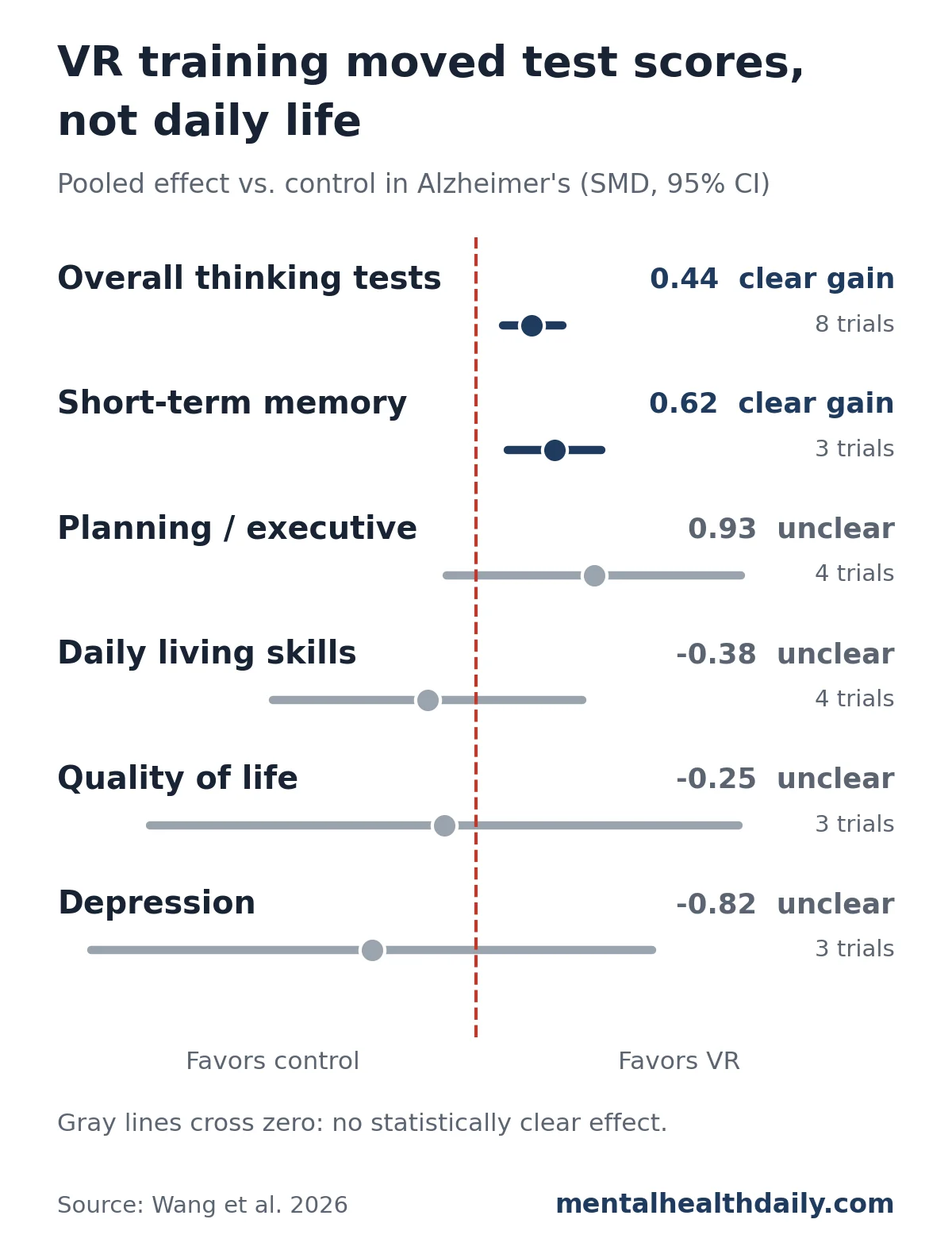
A comprehensive 2026 meta-analysis, synthesizing findings from 11 small randomized trials, has indicated that virtual reality (VR) training offers a modest improvement in cognitive test scores for individuals diagnosed with Alzheimer’s dementia. The analysis reported a standardized effect of 0.44 for overall thinking abilities. However, the review, led by Wang et al. from Wuhan, found no clear evidence that VR training produced substantial benefits in critical areas such as everyday functioning, quality of life, or mood. The researchers themselves underscored the preliminary nature of these findings, characterizing the evidence as "weak" due to the small scale of the included studies and various design limitations.
This meta-analysis arrives at a crucial juncture in Alzheimer’s care, a field desperately seeking effective, non-pharmacological interventions. With pharmaceutical options like anti-amyloid antibodies (e.g., lecanemab) offering benefits primarily in the early stages of the disease and carrying significant risks such as brain swelling and bleeding, families and care providers are increasingly exploring alternative strategies. The appeal of VR lies in its potential to support cognitive function and independence without the severe tradeoffs associated with some drug therapies. Unlike previous reviews that often aggregated data from individuals with mild cognitive impairment (MCI) of various etiologies—vascular, frontotemporal, and others—this particular study focused exclusively on participants with diagnosed Alzheimer’s disease, aiming to provide a clearer understanding of VR’s specific impact within this population.
The Evolving Landscape of Alzheimer’s Treatment and Non-Pharmacological Interventions
The global challenge of Alzheimer’s disease continues to grow, with millions affected worldwide. Despite decades of intense research, a definitive cure remains elusive, and current treatments largely focus on symptom management and slowing disease progression, often with limited efficacy and notable side effects. This reality has spurred a significant pivot towards non-pharmacological interventions, which are increasingly recognized for their potential to complement medical treatments, improve quality of life, and enhance daily coping mechanisms for patients and caregivers alike.
For years, cognitive training has been a cornerstone of non-drug interventions, evolving from traditional paper-and-pencil exercises to sophisticated computer-based programs. The emergence of digital technologies, particularly virtual reality, has injected new optimism into this domain. VR offers a unique blend of immersion and interactivity, creating multisensory environments that are believed to hold attention more effectively than conventional methods. The underlying hypothesis is that an engaging, game-like setting can motivate individuals with dementia to practice longer and activate multiple brain regions simultaneously—encompassing movement, planning, and memory within a single, cohesive task. This holistic engagement is thought to foster greater cognitive improvements and, ideally, translate into real-world functional gains.
The timeline of VR’s integration into healthcare has seen a gradual but accelerating adoption. Initially explored for rehabilitation, pain management, and anxiety reduction, its potential in cognitive training for neurodegenerative diseases like Alzheimer’s became a natural progression. Early studies in the late 2010s began to hint at cognitive benefits, often using less sophisticated "exergaming" platforms like the Nintendo Wii or Xbox Kinect. These early explorations laid the groundwork for more rigorous investigations into how immersive technologies could be tailored to the specific needs of individuals living with dementia.
Deconstructing "Virtual Reality" in Alzheimer’s Research: Beyond the Headset
It is critical to understand what "virtual reality" encompassed within the context of the 11 trials analyzed in the Wang et al. meta-analysis. The term often conjures images of fully immersive headsets that transport users to entirely different digital worlds. However, the definition adopted by these studies was considerably broader, reflecting the diverse range of digital interactive technologies available and tested over the past decade. The search terms utilized for identifying relevant studies included "Wii," "Kinect," "Xbox," "video games," and "computerized cognitive training," indicating a wide spectrum of digital platforms.
The included studies primarily fell into two main categories: those utilizing interactive video games or "exergames" that often involve physical movement tracked by sensors (ee.g., Wii Fit), and those employing structured computerized cognitive training programs typically accessed via a regular screen. Only a minority of programs utilized true head-mounted displays that provided a fully surrounding, immersive experience, such as a nature-scene program implemented in a U.S. care facility. The largest trial contributing to the meta-analysis, for instance, focused on structured computerized cognitive training delivered through a standard monitor. Therefore, it is important for the public and healthcare providers to recognize that "VR" in this research largely signifies interactive digital training, not necessarily the fully immersive, goggle-based experiences often associated with modern virtual reality technology.
The "trial snapshot" reveals common characteristics among the studies: participants were typically individuals with mild to moderate Alzheimer’s dementia, engaging in sessions ranging from 10 to 40 over a period of 4 to 12 weeks, usually two to three times per week for 20 to 45 minutes per session. This consistency in intervention intensity provides a baseline for understanding the observed effects.
Cognitive Gains: A Detailed Examination of Test Score Improvements
The findings related to cognitive test scores were reported using a standardized mean difference (SMD), a statistical measure that normalizes results from different test scales into a common unit—specifically, how far apart the VR and control groups ended up, measured in standard deviations. Standard conventions interpret an SMD of 0.2 as a small effect, 0.5 as a moderate effect, and 0.8 as a large effect.
For overall cognition, a composite measure typically assessed using widely recognized instruments such as the Mini-Mental State Examination (MMSE) or the Alzheimer’s Disease Assessment Scale–Cognitive Subscale (ADAS-Cog), eight trials were pooled. These trials yielded an SMD of 0.44 (95% CI 0.21 to 0.68). This falls within the range of a moderate effect, suggesting a tangible, albeit not dramatic, improvement in general thinking abilities. The moderate heterogeneity among the trials (I² = 43%) indicated some variability in results, but not enough to undermine the overall conclusion. Furthermore, the robust nature of this finding was supported by sensitivity analyses, which showed that removing any single trial did not alter the fundamental conclusion.
Even more pronounced improvements were observed in short-term memory, a crucial cognitive domain often significantly impacted in Alzheimer’s. Measured through tasks like digit span, three trials contributed to an SMD of 0.62 (95% CI 0.25 to 0.99), indicating a moderate to large effect. The close agreement of results across these three trials lent further credibility to this specific finding. The visual representation in the accompanying forest plot confirmed that only these two cognitive-test outcomes—overall thinking tests and short-term memory—had confidence intervals that remained above zero, statistically signifying a benefit over control conditions.
Subgroup analyses, however, failed to yield statistically significant distinctions. Neither exercise-based VR (SMD 0.33) nor purely cognitive VR (SMD 0.63) demonstrated individual statistical significance, nor was there a significant difference between their effects. Similarly, while the point estimate for moderate dementia (0.70) appeared larger than for mild dementia (0.35), this gap was not statistically confirmed, and the moderate dementia group was based on only three trials, limiting the generalizability of this observation.
A compelling, though preliminary, finding emerged regarding executive function—the set of mental skills involved in planning, task switching, and impulse control. Overall, executive function did not show significant improvement (SMD 0.93, 95% CI –0.23 to 2.09). However, a tantalizing hypothesis arose from a subgroup analysis: in the two trials that included 24 or more sessions of VR training, the effect on executive function was substantial and statistically significant (SMD 1.6). In contrast, the two trials with fewer sessions showed no such benefit. While this suggests that longer durations of VR training might be necessary for executive function gains, the very small sample size (two trials per subgroup) means this should be treated as a hypothesis requiring much more robust investigation rather than a definitive "dosing rule."
The Unanswered Questions: Daily Functioning, Quality of Life, and Mood
Despite the observed cognitive gains, the meta-analysis delivered a sobering message regarding the outcomes that families and caregivers often prioritize most: real-world functional improvements and overall well-being. The study found no statistically clear change in daily living skills, quality of life, mood (including depression), or the risk of falls.
The reported scores were standardized such that higher values consistently indicated a better outcome. Interestingly, for some of these critical measures, the point estimates leaned slightly towards the control group, implying a potential, albeit non-significant, negative trend for the VR intervention. However, it is crucial to interpret these findings with caution. The confidence intervals for these outcomes were exceptionally wide, encompassing both potential benefit and potential harm. Therefore, the accurate interpretation is not that "VR made daily life worse," but rather that the effect on these outcomes remains "unknown" based on the current evidence.
Wang et al. posited that these non-significant results might stem from insufficient statistical power in the included trials rather than a definitive absence of effect. This argument holds some plausibility, particularly for outcomes like balance and falls, where the point estimates showed a positive, albeit non-significant, trend. However, for daily living and quality of life, where the best estimates were on the "wrong side of zero" (i.e., leaning towards the control group), the data do not yet provide any directional hint of benefit that researchers or clinicians can confidently lean on.
This pattern is not unique to VR. The meta-analysis highlights a consistent theme observed over two decades of research into non-VR brain training for dementia. Numerous reviews, utilizing various technologies and diverse patient populations, have converged on a similar conclusion: modest improvements in cognitive test scores often fail to translate into meaningful enhancements in daily functional abilities. Test-score gains, it seems, tend to remain specific to the trained tasks. Performing better on an MMSE or a digit-span test after weeks of memory-focused games is distinct from remembering to take daily medications consistently or effectively managing personal finances—tasks that represent the true challenges of living with Alzheimer’s.
Scrutinizing the Evidence: Weaknesses and Limitations
While a meta-analysis of randomized controlled trials typically represents a high level of evidence, the inherent weaknesses of the individual studies comprising this review significantly temper the strength of its conclusions. The pooled result, at best, supports a claim that short VR programs can modestly elevate cognitive test scores in individuals with mild-to-moderate Alzheimer’s dementia at the conclusion of the training period. Crucially, it provides no support for claims that VR slows disease progression, preserves independence over the long term, or substantially improves mood.
Specific weaknesses inherent in the underlying trials include:
- Small Participant Numbers: The average number of participants per trial was approximately 36, making it difficult to detect subtle effects or generalize findings to the broader Alzheimer’s population.
- Heterogeneous VR Definitions: The broad interpretation of "VR" meant that diverse programs, ranging from simple video games to more immersive experiences, were grouped together, potentially masking differential effects of specific technologies or approaches.
- Lack of Blinding: Most trials lacked blinding for participants and trainers, introducing potential performance and observer biases that could inflate perceived benefits.
- Potential Publication Bias: The possibility that studies with positive results are more likely to be published than those with null or negative findings could skew the overall evidence base.
- Short Duration of Interventions: The trials typically lasted only 4 to 12 weeks, making it impossible to assess long-term effects on disease progression or sustained functional improvements.
Furthermore, one specific claim made in the discussion by Wang et al.—that VR outperformed conventional exercise—runs ahead of the data. This subgroup analysis was based on only two trials, yielding a confidence interval of –6.3 to 6.82. Such a wide interval indicates extreme uncertainty and provides no statistical basis for claiming superiority. These limitations underscore the necessity for more rigorous, larger-scale, and longer-duration studies.
Practical Considerations and Future Directions
For individuals with mild or moderate Alzheimer’s who enjoy games or find traditional exercises unengaging, a supervised VR or exergaming program can be a reasonable and enjoyable activity. The most realistic upside, based on current evidence, is a modest, short-term improvement in cognitive test performance during the active training period. However, it is paramount for patients, caregivers, and clinicians to maintain realistic expectations: current evidence does not suggest that VR will significantly ease daily tasks, slow the progression of the disease, or profoundly impact overall quality of life or mood.
Several key questions frequently arise regarding VR training for Alzheimer’s:
- Does virtual reality slow Alzheimer’s disease? There is currently no evidence to support this claim. The trials were short-term (4 to 12 weeks) and focused on immediate post-training test scores, not long-term disease progression.
- Is a VR headset better than a tablet or Wii game? Head-to-head evidence is lacking to establish the superiority of fully immersive VR headsets over screen-based or exergaming platforms. Most trials in the 2026 meta-analysis utilized screens or game consoles rather than headsets. An earlier meta-analysis did find a larger pooled effect in semi-immersive studies across mixed outcomes, but this was based on only two studies using full immersion.
- How many sessions are needed? Trials typically involved 10 to 40 sessions over 4 to 12 weeks, usually 2 to 3 times per week for 20 to 45 minutes. While overall cognition did not show a significant difference between shorter and longer programs, the preliminary hint for executive function suggested that 24 or more sessions might be beneficial, though this is based on very limited data.
- Did VR make daily living or mood worse? No clear harm was demonstrated. While some point estimates leaned slightly towards the control group, the wide confidence intervals mean the effect on these outcomes remains unknown.
- Does this apply to mild cognitive impairment (MCI)? Not directly. The meta-analysis focused exclusively on participants with diagnosed Alzheimer’s dementia. While computerized training has shown stronger evidence in MCI, those trials often included a mix of impairment causes, not solely Alzheimer’s-related MCI.
Looking ahead, the scientific community and healthcare providers infer the critical need for larger, well-designed, multi-center trials with standardized VR interventions and longer follow-up periods. These future studies must employ consistent definitions of "VR" and prioritize outcome measures that genuinely reflect real-world functional improvements, patient independence, and quality of life, moving beyond mere cognitive test scores. Researchers are also exploring VR’s potential in other aspects of dementia care, such as providing comforting sensory experiences, reducing agitation, fostering social connection, and offering reminiscence therapy, even if these were not the primary focus of the Wang et al. meta-analysis. Patient advocates and care facility managers will continue to weigh the potential benefits of engaging activities like VR against their practical implementation challenges and costs, advocating for comprehensive care plans that integrate various supportive strategies.
In conclusion, the 2026 meta-analysis provides a cautious yet promising glimpse into the potential of virtual reality training for individuals with Alzheimer’s dementia. While it confirms a modest positive impact on cognitive test scores, particularly short-term memory, it simultaneously highlights the critical gaps in evidence regarding improvements in daily functioning, quality of life, and mood. The road ahead requires substantial, rigorous research to transform these modest cognitive gains into tangible, life-enhancing benefits for those living with this challenging disease.

