

A groundbreaking 2026 PLOS Biology study challenges conventional notions of "deep sleep," revealing that the quality of conscious experience during non-rapid-eye-movement stage 2 (NREM2) sleep significantly influences how profoundly an individual perceives their rest. Utilizing 256-electrode EEG and an unprecedented 1,024 NREM2 awakenings, researchers Michalak et al. found that immersive dreaming predicted deeper subjective sleep (beta = 0.277), while abstract reflective thought correlated with shallower subjective sleep (beta = -0.195). This pivotal research suggests that the brain’s subjective interpretation of sleep is not merely a function of physiological metrics but is profoundly shaped by the intricate landscape of inner experience.
Re-evaluating "Deep Sleep" Beyond Traditional Metrics
For decades, the scientific community has largely defined "deep sleep" through physiological markers, primarily focusing on slow-wave activity (NREM3) or the absence of consciousness. However, the lived experience of sleep often diverges from these objective measurements. Individuals frequently report feeling "lightly" rested despite adequate sleep duration or seemingly robust sleep architecture. This new study directly addresses this discrepancy, probing the subjective dimension of sleep depth at a granular level. By systematically awakening participants from NREM2—a stage typically considered less dream-rich than REM sleep but constituting a significant portion of the night—the research team gained direct insights into the mental states preceding awakening and their immediate impact on perceived sleep quality. This approach provides a crucial bridge between the objective world of brainwaves and the subjective realm of consciousness, highlighting the limitations of relying solely on polysomnography (PSG) for a complete understanding of restorative sleep.
The Methodology: A Deep Dive into NREM2 Mentation
The study involved 44 healthy adult participants over 196 overnight recordings, employing high-density 256-electrode electroencephalography (EEG) to precisely monitor brain activity. Participants were repeatedly awakened from NREM2 sleep—a stage characterized by sleep spindles and K-complexes, bridging lighter NREM1 and deeper NREM3 slow-wave sleep. Upon each awakening, participants were immediately asked about their prior mental activity, their perceived sleep depth, and their level of sleepiness. This rigorous design yielded 1,024 subjective reports, offering an unparalleled dataset on NREM2 mentation.
Reports of conscious experience were categorized into three broad groups:
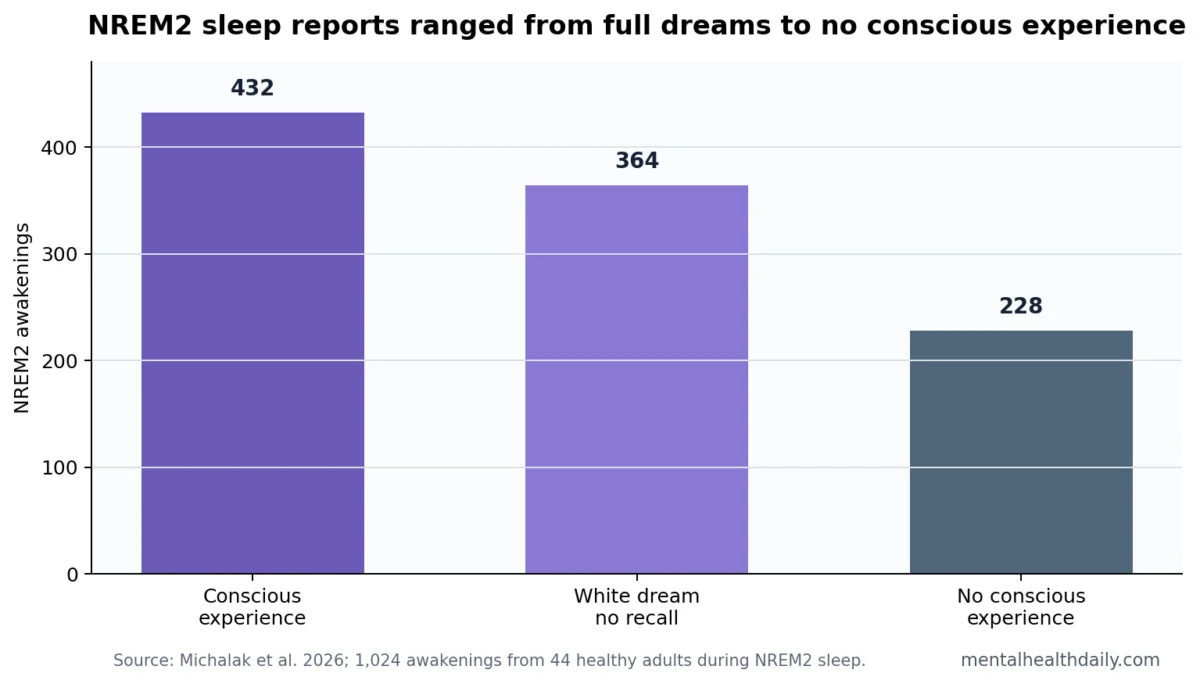
- Conscious experiences with recalled content (432 awakenings): These included vivid dreams or clear mental narratives.
- Conscious experiences without recall of content (364 awakenings): Often referred to as "white dreams," where participants felt they had experienced something but could not remember specific details. This category is vital as it acknowledges the presence of consciousness even in the absence of explicit memory.
- No conscious experience (228 awakenings): Participants reported no mental activity whatsoever.
This meticulous data collection strategy, designed to minimize memory decay and post-awakening interpretation, allowed researchers to correlate specific types of mental content with immediate subjective ratings of sleep depth.
The Quality of Experience: Immersive Dreams vs. Reflective Thought
The most striking revelation emerged from the qualitative analysis of these experiences. Researchers used principal component analysis to distill the dream ratings into two primary dimensions:
- Perceptual immersion: This dimension encompassed vividness, sensory richness, duration, emotional intensity, bizarreness, and overall REM-like dream quality. It represents a state where the sleeper is deeply engrossed in their internal world.
- Reflective thought: This dimension captured more abstract, thinking-like mentation, characterized by internal monologue, problem-solving, or fragmented ideas, often devoid of strong sensory or emotional components.
The statistical analysis showed a clear and robust pattern:
- Perceptual immersion strongly predicted deeper subjective sleep: (beta = 0.277, CI 0.208 to 0.346, p < 0.00001). This finding directly contradicts the simplistic notion that any form of dreaming equates to "light" or less restorative sleep. Vivid, engaging dreams, even within NREM2, were associated with a profound sense of having slept deeply.
- Reflective thought predicted shallower subjective sleep: (beta = -0.195, CI -0.287 to -0.102, p = 0.00004). This suggests that mental activity characterized by abstract thinking or a more fragmented, conscious-like state during NREM2 can lead to the perception of less restorative sleep.
The study highlights that while complete unconsciousness also contributed to a feeling of deep sleep, it was not the exclusive pathway. Immersive conscious experiences presented an alternative route to perceived profundity, offering a nuanced understanding of how we internally gauge the quality of our rest.
EEG Activation: A Decoupling from Subjective Depth
The Michalak et al. study further explored the relationship between high-density EEG patterns and subjective sleep depth. Generally, higher gamma activity and an increased gamma-to-delta ratio in EEG—indicators often associated with wakefulness or lighter sleep—tend to correlate with shallower perceived sleep. However, this study uncovered a fascinating attenuation effect: when participants reported dreaming, this usual inverse relationship between high-frequency activity and deep-feeling sleep was significantly reduced. In other words, wake-like cortical activation appeared less disruptive to subjective sleep depth when embedded within a conscious, immersive experience.
This finding resonates with earlier research by Nir et al. (2010), which demonstrated that dream reports could be predicted by local EEG patterns within specific posterior cortical "hot zones," rather than by global sleep stage alone. Siclari et al. (2017) further extended this with high-density EEG, showing that NREM dreaming relies on local sleep dynamics, challenging the idea of a simple global on/off switch for consciousness during sleep. The Michalak study builds upon these foundations, showing that not only can dreaming occur in NREM, but its qualitative nature can override typical EEG-subjective correlations, redefining how we interpret "wake-like" activity during sleep.
The Evolving Night: Sleep Depth and Sleepiness Diverge
Another counterintuitive finding concerned the trajectory of subjective sleep depth and sleepiness across the night. The study revealed that subjective sleep depth increased as the night progressed (beta = 0.127, CI 0.103 to 0.151, p < 0.00001). This contrasts with the typical physiological expectation that sleep pressure dissipates overnight, leading to a shallower feeling of sleep as morning approaches. Intriguingly, subjective sleepiness followed a different, less steep trajectory, suggesting a dissociation between the two measures (beta = -0.166, CI -0.277 to -0.056, p = 0.00325).
This divergence implies that the feeling of deep sleep isn’t solely dictated by the body’s homeostatic need for rest. Instead, it seems increasingly influenced by the quality of conscious experiences as the night unfolds, particularly the rise of immersive dream states. This challenges the simple "sleep pressure" model and points to a more complex interplay of internal states governing our perception of restorative sleep.
Implications for Clinical Practice and Insomnia Research
The findings from Michalak et al. carry significant clinical implications, particularly for understanding and treating sleep disorders like insomnia. Complaints about "light sleep" are ubiquitous among insomniacs, yet these subjective reports often do not perfectly align with objective measures of sleep architecture, such as total sleep time or sleep stage percentages. This study provides a plausible mechanism for this persistent mismatch.
If a patient reports "light sleep" despite sufficient NREM2 time, it might not be due to frequent arousals or lack of slow-wave sleep. Instead, it could be that their NREM2 mentation is dominated by reflective, fragmented thought rather than immersive, deep-feeling dreams. Conversely, a person experiencing vivid NREM2 dreams might perceive their sleep as deep and restorative, even if other objective markers might suggest otherwise.
This research underscores that subjective sleep quality cannot be reduced to a single metric. A comprehensive model of sleep perception must integrate at least three layers: objective physiology (EEG stages, arousal thresholds), the timing and frequency of awakenings, and, crucially, the specific content and form of conscious or near-conscious experience immediately prior to awakening. For insomnia and sleep-quality research, understanding this complex combination is paramount. Clinicians may need to delve deeper into patients’ subjective experiences, asking not just if they dream, but how they dream, and what mental states accompany their near-awakening moments.
The Future of Sleep Trackers and Integrated Models
The study also casts a critical eye on the limitations of consumer sleep trackers. While these devices have become ubiquitous, estimating movement, heart rate, breathing, or even EEG-like signals, they inherently lack the capacity to discern the qualitative nature of internal conscious experience. A device might accurately estimate NREM2 duration, but it cannot know if that period was filled with immersive dreaming, vague presence, fragmented thought, or true unconsciousness. This inherent gap explains why individuals often find their subjective experience of sleep diverging from their tracker’s "score."
Moving forward, sleep research must embrace integrated models that combine objective measurement with richer, immediate subjective reports. This is particularly relevant for understanding individuals who complain of poor sleep despite objectively adequate sleep, especially those experiencing repeated brief awakenings or gaps in morning dream recall. The serial-awakening method employed by Michalak et al., while creating less "natural" sleep, offers an invaluable template for capturing these immediate experiences, bypassing the distortions of memory delay and post-sleep interpretation.
Methodological Nuances and Cautions
It is crucial to acknowledge that this study, while highly impactful, is correlational. It demonstrates a strong association between immersive NREM2 dreaming and deeper perceived sleep but does not definitively prove causation. Future experiments would be needed to manipulate dream immersion or sensory input directly to establish causal links. Furthermore, the very design of serial awakenings, while providing rich data, inherently fragments sleep and could potentially alter subsequent sleep perception. Therefore, the results are best interpreted as a controlled map of sleep perception rather than a perfect mirror of an uninterrupted night.
The study reinforces the argument by Windt et al. (2016) that minimal conscious experience can exist without full narrative content. This concept helps interpret the "lowest-depth" category in Michalak et al.’s findings: a vague sense of presence may be neither restful unconsciousness nor immersive dreaming, thus contributing to the perception of shallow sleep.
Ultimately, the Michalak et al. study does not render subjective reports unreliable; instead, it elevates their scientific value. It demonstrates that subjective reports measure a distinct, yet critical, layer of sleep experience that polysomnography alone cannot capture. The useful question is not whether objective or subjective measures are "better," but how they combine to form a holistic understanding of sleep health and restoration. This paradigm shift will undoubtedly influence how sleep is studied, diagnosed, and treated in the coming years, pushing the boundaries of our understanding beyond mere brainwave patterns to encompass the profound inner world of the sleeping mind.

