

A comprehensive 2026 analysis of a large European web survey reveals that approximately one in seven adults in Spain who use illicit drugs reported engaging in sexualized drug use (SDU) within the past year. This practice, defined as deliberately taking drugs to enhance or prolong sexual experiences, encompasses a broad spectrum of behaviors. While SDU was a notable finding, the survey underscored that the vast majority of illicit drug use in Spain was for recreational purposes, such as fun, relaxation, or socializing. A significantly smaller proportion, around 3% of the surveyed drug users, reported attending "chemsex parties," a more specific and high-risk form of SDU that has garnered increasing attention from public health authorities.
Understanding Sexualized Drug Use and Chemsex
To properly contextualize these findings, it is crucial to differentiate between sexualized drug use (SDU) and chemsex. SDU is a broad term, lacking a universally agreed-upon definition, but generally refers to the intentional use of any drug to augment or extend sexual activity. This can range from casual cannabis use with a partner to the consumption of stimulants during group sex events. The scope of SDU is wide, reflecting diverse motivations and drug choices.
Chemsex, in contrast, represents a narrower and more intense pattern of SDU. Originating as a term in the United Kingdom, chemsex typically describes prolonged sexual sessions, often involving multiple partners, fueled by a specific cocktail of stimulant and sedative drugs. Common substances associated with chemsex include methamphetamine, mephedrone, and GHB/GBL. Historically, research and public discourse surrounding chemsex have predominantly focused on men who have sex with men (MSM), as this demographic was where the practice was first documented and observed to be more prevalent. However, as the Spanish survey indicates, the practice is not exclusive to this group.
The health risks associated with chemsex are significant and well-documented. It is strongly linked to an elevated risk of acquiring HIV, hepatitis C, and other sexually transmitted infections (STIs) due to risky sexual behaviors often accompanying drug intoxication, such as unprotected sex or sharing injection equipment. Beyond infectious diseases, chemsex is also associated with severe mental health problems. A 2021 systematic review, synthesizing findings from 12 studies, found that MSM who engaged in chemsex were more likely to experience depression, anxiety, or substance dependence. While not every study in the review reached identical conclusions, the trend was clear, with symptoms often being more severe among individuals who injected drugs during sex, a practice known as "slamsex." These findings underscore the urgent need for targeted public health interventions and support services.
Methodology: The European Web Survey on Drugs in Spain
The insights into drug use patterns in Spain stem from an in-depth analysis of the Spanish portion of the European Web Survey on Drugs (EWSD). This anonymous, online survey is a crucial initiative spearheaded by the European Union Drugs Agency (EMCDDA), designed to gather comprehensive data on drug use across 30 European countries. The EWSD aims to understand what substances people use, how frequently, in what settings, their motivations for use, and how they acquire drugs. By leveraging an online platform, the survey seeks to reach a diverse population of drug users, including those who might not engage with traditional healthcare or research settings, thereby providing valuable insights into often hidden populations and behaviors.
For the Spanish analysis, led by Lucia Gallego-Deike and her team, a total of 6,399 individuals participated. Respondents were asked to report on their drug use over the past year. For each illicit substance they had used, they selected their primary reasons for consumption and the typical settings where use occurred. Crucially, one of the available setting options was "chemsex party." Any respondent who selected this option for at least one drug was classified as having engaged in chemsex. This methodology, while reliant on self-reporting and subject to certain limitations, offers a snapshot of drug use patterns and motivations from the perspective of the users themselves.
Dominant Motives: Recreation, Relaxation, and Socializing
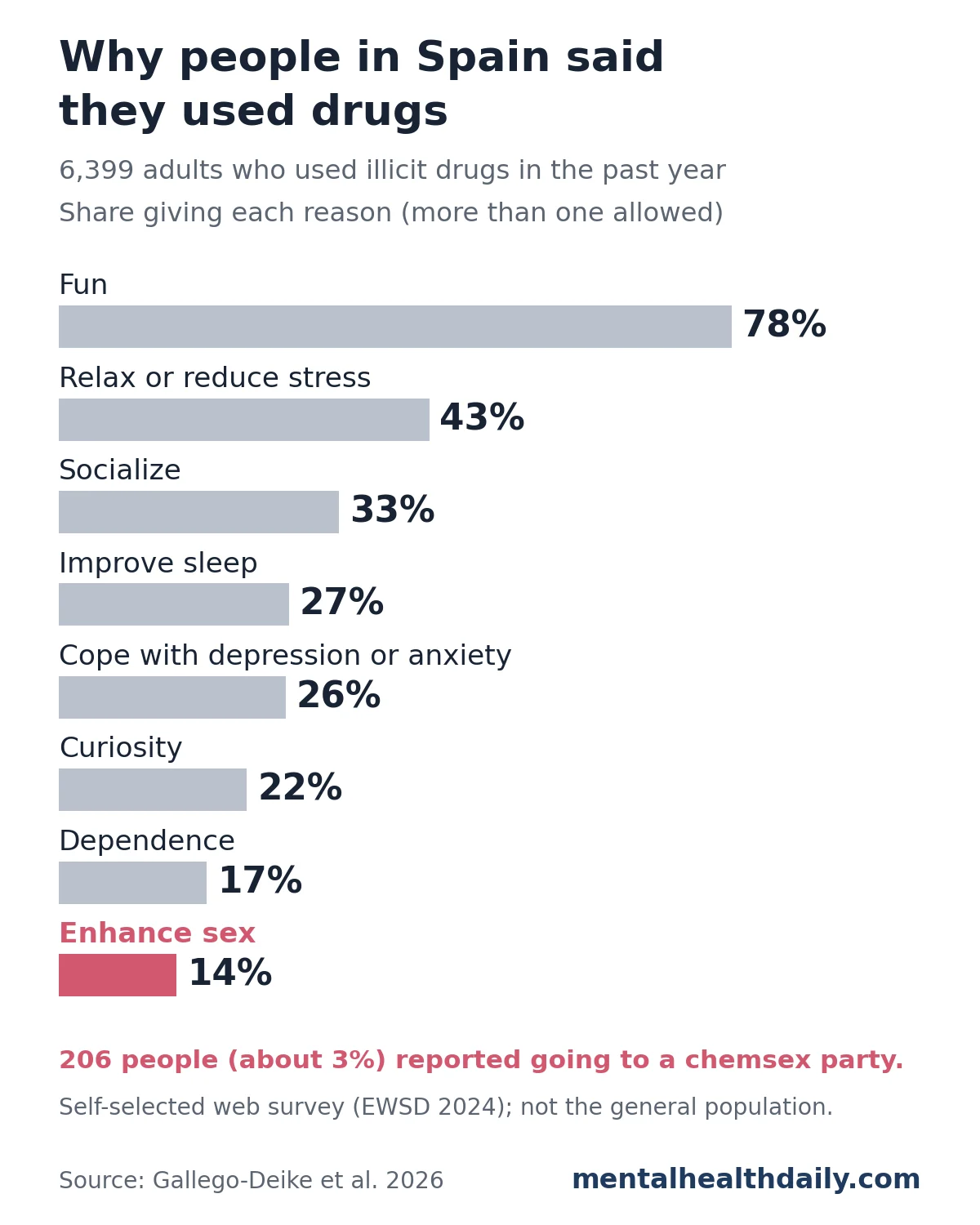
The survey’s findings unequivocally demonstrate that recreation remains the predominant motive for illicit drug use in Spain. "Fun" was cited by an overwhelming 78% of respondents as a reason for their drug use. Other significant recreational and social motives included using drugs to "relax or reduce stress" (43%) and "socialize" (33%). These figures paint a picture of drug use primarily embedded within social contexts and leisure activities.
Using drugs to enhance sex, at 14%, ranked significantly lower on the list of motivations, positioned below improving sleep (27%), coping with depression or anxiety (26%), curiosity (22%), and dependence (17%). This hierarchy of motives suggests that while SDU is a recognized behavior among a segment of drug users, it is not the primary driver for the majority.
The settings where drugs were consumed further illustrate these patterns. Home was the most common setting for most drugs, including 80% of cannabis users, 60% of heroin users, and 49% of cocaine users. This indicates a significant amount of private, non-public drug use. In contrast, MDMA use was overwhelmingly linked to public recreational spaces, with 70% of its users reporting consumption at music festivals or parties. Cocaine also featured prominently in clubs and bars, cited by 52% of its users. These diverse settings reflect the varied social functions and user profiles associated with different substances.
Beyond Recreation: Coping Mechanisms and Dependence
While recreation was dominant, the survey also shed light on the significant role of drugs as coping mechanisms. Cannabis use, in particular, diverged from the purely recreational pattern. A substantial 50% of cannabis users reported using it to relax or reduce stress, 35% to improve sleep, and 28% to manage symptoms of depression or anxiety. This highlights a critical public health concern, as many individuals may be self-medicating underlying mental health issues or sleep disorders with cannabis, potentially delaying professional help and risking dependence.
A similar pattern emerged among the smaller group of heroin users, with 30% citing stress reduction and 30% citing the management of depression or anxiety as reasons for their use. These figures underscore the complex interplay between drug use, mental health, and emotional well-being. Furthermore, the issue of dependence was not insignificant, with 22% of cannabis users and 27% of heroin users explicitly stating they used the drug because they were dependent on it. This points to a pressing need for accessible addiction treatment and support services, particularly for those using drugs to manage chronic stress, mood disorders, or sleep disturbances.
Sexualized Drug Use: A Deeper Dive into Demographics and Substances
Of the 874 individuals who reported using drugs to enhance sex, the majority (712, or 81%) reported using only one drug for this purpose over the past year. A smaller proportion (113, or 13%) used two or more different drugs for sexual enhancement, with the use of five or more substances being rare. This suggests that while SDU is practiced, multi-drug SDU is less common among the general population of drug users in Spain.
When examining which drugs were most frequently used for sexual enhancement among their respective user groups, certain patterns emerged:
- Methamphetamine: 38% of methamphetamine users reported using it for sex.
- Ketamine: 30% of ketamine users reported using it for sex.
- GHB/GBL: 29% of GHB/GBL users reported using it for sex.
- NPS (New Psychoactive Substances): 27% of NPS users reported using them for sex.
- MDMA: 19% of MDMA users reported using it for sex.
- Cocaine: 16% of cocaine users reported using it for sex.
- Cannabis: 13% of cannabis users reported using it for sex.
Despite cannabis having a lower proportion of its users reporting SDU compared to drugs like methamphetamine or ketamine, it was the drug most frequently used for sex overall across all gender groups. This is primarily due to cannabis’s significantly wider prevalence of use compared to less common substances like methamphetamine.
Demographically, individuals who reported using drugs for sex were more often cisgender men (66% compared to 61% of other respondents) and slightly more often identified as transgender or non-binary (3.7% compared to 2.4%). They were also marginally younger on average (30.8 years versus 31.5 years). Interestingly, the survey found no significant differences in education level, income, living situation, or geographical location between those who engaged in SDU and those who did not, suggesting that SDU transcends typical socioeconomic boundaries.
Chemsex Parties: A High-Risk Niche
The survey identified 206 individuals who reported attending a chemsex party in the past year. This represents a distinct and particularly high-risk segment within the broader SDU landscape. The demographic breakdown of chemsex party attendees further refines our understanding: 170 were men, 22 were women, and 14 identified as transgender or non-binary. While men constitute the majority, the presence of women and transgender/non-binary individuals highlights that chemsex is not exclusively a phenomenon among cisgender gay and bisexual men, challenging some prevailing assumptions.
Methamphetamine and New Psychoactive Substances (NPS) were the drugs most strongly associated with chemsex party attendance. Nearly 10% of all methamphetamine users and 5% of NPS users reported consuming these substances at a chemsex party. In contrast, only about 2% or less of cannabis, cocaine, and MDMA users reported use in this specific setting. NPS, which are synthetic drugs designed to mimic the effects of established illicit substances, pose additional risks due to their unknown composition, purity, and lack of regulatory oversight. The survey did not delve into the specific types of NPS used, but their presence in chemsex contexts is a significant concern.
A particularly alarming finding related to chemsex parties was the higher incidence of riskier drug administration routes. Attendees of chemsex parties were more likely to report injecting drugs or smoking them from a pipe. For methamphetamine, 14% of chemsex party attendees reported injecting it, a stark contrast to just 4% of all methamphetamine users. Injecting drugs during sex, known as "slamsex," carries exceptionally high risks, dramatically increasing the chances of HIV and hepatitis C transmission through shared needles, severe overdose, drug-induced psychosis, and rapid development of addiction. These practices necessitate highly targeted harm reduction strategies and immediate access to support services.
Spain in a Broader Context: International Comparisons and Trends
The findings from the Spanish EWSD align with and expand upon existing international research on SDU and chemsex. Estimates of chemsex prevalence vary widely across studies, primarily due to differences in survey populations, methodologies, and definitions of what constitutes "chemsex." For instance:
- A 2017 survey in the UK reported that 21% of gay and bisexual men had engaged in chemsex.
- A 2019 study among MSM in Ireland found that 12% had participated in chemsex.
- A 2018 European-wide online survey among MSM indicated a chemsex prevalence of 11%.
These figures, typically higher than the 3% reported in the general drug-using population in Spain, underscore the specific concentration of chemsex within MSM communities. However, the Spanish data, by surveying a broader drug-using population, demonstrates that SDU and even chemsex extend beyond this group.
This broader reach of sex-linked drug use is consistent with the 2013 Global Drug Survey, which included 22,289 participants. That survey found that substance-linked sex was reported across all sexes and sexual orientations, with at least 20% of every group having used drugs to enhance sex. Alcohol, cannabis, and MDMA were identified as the most common choices for SDU in that wider demographic. While classic chemsex drugs like methamphetamine and GHB/GBL were still more frequently used by gay and bisexual men, the Global Drug Survey helped establish that the phenomenon of using drugs for sexual enhancement is not confined to a single demographic.
Limitations of the Spanish Web Survey
While the EWSD provides invaluable data, it is essential to acknowledge its limitations. As an online survey, it primarily relies on self-reported information, which can be subject to recall bias, social desirability bias, or underreporting of stigmatized behaviors. The sample, while large, is not necessarily representative of the entire drug-using population in Spain or the general adult population. Online surveys tend to attract participants who are more digitally literate and may skew towards certain demographics.
Furthermore, the survey focused exclusively on illicit drugs, meaning it did not capture data on the use of alcohol or prescription medications for sexual enhancement. Given that alcohol and certain prescription drugs are also commonly used in sexual contexts, their exclusion may lead to an underestimation of the true prevalence of SDU. The definition of "chemsex party" was also based on a single self-reported option, which might not fully capture the nuances of individual experiences or the specific context of these events. Despite these limitations, the EWSD remains a robust tool for identifying trends and informing public health strategies.
Implications for Public Health and Care in Spain
The findings from the Spanish EWSD analysis carry significant implications for public health, harm reduction, and clinical care.
1. Routine and Non-Judgmental Screening: The fact that approximately one in seven drug users reported SDU indicates that this behavior is common enough to warrant routine inquiry by health services. Healthcare providers, including general practitioners, mental health professionals, and addiction specialists, should be equipped and trained to ask about drug use in sexual contexts in a non-judgmental, inclusive, and confidential manner. Normalizing these conversations can facilitate disclosure and allow for timely interventions and support.
2. Broadening Prevention and Harm Reduction Strategies: Current prevention and harm reduction campaigns often focus heavily on gay and bisexual men, given the historical concentration of chemsex in these communities. However, the Spanish data clearly shows that SDU and chemsex are practiced by women and transgender or non-binary individuals as well. Public health education and harm reduction initiatives must adopt a wider, more inclusive lens, ensuring that campaigns and services are accessible, relevant, and culturally competent for all affected populations. This includes tailored information on safer drug use, safer sex practices, and overdose prevention, disseminated through diverse channels. Professional training for healthcare providers on the varied presentations of SDU across different demographics is also crucial.
3. Addressing Drug Use as a Coping Mechanism: The substantial proportion of respondents using drugs to manage stress, improve sleep, or cope with depression and anxiety highlights a critical intersection between substance use and mental health. This "coping use" signals underlying needs that require professional attention. Public health campaigns should encourage individuals who rely on drugs to manage mood, stress, or sleep to seek support from doctors or addiction services. Effective treatments for mental health conditions, sleep disorders, and substance dependence are available, and integrating these services can lead to more holistic and successful outcomes. Early intervention for coping-driven drug use can prevent escalation to dependence and more severe health consequences.
4. Integrated Mental Health and Addiction Services: The strong links between drug use, mental health, and sexual health necessitate an integrated approach to care. Services should be designed to address these interconnected issues concurrently, rather than in silos. This includes providing mental health support within addiction treatment programs, offering sexual health screening and counseling in drug treatment settings, and training professionals across disciplines to recognize and respond to the complex needs of individuals engaging in SDU or chemsex.
5. Policy Development and Resource Allocation: The insights from this survey can inform policy development, guiding the allocation of resources towards comprehensive harm reduction programs, accessible treatment services, and targeted public awareness campaigns. A nuanced understanding of why people use drugs, and in what contexts, is essential for creating effective and humane drug policies that prioritize public health and well-being over punitive measures. Continued monitoring through surveys like the EWSD is vital for tracking trends and evaluating the effectiveness of interventions.
In conclusion, the 2026 analysis of drug use in Spain provides a crucial update on patterns of sexualized drug use and chemsex. While recreational motives dominate, the significant presence of SDU, its demographic spread, and the high-risk practices associated with chemsex parties underscore persistent public health challenges. By embracing comprehensive, inclusive, and integrated approaches to prevention, harm reduction, and treatment, Spain can better support individuals affected by these complex behaviors and mitigate associated health risks.

