

A groundbreaking 2026 PROTECT study involving 174 older adults has unveiled the potential of self-administered fingerprick blood tests for remote Alzheimer’s risk triage, marking a significant step towards more accessible early assessment. The research, published in a leading medical journal, found that levels of p-tau217, a specific Alzheimer’s biomarker, correlated significantly with episodic memory (r = 0.299, p < 0.001), while glial fibrillary acidic protein (GFAP), an indicator of astrocyte activation, showed a correlation with working memory (r = 0.183, p = 0.034). These findings bolster the case for remote screening tools to identify individuals at higher risk, thereby streamlining referrals for formal evaluation rather than providing a definitive dementia diagnosis.
Understanding the Biomarkers: p-tau217 and GFAP
At the heart of this innovation are two critical blood-based biomarkers. p-tau217 (phosphorylated tau at amino acid 217) is a highly specific indicator that rises in the blood when Alzheimer’s-type tau and amyloid pathologies are present in the brain. Its specificity makes it a powerful tool for distinguishing Alzheimer’s disease from other neurodegenerative conditions. GFAP (glial fibrillary acidic protein), on the other hand, is a marker of astrocyte activation, which can signal neuroinflammation, vascular injury, or a general glial response associated with various neurological conditions, including Alzheimer’s. While GFAP offers a broader view of brain health, p-tau217 provides a more direct indication of Alzheimer’s pathology.
These blood markers have already demonstrated superior efficacy compared to many traditional dementia-screening tools that rely solely on cognitive assessments. The PROTECT study, led by Corbett et al., aimed to push the boundaries further by investigating a crucial operational question: could older adults successfully collect capillary blood samples at home and still yield biomarker values that align reliably with cognitive function, functional abilities, venous blood results, and positive user feedback? The affirmative answer opens new avenues for scalable, patient-centric screening.
The PROTECT Study: Methodology and Participants
The PROTECT study (Prospective Research in Older People: A Tool for Enhancing Cognitive Training) is a well-established, UK-based online research program designed to track cognitive function and brain health in a large cohort of older adults over time. For this particular investigation, researchers recruited 226 individuals from the PROTECT program. Of these, 174 participants successfully completed the at-home blood-test kits, forming the final analytical group. The cohort was diverse, comprising 146 individuals with normal cognition and 28 diagnosed with dementia, reflecting a spectrum of cognitive states. The mean age of participants was 66.03 years, with 54% identifying as female.
The study’s workflow was intentionally designed for minimal friction and maximum accessibility. Participants received a mailed kit containing all necessary components for a fingerprick blood collection. Detailed, easy-to-follow instructions, often supplemented by video tutorials, guided them through the process. The collected samples were then returned via pre-paid mailers to a central laboratory for analysis. This streamlined approach bypasses the traditional requirement for a clinic visit or phlebotomy service, which can be a significant barrier for many, particularly those in rural areas, with mobility challenges, or who face logistical constraints.
Remote Capillary Sampling: A Triage Tool, Not a Diagnostic Replacement
The overarching conclusion from the PROTECT study is clear: remote capillary sampling for p-tau217 and GFAP is a highly promising triage tool, not a stand-alone diagnostic replacement. The practical advantage of this approach lies in its vastly expanded reach. Unlike venous blood testing, which necessitates clinical infrastructure, capillary sampling can be seamlessly integrated with computerized cognitive testing, mailed kits, and remote trial-screening workflows. This synergy allows for the identification of individuals who would benefit most from more intensive, in-person clinical evaluation.
P-tau217: A More Alzheimer-Specific Signal
The study provided compelling evidence for the specificity of p-tau217. Capillary p-tau217 exhibited its strongest cognitive association with episodic memory, the memory system most typically and visibly affected in the early stages of Alzheimer’s disease. Beyond episodic memory, p-tau217 also correlated with other critical cognitive domains, including attention and executive function, as well as both functional measures assessed in the study (Instrumental Activities of Daily Living – IADL, and the Informant Questionnaire on Cognitive Decline in the Elderly – IQCODE). This pattern strongly supports its role as a marker for Alzheimer’s-related pathology.
GFAP: A Broader Indicator of Neuroinflammation and Vascular Risk
In contrast, GFAP displayed a broader, yet less Alzheimer-specific, pattern of association. It correlated with working memory, executive function, and instrumental activities of daily living (IADL), but notably did not show a significant correlation with the IQCODE functional informant measure. Furthermore, the researchers reported a discernible relationship between elevated GFAP levels and a history of heart disease, lending credence to the interpretation that GFAP levels can reflect broader neuroinflammatory processes or vascular injury, in addition to Alzheimer-related glial responses. This distinction is crucial for appropriate clinical interpretation.
This split in biomarker specificity aligns well with existing adjacent research. Studies by Palmqvist et al. (2017) and Ashton et al. (2021) have previously demonstrated the capacity of plasma p-tau217 to accurately discriminate Alzheimer’s disease from other neurodegenerative disorders and its strong diagnostic accuracy against confirmed Alzheimer’s pathology. While GFAP is undoubtedly clinically useful as a general marker of brain injury or inflammation, its less direct association with Alzheimer’s pathology means it should be interpreted within a broader clinical context.
Identifying Higher-Risk Subgroups: Thresholds and Predictive Power
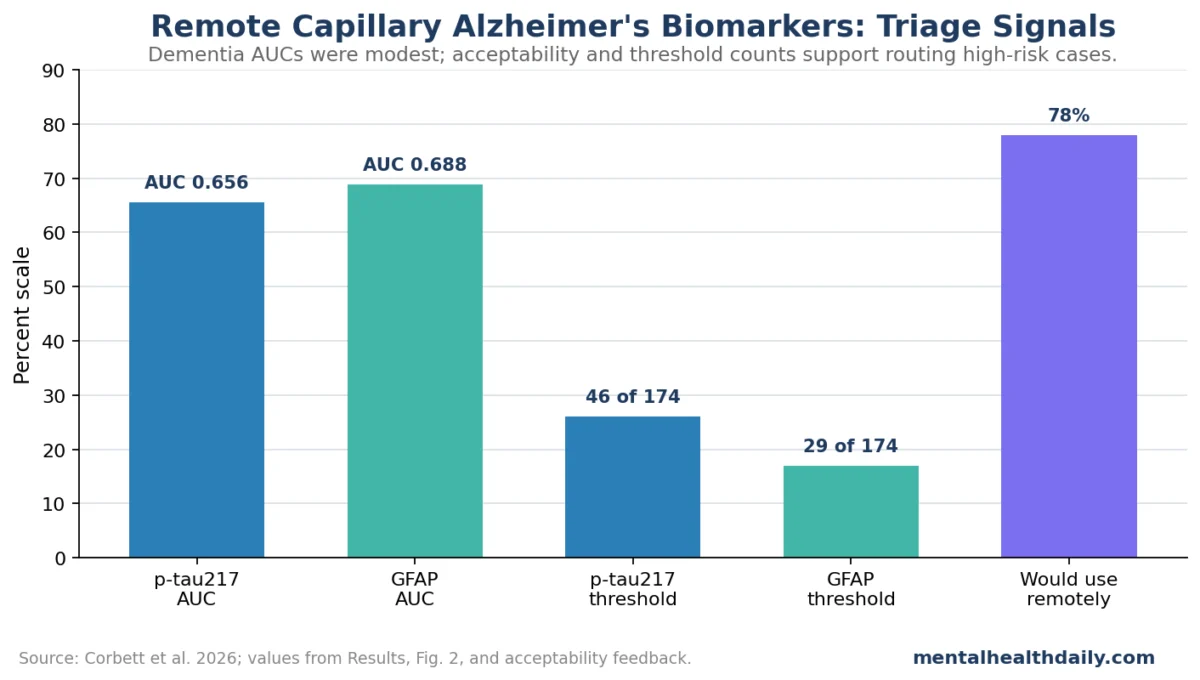
To evaluate the utility of these markers in identifying individuals at higher risk, Corbett et al. established prespecified 85% specificity thresholds: 0.016 pg/ml for capillary p-tau217 and 12.45 pg/ml for capillary GFAP. Applying these thresholds, the study identified 46 participants (26%) with elevated p-tau217 and 29 participants (17%) with elevated GFAP.
Crucially, individuals exceeding these thresholds consistently performed worse on several cognitive and functional measures. For those with elevated p-tau217, the memory difference had a Cohen’s d of 0.548 (p = 0.020), IADL a d of 0.542 (p = 0.017), and IQCODE a d of 0.657 (p = 0.001). For elevated GFAP, the IADL difference was even larger at d = 0.754 (p = 0.004), while executive function showed a d of 0.541 (p = 0.016). These Cohen’s d values indicate medium to large effect sizes, signifying meaningful differences in performance between the elevated and non-elevated groups.
A vital aspect of the study’s validation was demonstrating that these capillary-derived thresholds were recognizable in venous plasma, the current gold standard for blood-based biomarker analysis. Plasma p-tau217 discriminated the capillary p-tau217 threshold group with an Area Under the Curve (AUC) of 0.785, and plasma GFAP discriminated the capillary GFAP threshold group with an AUC of 0.895. These strong AUC values confirm that the remote capillary sampling method produces clinically meaningful results that correlate well with established blood chemistry, thereby avoiding the generation of "separate artifacts" unique to the home testing method.
Integrating Capillary Blood Testing with Cognitive Context
The study’s most potent clinical idea proposes a combined triage profile: identifying individuals with p-tau217 levels above the 85% specificity threshold and memory performance low enough to meet age-associated cognitive-decline criteria. This integrated approach can effectively prioritize individuals who warrant a faster trajectory toward formal dementia evaluation, moving beyond the limitations of symptom questionnaires alone.
The AUC values for discriminating dementia vs. non-dementia status further illuminate the utility and limitations of these markers. Capillary p-tau217 achieved an AUC of 0.656, and GFAP an AUC of 0.688. While these values indicate better-than-chance discrimination, they are not high enough to be considered diagnostic-grade. This underscores the critical distinction between risk stratification and definitive diagnosis. A normal result also cannot conclusively rule out non-Alzheimer causes of cognitive decline, early pathology below the detection threshold, or future conversion to dementia.
The clinical role envisioned for remote p-tau217 and GFAP is therefore multi-faceted: they can efficiently sort risk, reduce screen failures in clinical trials by identifying suitable candidates, and direct scarce specialist appointments towards individuals exhibiting a higher biological signal. It is imperative that these tests are not marketed or interpreted as a direct-to-consumer Alzheimer’s diagnosis.
The nuance between "risk sorting" and "diagnosis" is far from semantic. An AUC of 0.656 for p-tau217 means there is still significant overlap between dementia and non-dementia cases based solely on capillary p-tau217 levels. GFAP is even less disease-specific, as astrocyte activation can be elevated due to vascular injury, inflammation, general neurodegeneration, or mixed pathologies.
Thus, the most useful application of this test is as a sophisticated referral aid. The blood result should be combined with a comprehensive assessment that includes memory performance, daily-function reports from patients and informants, a thorough medication review, depression screening, sensory assessments (e.g., hearing and vision), and a detailed vascular-risk history. Only after integrating these multiple data points can clinicians judiciously decide who requires confirmatory imaging (like PET scans), cerebrospinal fluid (CSF) testing, or specialist neurological evaluation.
Remote Screening: The Indispensable Confirmatory Pathway
The utility of capillary biomarkers is intrinsically linked to the existence of a well-defined subsequent pathway. A positive remote result must not leave a patient with a troubling label but no clear route forward. Instead, it should trigger a structured sequence of cognitive testing, medical review, and, when appropriate, confirmatory assessment. A workable pathway would ideally delineate three distinct roles:
- Remote Triage: Utilizing self-administered capillary tests and online cognitive assessments to identify individuals at elevated risk.
- Primary Care Review: General practitioners or primary care providers interpret these results within the broader patient context, conducting initial medical evaluations and differential diagnoses.
- Specialist Confirmatory Pathway: Referral to memory clinics or neurologists for definitive diagnosis using advanced imaging, CSF analysis, and comprehensive neurocognitive assessments.
This tiered approach addresses the "access effect." Many individuals with early cognitive impairment never engage with specialist pathways due to barriers like travel distance, rural access limitations, clinic capacity issues, or the perceived burden of trial screening. A mailed capillary kit can dramatically lower this barrier, reaching populations previously underserved. However, lowering the barrier simultaneously increases the responsibility to prevent overdiagnosis and unwarranted anxiety.
A crucial boundary condition highlighted by the study is that p-tau217 is more closely tied to Alzheimer’s biology, while GFAP may flag broader neuroinflammatory or vascular risks. A triage algorithm that treats both markers as interchangeable "Alzheimer positive" signals would obscure the most valuable distinction offered by the paper. Clinical interpretation must maintain this nuance.
Immediate Benefits for Clinical Trial Recruitment
The most immediate and impactful use case for remote fingerprick testing is likely to be in clinical trial recruitment. Alzheimer’s prevention and early-intervention trials often require screening large numbers of individuals to identify a smaller, specific group with the precise biomarker profile necessary for study inclusion. The current process is resource-intensive and often results in high screen-failure rates, driving up trial costs and timelines. Fingerprick p-tau217, by pre-screening potential participants, could significantly reduce expensive screen failures by identifying individuals who are more likely to have confirmatory amyloid or tau evidence upon more rigorous evaluation. This could accelerate the development of new treatments by making trials more efficient and cost-effective.
Routine population screening, however, presents a more complex proposition. The implementation of any broad screening program requires robust evidence that testing demonstrably improves patient outcomes, reduces harms, and avoids creating unnecessary anxiety or superfluous procedures. A single cross-sectional correlation study, while highly informative, cannot fully address these multifaceted implementation questions.
The practical threshold for adoption, therefore, suggests that the evidence is strong enough to justify further validation of remote triage, particularly in the contexts of trial recruitment and enriching specialist referrals. It is not yet sufficient to support the marketing of home fingerprick testing as a direct-to-consumer Alzheimer’s diagnostic tool.
The equity argument for these tests is strongest when they expand access to necessary follow-up care rather than replacing it. A mailed kit can indeed reach individuals residing far from memory clinics, but the results still demand careful interpretation by a clinician who can consider a holistic view of the patient’s health, including medications, alcohol use, sleep patterns, depression, sensory impairment, vascular risk factors, educational background, and day-to-day functional status.
Furthermore, effective false-positive management is paramount. A person with elevated GFAP and known vascular disease may benefit more from aggressive vascular-risk management than from an Alzheimer’s label. Conversely, an individual with elevated p-tau217 and documented declining memory may indeed require a confirmatory Alzheimer’s workup. Maintaining these distinct clinical pathways based on biomarker profiles is what makes the pair clinically useful.
The Future: Longitudinal Validation and Integrated Pathways
The missing link for widespread routine screening remains longitudinal follow-up. The most valuable future outcome is not merely whether a capillary marker correlates with memory on a single date, but whether it reliably predicts conversion to dementia, faster cognitive decline, or eligibility for specific treatment trials over a period of several years. This is the evidence base required before remote screening can transition from promising triage research into routine primary-care pathways.
Implementation strategies must also account for low-signal results. A low capillary biomarker result should never dismiss a caregiver’s report of worsening memory, medication errors, falls, hallucinations, or financial mistakes. Instead, it should narrow the immediate probability of Alzheimer’s-specific pathology while keeping a broader differential diagnosis open. This is especially critical in primary care settings, where conditions such as depression, sleep apnea, anticholinergic medications, alcohol exposure, hearing loss, and cerebrovascular disease can all mimic early dementia symptoms, posing diagnostic challenges for families and clinicians alike.
Key Questions Addressed by the Research:
- Could this replace a memory-clinic assessment? No. The PROTECT data strongly support the role of these tests for triage. A definitive diagnosis still necessitates a comprehensive clinical history, detailed cognitive testing, functional assessment, and often confirmatory biomarker or imaging evidence from specialist centers.
- Why include GFAP if p-tau217 is more Alzheimer-specific? GFAP serves a crucial role by potentially flagging broader vascular or inflammatory risks that p-tau217, being highly specific to Alzheimer’s, might miss. In a clinical context aiming to identify progressive cognitive impairment stemming from a multitude of causes, this broader signal from GFAP can be immensely useful for directing further investigations or interventions.
- What would make this ready for routine screening? Longitudinal validation is the key. For a screening pathway to be deemed ready for routine implementation, it must demonstrate that remote biomarker-plus-cognition profiles predict future diagnosis, functional decline, or trial eligibility with greater accuracy and efficiency than current referral pathways, and do so without causing undue harm or anxiety.

