

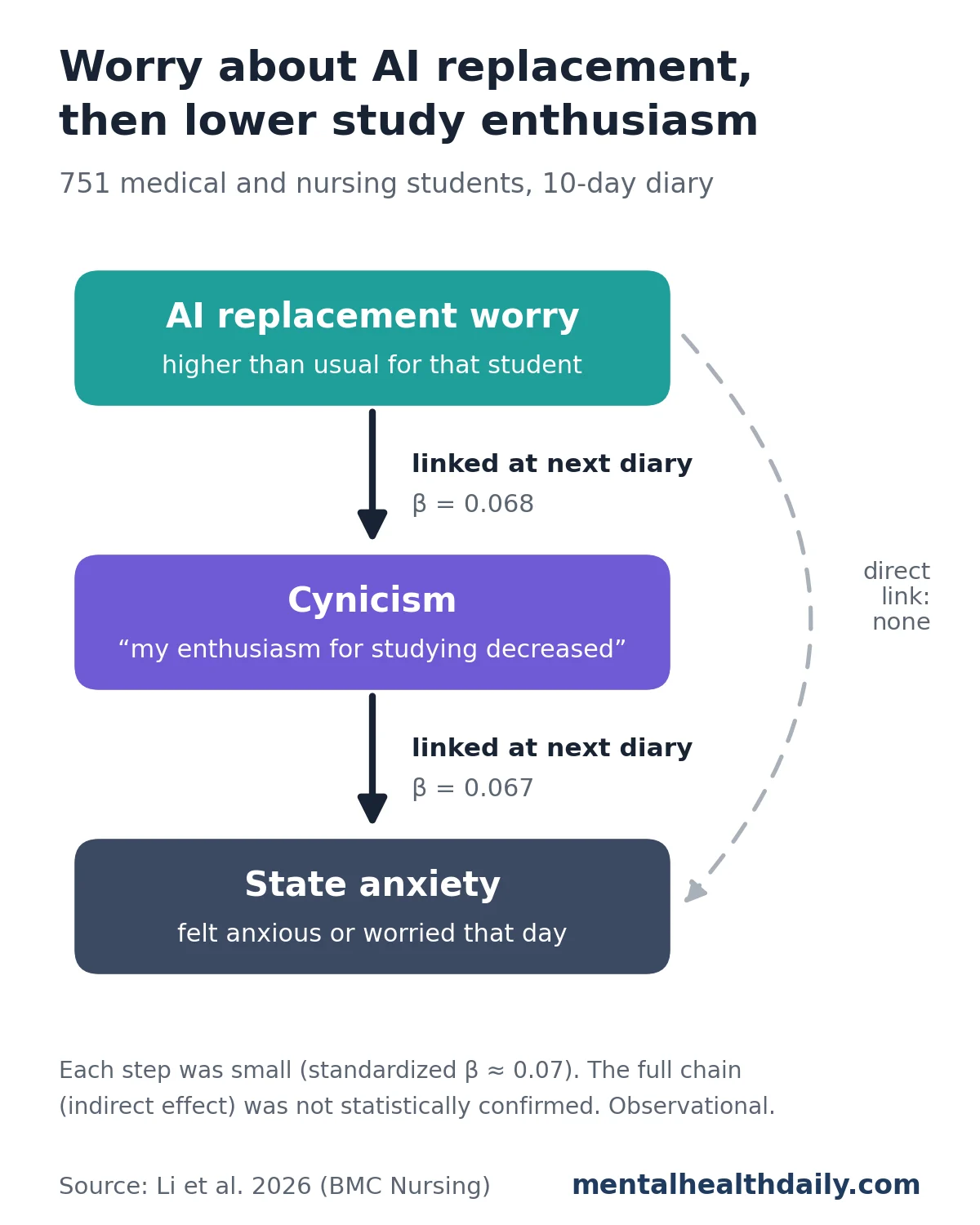
A pioneering 10-day diary study involving 751 medical and nursing students in China has provided critical insights into the real-time, day-to-day impact of Artificial Intelligence (AI) replacement anxiety on academic engagement and mental well-being. The research found that when students worried more than usual about AI potentially rendering their future skills or jobs obsolete, they reported a notable decrease in their enthusiasm for studying by their next diary entry. This dip in academic enthusiasm was, in turn, associated with an increase in anxiety during the subsequent entry, highlighting a concerning temporal pathway within the student experience. This study moves beyond traditional single-point surveys, offering a dynamic perspective on how the burgeoning integration of AI in healthcare shapes the psychological landscape of future clinicians.
The Accelerating Integration of AI in Healthcare and Emerging Anxieties
The landscape of modern healthcare is undergoing a profound transformation driven by rapid advancements in Artificial Intelligence. From diagnostic algorithms that can interpret medical images with human-level accuracy to robotic surgical assistants, automated documentation systems, and predictive analytics for patient management, AI is no longer a futuristic concept but a present-day reality in hospitals and clinics worldwide. This technological revolution promises enhanced efficiency, improved diagnostic precision, and potentially better patient outcomes. However, for those currently embarking on careers in medicine and nursing, this rapid evolution also casts a shadow of uncertainty, fueling what researchers term "AI replacement anxiety."
AI replacement anxiety is defined as the apprehension that artificial intelligence, robots, or advanced algorithms will diminish the value of one’s skills, work, or render future job roles less significant or entirely unnecessary. For medical and nursing students, these worries are not abstract; they are made concrete by the very tools they are learning about and are expected to use. Discussions around AI-assisted diagnosis, automated patient monitoring, and intelligent decision-support systems, while presenting opportunities, simultaneously evoke concerns about job security, professional identity, and the evolving nature of human-centric care. These anxieties are particularly acute in countries like China, which is at the forefront of AI development and implementation across various sectors, including healthcare, leading to a unique environment for studying such phenomena.
A Novel Approach: Tracking Daily Psychological Shifts
While previous research has acknowledged the existence of AI anxiety among healthcare students, most studies have relied on single-point surveys, capturing a snapshot rather than the ebb and flow of these concerns. Haoqian Li and their colleagues sought to fill this methodological gap by investigating whether AI worry fluctuates on a daily basis and how these daily swings correlate with changes in academic burnout and day-to-day anxiety. This granular, within-person approach allowed researchers to observe how an individual student’s experience varied from one day to the next, offering a more nuanced understanding than aggregated cross-sectional data.
The researchers adopted a robust methodology, employing a 10-day diary study design. Over this period, 751 medical and nursing students from a single university in China provided daily self-reports on their levels of AI replacement worry, components of academic burnout, and state anxiety. The study specifically focused on three distinct parts of academic burnout, recognizing that these elements can manifest and interact differently:
- Cynicism (Lower Study Enthusiasm): A sense of detachment, lack of interest, or reduced engagement in academic activities. This component reflects a disengagement from the learning process itself.
- Exhaustion: Feelings of being physically and emotionally drained by academic demands.
- Inefficacy (Didn’t Learn Anything Interesting): A perception of diminished personal accomplishment or a belief that one is not effectively learning or making progress.
The analysis leveraged dynamic structural equation modeling (DSEM), a sophisticated statistical technique ideally suited for repeated diary entries. DSEM allows researchers to compare each student’s daily scores against their own average, thereby isolating within-person variations. This means the analysis could determine if a student’s higher-than-usual AI worry on one day predicted a change in another score (like study enthusiasm or anxiety) on the subsequent day, effectively controlling for stable individual differences in personality or baseline anxiety levels.
Key Findings: The Pathway from Worry to Disengagement
The study revealed several significant findings regarding the daily dynamics of AI anxiety and its psychological repercussions. On average, students rated their AI worry at 2.69 on a 5-point scale, indicating a moderate but consistent level of concern. Importantly, approximately 29% of the variation in this worry was attributable to day-to-day fluctuations within the same student, underscoring the dynamic nature of AI anxiety. The remaining variation reflected stable differences between students, such as some individuals being inherently more worried than others.
The most critical finding elucidated a sequential link between AI worry, academic cynicism, and anxiety. Specifically, the study found that a higher-than-usual level of AI replacement worry on one day was linked to increased cynicism—manifesting as lower study enthusiasm—at the next diary entry. Subsequently, this heightened cynicism was then linked to an increase in state anxiety at the following diary entry. This suggests a potential chain reaction: AI worry leading to disengagement from studies leading to increased anxiety.
The strength of these daily connections, represented by standardized coefficients (beta values), was approximately 0.068 for the link between AI worry and cynicism, and 0.067 for the link between cynicism and anxiety. While these effect sizes are statistically significant and robust within the context of daily fluctuations, they are considered small. For instance, the within-person daily correlation between AI worry and cynicism was 0.16, and between AI worry and anxiety was 0.12. However, even small, consistent daily effects can accumulate over time and contribute to broader patterns of distress or disengagement.
The researchers used credible intervals, the Bayesian equivalent of confidence intervals, to assess the robustness of these links. When a credible interval excludes zero, the link is considered statistically supported. In this study, both steps in the AI-worry-to-cynicism-to-anxiety pathway were supported. The findings remained robust even after accounting for potential confounding factors, such as the longer gap between Friday and Monday diary entries (the study skipped weekends). When researchers coded days by actual calendar spacing, both cynicism steps remained supported (β = 0.075 and 0.056). The results also held true in a stricter sample of 695 students who completed at least three valid diaries, further reinforcing the reliability of the observed patterns.
Notably, among the three burnout components tested, only cynicism exhibited this sequential link. AI worry was not found to be directly linked to next-day exhaustion or to the "didn’t learn anything interesting" item. While the "didn’t learn anything interesting" item was linked to later anxiety (β = 0.126), there was no direct connection established between AI worry and this specific perception of inefficacy. This highlights cynicism, or reduced study enthusiasm, as a particularly sensitive and early indicator of the psychological impact of AI replacement anxiety in this academic context.
Why the Full AI-to-Anxiety Chain Was Not Statistically Confirmed as a Mediating Pathway
Despite identifying supported individual steps—AI worry leading to cynicism, and cynicism leading to anxiety—the researchers emphasized that these two supported steps do not automatically confirm a statistically supported indirect effect or a mediating pathway where cynicism definitively explains how AI worry turns into anxiety. When the researchers estimated the indirect effect (how much of AI worry’s link to later anxiety actually runs through cynicism), the credible interval for this estimate included zero across all six models.
In simpler terms, while the data clearly demonstrated the correct chronological order of events—an increase in AI worry followed by cynicism, which was then followed by anxiety—the study could not definitively state with high statistical confidence that cynicism is the sole or primary route through which AI worry translates into anxiety. The statistical challenge lies in the fact that estimating an indirect effect involves multiplying two potentially small and uncertain numbers (the beta coefficients for each step), and this effect can also vary considerably from student to student. This makes it inherently more difficult to precisely pin down than either individual step alone. The researchers prudently framed their findings as linked steps in time rather than definitive proof of a mediating pathway or a direct causal chain, advocating for a cautious interpretation of the cumulative effect.
The Bidirectional Relationship: Anxiety’s Influence on Learning
The study also explored the reverse direction: whether a more anxious day could precede signs of academic burnout and subsequent increases in AI worry. This analysis yielded another intriguing finding: a higher-than-usual level of state anxiety on one day was linked to students reporting that they "didn’t learn anything interesting" in their studies at the next diary entry (β = 0.126). This suggests that anxiety can color a student’s perception of their learning experience, potentially leading to feelings of disengagement or a sense that their academic efforts are not yielding valuable insights.
The researchers interpreted this finding not as evidence that anxiety directly diminishes a student’s cognitive competence or ability to learn, but rather that it influences their subjective judgment of the learning process. Anxious states might lead students to perceive lessons as less engaging, less stimulating, or simply less interesting, which could also reflect underlying boredom or a general lack of motivation stemming from emotional distress. Interestingly, this perception of not learning anything interesting was not subsequently linked to increased AI worry in the reverse direction.
A Global Challenge: Previous Research and Broader Context
The findings of this Chinese diary study resonate with and build upon a growing body of international research highlighting the prevalence of AI anxiety and academic burnout among future healthcare professionals. Earlier single-survey studies from various regions have consistently shown that worry about AI’s impact is common among medical and nursing students. For example, studies have indicated that a significant proportion of medical students globally express concerns about AI affecting their career prospects, with some even considering career changes due to these anxieties. This phenomenon is not limited to a single geography but is a shared experience across different healthcare education systems grappling with technological integration.
Academic burnout itself is a pervasive issue within medical and nursing education. The demanding nature of these programs, coupled with high stakes and intense pressure, often leads to significant psychological strain. A comprehensive 2024 meta-analysis, encompassing 34 studies and 9,554 nursing students, estimated the global prevalence of academic burnout at 35%. Alarmingly, this rate was highest in Asia, reaching 58%, underscoring the particular relevance of the current diary study’s setting. This high baseline level of burnout suggests that any additional stressors, such as AI replacement anxiety, could further exacerbate an already challenging mental health landscape for students. The 2026 diary study, by providing a day-level perspective, uniquely demonstrates how a spike in AI worry can, within the same student, immediately precede a dip in study enthusiasm, adding a crucial temporal dimension to our understanding of this complex issue.
Addressing the Concerns: Strategies for Medical and Nursing Education
The implications of this study are significant for medical and nursing schools, professional bodies, and policymakers involved in healthcare education. Recognizing "study enthusiasm" as an early and sensitive indicator of AI-related distress offers a practical avenue for intervention. Instead of waiting for overt signs of exhaustion or clinical anxiety, educators can monitor and address decreases in student engagement and motivation. If a student’s motivation visibly sags after a period of worrying about AI, it aligns with the pattern identified in this research and signals a need for proactive support.
Given that the observed effects were small and primarily manifested as brief, day-to-day fluctuations rather than leading to lasting burnout or clinical anxiety disorders within the short study period, interventions can be targeted and preventative. The findings do not suggest an immediate crisis of widespread, severe pathology but rather highlight a pervasive undercurrent of daily stress that could, if unaddressed, contribute to more significant problems over time.
The researchers themselves suggest a forward-thinking approach: schools should pair AI training with a deliberate focus on career meaning and professional identity. Rather than merely teaching technical AI skills, educational programs could be enriched by discussions that address how humans and AI can collaborate effectively, emphasizing the enduring value of human empathy, critical thinking, and complex problem-solving that AI cannot replicate. This approach would involve:
- Reinforcing Professional Meaning: Helping students articulate and reaffirm the unique human value they bring to healthcare that AI cannot replace, such as compassionate care, ethical judgment, and interpersonal communication.
- Competence Support: Ensuring students feel adequately prepared to integrate AI into their practice, thereby reducing fears of being outmoded. This includes hands-on training and exposure to AI tools in a supportive learning environment.
- Human-AI Collaboration Models: Explicitly teaching models of practice where humans and AI work synergistically, rather than viewing AI as a competitor. This could involve case studies, simulations, and discussions on ethical AI use.
While this idea of integrating professional meaning and collaboration with technical AI skills has not yet been rigorously tested in a clinical trial, it offers a promising conceptual framework for developing educational interventions. Such strategies could help students contextualize AI within their professional development, mitigating anxiety by fostering a sense of agency and preparedness rather than passive apprehension. Professional organizations, such as the World Medical Association or the International Council of Nurses, could play a pivotal role in developing guidelines and best practices for integrating AI education that prioritizes both technical proficiency and professional well-being.
Navigating Limitations and Future Research Directions
Despite its innovative design and valuable insights, the study acknowledges several limitations. Firstly, all data were self-reported, which inherently carries the risk of social desirability bias or subjective interpretation. Future studies could incorporate objective measures where feasible, though capturing internal states like worry and enthusiasm often necessitates self-report. Secondly, the study focused on a specific population of medical and nursing students from a single university in China. While this provides a strong case study for a region at the forefront of AI, generalizability to students in other countries, cultures, or different academic disciplines may be limited.
Thirdly, the 10-day duration, while an improvement over single surveys, still represents a relatively short window. Long-term longitudinal studies spanning months or even years would be necessary to understand if these day-to-day fluctuations aggregate into more stable patterns of chronic burnout or clinical anxiety disorders. Such extended research could also track the effectiveness of interventions designed to mitigate AI anxiety. Finally, the study design, while sophisticated, could not definitively prove a causal mediating pathway for the full AI-worry-to-anxiety chain, but rather supported linked steps in time. Future research employing experimental designs or more intensive longitudinal data collection might be able to disentangle these causal relationships further.
Conclusion: Preparing the Next Generation of Clinicians for an AI-Integrated Future
The dynamic diary study from China offers a compelling, real-time glimpse into the psychological challenges faced by medical and nursing students as they prepare for a future intertwined with Artificial Intelligence. It underscores that AI replacement anxiety is not a static concern but a fluctuating daily experience that can subtly erode study enthusiasm, which then contributes to increased anxiety. The findings serve as a crucial early warning system for educators and institutions.
As AI continues to embed itself deeper into healthcare, preparing the next generation of clinicians demands more than just technical training. It requires a holistic educational approach that acknowledges and actively addresses the psychological impact of these technological shifts. By integrating discussions on professional meaning, competence development, and collaborative human-AI models into curricula, and by monitoring early signs like declining study enthusiasm, educational institutions can foster a workforce that is not only technologically proficient but also resilient, engaged, and confident in their irreplaceable human role within an evolving healthcare ecosystem. The future of healthcare relies as much on the well-being and psychological preparedness of its human practitioners as it does on the sophistication of its algorithms.

