


The essence of existence, according to ancient Buddhist teachings, resides not in the echoes of the past or the unformed landscapes of the future, but in the vibrant, immediate reality of the present moment. This profound perspective, articulated in texts like the Avatamsaka Sutra, posits that true peace, joy, awakening, and even Buddhahood are not distant aspirations but immediate attainments, accessible through a conscious engagement with the "here and now." This philosophical cornerstone, explored in depth by Zen Master Thich Nhat Hanh, offers a timeless framework for navigating the complexities of human experience and finding profound contentment amidst the flux of life.
The Interconnectedness of Time and Space
The Avatamsaka Sutra, often translated as the Flower Garland Sutra, introduces a radical understanding of time and space, asserting their intrinsic interconnectedness. It challenges conventional notions by stating that "time is made up of space, and space is made up of time." This concept suggests that temporal and spatial dimensions are not discrete entities but rather interwoven aspects of a singular reality. For instance, the experience of spring, typically perceived as a temporal marker, is also inherently spatial. The presence of spring in one hemisphere, say Europe, coexists with winter in another, such as Australia, illustrating how different temporal states can simultaneously occupy different spatial realities, highlighting their mutual dependence.
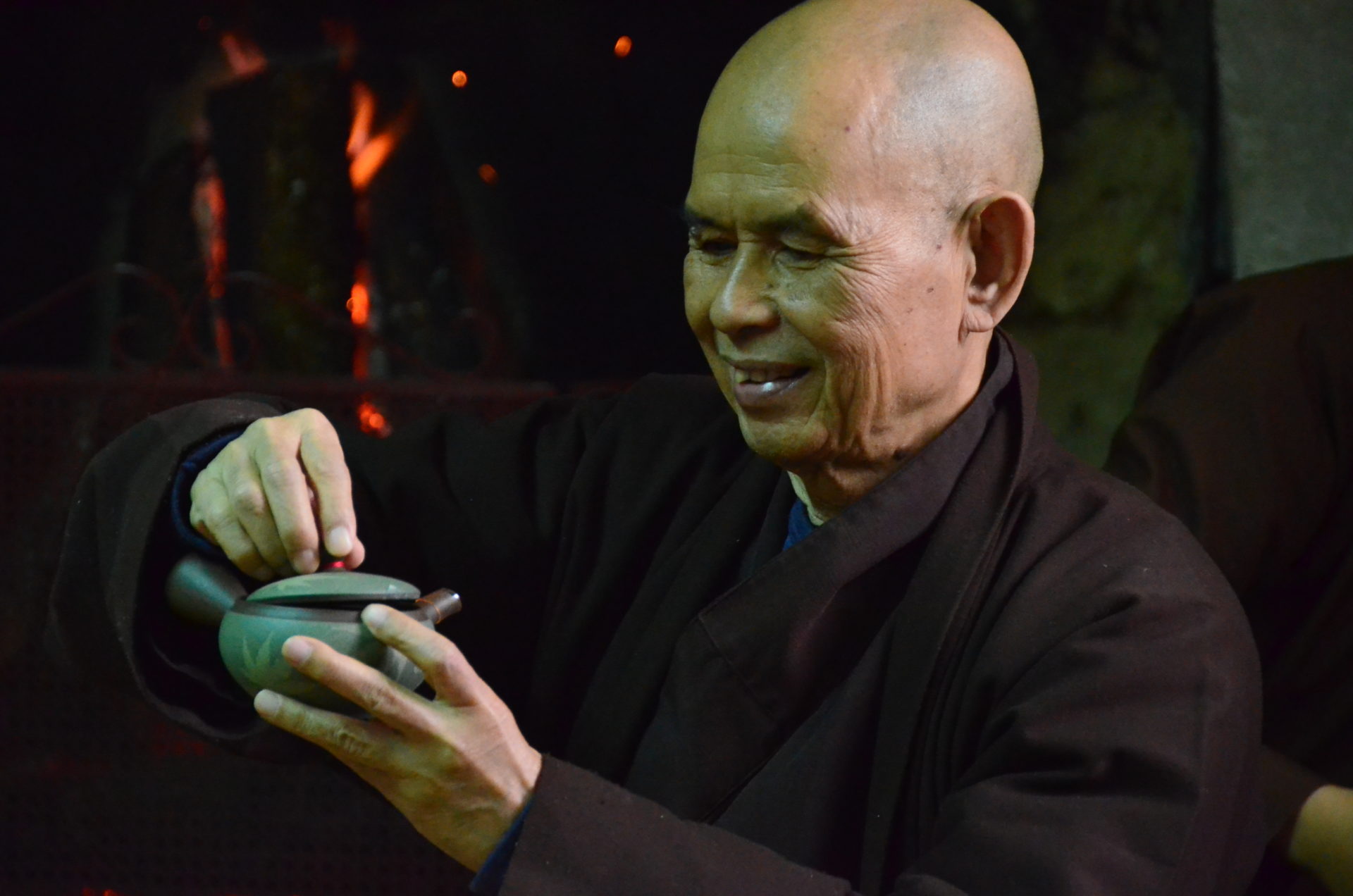
This interconnectedness is not merely an abstract philosophical concept but a practical guide for mindful living. During a tea meditation, participants engage in a ritualistic practice that embodies this principle. Before taking their first sip, they recite a gatha, or verse:
"This cup of tea in my two hands—
mindfulness is held uprightly.
My mind and body dwell
in the very here and now."
This simple yet powerful recitation serves as an anchor, drawing the practitioner’s attention away from past regrets or future anxieties and firmly into the present sensory experience. The act of drinking tea, when performed with full mindfulness, transforms a mundane activity into an opportunity for deep connection with life. The steaming cup, its aroma, its warmth, and its taste become vividly apparent, revealing themselves as "wonderful aspects of existence." It is in these moments of complete presence that life is truly experienced, not as a concept or a goal, but as a palpable reality.
Aimlessness: The Path to Unburdened Existence
The pursuit of happiness, liberation, and enlightenment often leads individuals to project these desires into the future, effectively abandoning the present moment in favor of a shadowed ideal. Buddhism, however, advocates for a path of "aimlessness" (apranihita), a concept that encourages practitioners to release the relentless pursuit of future outcomes. Aimlessness, also referred to as wishlessness, is one of the "three doors of liberation," alongside emptiness (sunyata) and signlessness.
By relinquishing the need to constantly strive for a future state, individuals can begin to recognize that the qualities they seek—peace, joy, and fulfillment—are not external destinations but inherent potentials residing within the present moment. Life, in this view, is not a fixed point to be reached but a continuous journey. The practice of walking meditation exemplifies this, where the focus is not on arriving at a destination but on embracing the peace, joy, and liberation that can be found in each step. This is the spirit of aimlessness: understanding that the path itself, with its inherent experiences, is the true fulfillment. The "appointment with life," whether understood as encountering the Buddha, achieving liberation, or finding happiness, is not scheduled for some distant future but is happening now, here.
The Foundation of Mindfulness: Breathing and Oneness
Central to the Buddhist approach to presence is the practice of mindful breathing, as outlined in the Anapanasati Sutta, or Sutra on the Full Awareness of Breathing. This ancient teaching emphasizes the capacity of conscious breathing to unify the body and mind, enabling a direct encounter with life. The practice fosters the "oneness of body and mind," a state where the practitioner is fully embodied and mentally present.
However, returning to the present moment does not imply a passive or uncritical immersion in current circumstances. The Buddha’s teachings encourage a deep observation of life as it is, acknowledging both its sufferings and its wonders. This observation must be conducted with mindfulness, maintaining a high degree of awareness to avoid being swept away by desire or aversion. The Sutra on Knowing the Better Way to Live Alone articulates this:
"Looking deeply at life as it is
in the very here and now,
the practitioner dwells
in stability and freedom."
"Stability and freedom" are described as the contentment and tranquility that arise from not being swayed by external circumstances. These are considered characteristics of nirvana. The Pali terms asankuppam (unwavering, unshakable) and asamhiram (not folded together, not restrained, not carried away) further illuminate this state of unshakeable equanimity. This profound stability allows for genuine freedom, not in the sense of unrestrained action, but in the liberation from being bound by the impermanent and often turbulent nature of existence.
Impermanence and Selflessness: The Pillars of Reality
A cornerstone of Buddhist philosophy, and a key insight gained through deep present-moment awareness, is the understanding of impermanence (anicca) and selflessness (anatta). These are not viewed as negative attributes but as the fundamental principles upon which all existence is built. Impermanence signifies the constant flux and transformation inherent in all phenomena. Without this ceaseless change, life itself would be impossible. Selflessness, on the other hand, refers to the interdependent nature of all things. Nothing exists in isolation; all phenomena arise in relation to countless other factors. The example of a tulip blooming illustrates this: its existence is contingent upon the sun, clouds, and Earth.
The tendency to cling to the illusion of permanence and a fixed self often leads to suffering. When individuals perceive impermanent things as eternal or selfless entities as possessing an independent self, they inevitably experience disappointment and pain when reality inevitably shifts. However, by deeply observing the impermanent and selfless nature of things, one can transcend this suffering. This understanding does not diminish the joy of life; rather, it enhances it by fostering a greater appreciation for the preciousness of fleeting moments.
The beauty of a rose, for instance, is amplified when one recognizes its fragile, impermanent nature. The more transient something is, the more precious it often appears—like a rainbow, a sunset, or a shooting star. The Buddha, observing the sunrise over Vulture Peak or the golden rice fields, recognized the beauty in these ephemeral scenes without succumbing to despair at their eventual transformation. By embracing this perspective, individuals can overcome despair and find wonder in the everyday miracles: a glass of clear water, a cool breeze, a step taken with ease.
Navigating Suffering with Compassion and Wisdom
Life, while containing profound beauty and wonder, is also characterized by suffering. Sickness, old age, death, accidents, and natural disasters are unavoidable aspects of the human condition. However, a deep understanding and a mind free from clinging can allow individuals to accept these realities with tranquility, thereby significantly reducing the associated suffering. Crucially, this acceptance is not a passive resignation but a gateway to cultivating compassion.
By engaging with suffering, rather than averting one’s gaze, individuals can nurture their innate capacity for love and compassion. Suffering becomes a catalyst, an element that nourishes these qualities, removing the fear associated with it. A heart filled with love and compassion naturally compels action to alleviate the suffering of others. This capacity for compassion is seen as the driving force behind human progress. By learning from compassionate beings and practicing deep observation for the benefit of others, individuals can share the wisdom of living in the present and understanding the impermanent and selfless nature of reality, thereby lightening the burden of suffering for all.
Living an Awakened Life
The fear of the unexpected often leads to a constricted and anxious existence. While future misfortunes cannot be predicted, living an "awakened" life—deeply inhabiting each moment, treating loved ones with gentleness and understanding—prepares one for whatever may arise, leaving no room for regret. By living in the present, individuals can connect with the life-affirming phenomena that promote healing and renewal. This continuous engagement with the present moment fosters personal growth, leading to a life that becomes progressively more wonderful, fresh, and healthy.
The teachings excerpted from Our Appointment with Life: Sutra on Knowing the Better Way to Live Alone by Thich Nhat Hanh, published by Parallax Press, offer a profound and practical guide for navigating the complexities of existence. They underscore that the path to peace, liberation, and genuine happiness is not found in distant aspirations but in the conscious, mindful embrace of the present moment, transforming the ordinary into the extraordinary and fostering a life of deep contentment and resilience.

