

A groundbreaking 2026 video study of 97 lunches across four Swedish preschools has unveiled that children as young as two years old are not only capable of communicating their satiety but also employ strategic timing when stating "I’m full." Preschool staff, the study found, predominantly accept these declarations at face value, a practice that aligns with international and national guidelines promoting responsive feeding. This in-depth observational research, conducted by Sandra Nyberg-Akremi and colleagues at Linköping University, offers unprecedented insights into the verbal and non-verbal dynamics of mealtime interactions, highlighting the intricate social processes underlying children’s food intake regulation.
Understanding Responsive Feeding in Early Childhood Education
The concept of responsive feeding forms the bedrock of healthy eating guidelines for young children worldwide, including those endorsed in Sweden. It advocates for a nurturing, reciprocal approach where adults meticulously observe and empathetically respond to a child’s hunger and fullness cues, rather than imposing external pressures or overriding their internal signals. This approach is rooted in extensive research demonstrating young children’s inherent ability to self-regulate their food consumption. A seminal study involving 15 children aged two to five, for instance, illustrated that while individual mealtime intake might fluctuate considerably, total daily caloric intake remained remarkably consistent. This natural regulation saw children compensating for a large meal by eating less at the subsequent one and vice versa, underscoring an innate physiological wisdom that responsive feeding seeks to protect and foster.
However, despite the established importance of responsive feeding, direct empirical investigation into how children verbally express fullness at the table has been conspicuously absent from the scientific literature. Much of the prior research has relied on indirect methods, such as parent reports or simplified visual scales like teddy bear rating charts, which may not fully capture the nuanced, real-time interactions that shape mealtime experiences. The Swedish study thus fills a critical void, providing a detailed, ecologically valid examination of these crucial moments. By capturing actual mealtime conversations and behaviors, the researchers aimed to understand not just if children say "I’m full," but how and when they do, and critically, how adults respond.
A Deep Dive into Preschool Lunch Dynamics: Methodology and Cultural Context
The study meticulously documented ordinary lunch sessions between October 2021 and November 2022. Researchers visited each of the four participating preschools once a week during three distinct recording periods, each spanning approximately five to seven weeks. This longitudinal approach allowed for the observation of a diverse range of mealtime scenarios and interactions under typical daily conditions, minimizing the potential for observer effect.
A unique aspect of the Swedish preschool system, central to this study’s context, is the practice of "pedagogic meals." In these settings, all children are served a free, hot lunch, and critically, adults actively participate in the meal, sitting at the table and often consuming the same food as the children. This integrated approach aims to cultivate a positive relationship with food, meals, and overall health, fostering an environment where eating is seen as a social and educational experience rather than merely a nutritional one. This cultural emphasis on shared meals and positive food experiences provides a rich backdrop against which to observe responsive feeding practices.
To analyze the complex verbal and non-verbal cues exchanged during these lunches, the research team employed discursive psychology. This sophisticated qualitative method goes beyond simply interpreting speech as a reflection of an internal state. Instead, it examines what individuals accomplish with their words within a conversation, meticulously analyzing elements such as timing, pauses, gaze, gestures, and the sequential organization of talk. By dissecting these interactions line by line, researchers could discern the communicative intent and social functions of children’s "I’m full" statements, revealing them as dynamic social acts rather than mere physiological reports. This methodological rigor allowed for a nuanced understanding of how children navigate and influence their mealtime environment.
Children’s Strategic Communication: Timing and Intent
One of the study’s most striking revelations was the strategic nature of children’s "I’m full" declarations. While no statements about fullness were discernible from one-year-olds, children aged between two years three months and six years two months actively expressed their satiety. Four-year-olds emerged as the most vocal group, accounting for 27 of the 77 (35%) recorded statements. This suggests a developmental progression in children’s ability to articulate internal states and engage in mealtime discourse.
The timing of these statements was particularly insightful. Children typically declared themselves full a median of 25 minutes after they began serving themselves, with a range spanning 12 to 41 minutes. A significant majority—62 out of 77 statements—occurred between 20 and 39 minutes into the meal, precisely as lunch service was winding down. This pattern strongly suggests that children were not just reporting a feeling but were making a conscious effort to communicate it at a moment when adults were likely to be receptive and when the meal was nearing its conclusion, thus maximizing the likelihood of their statement being heard and acted upon.
Furthermore, the study analyzed the initiation of these statements. A substantial 58% (45 statements) were entirely self-initiated by the child, demonstrating proactive communication. The remaining 42% (32 statements) were responses to an adult’s or another child’s query, such as "How’s it going?" or "Are you still eating?" Regardless of initiation, the video excerpts provided compelling evidence of children actively working to ensure their message was received. Pseudonymized examples from the study illustrate this: a child might repeat "I’m full" several times, make direct eye contact, or use gestures to draw an adult’s attention. These behaviors underscore the researchers’ conclusion that young children perceive their fullness not merely as a private sensation but as an important piece of information that adults need to acknowledge and respond to, thereby influencing their participation in the meal.
Staff Responses: Acknowledgment and Acceptance
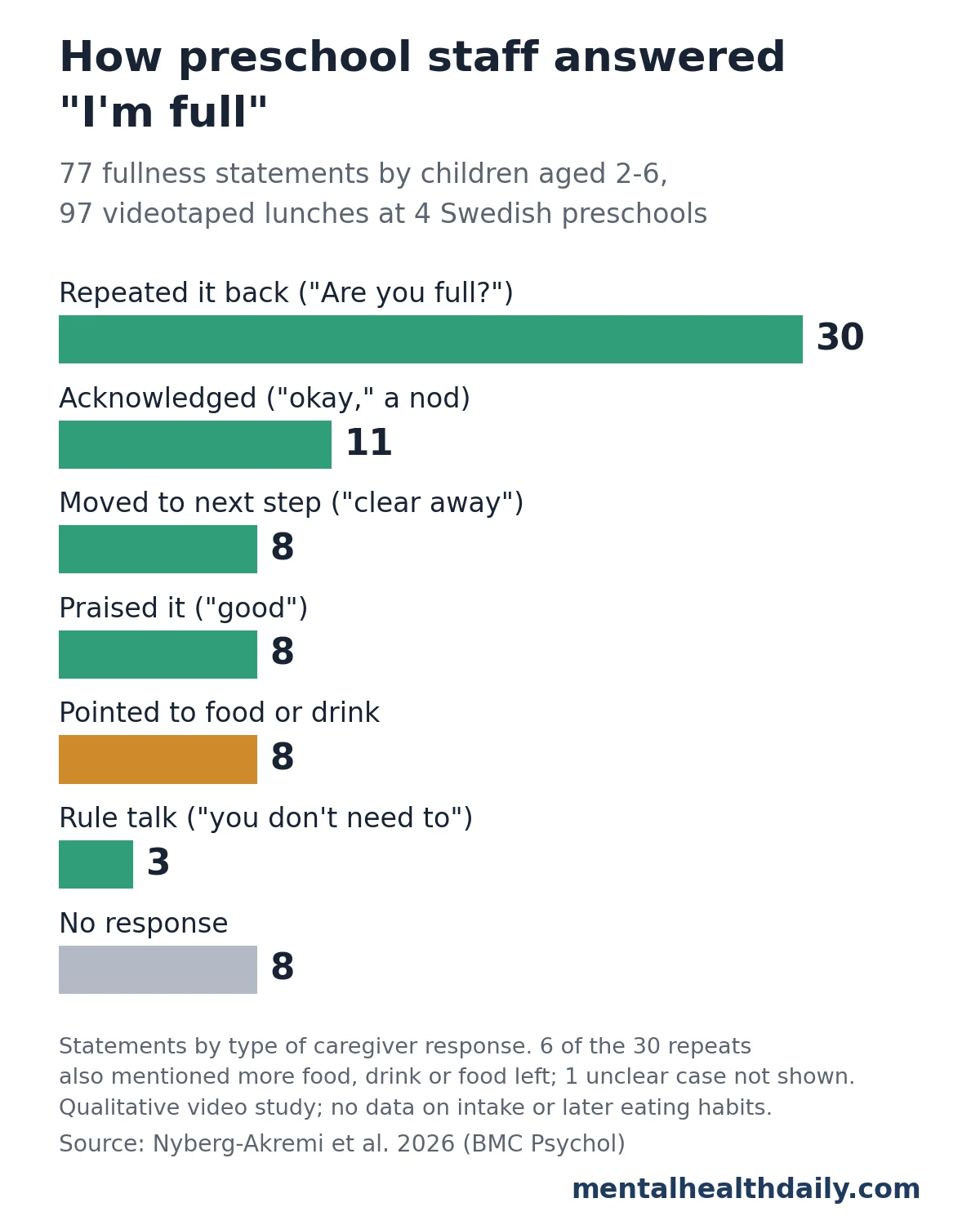
The responses from preschool staff were found to be remarkably consistent and largely accepting. Adults typically reacted in a narrow range of ways, with the vast majority taking the children’s statements at face value. The most common response, occurring 30 times out of 76 recorded instances (one unusual case was omitted), was to simply repeat the child’s statement back, often in the form of a question like "Are you full?" Other common responses included acknowledging the statement (11 times), moving to the next step (e.g., clearing the plate, 8 times), or praising the child (8 times). Staff also sometimes pointed to food or drink (8 times) or used "rule talk" (3 times), but these were less frequent.
Crucially, no adult in the study ever framed being full as a negative experience or challenged a child’s internal sensation of satiety. The few instances where statements went unanswered (8 times) were attributed to factors such as the child’s statement being unclear, spoken over by another child, or made while the adult was engrossed in another conversation, rather than intentional disregard. This pattern of acceptance by staff is a key indicator of responsive feeding practices being ingrained within these Swedish preschool environments.
Navigating Nuance: When Fullness Meets Mealtime Expectations
While staff generally accepted declarations of fullness, a handful of exchanges revealed how these statements could become intertwined with other mealtime considerations. In these cases, the "I’m full" declaration sometimes met with gentle pushback, not as a challenge to the child’s actual state of satiety, but concerning other mealtime expectations. For example, a child might declare fullness to avoid a particular food item or to leave a portion of food behind. An adult might then respond by gently reminding the child about trying all foods or finishing a small amount.
However, even in these instances, the underlying principle remained consistent: adults did not tell children they could not be full. The disagreement centered on the behavioral implications of being full within the structured mealtime environment – specifically, whether being full exempted the child from finishing a specific food or clearing their plate. This distinction is vital, as it highlights a pedagogical approach that seeks to balance responsive feeding with broader lessons about nutrition, trying new foods, and mealtime routines, without undermining the child’s autonomy over their internal hunger and fullness cues.
Broader Implications: The Shadow of Pressure and Portion Size
The findings of this Swedish study hold significant weight when viewed against a backdrop of extensive earlier research on the detrimental effects of pressure to eat and inappropriate portion sizes on children’s appetite regulation and long-term eating habits. These "small exchanges" at the lunch table are far from trivial; they contribute to a child’s developing relationship with food and their body.
Previous studies have consistently demonstrated that applying pressure on children to eat, whether through explicit demands, rewards, or even subtle encouragement, can paradoxically lead to reduced food intake, decreased enjoyment of meals, and a diminished ability to self-regulate. For instance, research has shown that children who experience greater parental pressure to eat tend to have poorer self-regulation of energy intake and are more likely to exhibit emotional eating behaviors later in life. Similarly, studies on portion size have unequivocally shown that larger portions lead children to eat more, irrespective of their actual hunger levels, overriding their natural satiety signals. This "portion distortion" can desensitize children to their internal cues, potentially contributing to overeating and weight gain over time.
This contrasts sharply with observations from other cultural contexts. A 2010 video study conducted in 29 Head Start programs across three U.S. states, for example, revealed a different pattern of mealtime communication. In that study, staff interactions primarily directed children’s attention towards external cues, such as how much food to take, whether they were "done" with their meal, or offering praise for eating. There was a notable absence of conversations that encouraged children to reflect on their internal bodily sensations of hunger or fullness. While these studies differ in setting and methodology, the comparison underscores the distinct cultural and pedagogical approaches to feeding practices in early childhood education. The Swedish findings, therefore, align with an older sociological observation that finishing a meal and declaring oneself full is often a social construct, negotiated through conversation within families and groups, rather than a purely physiological signal emanating from the stomach.
Study Limitations and Future Directions
While highly insightful, the Swedish preschool study is not without its limitations. Its observational nature means it cannot establish causality; it describes what happens, not why it happens or how to intervene. The study was conducted in a specific cultural context (Swedish preschools with pedagogic meals), which may limit the generalizability of its findings to other countries or childcare settings with different feeding philosophies or resources. The relatively small number of preschools (four) also warrants caution in extrapolating results too broadly. Furthermore, the study focused solely on verbal declarations of fullness, acknowledging that non-verbal cues (e.g., pushing food away, playing with food, decreased eating speed) also convey satiety, though these were not the primary focus of this specific analysis. Future research could explore these non-verbal signals in conjunction with verbal statements.
Practical Implications for Parents and Early Childhood Educators
Despite these limitations, the study offers clear and actionable takeaways for both parents and preschool staff, reinforcing the importance of responsive feeding in nurturing healthy eating behaviors:
Young Children Can Communicate Fullness Effectively: The research unequivocally demonstrates that children as young as two possess the capacity to articulate their fullness clearly. Moreover, they exhibit a nascent understanding of social timing, choosing moments when their statements are most likely to be heard and addressed. For children who repeat or rephrase their declarations, it’s often a clear signal that they are actively seeking an acknowledgment or a response, underscoring their communicative intent. Recognizing this capability empowers adults to trust children’s cues.
Simple Acknowledgment Holds Significant Value: In the bustling environment of a preschool or a busy family meal, adults might feel overwhelmed by the need for elaborate responses. However, the study shows that effective acknowledgment does not require lengthy conversations. The most common and accepted responses from Swedish staff were brief and direct: repeating "Are you full?", a simple nod, or a practical prompt like "You’re welcome to clear away." These short, affirming responses are manageable even for busy adults overseeing multiple children, yet they powerfully convey respect for the child’s autonomy and internal signals.
Vigilance Against Subtle Pressures is Key: The study highlights how easily unintended pressure can slip into mealtime interactions. Comments about food remaining on the plate ("You haven’t finished your peas") or quick offers of alternative foods ("If you eat your vegetables, you can have dessert") can subtly override a child’s internal cues and create an environment where external directives, rather than internal satiety, dictate eating. Adults should cultivate awareness of their language and actions at the table. To align with broader evidence on portion size and pressure to eat, a recommended strategy is to serve smaller initial portions, allowing children the autonomy to ask for more if they are still hungry. While this study did not directly test these intervention strategies, its findings reinforce the importance of creating a pressure-free eating environment that fosters a positive relationship with food from an early age.
In conclusion, the Swedish preschool study provides invaluable empirical evidence supporting the principles of responsive feeding. It illuminates the sophisticated ways young children communicate their satiety and emphasizes the crucial role of attentive, accepting adult responses in nurturing children’s innate ability to self-regulate their food intake, laying the groundwork for lifelong healthy eating habits.

