

A groundbreaking electroencephalography (EEG) study conducted in Beijing in 2026 has revealed that autistic children exhibit more complex and irregular brain-wave signals at rest compared to their typically developing peers. The comprehensive study, involving 186 children aged 3 to 11, identified this disparity as most pronounced in preschoolers aged 3 to 6, with differences becoming smaller and more regionally confined in school-age children. These findings offer critical insights into the neurobiological underpinnings of autism spectrum disorder (ASD) and could pave the way for a deeper understanding of its developmental trajectories.
Deciphering Neural Signal Complexity through EEG
Electroencephalography (EEG) is a non-invasive neuroimaging technique that records the brain’s electrical activity. By placing an array of sensors, typically embedded in a head net, onto the scalp, researchers can capture the minuscule electrical impulses generated by neuronal firing. These signals are then translated into a series of wavy lines, each representing the activity beneath a specific sensor, fluctuating many times per second. EEG is particularly valuable for its high temporal resolution, allowing scientists to observe brain activity in real-time, minute-by-minute, or even millisecond-by-millisecond. Its accessibility and relatively low cost compared to other imaging modalities like fMRI also make it a preferred tool for studying developing brains, especially in pediatric populations.
The core concept investigated in this study is "neural signal complexity," which quantifies the predictability of these brainwave patterns. A signal characterized by repetitive, easily foreseeable patterns is considered "simple." Conversely, a "complex" signal is one where the subsequent fluctuation is difficult to predict based on preceding patterns. This unpredictability is scientifically measured using a metric called "entropy." Higher entropy values indicate greater unpredictability and, thus, higher complexity. The Beijing study specifically employed "multiscale entropy (MSE)," an advanced analytical method that assesses signal predictability across a broad range of timescales or speeds. This multiscale approach allows for a more nuanced understanding of brain dynamics, as different cognitive processes operate at varying temporal resolutions.
While a general increase in neural complexity is often associated with healthy brain maturation and the development of more sophisticated neural networks, excessively high complexity can sometimes signify disorganized or "noisy" signaling, indicating a potential lack of coordinated brain activity. The researchers in this 2026 study interpreted the elevated complexity observed in autistic children through this lens, suggesting it might reflect less integrated or less efficient neural processing rather than enhanced cognitive function.
The 2026 Beijing Study: Methodology and Participants
The extensive study, led by Han et al. and conducted at a prominent research institution in Beijing, meticulously collected approximately five minutes of resting-state EEG data from each child. Participants were instructed to keep their eyes open during the recording session, a standard protocol for resting-state EEG to minimize artifacts from eye movements or drowsiness. A high-density 128-sensor head net was utilized to ensure comprehensive coverage of the scalp and capture fine-grained spatial information regarding brain activity.
The study cohort comprised 186 children, divided into two primary groups: 80 children diagnosed with Autism Spectrum Disorder (ASD) and 106 typically developing (TD) children. To investigate age-related differences, the researchers further stratified these groups into two age brackets: preschoolers (3 to 6 years old) and school-age children (6 to 11 years old). Specifically, the preschool group included 60 autistic children and 76 typically developing children, while the school-age group consisted of 20 autistic children and 30 typically developing children.
Rigorous data quality control was a critical aspect of the study design. After initial data acquisition, noisy segments, often caused by muscle artifacts, movement, or external electrical interference, were carefully identified and removed. Crucially, both the autistic and typically developing groups maintained a comparable number of clean, usable EEG segments post-processing. This meticulous approach significantly reduced the likelihood that observed group differences were merely artifacts of fidgeting or other non-neural disturbances, bolstering the reliability of the findings. The robust sample size, particularly in the preschool cohort, allowed for statistically powerful comparisons and enhanced the generalizability of the results within the studied population.
Key Findings: Elevated Complexity Across Brain Regions and Age-Dependent Patterns
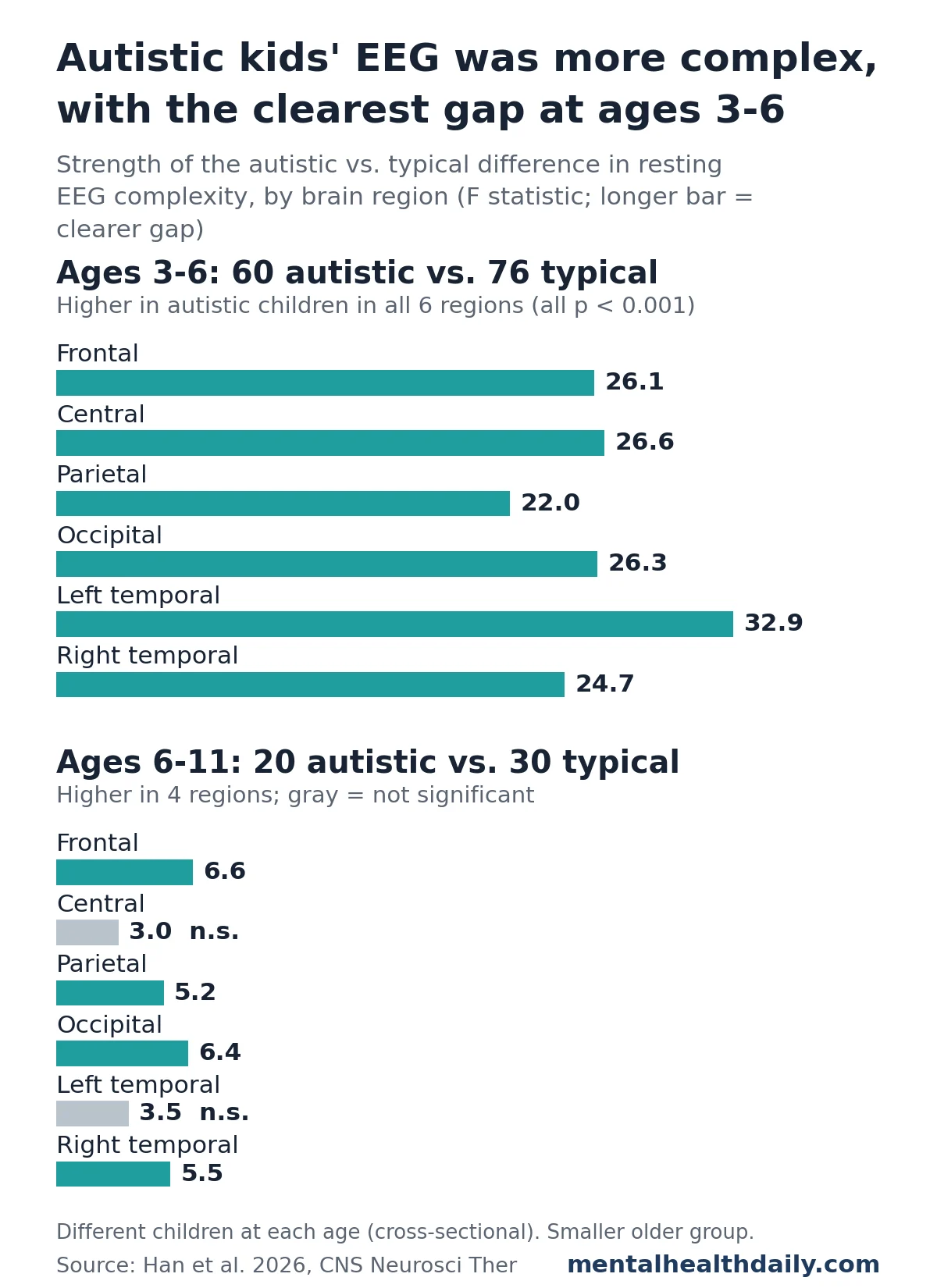
The overarching finding of the 2026 study was that autistic children consistently demonstrated higher multiscale entropy compared to typically developing children across all six major brain regions examined (frontal, central, parietal, occipital, left temporal, and right temporal). This difference was highly statistically significant (all p < 0.001), indicating an extremely low probability that these results occurred by chance. Sensor-by-sensor analyses further corroborated this pattern, revealing higher complexity in autistic children across nearly all individual sensors and at various timescales. This broad, pervasive difference suggests a fundamental divergence in resting-state brain dynamics in ASD.
It was also noted that the magnitude of this difference was not uniform across all timescales within each region, implying that the gap between groups varied depending on the speed of the signal patterns being analyzed. Interestingly, sex was not found to be a significant factor influencing EEG complexity in any region, suggesting that these neural differences are not sex-specific within the studied age range.
A critical aspect of the study was its examination of age-related variations in neural complexity. When the cohort was divided into the two age groups:
- Preschoolers (3 to 6 years old): This group included 60 autistic children and 76 typically developing children. In this younger cohort, the difference in signal complexity between autistic and typically developing children was remarkably clear and statistically significant across all six brain regions. The F statistics, a measure of the strength of the effect, ranged from 22.0 (parietal region) to 32.9 (left temporal region), underscoring a substantial and widespread divergence in neural dynamics.
- School-age children (6 to 11 years old): This group comprised 20 autistic children and 30 typically developing children. In the older cohort, the complexity gap was noticeably smaller and less pervasive. While differences remained statistically significant in the frontal, parietal, occipital, and right temporal regions, they were no longer significant in the central or left temporal regions. The F statistics in this group were considerably lower, ranging from 3.0 to 6.6, indicating a reduced effect size. Furthermore, in this older group, the remaining differences were predominantly observed at the fastest timescales, and scalp maps localized these disparities primarily to the frontal region, an area crucial for executive functions, attention, and social cognition.
Age-Related Trajectories and Symptom Links
The study also shed light on how EEG complexity evolves with age in both groups. In typically developing children, older age was consistently associated with higher complexity across every timescale, with the strongest correlation observed at slower timescales (steps 11 to 20). This finding aligns with the established understanding that as the brain matures, its neural networks become more intricate and robust, leading to richer and more complex signal patterns.
However, the pattern of age-related complexity in autistic children was notably uneven and distinct from their typically developing peers. At the fastest timescales, complexity tended to decrease with age in autistic children. In contrast, at slower timescales, complexity showed an increase with age, similar to typically developing children, but only up to a certain point before potentially leveling off or even decreasing. One interpretation of these findings is that autistic children might begin with an elevated baseline of neural complexity, and as they age, their brain signals, particularly at slower timescales, might begin to resemble those of their typical peers more closely, perhaps reflecting some compensatory mechanisms. The researchers also hypothesized that higher-order brain systems might be involved in such compensation. It is crucial to remember, however, that this was a cross-sectional study, meaning each child was recorded only once. Therefore, while it provides valuable insights into group averages across age groups, it cannot definitively ascertain how any individual child’s brain signals evolve over time. Longitudinal studies, tracking the same individuals over several years, would be necessary to establish such developmental trajectories.
When exploring links between EEG complexity and autism symptoms, assessed through parent-reported scores on the Autism Behavior Checklist (ABC) and the Social Responsiveness Scale (SRS), the findings were mixed and required careful interpretation. The results section indicated a potential association between higher complexity and better social thinking in certain contexts. Conversely, the discussion section suggested that elevated frontal and parietal complexity might correlate with greater difficulties in areas such as sensory processing, communication, language, and social cognition. The exact direction and strength of these correlations were not explicitly detailed in the report, and given the extensive number of sensor-timescale pairs tested, these symptom links are considered exploratory and warrant further investigation. The nuanced and sometimes contradictory findings highlight the complex relationship between underlying neural dynamics and the diverse phenotypic expressions of ASD.
Broader Scientific Context: Prior Research and Divergent Findings
The 2026 Beijing study builds upon a growing body of research investigating brain signal variability and complexity in autism, while also highlighting some intriguing discrepancies. Previous studies using various neuroimaging techniques have yielded a complex picture:
- Younger Autistic Children, More Variable Signals (MEG): A 2016 study by Takahashi et al. utilized magnetoencephalography (MEG), which measures magnetic fields produced by electrical currents in the brain, to examine 43 autistic and 72 typically developing young children during silent video viewing. This study reported that signal variability increased with age in typical children but followed an atypical age pattern in autistic children, and was generally higher in autistic children, particularly the youngest participants. This finding aligns closely with the 2026 EEG study’s observation of higher complexity in younger autistic children.
- Infants at High Familial Likelihood (EEG): A 2011 study by Bosl et al. tracked resting EEG complexity in infants at higher familial likelihood for autism (i.e., those with an autistic older sibling) from 6 to 24 months. They found that EEG complexity followed a different developmental trajectory in these at-risk infants compared to controls, with the most significant differences emerging between 9 and 12 months of age. This earlier work suggested that deviations in brain signal complexity could be an early indicator of autism risk even before behavioral symptoms fully manifest.
- Adults During a Task, Lower Complexity (EEG): In contrast to studies on children, a 2011 study by Catarino et al. found reduced EEG complexity in 15 autistic adults compared to 15 controls. This reduction was observed over temporo-parietal and occipital regions while participants performed a task involving matching pictures of faces and chairs.
Taken together, these studies suggest that the direction of differences in brain signal complexity in autism (whether higher or lower) appears to be highly dependent on several factors: the age of the participants, the specific recording conditions (resting state versus engaging in a task), and the neuroimaging method employed (EEG versus MEG). The 2026 Beijing study significantly contributes to this field by providing a large sample of young children specifically at rest, reinforcing the notion of elevated complexity in early development during resting states. This comprehensive perspective underscores the dynamic and context-dependent nature of neural signatures in ASD.
Implications for Autism Understanding and Future Research
The findings from the 2026 Beijing study hold substantial implications for advancing our understanding of autism spectrum disorder. The consistent observation of higher neural signal complexity in autistic children, particularly preschoolers, suggests a potential neurobiological signature that distinguishes their brain function. This could reflect a state of neuronal hyperexcitability, a less organized intrinsic brain activity, or an imbalance in inhibitory and excitatory neural processes that characterize early autism development.
From a clinical perspective, while these findings are not a diagnostic tool for individual children, they contribute to the ongoing search for objective biomarkers of ASD. Understanding these neural differences could, in the long term, inform the development of more precise diagnostic aids, particularly for early identification. Early identification is paramount in autism, as it allows for earlier access to interventions, which are generally most effective during critical periods of brain development.
"This study provides compelling evidence of fundamental differences in intrinsic brain activity in young autistic children," stated Dr. Li Wei, a prominent neuroscientist not affiliated with the study but familiar with the research. "The age-dependent nature of these findings is particularly fascinating, suggesting a dynamic developmental course. It compels us to consider how brain organization evolves over time in ASD and what implications this has for targeted interventions at different developmental stages."
The reduction in the complexity gap in older children also raises questions about neural plasticity and compensatory mechanisms. Do the brains of older autistic children adapt over time, or do the differences manifest in more subtle ways that require even more refined analytical techniques to detect? This study, by highlighting these developmental shifts, underscores the need for longitudinal research that tracks brain complexity from infancy through adolescence and adulthood in individuals with ASD. Such studies could reveal critical periods for intervention and help tailor therapies to specific developmental windows.
"While EEG complexity is not a diagnostic test for autism, these findings deepen our understanding of the underlying brain differences," commented Dr. Chen Jing, a pediatric neurologist. "The increased complexity, especially in younger children, might be indicative of a brain that is ‘too noisy’ or less efficient in processing information. This could explain some of the sensory sensitivities and difficulties in integrating information often seen in ASD. Future research could explore if interventions that aim to ‘normalize’ brain activity, such as certain neurofeedback approaches or pharmacological agents, could impact these complexity metrics and, more importantly, lead to improvements in core autism symptoms."
Limitations and Future Directions
Despite its significant contributions, the 2026 Beijing study, like all scientific endeavors, has limitations that must be acknowledged. As a cross-sectional study, it captures a snapshot of brain activity at one point in time for each child. This means it cannot definitively track individual developmental changes in EEG complexity over age. Longitudinal studies, which follow the same group of children over several years, are essential to understand the dynamic evolution of these neural signatures within individuals.
Furthermore, the study describes group averages. EEG complexity is not, and should not be interpreted as, a standalone diagnostic test for autism in an individual child. The variability within both autistic and typically developing populations is substantial, and group-level differences do not translate directly to individual diagnostic criteria. The study also did not investigate treatment implications, meaning it offers no direct guidance on how these findings could be used to inform therapeutic strategies.
"This research opens many doors for future inquiry," said Ms. Zhang Lei, an advocate for autism research and support. "We need more research, especially longitudinal studies, to understand the trajectory of these brain differences and how they relate to individual experiences and outcomes. Critically, we must ensure that such scientific advancements translate into tangible benefits for autistic individuals and their families, whether through earlier support, more personalized interventions, or a deeper societal understanding."
Future research should aim to:
- Conduct Longitudinal Studies: Track EEG complexity in the same individuals over several years to understand developmental trajectories and critical periods.
- Explore Causal Links: Investigate whether elevated complexity is a cause, a consequence, or a correlate of other autism-related brain changes and behavioral symptoms.
- Investigate Intervention Effects: Examine how different therapeutic interventions impact brain signal complexity and whether changes in complexity correlate with improvements in clinical symptoms.
- Diverse Populations: Replicate these findings in more diverse populations, including different ethnicities, socioeconomic backgrounds, and severity levels of ASD, to ensure generalizability.
- Multimodal Integration: Combine EEG complexity data with other neuroimaging techniques (e.g., fMRI, DTI) to build a more comprehensive picture of structural and functional brain differences in autism.
In conclusion, the 2026 Beijing EEG study provides a crucial piece of the puzzle in understanding the neurobiological underpinnings of autism. By highlighting distinct patterns of brain signal complexity, particularly in young children, it sets a new benchmark for future research aimed at unraveling the complex neural landscape of ASD and ultimately, improving the lives of individuals on the spectrum.

