

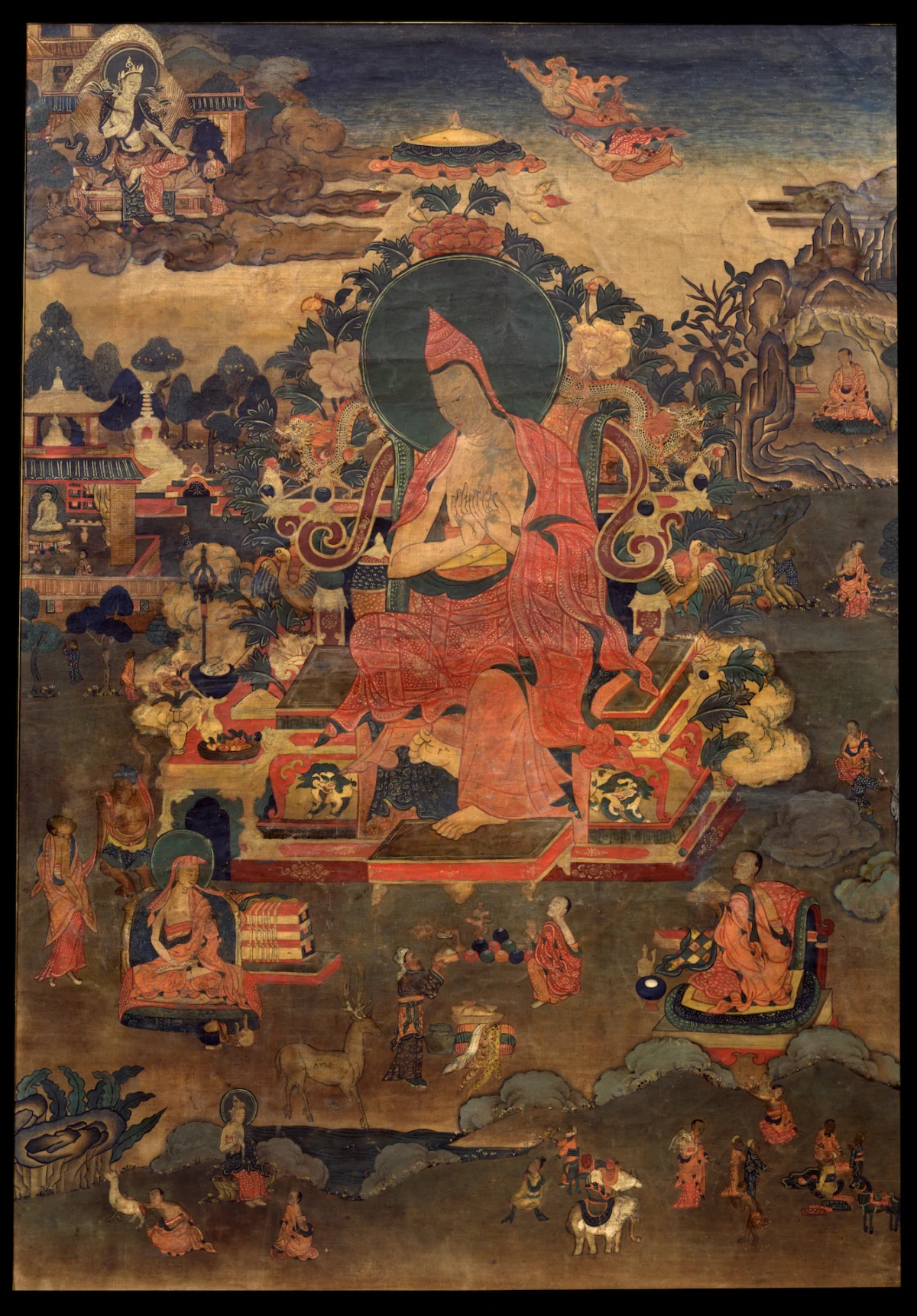
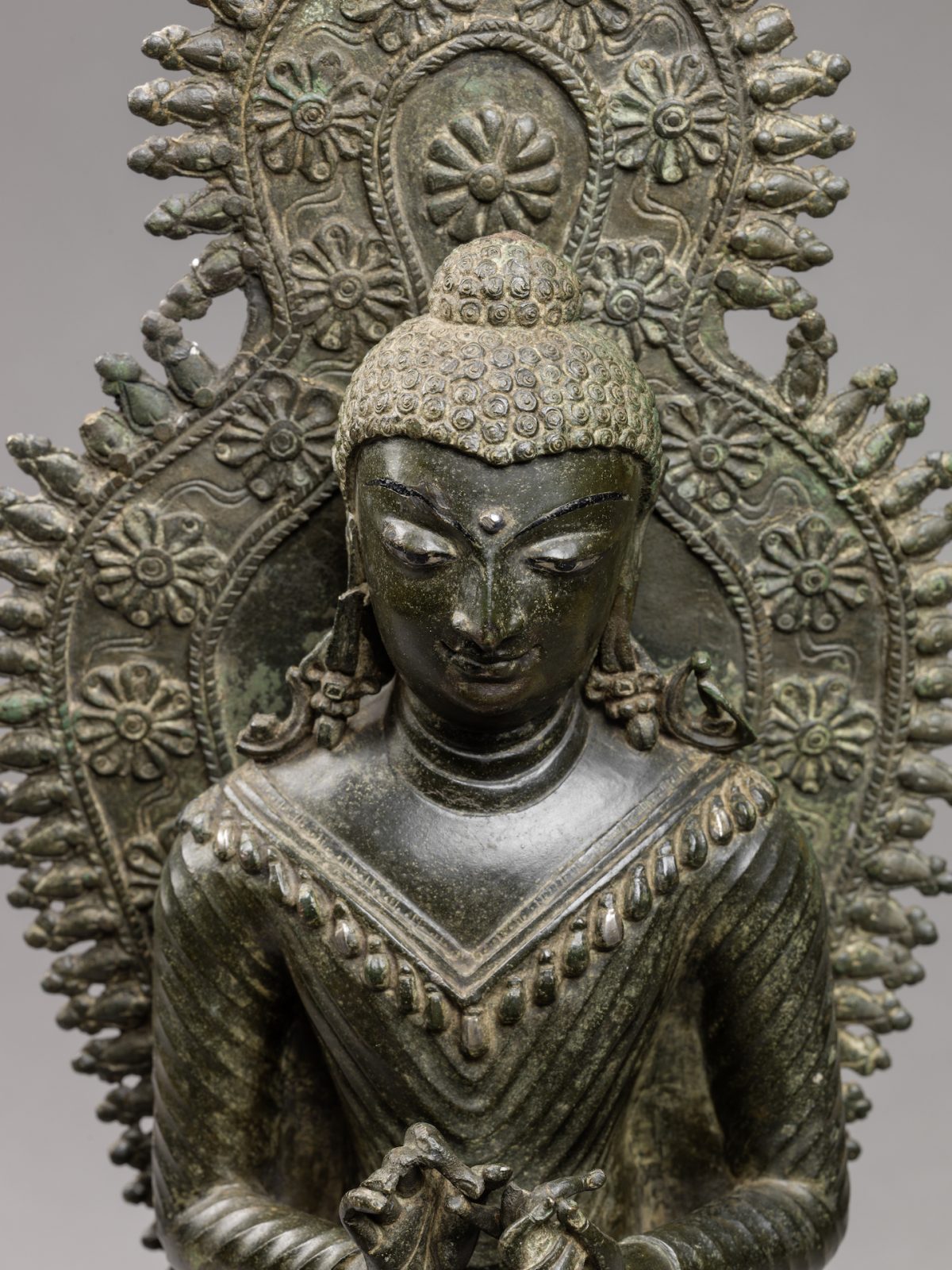
Buddhist scriptures delineate a celestial hierarchy of Buddhas, encompassing those of the past, the present, and the future. Central to this eschatological vision is Maitreya, the prophesied Buddha of the future, whose advent is anticipated when the teachings of the current Buddha, Shakyamuni, have faded from human memory. While his arrival is posited millions of years hence, Buddhist tradition offers insights into his identity, location, and the profound significance of his eventual appearance. An artifact, likely originating from the Swat Valley in the 8th or 9th century, now part of Pakistan, is believed to depict this future Buddha. His name, Maitreya, derives from the Sanskrit word for "kindness," a virtue central to his eventual mission. The depicted figure, seated on a throne and already bearing the characteristic protuberance atop his head—one of the thirty-two "marks of a great being" signifying Buddhahood—is understood to reside in Tushita, a celestial realm of joy situated in the heavens above Mount Meru, the axis of the Buddhist cosmos.
Maitreya’s Presence in Buddhist Canons and Traditions
Maitreya receives a singular mention within the Pali Canon, the foundational scriptures of Theravada Buddhism, prevalent in Sri Lanka and Southeast Asia. However, his role expands significantly within the Mahayana tradition, encompassing Tibetan and East Asian Buddhism. Here, Maitreya appears in numerous pivotal sutras, sometimes as a silent member of the Buddha’s audience, and at other times as a key interlocutor. Notable examples include the Lotus Sutra, the Vimalakirti Sutra, and the Gandavyuha Sutra. As the historical distance from Shakyamuni Buddha grew, the anticipation and importance of Maitreya’s future arrival correspondingly increased, shaping devotional practices and philosophical inquiries across these traditions.
The Practice of "Recollection of the Buddha" and the Rise of Iconography
The Buddha, according to tradition, expounded forty distinct topics of meditation, from which monastic practitioners could select. Among the most widely practiced is buddhanusmrti, or "recollection of the Buddha." This practice involves contemplating the sublime qualities of the Buddha, often through the recitation of a powerful mantra: "The Blessed One is accomplished, fully enlightened, endowed with clear vision and virtuous conduct, sublime, the knower of worlds, the incomparable leader of humans to be tamed, the teacher of gods and humans, enlightened and blessed."
It is crucial to contextualize the development of Buddhist art and practice. Images of the Buddha in the anthropomorphic forms recognized today did not emerge in India until the early second century CE, approximately five centuries after Shakyamuni’s passing into nirvana. The advent of these images profoundly influenced the practice of "recollection of the Buddha." Meditators were then instructed to fix their gaze upon an image, striving to achieve a detailed mental visualization of the Buddha. Concurrently, around the 2nd century CE, monks in the region of Kashmir began to center their practice of "recollection of the Buddha" on Maitreya. Their aspirations varied: some sought to receive his direct teachings, while others aimed for rebirth in Tushita heaven to join his retinue when he descends to re-establish the Dharma in the world. The 8th-9th century Swat Valley artifact, mentioned earlier, may well have served such a devotional purpose.
The Profound Narrative of Asanga and the Twelve-Year Devotion
One of the most celebrated accounts of encountering Maitreya involves the 4th-century Indian monk Asanga, a monumental figure in Buddhist history. Asanga is credited as the principal architect of the Yogacara (or "Mind Only") school of Mahayana philosophy and authored significant treatises on meditation, including practices focused on visualizing the Buddha. Born in Purushapura (modern-day Peshawar, Pakistan), Asanga’s profound erudition meant that few could answer his complex philosophical inquiries. This led him to seek the wisdom of the future Buddha.
Determined to meet Maitreya, Asanga retreated to a cave for intensive meditation, praying for his manifestation. After three years of unwavering devotion with no sign of Maitreya, he nearly abandoned his quest. However, witnessing a man meticulously grinding an iron spike with a piece of cloth, who revealed he was making sewing needles, deeply inspired Asanga. The tailor’s extraordinary perseverance reignited Asanga’s resolve. He returned to his cave and resumed his entreaties. Another three years passed without success, followed by another three-year period of renewed effort and subsequent despair. In total, Asanga dedicated twelve years to this solitary meditation, yet Maitreya remained elusive.
As Asanga prepared to leave the cave, disheartened, he observed a dog in distress outside, its body afflicted with a deep, maggot-infested wound. Moved by profound compassion, Asanga knelt to tend to the animal. As he reached for a stick to remove the maggots, he was struck by the realization that these creatures, too, were sentient beings, deserving of his pity. Removing them would deprive them of sustenance, yet saving the dog was paramount. A passerby approached, and Asanga, in an act of profound self-sacrifice, traded his monastic staff for the man’s knife. He then cut a piece of flesh from his own thigh, intending to place it near the dog to transfer the maggots. However, he recognized that even with the stick or his fingers, some maggots would be harmed. The only method that would ensure their survival was his tongue. To prevent himself from being overcome by nausea, he covered his eyes with his hand, extended his tongue, and lowered his head to begin the delicate task.
Instead of encountering the warmth of the dog’s flesh, his tongue touched the cold stone floor of the cave. Opening his eyes, Asanga found the dog gone, replaced by Maitreya, radiant in his full glory.
The Unveiling of Inner Obstacles and the Transmission of Mahayana Teachings
A bewildered and somewhat disappointed Asanga expressed his twelve years of fruitless prayer. Maitreya explained that he had been present throughout, but Asanga’s own mental obscurations prevented him from perceiving him. When Asanga remained skeptical, Maitreya pointed to the remnants of food and dried saliva clinging to his magnificent robes, evidence of his proximity to Asanga during his daily meals. This profound encounter revealed that Asanga’s twelve years of prayer and meditation had not sufficed to remove the internal barriers preventing his spiritual vision; it was an act of selfless compassion that ultimately cleared his mind.
To further demonstrate this, Maitreya instructed Asanga to carry him into the nearby town. Astonishingly, no one saw Maitreya; they only perceived a monk carrying a dog. Maitreya then commanded Asanga to set him down and grasp his robe. In a swift ascent, they were transported to Tushita heaven. There, Asanga spent a celestial morning, equivalent to fifty human years, receiving the "five books of Maitreya." These profound texts, including the Mahāyānasūtrālamkāra, Madhyāntavibhāga, Dharmadharmatāvibhāga, Abhisamayālaṃkāra, and Ratnagotravibhāga, became foundational treatises of Mahayana Buddhism, profoundly shaping its philosophical and contemplative landscape.
Cosmic Cycles and the Decline of the Dharma
Maitreya’s eventual appearance on Earth is envisioned as a momentous event, occurring within a vastly transformed world. Buddhist cosmology describes the world as undergoing cyclical stages, influenced by collective karma. The current epoch, the "Stage of Abiding," is characterized by fluctuating human lifespans. Presently, the cycle is in a downward phase, with human longevity diminishing to as little as ten years, before eventually ascending to a peak of eighty thousand years. During this period of decline, both the material conditions of the world and the efficacy of the Dharma are expected to deteriorate.
This decline is often attributed to the "five degradations" (pañca-kalpa-vyavasthāna):
- Degradation of Lifespan: The shortening of human life.
- Degradation of Views: The proliferation of erroneous and unwholesome perspectives.
- Degradation of Afflictions: The intensification of negative emotions such as greed, hatred, and delusion.
- Degradation of Sentient Beings: The weakening of both physical and mental capacities of individuals.
- Degradation of the Eon: The deterioration of the physical environment.
As these degradations intensify, the capacity for sentient beings to follow the path to enlightenment diminishes, rendering enlightenment seemingly unattainable. The precise commencement of this period of decline has been a subject of scholarly and devotional calculation. In Japan, for instance, it was determined that the decline of the Dharma began in 1052 CE. Consequently, many practitioners, particularly in East Asia, have turned their focus away from awaiting Maitreya’s advent and instead aspire for rebirth in Sukhavati, the Western Paradise, the pure land of Amitabha Buddha, the Buddha of Infinite Light and Life. Rebirth in Sukhavati guarantees enlightenment without further rebirths in this world.
Maitreya’s Descent and the Optimal Human Lifespan
The timing of Maitreya’s descent is intricately linked to the fluctuating human lifespan. In the Theravada account of Shakyamuni Buddha’s appearance, he deliberated on the optimal lifespan for a Buddha to manifest. He reasoned that if the lifespan were excessively long, the suffering associated with aging and death would not become apparent quickly enough for his teachings to resonate. Conversely, a lifespan under one hundred years would be too brief for disciples to achieve significant progress on the spiritual path. Therefore, he concluded that a hundred years represented an ideal human lifespan for a Buddha’s appearance.
Maitreya, however, appears to have arrived at a different calculation. It is widely believed that he will not descend from Tushita until the human lifespan reaches its zenith of eighty thousand years, an event projected to occur in approximately six billion years. This significant temporal distance has led many individuals throughout history who have claimed to be Maitreya to be regarded as pretenders, particularly within millenarian movements. Nevertheless, the vast temporal gap to Maitreya’s eventual arrival is mitigated by his perceived physical proximity. Maitreya does not reside in a pure land separate from our reality; he remains within samsara, our realm of cyclic existence, specifically in the "Realm of Desire," reflecting humanity’s deep attachment to sensory pleasures. His current abode in Tushita heaven, above Mount Meru, is a destination accessible through rebirth, signifying that his presence, though future, is not entirely beyond our reach.
The Significance of Maitreya’s Iconography and His Promise of Kindness
The artistic representation of Maitreya, such as the artifact from the Swat Valley, often conveys profound symbolic meaning. His hands, depicted in a teaching gesture, suggest his role as an instructor, perhaps even in his interactions with figures like Asanga. His posture, seated on a throne rather than the traditional lotus posture, is interpreted as a readiness to swiftly ascend and descend to our world when the time comes to re-establish the Dharma.
Ultimately, the narrative of Maitreya, particularly through the story of Asanga, underscores a vital message: the transformative power of kindness. Even before his prophesied descent, acts of genuine compassion serve as a conduit for experiencing his presence. This understanding offers a profound perspective on how to perceive a Buddha—not merely as a future savior, but as an embodiment of ethical conduct and boundless empathy, accessible in the present moment through our own benevolent actions.
This essay was originally published in "Approaching the Buddha: Transmission and Transformation" by Hao Sheng (The Museum of Fine Arts, Houston, 2026), a publication that showcases masterpieces from diverse Buddhist cultures across Asia from the Xuzhou Collection of Buddhist Art. Reprinted with the gracious permission of the author and publisher.

