

A groundbreaking 37-question survey, designed to comprehensively map the resources available to families caring for individuals with schizophrenia, has demonstrated robust reliability and validity in its inaugural full test involving 304 caregivers in Beijing. This innovative tool, dubbed the Multidimensional Family Resource Assessment Tool for Schizophrenia (M-FRAT), assesses a spectrum of support, ranging from financial and emotional resources within the family unit to crucial community services and broader policy frameworks. Its successful validation marks a significant step towards better understanding and addressing the multifaceted needs of family caregivers, particularly in cultural contexts like China and other Asian nations where families often bear the primary responsibility for long-term care.
The Indispensable Role and Burden of Family Caregivers
In China, as in many parts of Asia, the vast majority of individuals living with schizophrenia reside with their relatives. These family members assume an extensive and often demanding role, encompassing daily supervision, medication management, providing emotional support, and navigating complex health and social service systems. This profound level of commitment, while culturally ingrained and often deeply loving, comes at a considerable personal cost to the caregivers.
Research consistently highlights the immense toll this responsibility takes on caregivers’ well-being. A poignant survey conducted across five European countries, for instance, revealed that 398 schizophrenia caregivers scored significantly lower on the mental health summary of the SF-36 quality-of-life questionnaire compared to matched non-caregivers (40.3 vs. 45.9). Alarmingly, their mental health scores were also lower than those caring for individuals with other severe conditions such as dementia, cancer, and stroke (40.3 vs. 42.7). This data underscores the unique and often unacknowledged burden associated with caring for someone with schizophrenia, a condition characterized by its chronic nature, potential for relapse, and significant societal stigma.
Beyond the caregiver’s personal well-being, robust family support is also intrinsically linked to improved patient outcomes. A comprehensive 2022 network meta-analysis, pooling data from 90 randomized trials involving 10,340 participants, established that nearly every type of family intervention significantly reduced the likelihood of relapse at 12 months when compared to standard care. The only exceptions were highly crisis-oriented approaches or extremely brief family education sessions consisting of two or fewer interactions. This evidence firmly establishes family involvement not merely as a social reality but as a critical therapeutic component in schizophrenia management.
The Urgent Need for a Holistic Assessment Tool
Despite the acknowledged importance of family resources and support, clinicians and support networks have historically lacked a comprehensive instrument to effectively gauge the full spectrum of resources available to a family. Existing questionnaires often focus on isolated aspects, such as social support networks or general family functioning, providing only a fragmented view of the intricate challenges and strengths within a caregiving household. This piecemeal approach makes it difficult for healthcare professionals to identify specific deficits and tailor interventions effectively.
Recognizing this critical gap, the M-FRAT was meticulously developed to provide a holistic, caregiver-centric perspective on available resources. Its design aims to equip healthcare providers with a tool that can paint a complete picture, enabling them to pinpoint areas where families are strong and, more importantly, where they are struggling and require additional support.
The Genesis of M-FRAT: A Collaborative Expert Consensus
The development of the M-FRAT was a rigorous, multi-stage process rooted in expert consensus, emphasizing its foundational validity. Its conceptual framework emerged from a 2024 study that employed a two-round Delphi survey. This structured methodological approach involved a panel of 21 experts who systematically rated and refined potential family resource indicators until a strong consensus was reached. Initially, this collaborative process identified 46 family resource indicators, categorized across 10 distinct domains, laying the groundwork for the questionnaire’s content.
Caregivers using the M-FRAT are asked to rate statements on a five-point Likert scale, ranging from 1 (strongly disagree) to 5 (strongly agree). Higher cumulative scores indicate a greater availability of resources within the family’s caregiving ecosystem. Notably, religious resources were consciously excluded from the final version of the questionnaire, a decision made by the development experts who deemed religious activities potentially unsuitable or less universally relevant for people with schizophrenia within the specific cultural context of the study. However, the researchers prudently suggested that the role of religious resources should be explored in other cultural settings, acknowledging the diversity of global caregiving experiences.
The Beijing Validation Study: Methodology and Demographics
To ascertain the M-FRAT’s psychometric properties—its reliability and validity—Li et al. conducted a two-stage evaluation process in Beijing. The study enrolled 304 caregivers out of 322 invited participants, achieving an impressive participation rate of 94.4%. The primary reasons cited by those who declined to participate were concerns about stigma and a reluctance to share personal information, highlighting the persistent challenges associated with mental illness in many societies.
The demographic profile of the participating caregivers offered valuable insights into the caregiving population. The average age of caregivers was 59 years. Spouses constituted the largest group, accounting for 44.7% of participants, followed by parents at 31.6%. A striking 71.0% reported having been in a caregiving role for more than a decade, underscoring the long-term commitment and chronic nature of schizophrenia care. This sample provides a representative snapshot of experienced, long-term caregivers, making the M-FRAT’s validation particularly relevant for real-world application.
Refining the Tool: 37 Questions in 7 Robust Groups
The validation phase involved a series of standard psychometric checks to determine the questionnaire’s efficacy as a reliable measuring instrument. These checks typically include assessments of internal consistency (how well items within a scale measure the same construct) and structural validity (whether the items group together in a meaningful way).
To uncover the inherent structure of the scale, the research team employed exploratory factor analysis. This statistical method systematically groups questions based on how similarly caregivers tend to respond to them, revealing underlying dimensions or factors. Over three iterative rounds of analysis, nine items were ultimately removed from the initial 46, either because they showed weak correlation with any specific factor, straddled multiple groups ambiguously, or did not logically fit into their assigned categories. This meticulous refinement process ensured that the final M-FRAT is both concise and robust.
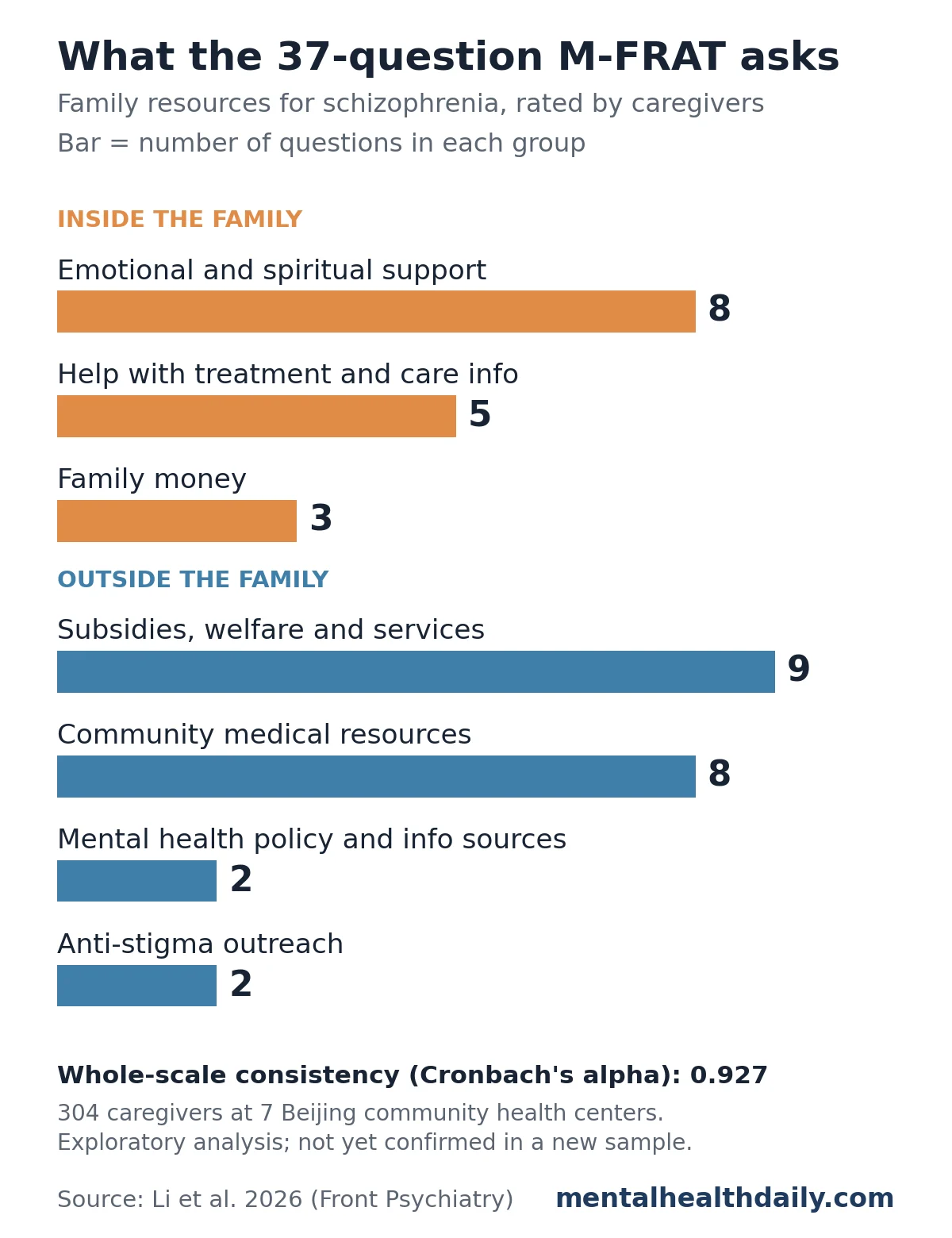
The exploratory factor analysis ultimately refined the M-FRAT into 37 questions organized into seven distinct groups of family resources. These seven groups can be broadly categorized into resources inside the family and those outside it. Inside the family, the tool assesses:
- Emotional and Spiritual Support (8 questions)
- Help with Treatment and Care Information (5 questions)
- Family Money (3 questions)
Outside the family, the M-FRAT evaluates:
- Subsidies, Welfare, and Services (9 questions)
- Community Medical Resources (8 questions)
- Mental Health Policy and Information Sources (2 questions)
- Anti-Stigma Outreach (2 questions)
The entire scale demonstrated strong internal consistency, with a Cronbach’s alpha of 0.927, indicating excellent reliability. This high alpha value suggests that the M-FRAT’s items consistently measure the intended constructs.
During this structural refinement, two pairs of the original 10 domains merged, reflecting natural overlaps in caregiver experiences. Economic resources (such as rehabilitation subsidies and employment support) combined with environmental resources (like welfare and access to nursing or rehabilitation facilities). Similarly, information and education support integrated into medical treatment support. Conversely, the "structural support" domain, which focused on practical home arrangements (e.g., keeping dangerous items in a safe place), did not cohere adequately (alpha 0.117) and was consequently dropped. The researchers hypothesized that this might be due to the study’s sample largely consisting of patients in a stable phase of illness, where such home adjustments might be less critically perceived.
Identifying Critical Resource Gaps: Subsidies and Community Services
A crucial finding from the M-FRAT’s initial application was the identification of significant resource deficiencies, particularly in areas related to external support. On the original 46-item version, caregivers consistently assigned the lowest per-question scores to economic and environmental resources. This indicates a widespread perception of inadequacy in these areas. While the highest-rated single item was the availability of a free yearly physical exam in the community, with 60.5% strongly agreeing to its accessibility, this positive aspect did not offset the overall deficit in other crucial external supports.
This pattern of unmet needs aligns strikingly with an earlier survey involving 363 caregivers across six urban Beijing districts. That study found that fewer than 10% of caregivers were aware of available rehabilitation programs and related subsidies, and an even smaller fraction, less than 5%, had actually utilized them. Li et al. pointed to several probable reasons for this pronounced gap between available (or theoretically available) resources and their actual utilization:
- Lack of Awareness: Many caregivers simply do not know about the existence of specific policies or services.
- Complex Application Procedures: Bureaucratic hurdles and complicated application processes deter caregivers, who are often already overwhelmed.
- Stigma and Reluctance: The pervasive stigma associated with mental illness can make families hesitant to seek out and utilize community services, fearing judgment or discrimination.
- Limited Service Availability: Despite policies, the actual availability and accessibility of high-quality rehabilitation and support services in communities may be insufficient.
These findings underscore a critical disconnect between policy intent and practical implementation, highlighting the need for more effective dissemination of information and streamlined access to services.
Urban and Rural Disparities: More Similar Than Expected
One of the researchers’ initial predictions was that resource levels would differ significantly based on whether families resided in rural or urban areas, given potential disparities in infrastructure and access to services. Surprisingly, the total M-FRAT scores did not show a statistically significant difference between these groups, with rural families averaging 131.4 and urban families 127.0 (p = 0.089). This suggests that the overall resource landscape, while potentially different in composition, might be perceived as equally challenging across both settings.
The only domain where a significant difference emerged was the "cultural resources" group, which comprises two items related to community anti-stigma outreach. Here, rural families scored higher (7.16) than urban families (6.59, p = 0.030). The researchers interpreted this as partial support for their prediction, suggesting that while overall resource levels may be comparable, specific types of support, such as community-led anti-stigma initiatives, might be perceived differently or be more prevalent in rural contexts, perhaps due to closer-knit community structures or different awareness campaigns.
The Link Between Resources and Caregiver Well-being
The study also investigated the relationship between the availability of family resources, as measured by the M-FRAT, and caregivers’ general health. Caregivers’ SF-36 scores for general health, vitality, and mental health averaged approximately 58 out of 100. The researchers noted that these scores were "relatively low," echoing previous findings about the significant burden on this population.
As hypothesized, higher total M-FRAT scores were statistically linked to better scores across seven of the eight SF-36 domains in regression models. This indicates that families with more perceived resources tend to experience better quality of life and health outcomes. However, the magnitude of these links was modest, with M-FRAT scores explaining between 1.7% and 5.3% of the observed differences in caregiver quality of life. Simple correlations were significant only for the four physical-health domains (r = 0.124 to 0.187).
The researchers interpreted these findings as expected, acknowledging that caregiver quality of life is a complex construct influenced by numerous factors beyond just available resources. These include the patient’s illness severity and stability, the caregiver’s own pre-existing health conditions, the pervasive impact of stigma, and various other psychosocial determinants. Furthermore, as the data is cross-sectional (a snapshot in time), it cannot establish causality. While a correlation exists, the study cannot definitively prove that an increase in resources would directly lead to an improvement in caregiver health, though this is a logical inference and a primary aim of future interventions.
Implications for Clinical Practice and Policy
The intended utility of the M-FRAT is highly practical and directly actionable. A primary care physician or a community mental health worker could administer the questionnaire to a caregiver during a routine visit. By analyzing the scores, they could quickly identify specific resource deficits within the family’s support system. For example, if scores are low in "Subsidies, Welfare, and Services," the clinician could proactively connect the family to relevant government programs, rehabilitation subsidies they may not have known about, or local community rehabilitation guidance services they are currently missing.
While the M-FRAT holds immense promise for personalized care planning, its application in intervention studies is still a future proposal. As of now, the tool has not been tested in trials designed to demonstrate whether its use directly leads to measurable improvements in caregiver burden, enhanced patient recovery rates, or reduced relapse occurrences. This critical step will be necessary to fully establish its impact as an intervention-guiding instrument.
Beyond individual clinical utility, the M-FRAT’s findings also carry significant implications for broader mental health policy and public health initiatives, especially in China. The consistent identification of gaps in economic and environmental resources, coupled with low awareness and utilization of existing services, calls for a multi-pronged policy response. This includes:
- Enhanced Information Dissemination: Creating clearer, more accessible channels for caregivers to learn about available support programs.
- Streamlined Access: Simplifying application processes for subsidies and services to reduce administrative burden.
- Increased Funding for Community Services: Investing more in local mental health services, rehabilitation programs, and support groups.
- Targeted Anti-Stigma Campaigns: Developing and implementing effective public awareness campaigns to reduce the pervasive stigma associated with schizophrenia, thereby encouraging families to seek help.
- Integration of Care: Fostering better collaboration between primary care, mental health specialists, and community social services to create a more cohesive support ecosystem.
The insights gleaned from the M-FRAT can serve as a valuable evidence base for policymakers to prioritize areas of investment and reform, moving towards a more compassionate and effective system of care for individuals with schizophrenia and their families.
Limitations and Future Directions
While the Beijing validation study represents a crucial milestone, it is important to acknowledge its inherent limitations. The study was cross-sectional, meaning it captured data at a single point in time, precluding the establishment of cause-and-effect relationships between resources and caregiver outcomes. Furthermore, the sample was exclusively drawn from caregivers in Beijing, a major metropolitan area in China. This raises questions about the generalizability of the M-FRAT’s structure and findings to other regions within China, particularly rural areas, or to diverse cultural contexts globally. Different cultural norms, healthcare systems, and levels of community development could significantly alter the perception and availability of family resources.
The study also relied on self-reported data from caregivers, which, while valuable, can be subject to recall bias or social desirability bias. The M-FRAT’s psychometric properties, specifically its factor structure, were derived using exploratory factor analysis. While a robust method for initial scale development, future research should aim to conduct a confirmatory factor analysis (CFA) on an independent, larger sample to rigorously confirm the derived seven-factor structure.
Future research should also prioritize longitudinal studies to track how resources change over time and how these changes impact caregiver well-being and patient outcomes. Intervention studies are paramount to demonstrate the M-FRAT’s practical utility in guiding care and improving health metrics. Additionally, adapting and validating the M-FRAT in various linguistic and cultural settings would broaden its applicability and contribute to a more global understanding of schizophrenia caregiving. The M-FRAT represents a promising step forward, providing a much-needed lens through which to view and support the invaluable work of families caring for individuals with schizophrenia. Its continued development and application hold the potential to transform care, moving beyond mere treatment of illness to holistic support for the entire family unit.

