

Despite the growing understanding of the intersection of chronic disease and mental health, a critical gap exists in medical literature concerning suicide risk among Black men with diabetes. A groundbreaking 2026 review underscores the alarming scarcity of research in this demographic, revealing that virtually no studies have specifically measured suicide risk in Black men with diabetes, and none have focused on Black gay, bisexual, and other sexual minority men living with the condition. The review, however, emphasizes that primary care providers possess immediate opportunities to screen for distress and suicide risk, even in the absence of extensive demographic-specific data.
The Groundbreaking 2026 Review: Unveiling a Data Desert
Led by researchers Donte Boyd from Ohio State University and the University of Michigan, the comprehensive narrative review systematically examined five major research databases for studies published between January 2000 and August 2026. The central objective was to ascertain the existing knowledge regarding diabetes-related suicide risk in Black men and to identify practical, evidence-informed actions primary care clinicians could take.
Recognizing the anticipated paucity of studies directly addressing all these intersecting factors, the researchers judiciously categorized the available literature into five distinct streams. This methodological approach allowed for a thorough, albeit fragmented, understanding of the various contributing elements to suicide risk in this population. The review specifically defines "Black sexual minority men" as Black men who identify as gay, bisexual, queer, or another non-heterosexual identity, or who were classified as sexual minority men in a study based on attraction or behavior. Crucially, the review treats this group as a subgroup of Black men, not a separate population, and maintains a clear distinction between sexual orientation and gender identity. As a narrative review, the authors synthesized and summarized findings from individual studies rather than statistically pooling data, a necessity given the fragmented nature of the evidence.
The Broader Landscape: Diabetes and Elevated Suicide Risk
General research indicates a concerning link between diabetes and an increased risk of suicide. A 2017 meta-analysis, encompassing 54 studies, reported that individuals with diabetes faced a 56% higher risk of suicide overall (relative risk 1.56, 95% CI 1.29–1.89). This risk was even more pronounced for those with type 1 diabetes, more than doubling to a relative risk of 2.25. These figures highlight a significant public health concern, suggesting that chronic disease management must inherently integrate mental health considerations.
However, the picture is not uniformly clear-cut. A more recent 2024 meta-analysis, involving 31 studies focused on adolescents and young adults with type 1 diabetes, found that 15.4% reported suicidal thoughts and 3.5% reported suicide attempts. Interestingly, these rates were not definitively higher than those in their non-diabetic peers, primarily due to the imprecision of estimates and wide variations across studies. This nuance underscores the complexity of quantifying suicide risk and the need for highly specific, well-powered research.
The 2026 review identified several plausible pathways linking diabetes to increased suicide risk across both type 1 and type 2 diabetes. These pathways include the chronic stress of managing a lifelong condition, the physical burden of complications such as neuropathy or kidney disease, the financial strain of medication and appointments, the impact of glycemic variability on mood and cognitive function, and the psychological toll of body image issues or perceived loss of control. The review also made a crucial distinction between clinical depression and "diabetes distress," a separate but related problem characterized by feelings of overwhelm, frustration, and hopelessness specifically related to diabetes management. It explicitly recommends clinicians inquire about both conditions. Furthermore, the review cautioned against misinterpreting signs such as missed insulin doses, inconsistent medication use, or unstable blood sugar as deliberate self-harm without direct, sensitive questioning, emphasizing that these could be indicators of distress or practical barriers rather than suicidal intent.
A Void in Research: The Alarming Absence of Data for Black Men
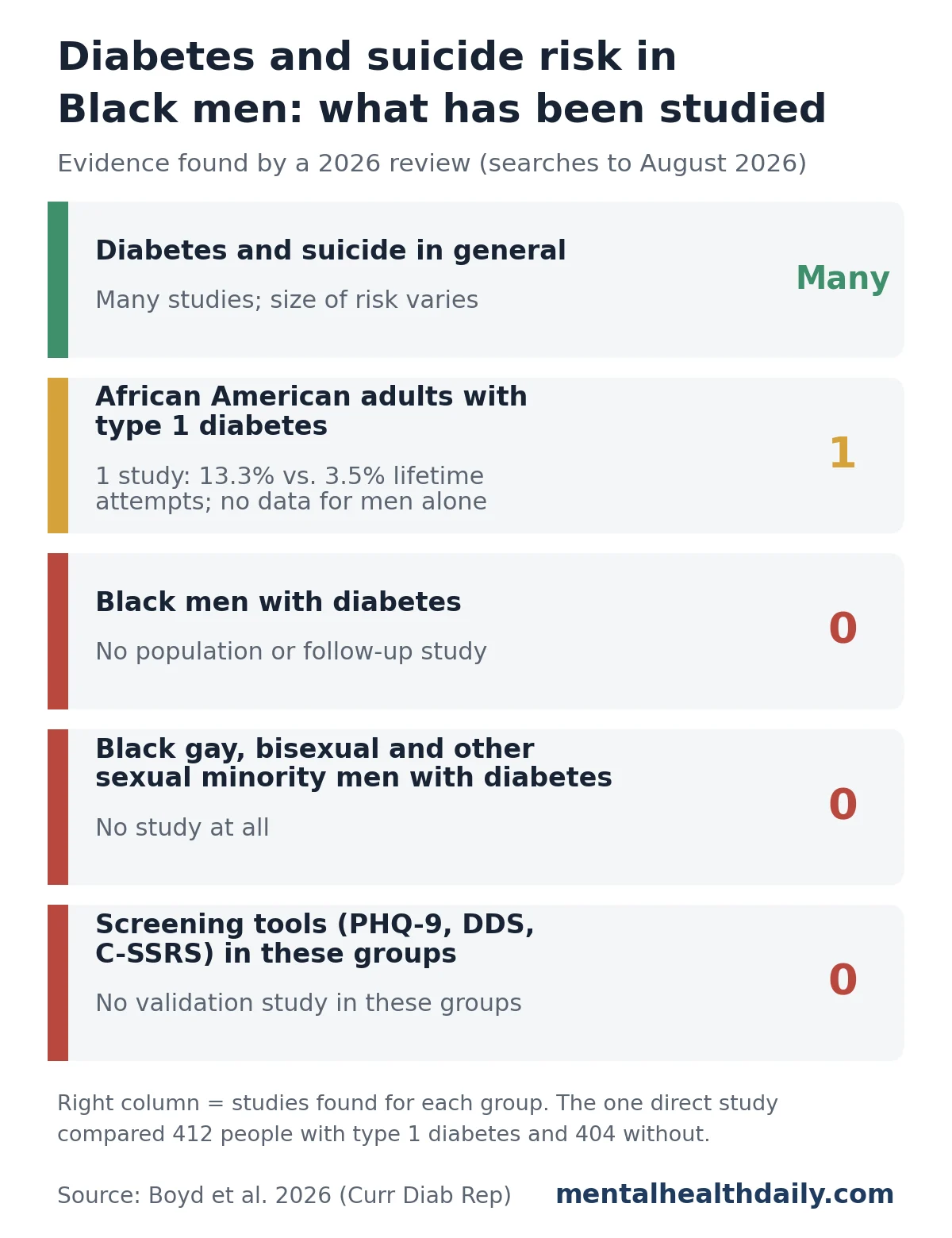
Despite the general association between diabetes and elevated suicide risk, the evidence base for Black men is strikingly thin. The most directly relevant study identified by the review was a 2010 publication by Roy et al., which compared 412 African American adults with type 1 diabetes to 404 African American adults without diabetes. This study reported a lifetime prevalence of suicide attempts at 13.3% among those with type 1 diabetes, significantly higher than the 3.5% found in the control group. While crucial, this study focused solely on type 1 diabetes and, critically, did not disaggregate data to report findings specifically for men.
Beyond this singular study, the 2026 review found no population-based study and no long-term follow-up study reporting suicidal thoughts, attempts, or deaths specifically in Black men with diabetes. This stark absence means current evidence cannot determine whether diabetes elevates suicide risk more for Black men than for White men, nor can it provide a reliable prevalence estimate for Black men with diabetes. The situation is even more dire for Black sexual minority men, for whom no studies estimating suicidal thoughts, attempts, or deaths were found whatsoever.
This glaring data gap is particularly concerning given that several known risk processes for suicide are understood to converge within this group. The review’s findings are starkly illustrated in its evidence summary: while many studies exist on diabetes and suicide in general, and one study addresses African American adults with type 1 diabetes (though not men alone), there are zero population or follow-up studies specifically on Black men with diabetes, and zero studies on Black gay, bisexual, and other sexual minority men with diabetes. Moreover, no validation studies for common screening tools (like PHQ-9, DDS, C-SSRS) have been conducted in these specific populations.
Systemic Barriers: Racism, Socioeconomic Disparities, and Healthcare Discrimination
The lack of specific data becomes even more alarming when contextualized within the broader health disparities experienced by Black men. Black men disproportionately bear the burden of type 2 diabetes and its severe complications, including kidney disease and lower-limb problems. The 2026 review firmly attributes these disparities not to inherent biological differences, but to the pervasive influence of structural racism and its multifaceted consequences.
Structural racism refers to the ways in which societal institutions, policies, and practices create and perpetuate racial inequality, leading to differential access to resources and opportunities. For Black men with diabetes, this manifests in numerous structural and daily barriers that compound their health challenges. These include prohibitive costs of medication and supplies, inadequate insurance coverage, limited access to transportation for appointments, inflexible work schedules that conflict with healthcare, pervasive food insecurity, and living in neighborhoods with unsafe environments and limited access to healthy options. When healthcare clinicians misinterpret these systemic barriers as personal "nonadherence" to treatment, they fail to recognize how this accumulation of challenges contributes to profound feelings of shame, frustration, and hopelessness—a plausible, yet untested, pathway to increased suicide risk in Black men.
Discrimination within healthcare settings further exacerbates the problem. A 2017 study involving 163 Black adults with type 2 diabetes (85 men and 78 women) revealed that men reported experiencing more racial discrimination in healthcare than women. Critically, this discrimination was directly linked to higher hemoglobin A1c levels (a key measure of average blood sugar) in men, but not in women. Such experiences of discrimination foster well-founded mistrust in the medical system, making individuals less likely to disclose sensitive issues like depression or suicidal thoughts. This aligns with findings from separate studies linking racial discrimination in Black men to higher rates of depression and suicidal ideation.
Adding to this complex picture are national suicide trends. While suicide has historically been less common among Black men than White men overall, the age-adjusted rate among non-Hispanic Black men rose significantly to 13.1 per 100,000 in 2020. More recent national data indicate substantial increases across several age groups of Black Americans, signaling an urgent and evolving crisis that demands attention, particularly at the intersection of chronic illness.
Furthermore, societal expectations of masculinity can play a significant role. Norms emphasizing self-reliance, stoicism, and emotional suppression can make it exceedingly difficult for some Black men to articulate their emotional pain or seek help. However, the review also highlights the protective factors inherent within Black communities, stressing that faith, strong family commitment, racial pride, and community responsibility serve as crucial strengths. It points to the early success of peer-led, culturally tailored diabetes programs for Black men as promising models for integrating these strengths into effective interventions.
The "Triple Jeopardy": Black Gay and Bisexual Men with Diabetes
The lack of research on Black sexual minority men with diabetes and suicide risk represents a critical and alarming blind spot. This group faces intersecting forms of oppression, including racism and heterosexism (or homophobia/biphobia), often simultaneously with pressure to conceal their identity, family rejection, housing or financial instability, and social isolation. The review emphasizes that these stressors are not merely additive but reinforce one another, creating a uniquely challenging environment.
Adjacent research provides some insights into the elevated risks faced by this population. Studies on sexual minority individuals broadly indicate higher rates of mental illness, suicidal ideation, and suicide attempts compared to their heterosexual counterparts. More specifically, research on Black sexual minority men points to higher rates of depression, anxiety, post-traumatic stress disorder (PTSD), and suicidal ideation when compared to heterosexual Black men.
Regarding diabetes itself, the evidence on sexual orientation and diabetes is mixed and rarely disaggregated by race. One national study did find a link between bisexual behavior and diabetes, though sexual minority identity and attraction were not consistently associated. The 2026 review found no studies that specifically estimated suicidal thoughts, attempts, or deaths among Black sexual minority men with diabetes. Given the convergence of multiple established risk processes—racial discrimination, heterosexism, and the burdens of diabetes management—the review designates this group as a "high-priority" population for urgent research. While the concept of a "multiplied ‘triple jeopardy’" effect (where risks are compounded exponentially) has been hypothesized, the review notes that it has not yet been empirically demonstrated due to the complete absence of dedicated research.
Primary Care’s Critical Role: Screening and Support
Given that diabetes is often managed in primary care settings over many years, and a significant proportion of individuals who die by suicide have had recent contact with health services, primary care physicians are uniquely positioned to intervene. However, challenges such as short visit times, competing demands during appointments, and weak referral pathways to mental health specialists often hinder effective intervention.
The review highlights several common screening tools that primary care can employ:
- PHQ-9 (Patient Health Questionnaire-9): A widely used screener for depression, including a direct question about suicidal thoughts.
- DDS (Diabetes Distress Scale): Specifically measures distress related to living with and managing diabetes.
- C-SSRS (Columbia-Suicide Severity Rating Scale): A structured interview to assess the severity and recency of suicidal ideation and behavior.
It is crucial to note that while these tools are widely used, no research has specifically demonstrated their effectiveness or validated their use in Black men with diabetes, or even more so, in Black sexual minority men with diabetes. The evidence simply has not been gathered. Therefore, the review strongly recommends using these tools not as definitive diagnostic instruments, but as essential prompts to initiate a direct, empathetic conversation with patients. A positive answer on the last PHQ-9 item (concerning suicidal thoughts) demands immediate and direct follow-up. Conversely, a negative answer should not end the conversation if other warning signs or indicators of distress are present.
The review proposes a practical five-step primary care framework designed to integrate suicide risk assessment into routine diabetes management:
- Identify Symptoms and Risk Factors: Proactively look for signs of distress, depression, and other suicide risk factors, including social determinants of health and structural barriers.
- Screen: Utilize validated tools like the PHQ-9, DDS, and C-SSRS as conversation starters.
- Assess and Develop a Safety Plan: If risk is identified, conduct a thorough assessment and collaboratively create a safety plan that includes strategies for managing suicidal thoughts and reducing access to lethal means.
- Collaborate: Engage the patient, their family, and community resources in the care plan, fostering a supportive network.
- Follow Up and Refer: Ensure ongoing monitoring and facilitate timely referrals to mental health specialists or other support services as needed.
A critical component of safety planning involves ensuring safe access to medications, including insulin, and other lethal means such as firearms. The review strongly emphasizes that any changes to diabetes treatment, particularly regarding insulin, must be made jointly with the patient and the diabetes care team. Abrupt or punitive restrictions on insulin can severely damage trust and pose significant medical dangers, potentially exacerbating rather than alleviating risk.
Limitations and the Imperative for Future Research
The 2026 narrative review, while groundbreaking in its comprehensive synthesis of a fragmented literature, acknowledges its inherent limitations. Its findings are based solely on published studies, and the absence of data means it could not statistically analyze specific risk factors or outcomes in the target populations. The review could not account for unpublished research or ongoing studies, which might eventually fill some of the identified gaps.
Consequently, the review issues an urgent call for robust, long-term research. Future studies must be designed to link clinical and death records, ensuring sufficient inclusion of Black men and Black sexual minority men. It is imperative that these studies differentiate between type 1 and type 2 diabetes, as the disease pathways and management challenges differ. Furthermore, rigorous research is needed to validate the effectiveness and cultural appropriateness of existing screening tools within these specific demographic groups. Without such dedicated research, healthcare providers will continue to operate with an incomplete understanding of a critical public health issue.
Actionable Insights for Patients, Providers, and Policy
The findings of the 2026 review carry profound implications for patients, primary care providers, and public health policy.
For patients, the message is clear: the stress of living with diabetes—be it from blood sugar checks, financial burdens, complications, or experiences of unfair treatment in healthcare—is a valid and significant concern that warrants discussion. It is not a sign of weakness but a genuine burden that clinicians should actively inquire about.
For clinicians, the review offers empowerment: do not hesitate to ask direct, specific questions about distress and suicide. These conversations should be holistic, considering the patient’s unique life circumstances rather than relying solely on a single screening score. The review reinforces that trust shapes care. Respectful communication, shared decision-making, ensuring affordable treatment options, and fostering continuity with clinicians who earn trust are not just ideals, but concrete, changeable targets that can significantly improve patient outcomes and reduce suicide risk.
Beyond individual clinical encounters, the review implicitly calls for broader systemic changes. Policymakers must address the structural racism and socioeconomic disparities that disproportionately affect Black men, influencing their diabetes outcomes and mental well-being. Healthcare systems must invest in culturally competent care, anti-discrimination training, and robust mental health referral pathways. Medical education must integrate comprehensive training on intersectional health disparities and sensitive communication strategies.
The stark absence of data highlighted by this 2026 review is not merely a scientific gap; it represents a profound ethical imperative. It signifies a population that has been historically underserved and overlooked in critical health research. Addressing this crisis demands an immediate, concerted effort from researchers, healthcare providers, and policymakers to ensure that Black men, including Black sexual minority men, receive the equitable, evidence-based care they urgently need.
If you or someone you know is struggling, help is available. In the United States, call or text 988 to reach the 988 Suicide & Crisis Lifeline. Elsewhere, contact local emergency services or a local crisis line.

