

A comprehensive longitudinal study conducted in Spain has unveiled a significant correlation between mothers who screen positive for Attention-Deficit/Hyperactivity Disorder (ADHD) symptoms and lower parent-rated quality of life in their children. This finding emerged from the EPINED study, a school-based cohort that tracked 456 children, both with and without ADHD, in Tarragona province, Catalonia. Intriguingly, no such link was observed for fathers’ ADHD symptoms, and children’s conduct problems were more directly tied to their own ADHD diagnosis rather than parental ADHD screens.
The study underscores the intricate interplay of familial factors in the well-being of children, particularly within the context of neurodevelopmental conditions like ADHD. While ADHD is widely recognized for its impact on individuals, this research highlights the broader ripple effects across the family unit, emphasizing the need for a holistic, family-centered approach to diagnosis and support.
Understanding ADHD and its Familial Landscape
Attention-Deficit/Hyperactivity Disorder (ADHD) is a neurodevelopmental condition characterized by persistent patterns of inattention, hyperactivity, and impulsivity that interfere with daily functioning and development. It is one of the most common childhood neurodevelopmental disorders, often persisting into adulthood. Global prevalence estimates for ADHD in children typically range between 5% and 7%, though figures can vary based on diagnostic criteria and methodologies. The condition is known to be highly heritable, meaning it often runs in families. If a parent has ADHD, their child has a significantly increased likelihood of also having the disorder, with estimates suggesting heritability rates as high as 70-80%.
Beyond direct genetic transmission, parental ADHD can profoundly influence the family environment. Parents with ADHD may face challenges in areas such as organization, time management, emotional regulation, and consistency in parenting practices. These difficulties, while often unintentional, can contribute to increased household stress, inconsistent routines, and potential strain on parent-child relationships. The quality of life for a child encompasses various dimensions, including physical health, psychological well-being, autonomy, relationships with parents and peers, and school environment. When these foundational elements are impacted by parental challenges, a child’s overall sense of well-being can suffer.
Previous research has established that parental mental health, including undiagnosed or unmanaged ADHD, can significantly affect children’s emotional and behavioral development. Studies have shown links between parental ADHD and increased risks for children developing emotional problems, conduct issues, and lower academic achievement. However, the specific impact on a child’s quality of life, a broader and more subjective measure of well-being, and the differentiation between maternal and paternal influences, are areas that warrant detailed investigation. The EPINED study aimed to fill some of these gaps by meticulously tracking a cohort of Spanish children and their parents over several years.
The EPINED Study: A Deep Dive into Spanish Families
The EPINED (Estudio Epidemiológico de los Trastornos del Neurodesarrollo en Tarragona) study, led by Fátima El-Bouhali-Abdellaoui and her team, is a school-based longitudinal investigation focusing on ADHD and autism spectrum disorder in the Tarragona province of Catalonia, Spain. This comprehensive study was designed to understand the prevalence, trajectory, and associated factors of these neurodevelopmental conditions within a community setting.
The initial assessment phase for the children involved in this particular analysis took place between 2014 and 2019. During this period, children were recruited at two distinct age groups: either 4-5 years old or 10-11 years old, allowing for insights into different developmental stages. A crucial follow-up assessment was then conducted several years later, between 2020 and 2023, providing valuable longitudinal data on the children’s development and their families’ circumstances.
Clinicians participating in the EPINED study employed rigorous diagnostic methods, including standardized DSM-5 interviews and direct observation, to diagnose ADHD and autism spectrum disorder in the children. This clinical assessment ensured accuracy and consistency in classifying the children’s neurodevelopmental profiles. The 456 children included in this analysis were categorized into four distinct groups based on their diagnoses:
- Children formally diagnosed with ADHD.
- Children with subthreshold ADHD symptoms, meaning they displayed some symptoms but did not meet full diagnostic criteria.
- Children diagnosed with both ADHD and autism spectrum disorder.
- A comparison group of neurotypical children without either diagnosis.
A significant strength of the EPINED study was its comprehensive data collection from parents. A total of 448 mothers and 375 fathers participated, providing crucial information about their own symptoms, psychological well-being, and their children’s development through a series of detailed questionnaires. This high level of parental involvement allowed researchers to explore the familial context in an unparalleled manner.
Methodology: Assessing Parental and Child Well-being
To assess parental ADHD symptoms, the researchers utilized the Adult ADHD Self-Report Scale (ASRS). This 18-question checklist, developed in collaboration with the World Health Organization, is a widely recognized screening tool for adult ADHD. For the purpose of this study, a quick screener comprising the first 6 questions of the ASRS was used. Parents who reported frequent symptoms on at least four of these six questions were considered "at risk" for ADHD. It is critical to note that a positive ASRS screen is an indicator for further evaluation and not a formal ADHD diagnosis. The study did not include clinical assessments for parental ADHD, which is a common limitation in large epidemiological studies but still provides valuable insights into symptom burden. The 6-question screener has demonstrated reasonable accuracy in its original validation, identifying approximately 69% of adults with clinically diagnosed ADHD while wrongly flagging fewer than 1% of adults without it.
Parental psychological distress, a key variable in understanding family dynamics, was measured using the General Health Questionnaire-12 (GHQ-12). This 12-question screening tool is designed to identify common psychological difficulties such as anxiety, depressive mood, and general strain, providing a snapshot of the parent’s current mental state.
For assessing child quality of life, the study relied on the KIDSCREEN-27. This 27-question parent-reported survey provides a comprehensive evaluation of a child’s well-being across five critical dimensions:
- Physical Well-being: Pertaining to physical health and energy levels.
- Psychological Well-being: Covering emotions, mood, and self-perception.
- Autonomy and Parent Relation: Exploring independence and relationship quality with parents.
- Social Support and Peers: Focusing on friendships and social connections.
- School Environment: Assessing satisfaction and experience within the educational setting.
Each question on the KIDSCREEN-27 is rated on a 1-to-5 scale, with higher scores indicating better quality of life. The researchers summed these ratings into a total score ranging from 27 to 135. It is important to remember that parents, not the children themselves, completed this survey at the follow-up assessment.
Finally, child emotional and conduct problems were assessed using standard checklists completed by parents at both the initial and follow-up assessments. This allowed researchers to identify problems that were persistent, defined as reaching the clinical range at both measurement points, providing a more robust indicator of ongoing difficulties.
Key Findings: The Maternal Link to Child Quality of Life
The most striking finding of the EPINED study was the consistent and significant association between mothers who screened positive for ADHD symptoms and lower parent-rated quality of life in their children. This link remained robust across every statistical model employed by the researchers, even after accounting for various confounding factors such as the child’s own ADHD diagnosis, autism diagnosis, age, sex, and socioeconomic status.
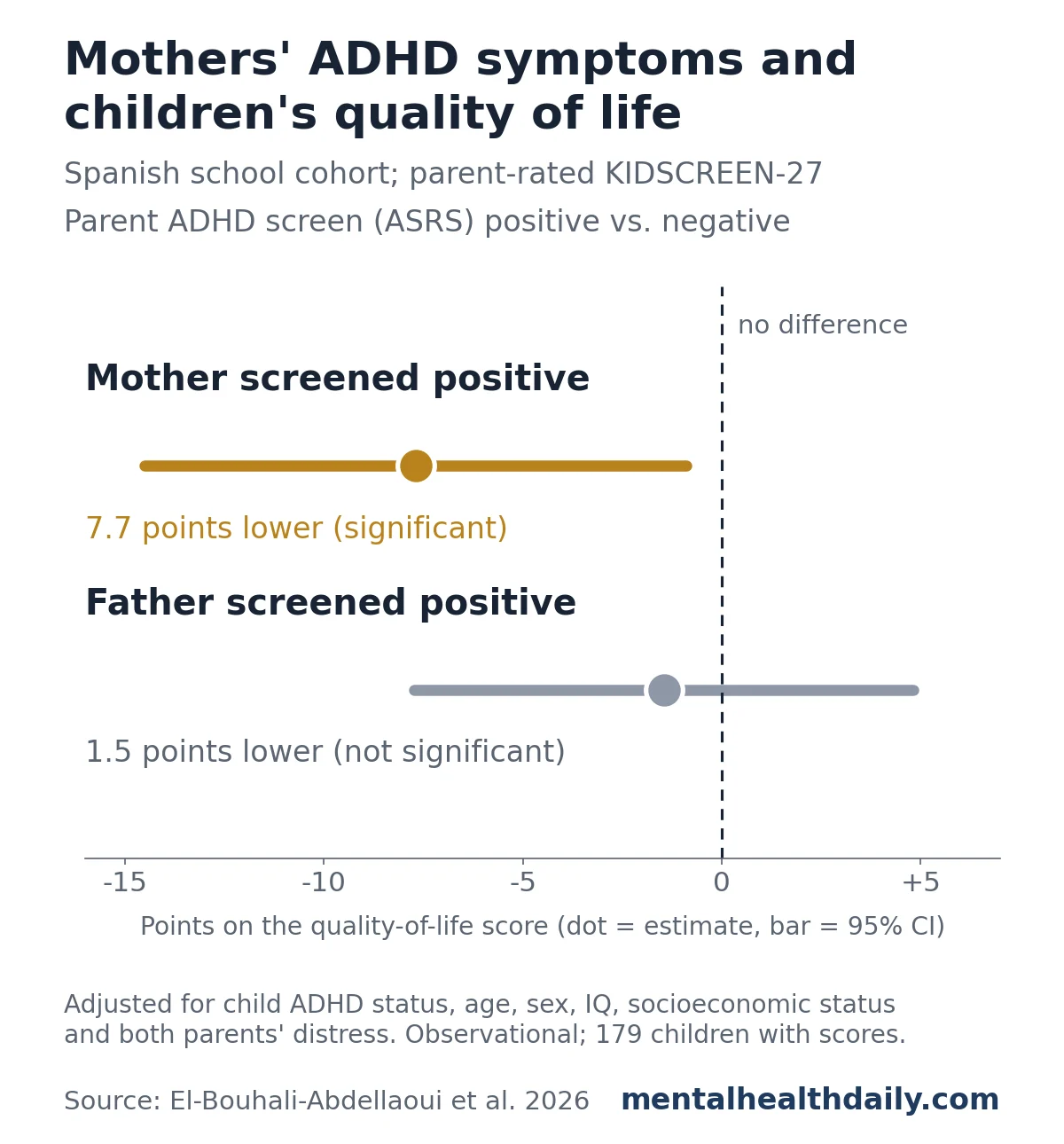
Specifically, children whose mothers screened positive for ADHD symptoms scored an average of 7.7 points lower on the KIDSCREEN-27 quality-of-life survey compared to children whose mothers did not screen positive. To put this into perspective, in the comparison group of children without neurodevelopmental diagnoses, average quality-of-life scores were around 107.4 with a standard deviation of 14.5. A 7.7-point difference represents approximately half a standard deviation, which is considered a moderate effect size in psychological research. While the confidence interval for this estimate was notably wide (ranging from about 0.9 points to 14.5 points lower), indicating some variability, the significance of the finding remained.
In stark contrast, fathers’ ADHD screens showed no such significant link to their children’s quality of life. Children of fathers who screened positive for ADHD symptoms scored, on average, only 1.5 points lower in the fully adjusted model. This estimate was consistent with no difference, as its 95% confidence interval spanned both negative and positive values (from 7.7 points lower to 4.8 points higher), indicating that the observed difference was not statistically significant.
Interestingly, the child’s own ADHD diagnosis did not, by itself, serve as the primary differentiator for quality of life scores. Average scores were relatively similar for children with ADHD (106.4), those with subthreshold symptoms (109.8), and the comparison group (107.4). The lowest average quality of life (98.9) was observed in the small group of children diagnosed with both ADHD and autism, a finding that, while notable, was based on only 10 scores and warrants further investigation with larger cohorts. This suggests that while a child’s diagnosis is important, the maternal context appears to play a uniquely influential role in their perceived quality of life.
Deeper Dive: Maternal Distress and Child Emotional Problems
The study further explored the nuances behind the maternal link by examining child emotional and conduct problems. Initially, before considering parental psychological distress, a positive maternal ADHD screen was indeed linked to a higher likelihood of emotional problems (such as anxiety and low mood) in children. Children of mothers who screened positive had 2.9 times higher odds of experiencing emotional problems at follow-up, and 4.3 times higher odds for problems that persisted across both assessment points. These links held even after adjusting for child-specific factors.
However, a crucial shift in the picture occurred when the researchers integrated parents’ psychological difficulties into the analysis. Once maternal distress, as measured by the GHQ-12, was added to the statistical models, it emerged as the factor most closely linked to children’s emotional problems. In models that included both maternal ADHD screen and maternal distress, the distress variable consistently showed a stronger association.
In a final, more complex model that allowed for interaction between ADHD symptoms and distress, both a positive maternal ADHD screen (with an odds ratio of 8.15) and maternal distress (with an odds ratio of 12.15) were independently linked to persistent emotional problems in children. It’s important to acknowledge that the confidence intervals for these odds ratios were very wide (e.g., 1.74 to 38.24 for the ADHD screen), primarily because only 38 children in the entire cohort experienced persistent emotional problems, making precise estimates challenging. Nonetheless, the consistent finding across various models was the robust link between maternal distress and children’s emotional difficulties.
Further supporting this, the study found that mothers of children with ADHD were significantly more often distressed: 37.6% met the GHQ-12 cutoff, compared with 20.6% of mothers in the comparison group. This suggests a potential cycle where the challenges of parenting a child with ADHD may contribute to maternal distress, which in turn impacts the child’s emotional well-being. Consistent with the quality-of-life findings, fathers’ distress was not significantly linked to children’s emotional problems.
Child’s Own ADHD and Conduct Problems
When it came to conduct problems, which include behaviors such as frequent temper outbursts, fighting, lying, and disobedience, the picture shifted away from parental ADHD screens. A positive maternal screen for ADHD symptoms was initially linked to persistent conduct problems (odds ratio 2.52) but this association disappeared once child-specific factors, such as the child’s own ADHD diagnosis, were included in the adjusted models. This indicates that while maternal ADHD symptoms might indirectly contribute to a challenging environment, they are not the primary driver of conduct problems in children.
Instead, the child’s own ADHD diagnosis carried the significant association in the fully adjusted model. Children diagnosed with ADHD were considerably more likely to experience persistent conduct problems. Specifically, 26.1% of children with ADHD exhibited persistent conduct problems, a stark contrast to only 6.1% in the comparison group of neurotypical children. Children with subthreshold ADHD symptoms showed rates similar to the comparison group (7.1%), further highlighting that a full ADHD diagnosis in the child is a stronger predictor for these specific behavioral challenges. This finding aligns with established clinical knowledge that conduct problems are a common comorbidity for children with ADHD, often complicating their daily lives and requiring targeted interventions.
Prevalence of Parental ADHD Screens within the Cohort
The EPINED study also provided valuable data on the prevalence of ADHD symptoms among the parents themselves. Overall, 18.2% of mothers and 15.9% of fathers screened positive for ADHD symptoms using the ASRS screener. This indicates that ADHD symptoms are relatively common in the parental population, especially in families participating in a study focused on neurodevelopmental disorders. The study also revealed that 28.2% of children had at least one parent who screened above the cutoff for ADHD symptoms, and 4.8% had both parents screening positive.
When analyzing the rates for mothers based on their child’s diagnosis, a clear pattern emerged:
- Mothers of children with ADHD: 30.6% screened positive for ADHD symptoms.
- Mothers of children with subthreshold ADHD symptoms: 20.8% screened positive.
- Mothers of children with both ADHD and autism: 20.0% screened positive.
- Mothers in the comparison group (neurotypical children): 12.6% screened positive.
These figures illustrate a significantly higher prevalence of ADHD symptoms among mothers whose children have an ADHD diagnosis compared to those whose children do not. This observation is consistent with the well-established high heritability of ADHD, suggesting that shared genetic factors likely play a role.
In contrast to mothers, fathers’ rates of positive ADHD screens were nearly flat across all four child diagnostic groups, ranging from 15.7% to 20.0%. This lack of variation among fathers, despite the known heritability of ADHD, could be attributed to several factors. The researchers suggest that it may partly reflect who typically fills out the questionnaires in households, with mothers often taking on a larger share of administrative and health-related tasks. It could also genuinely reflect different patterns of symptom presentation or impact between mothers and fathers within this specific cohort.
Broader Context: Other Research and Explanations
The findings from the EPINED study align with a growing body of international research that highlights the interconnectedness of parental ADHD and child well-being. Studies from various countries have similarly identified links between parental ADHD symptoms and difficulties in children, including increased behavioral problems, emotional dysregulation, and lower academic performance. For example, a Canadian study referenced by the EPINED researchers also found associations between parental ADHD and child outcomes, though it noted differences based on child sex and sometimes included both mothers and fathers.
The Spanish study’s specific finding of a null link for fathers, while notable, should be interpreted cautiously as one data point within a single cohort. Other research has indeed found significant associations for paternal ADHD, suggesting that the dynamics can be complex and potentially influenced by cultural context, family structure, and the specific outcome measures used.
The EPINED researchers propose that mothers’ typically larger share of daily caregiving responsibilities may help explain why maternal symptoms showed a clearer link to child quality of life compared to paternal symptoms. In many traditional family structures, mothers often bear the primary burden of childcare, household management, and emotional support. If a mother is struggling with unmanaged ADHD symptoms, such as difficulties with organization, emotional regulation, or consistent routines, these challenges could more directly impact the child’s daily environment and sense of stability, thereby affecting their perceived quality of life. Other potential mechanisms could include differences in parent-child interaction styles, the impact of parental stress on parenting capacity, and the shared genetic predispositions that influence both parent and child.
Limitations and Nuances
As an observational study, EPINED can identify associations and links, but it cannot definitively establish cause-and-effect relationships. Several specific limitations also warrant consideration:
- ASRS as a Screen, Not a Diagnosis: The Adult ADHD Self-Report Scale (ASRS) is a screening tool, not a diagnostic instrument. Parents were not clinically assessed for ADHD, meaning the study identified individuals "at risk" for ADHD symptoms rather than those with a confirmed diagnosis. This might lead to some misclassification, though the ASRS is a well-validated screener.
- Parent-Reported Data: Both parental ADHD symptoms/distress and child quality of life/problems were reported by parents. This introduces the possibility of reporter bias, where a parent’s own emotional state or perception of their child might influence their responses on the questionnaires. For instance, a distressed mother might rate both her own symptoms and her child’s quality of life more negatively.
- Sample Size for Subgroups: While the overall cohort of 456 children is substantial, some subgroups, such as children with both ADHD and autism (n=10) or those with persistent emotional problems (n=38), were quite small. This limits the statistical power and generalizability of findings specific to these smaller groups.
- Lack of Parenting Measures: The study did not directly measure parenting behaviors or styles. Therefore, it cannot definitively show whether specific parenting practices mediate the observed link between maternal ADHD symptoms and child quality of life. This is a crucial area for future research.
- Generalizability: The study was conducted in a specific region of Spain. While valuable, its findings may not be universally generalizable to all cultural contexts or socioeconomic backgrounds without further replication.
Implications for Clinical Practice and Families
The findings from the EPINED study carry significant implications for the clinical management of ADHD and for supporting families affected by the disorder.
A Family-Centered View of ADHD Care: The research strongly advocates for a more holistic, family-centered approach to ADHD evaluation and care. Given that ADHD symptoms are common in parents, especially mothers of children with ADHD, clinicians should consider routinely inquiring about parents’ own ADHD symptoms and psychological well-being during a child’s ADHD assessment. This integrated approach can help identify parental needs that, if addressed, could indirectly but profoundly benefit the child.
Parent Well-being as a Core Component: The study’s consistent finding that maternal distress had the most direct and consistent link to children’s emotional problems is a powerful message. It highlights that supporting a stressed or struggling parent is not merely a secondary concern but a direct pathway to improving a child’s emotional health. Mental health interventions, stress management techniques, and practical support for parents, particularly mothers, could be vital components of comprehensive ADHD care. This support can be pursued on its own merits, recognizing the intrinsic value of parental well-being.
Understanding, Not Blame: It is crucial to frame these findings not as a matter of blame, but as an opportunity for greater understanding and support. ADHD is a highly heritable condition, meaning it often runs in families through shared genes and, potentially, shared environmental factors. A parent who recognizes ADHD symptoms in themselves as a result of such research should be encouraged to speak with a doctor about a full evaluation. A positive screen alone does not constitute a diagnosis, but it is a call for further exploration and potential professional help, which can ultimately lead to better functioning for the parent and improved outcomes for the entire family.
Future Research Directions: This study opens several avenues for future research. Investigating the specific parenting mechanisms through which maternal ADHD symptoms and distress impact child quality of life would be invaluable. Developing and testing interventions specifically designed for parents with ADHD, focusing on practical skills and emotional support, could also yield significant benefits. Further research exploring these dynamics across diverse cultural and socioeconomic contexts is also warranted to enhance the generalizability of these findings.
In conclusion, the EPINED study from Spain provides compelling evidence that maternal ADHD symptoms, particularly when compounded by maternal distress, are significantly linked to lower parent-rated quality of life and increased emotional problems in children. While children’s own ADHD diagnosis remains the primary predictor of conduct problems, the maternal influence on overall well-being is undeniable. These findings underscore the critical importance of a family-wide perspective in ADHD care, advocating for interventions that support not only the child but also the well-being of their primary caregivers.

