

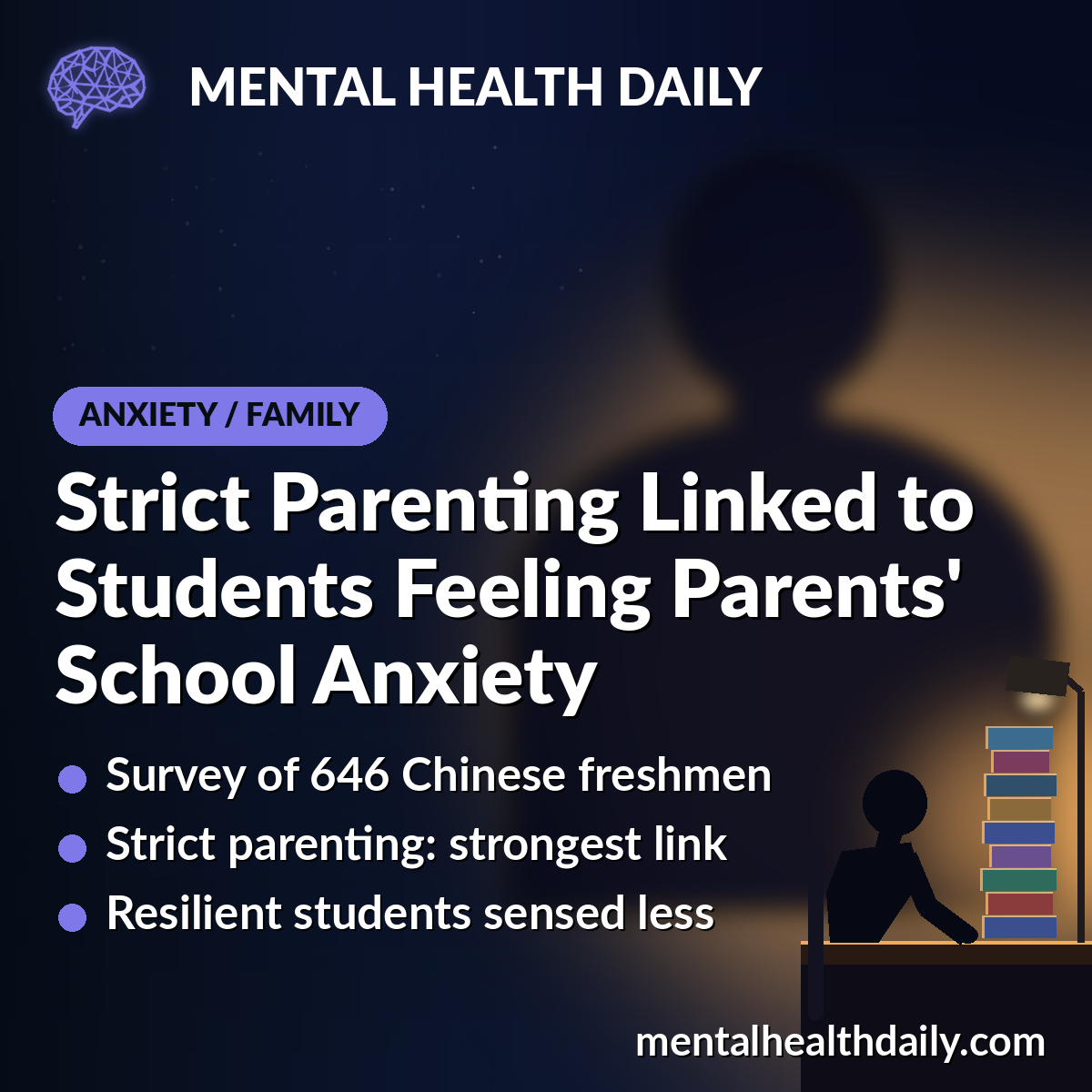
Chinese college freshmen hailing from homes characterized by stricter parenting styles and higher levels of family conflict reported sensing significantly more anxiety in their parents regarding their education, according to a groundbreaking 2026 survey involving 646 students. The study, conducted by researchers at the Army Medical University in Chongqing, China, further indicated that students with higher levels of personal resilience were less likely to perceive such parental anxiety, with strict parenting emerging as the strongest predictive factor among all variables examined. This research offers a crucial student-centric perspective on a pervasive issue within China’s highly competitive educational landscape, moving beyond traditional parent self-reports to capture the lived experience of young adults transitioning into higher education.
The Landscape of Educational Pressure in China
China’s educational system is renowned for its intense competitiveness, driven by a deeply ingrained cultural emphasis on academic achievement as a pathway to social mobility and economic success. At the apex of this system is the Gaokao, the national college entrance examination, which is widely regarded as one of the most demanding academic tests globally. The immense pressure associated with the Gaokao and subsequent career prospects filters down through every stage of a child’s schooling, creating a high-stakes environment for both students and their parents. This societal backdrop has cultivated a phenomenon known as "parental educational anxiety," which manifests as persistent worry, tension, and a profound sense of urgency among parents regarding their children’s academic performance and future educational and professional trajectories.
The pervasiveness of this anxiety became such a national concern that in 2021, the Chinese government introduced the "Double Reduction" policy. This sweeping reform aimed to alleviate the excessive academic burden on primary and middle school students by curbing after-school tutoring and reducing homework assignments. While the policy sought to mitigate the intense competition and reduce parental anxiety, its long-term effectiveness in shifting deeply entrenched cultural values and parental perceptions of success remains a subject of ongoing study and debate. The 2026 survey offers insights into the student experience several years after the policy’s implementation, suggesting that despite top-down reforms, the perception of parental anxiety continues to be a significant factor in students’ lives.
Shifting Focus: From Parent Report to Student Perception
Traditionally, much of the research on parental educational anxiety has relied on parents’ self-assessments of their own anxiety levels. However, as psychological research has consistently shown, a child’s perception of a parent’s emotional state can often diverge significantly from the parent’s self-reported feelings. Children are primarily reactive to the behaviors, expressions, and verbal cues they observe and hear, making their perception a vital, yet often overlooked, dimension of family dynamics. Recognizing this gap, Laiju Du and colleagues at the Army Medical University in Chongqing embarked on a study specifically designed to measure the extent to which students perceived educational anxiety in their parents throughout their upbringing. This innovative approach provides a more direct understanding of the psychological environment experienced by students.
To achieve this, the researchers ingeniously adapted a pre-existing 16-item questionnaire initially designed for parents. Each item was meticulously rephrased from the child’s perspective. For instance, a statement like "I feel anxious about my child’s studies" was transformed into "My parents feel anxious about my studies." Students were then asked to rate each item on a Likert scale from 1 (never) to 5 (always), yielding a potential total score ranging from 16 to 80. This methodological shift allowed the research to tap into the subjective reality of the students, offering unique insights into how parental pressures are internalized and interpreted. The questionnaire items were designed to encompass three broad categories of parental worry: concerns about academic performance, worries about future educational opportunities (e.g., university admission), and anxieties related to long-term career prospects.
Methodology and Participant Profile
The study strategically selected college freshmen as participants. This demographic was deemed ideal because these students had just completed a full 12-year cycle of primary and secondary education, providing them with a comprehensive retrospective viewpoint on their parents’ attitudes and behaviors throughout their formative academic years. All participants were first-year students enrolled at two distinct universities within the city of Chongqing. Strict inclusion criteria were applied: students were required to report no current or past history of mental disorder, substance abuse, or serious physical illness, ensuring a focus on the general student population’s perceptions rather than those influenced by pre-existing clinical conditions.
Prior to the main study, the rewritten questionnaire underwent rigorous testing in two separate groups of freshmen to ensure its reliability and validity. The results from these preliminary tests confirmed the instrument’s effectiveness, demonstrating that higher scores on the Perceived Parental School Anxiety Questionnaire (PPSA-Q) were significantly correlated with higher self-reported general anxiety levels among students (r = 0.291). Furthermore, students who perceived greater parental anxiety also tended to describe their parents as more rejecting, more overprotective, and less warm in their parenting styles, aligning with established psychological constructs of parent-child relationships and reinforcing the questionnaire’s validity.
Key Findings: Unpacking the Determinants of Perceived Anxiety
The core of the research involved a third, larger group of 646 freshmen who completed the PPSA-Q alongside other measures assessing family life and individual resilience. The median score on the PPSA-Q for this group was 40, with the middle 50% of scores falling between 32 and 49, indicating a considerable range in perceived parental anxiety among the student population.
A preliminary analysis revealed several demographic and familial factors associated with higher perceived parental educational anxiety:
- Stricter Parenting: Students from homes with more authoritarian parenting styles consistently reported higher scores.
- Increased Family Conflict: A greater frequency of arguments and expressions of anger within the family correlated with heightened perceived anxiety.
- Parental Oversight of Schoolwork: Students whose mothers, fathers, or both parents closely oversaw their schoolwork reported sensing more anxiety. Mothers’ oversight showed a particularly strong link.
- Gender: Male students tended to perceive more parental educational anxiety compared to their female counterparts.
Interestingly, the study found no significant link between perceived parental educational anxiety and either parents’ education level or overall family income, suggesting that this phenomenon transcends socioeconomic boundaries and is more rooted in family dynamics and parenting styles.
To ascertain which factors independently contributed to perceived parental educational anxiety, the researchers employed hierarchical regression analysis. This sophisticated statistical method allowed them to introduce groups of factors in successive steps, systematically evaluating the unique explanatory power of each step. The model first accounted for background details, followed by family factors, and finally, individual resilience.
The final model demonstrated that family factors played the most substantial role in explaining the differences in perceived anxiety among students. Collectively, the model accounted for 24% of the variance in students’ perceived parental educational anxiety scores. Within this, family factors contributed a dominant 20.1 percentage points, background details 2.6 percentage points, and resilience 1.5 percentage points.
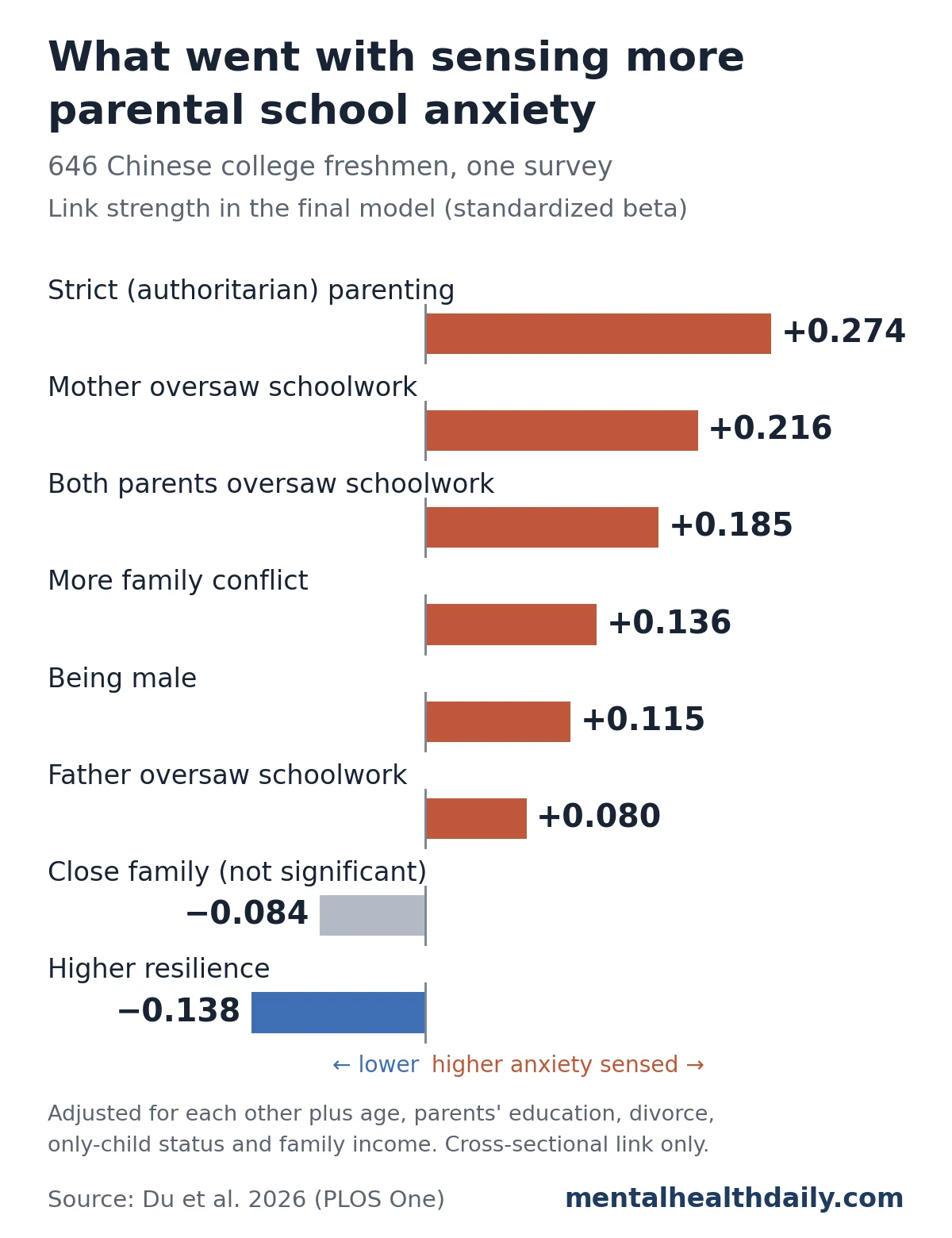
The standardized coefficients (β) from the hierarchical regression provided a clear picture of the strength and direction of these independent links:
- Authoritarian Parenting: +0.274 (Strongest positive link, indicating stricter parenting was highly associated with higher perceived anxiety).
- Mother Overseeing Schoolwork: +0.216
- Both Parents Overseeing Schoolwork: +0.185
- More Family Conflict: +0.136
- Being Male: +0.115
- Father Overseeing Schoolwork: +0.080
- Higher Resilience: -0.138 (Negative link, meaning higher resilience was associated with lower perceived anxiety).
Notably, the study initially found a link between family closeness (cohesion) and lower perceived anxiety (r = -0.242). However, once factors like family conflict, parenting style, and resilience were incorporated into the full regression model, this link diminished significantly to β = -0.084 and was no longer statistically significant. This suggests that while family cohesion might be beneficial, its effects on perceived parental anxiety are largely subsumed or overshadowed by more potent factors such as the frequency of family arguments and the rigidity of parental control. In practical terms, how much a family disputes and how strictly parents manage their children’s lives appear to be more salient indicators of a student’s sense of parental school anxiety than the overall feeling of family closeness.
Interpreting the Links: Conflict, Resilience, and Emotional Security
The researchers proposed compelling explanations for the observed links, particularly concerning family conflict and individual resilience. For the connection between family conflict and heightened perceived parental anxiety, two primary mechanisms were suggested. Firstly, an environment rife with frequent arguments and expressed anger could heighten children’s overall stress levels, making them more susceptible to noticing and internalizing any parental anxieties, including those related to education. Secondly, and perhaps more profoundly, this observation aligns with emotional security theory. This theory posits that children exposed to chronic or frequent family conflict develop a heightened vigilance for threats within their environment. In such a context, even subtle expressions of parental worry about education might be interpreted by the child as a potential threat to family harmony or their own well-being, thereby amplifying the perception of anxiety. Prior research grounded in emotional security theory has indeed linked inter-parental and parent-child conflict to a range of negative outcomes in children, including emotional, behavioral, social, and academic problems.
Regarding the inverse relationship between resilience and perceived parental educational anxiety, the researchers suggested a cognitive reappraisal mechanism. Highly resilient students possess a greater capacity to cope with stress and recover from setbacks. It is plausible that these students are more adept at reinterpreting parental pressure. Instead of perceiving it as an overwhelming burden or a source of personal threat, they might reappraise it as a legitimate expression of parental concern for their future or as a motivational push. While this interpretation aligns with established theories of resilience, the cross-sectional nature of the survey means it could not directly test this hypothesis, leaving it as a promising avenue for future longitudinal studies.
Broader Implications for Student Mental Health
The findings of this 2026 survey resonate with and significantly contribute to a growing body of Chinese research that consistently links parental educational anxiety to adverse mental health outcomes in children and adolescents. Other studies in China have previously established connections between higher parental educational anxiety and increased rates of depression, heightened incidences of problem behaviors, and lower levels of resilience in children. For instance, children perceiving greater parental anxiety about schooling have been found to exhibit more depressive symptoms, while others show externalizing behaviors like aggression or defiance. The current study’s finding that higher student resilience is associated with less perceived parental anxiety complements these earlier findings from a different angle, highlighting resilience as a potential protective factor.
It is important to note that many of these previous studies, similar to the 2026 survey, were cross-sectional in design. While they effectively demonstrate strong correlations and links between variables, they cannot definitively establish cause-and-effect relationships. Nevertheless, the consistency across multiple studies underscores the profound impact of parental educational anxiety on the psychological well-being of young people in China.
The novel aspect of measuring student-perceived anxiety also offers an intriguing comparison to previous parent-reported data. The median item score of 2.50 reported by students in this survey was noticeably lower than average scores typically reported by parents in earlier studies. This discrepancy hints at a possibility that children might perceive less anxiety than their parents actually experience or self-report. However, the researchers cautiously note that this is a rough comparison, not a tested result, as parents were not surveyed in the current study. Future research involving paired parent-child data could more precisely investigate this potential perception gap.
Limitations and Future Research Directions
While providing invaluable insights, the 2026 survey, like all research, is subject to certain limitations that warrant consideration. Firstly, its cross-sectional design means it captures a snapshot in time, preventing the establishment of causal relationships. Longitudinal studies would be necessary to understand how perceived parental anxiety, family dynamics, and student resilience evolve over time and influence each other. Secondly, the study was conducted exclusively with freshmen from two universities in Chongqing, a major city in southwest China. While this provides a geographically specific insight, it limits the generalizability of the findings to students in other regions of China or to different cultural contexts. The unique pressures of the Chinese educational system and family dynamics mean these findings may not directly apply to other countries without further validation.
Additionally, the reliance on self-report questionnaires for both perceived parental anxiety and other psychological measures introduces the potential for response biases. Students might consciously or unconsciously alter their responses. The absence of direct parental data within this specific study also means that the comparison between student perception and actual parental anxiety is indirect. Future research would benefit from a dyadic approach, collecting data from both parents and students simultaneously. Finally, the study focused on freshmen, a specific age group. Exploring these dynamics among younger students or those at different stages of their academic journey could provide a more comprehensive understanding.
Actionable Insights for Families and Educators
The findings of this study carry significant implications for families, educators, and policymakers grappling with the pressures of the Chinese education system.
-
The Critical Role of Home Climate: The research unequivocally demonstrates that the emotional climate of the home profoundly shapes how students perceive parental educational anxiety. Homes characterized by frequent arguments, unresolved conflict, or an overly rigid and demanding (authoritarian) parenting style are breeding grounds for higher student-perceived anxiety. This suggests that fostering lower-conflict homes and adopting more supportive, less authoritarian parenting styles are not merely desirable for general family well-being but are directly linked to reducing the burden of perceived educational pressure on children. Promoting open communication, conflict resolution skills, and authoritative (rather than authoritarian) parenting approaches could be beneficial.
-
Cultivating Student Resilience: The inverse relationship between resilience and perceived anxiety highlights the potential protective role of individual coping mechanisms. While the study did not test whether actively building a student’s resilience would alter their interpretation of parental worry, it strongly suggests that interventions aimed at enhancing students’ capacity to cope with stress, adapt to change, and recover from setbacks could be valuable. Educational programs and psychological support services that focus on developing resilience skills might empower students to view parental pressure as concern rather than an overwhelming threat.
-
A Research Tool with Broader Potential: The newly developed Perceived Parental School Anxiety Questionnaire (PPSA-Q) represents a valuable research tool. It provides researchers with a reliable and validated method to measure the student’s perspective on parental educational anxiety specifically within the Chinese freshman population. While its immediate application is for academic research, further testing is warranted to assess its value for broader screening purposes or its applicability in diverse cultural contexts beyond China.
In conclusion, the 2026 study from the Army Medical University offers a compelling and nuanced understanding of parental educational anxiety from the critical viewpoint of the students themselves. By illuminating the strong links between strict parenting, family conflict, and students’ perceptions of parental anxiety, alongside the protective role of resilience, this research provides a robust foundation for developing targeted interventions and policies aimed at fostering healthier family environments and promoting the holistic well-being of China’s next generation. The insights underscore that while academic achievement is highly valued, the emotional and psychological costs of intense, conflict-ridden educational pressure on young minds are substantial and deserve urgent attention from all stakeholders.

