

A comprehensive 2026 scoping review, analyzing 156 publications, has brought to light a significant disconnect in how emergency departments (EDs) approach the critical task of delivering bad news. The research indicates that the prevailing metric for assessing the effectiveness of bad news communication primarily centers on staff confidence levels, rather than the profound and lasting impact on patients and their grieving families. This finding underscores a critical gap in understanding and improving one of the most sensitive and challenging aspects of emergency medical care.
The review highlights that despite the high-stakes environment of an ED, where life-altering news is often delivered unexpectedly, the focus of research and training evaluation remains largely internal, neglecting the ultimate recipients of this news. This oversight has significant implications for patient experience, family bereavement, and the overall quality of care provided during moments of profound crisis.
The Unique Imperatives of Delivering Bad News in Emergency Settings
Delivering bad news in an emergency department is inherently distinct from other clinical settings, presenting a unique confluence of challenges that often test the limits of even the most experienced clinicians. Emergency medical professionals frequently encounter patients and their families for the very first time, often at the peak of an unforeseen crisis. This initial interaction might involve conveying a sudden, unexpected death; the discovery of a serious illness, such as cancer, identified on an urgent scan; or the somber determination that further medical intervention would be futile.
Such news is rarely delivered in an ideal environment. Emergency departments are, by their nature, bustling, noisy, and often overcrowded spaces, affording minimal privacy. This chaotic backdrop stands in stark contrast to the quiet, controlled settings typically envisioned for such sensitive conversations. Furthermore, the sheer volume and urgency of cases mean that clinicians operate under severe time constraints, limiting their ability to prepare adequately or offer extended support. It is a stark reality that in some health systems, as many as 50% of all cancer diagnoses are first made known to patients within the confines of an emergency department, turning a moment of crisis into a life-altering revelation without the benefit of prior context or relationship.
The manner in which this news is delivered carries profound weight, shaping the immediate and long-term psychological landscape for those who receive it. Research by Graham Johnson et al., a UK-based team led by an emergency physician, notes a clear correlation between insensitive or poorly managed communication and heightened grief intensity, complicated bereavement processes, and enduring psychological distress in both patients and their relatives. This emphasizes that the communication act itself is a critical therapeutic intervention, or potentially, a source of further trauma.
The strain is palpable among healthcare providers as well. An Irish survey cited by the researchers revealed that a mere 39% of less experienced emergency clinicians felt adequately comfortable discussing end-of-life care, a testament to the emotional burden and perceived lack of preparedness. A striking 79% of all respondents, irrespective of experience level, expressed a strong desire for more comprehensive training in this area, underscoring a collective acknowledgment of the skill deficit and the profound responsibility involved.
Mapping the Landscape: Insights from the Scoping Review Methodology
The 2026 scoping review served a crucial purpose: to systematically map the entire body of literature on how emergency departments deliver bad news. Unlike systematic reviews that grade studies and pool results to determine the best approach, a scoping review comprehensively surveys all existing evidence, regardless of study design or quality. Its objective is to identify what kinds of evidence are available, where the knowledge gaps lie, and what future research directions are most pressing. This methodological approach provides a broad overview rather than definitive answers on specific interventions.
The research team undertook a rigorous search strategy in July 2025, querying four major medical databases—likely including PubMed, Embase, CINAHL, and PsycINFO—alongside a thorough examination of "gray literature," which encompasses reports, guidelines, and conference proceedings not formally published in peer-reviewed journals. From an initial pool of 7,985 database records and an additional 285 records from gray literature, a total of 156 publications met the stringent inclusion criteria for the review. Notably, the scope of the review specifically excluded emergency care pertaining to children, focusing solely on adult populations.
The review broadly categorized "bad news" into three principal types, reflecting the diverse scenarios encountered in the ED and providing a structured understanding of the literature:
- Sudden Death or Imminent Mortality: This category encompassed publications addressing the communication of unexpected patient deaths, fatal injuries, or irreversible conditions leading to imminent demise, often requiring immediate family notification and support.
- Serious Diagnosis or Life-Altering Condition: This included research on informing patients or families about new, significant diagnoses such as acute cancer findings, severe neurological events (e.g., major stroke, spinal cord injury), or conditions requiring substantial, long-term changes to lifestyle or prognosis.
- Poor Prognosis or Withdrawal of Life-Sustaining Treatment: This focused on discussions surrounding the futility of further treatment, transitioning to palliative or comfort care, or decisions regarding the withdrawal of life support, often involving complex ethical and emotional considerations.
The nature of the identified literature also painted a clear picture of the research landscape:
- Training Program Evaluations: A significant portion of the publications assessed various educational interventions designed to improve clinicians’ bad news delivery skills.
- Qualitative Studies on Experiences: These studies explored the lived experiences, perceptions, and needs of patients, families, and clinicians regarding bad news communication in the ED.
- Communication Frameworks and Guidelines: The review identified documents proposing structured approaches, protocols, or best practice guidelines for delivering difficult news.
- Descriptive Studies: These provided overviews of current practices, challenges, or the frequency of bad news events in EDs.
Geographically, the United States was the most prolific contributor, accounting for 85 of the 156 publications, followed by the United Kingdom with 18. In total, 26 countries contributed to the body of literature. The review also revealed a clear temporal trend: output on this critical topic demonstrated consistent growth from 2010 onwards, reaching its peak in 2023 with 17 publications, signaling increasing awareness and scholarly interest in improving ED communication practices.
Training Evaluation: A Disconnect Between Confidence and Competence
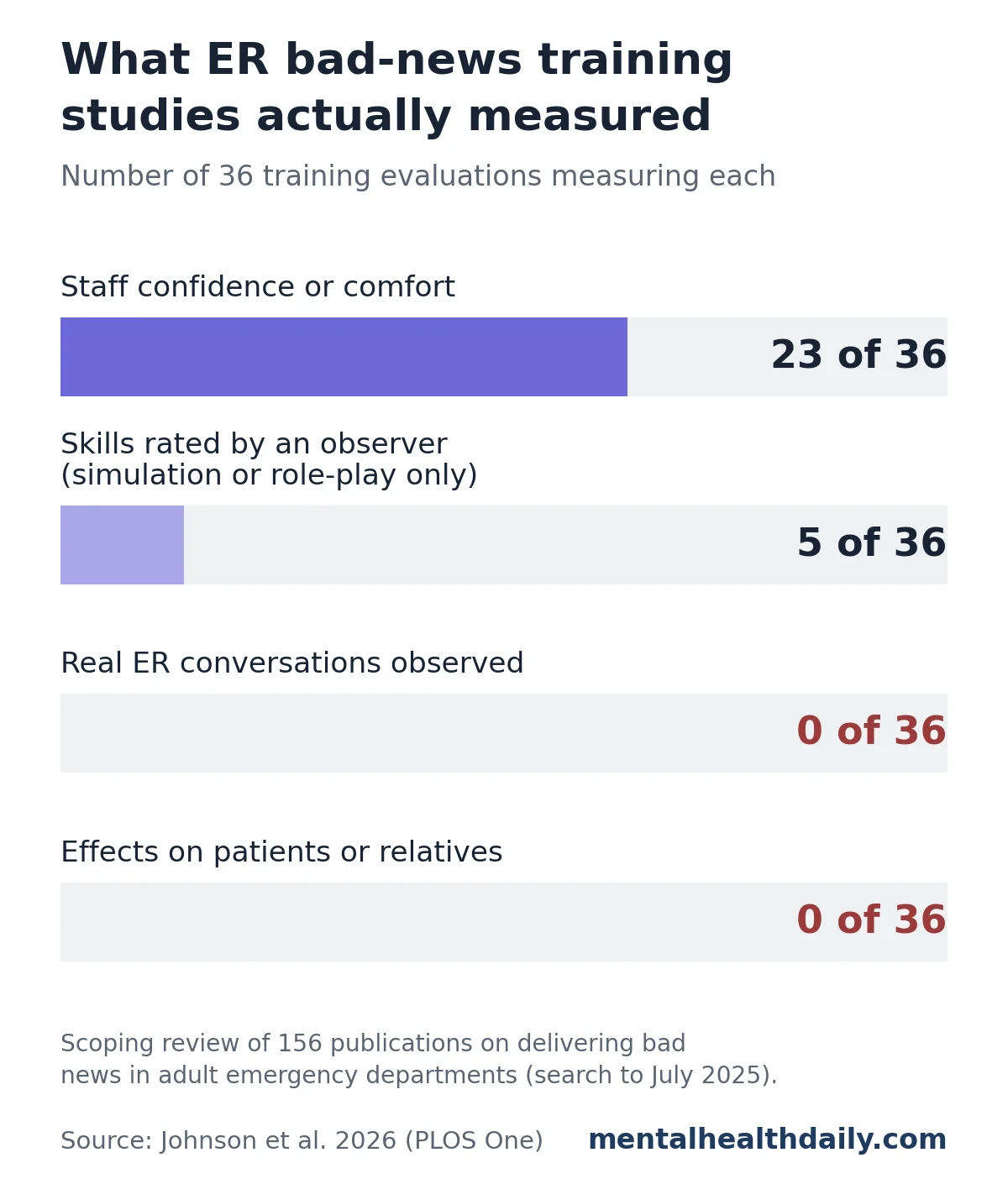
One of the most striking findings of the scoping review pertains to the evaluation methodologies employed for emergency department bad-news training programs. Of the 51 identified reports detailing such training initiatives, only 36 included some form of evaluation. A vast majority of these, 30 out of the 36, predominantly relied on before-and-after questionnaires utilizing Likert-type rating scales (e.g., "strongly agree" to "strongly disagree") to gauge staff confidence or comfort levels.
This reliance on self-reported confidence as a primary outcome measure presents a significant limitation. While an increase in clinician confidence is a desirable intermediate outcome, it does not directly translate into improved communication skills or, more importantly, better experiences or outcomes for patients and their families. The review critically notes:
- Self-Assessment Bias: Many evaluations were based on clinicians’ self-assessments of their comfort or confidence levels, which can be prone to bias and may not accurately reflect actual performance.
- Lack of Objective Skill Assessment: Only a small fraction of evaluations (5 out of 36) involved observer-rated skills, and these were confined to simulated environments or role-play, never in real clinical encounters.
- Zero Patient/Family Outcome Measures: Crucially, not a single training evaluation measured the direct effects on patients or relatives, such as their understanding of the news, satisfaction with communication, or psychological well-being post-disclosure.
Simulation emerged as the most common training format, being utilized in 23 of the evaluations. Of these, 19 reported positive results, 2 were neutral, and 2 provided no outcome data. While simulation offers a valuable platform for practice, the positive results, when based solely on self-reported confidence, must be interpreted with caution. The researchers cogently argue that feeling more comfortable in delivering bad news says little about whether patients and relatives genuinely felt informed, supported, or understood during their most vulnerable moments. Furthermore, the publication bias inherent in research means that training programs that did not yield positive results are less likely to be published, potentially inflating the perceived success rate.
This limitation is not unique to emergency medicine. A broader 2018 meta-analysis of 17 studies across various medical specialties examined the impact of bad-news training. It found that such training significantly improved observer-rated skills (standardized mean difference, or SMD, 0.74, indicating a large effect) and physician confidence (SMD 0.60). However, even within this larger dataset, only one of those 17 studies reported effects on patients’ depression or anxiety, underscoring a pervasive challenge in medical education research to move beyond surrogate markers and assess patient-centered outcomes.
The Pervasive Influence of Cancer-Care Frameworks
The review identified a total of 25 distinct communication frameworks across 80 publications. Among these, the SPIKES protocol was by far the most frequently cited, appearing in 37 mentions. Developed in 2000, SPIKES is a well-established framework designed specifically for delivering a cancer diagnosis. It guides clinicians through six sequential steps:
- S – Setting up the Interview: Preparing the physical environment and ensuring privacy.
- P – Patient’s Perception: Assessing the patient’s understanding of their medical situation.
- I – Invitation: Ascertaining how much information the patient wishes to receive.
- K – Knowledge: Delivering the information clearly, in small chunks, avoiding jargon.
- E – Emotions: Acknowledging and empathizing with the patient’s emotional reactions.
- S – Strategy and Summary: Developing a plan, discussing next steps, and summarizing the conversation.
While highly effective in its intended context, the SPIKES sequence inherently assumes several critical conditions: sufficient time for a structured conversation, the availability of a private room, and at least some prior knowledge of the patient’s history. These conditions are rarely met in the high-pressure, rapidly evolving environment of an emergency department. The review found no empirical study demonstrating whether SPIKES is actually utilized in routine emergency care, let alone whether it proves beneficial for patients or their relatives in this unique setting. This raises significant questions about the applicability and effectiveness of a widely taught framework when transplanted into an environment for which it was not originally designed.
The scarcity of frameworks tailored for the specific exigencies of emergency care is stark. The review identified only three frameworks that were explicitly developed for or adapted to emergency departments, highlighting a substantial deficit in context-specific communication tools:
- The ED-SPIKES Framework: An adaptation of the original SPIKES protocol, attempting to modify its steps for the unique constraints of the ED.
- The ABCDE Protocol for Breaking Bad News in the ED: A mnemonic-based approach focusing on "Advance preparation," "Build a therapeutic environment," "Communicate," "Deal with emotions," and "End the conversation with a plan."
- The R-E-S-P-E-C-T Model: Designed to provide a structured approach to communication in critical situations, emphasizing respect for patient autonomy and family involvement.
Beyond the frameworks themselves, the review also pointed to inconsistencies in terminology. The phrase "breaking bad news" was used in 61 publications, yet it often encompassed a vast array of disparate events—from the sudden death of a loved one to a goals-of-care discussion or the sensitive disclosure of an early pregnancy loss. This broad and often imprecise use of language can obscure the nuances required for different types of difficult conversations, further complicating the development of targeted training and research.
The Patient and Family Perspective: A Call for Empathy and Systemic Support
A critical imbalance in the research landscape was revealed by the review: studies focusing on staff views (20 publications) significantly outnumbered those exploring the perspectives of relatives (10 publications) and patients (8 publications). This disparity suggests a research agenda that, while important for understanding clinician challenges, has not adequately prioritized the voices and needs of those directly affected by the news delivery.
When patients and relatives were consulted, their priorities for effective bad news communication consistently emphasized several key elements:
- Clear and Honest Information: A direct, unambiguous explanation of the situation, avoiding jargon, and delivered with transparency.
- Compassion and Empathy: The desire for clinicians to convey genuine care, understanding, and sensitivity to their emotional state.
- Privacy and Respect: The need for a private space to receive and process devastating news, free from interruptions and with dignity.
- Time for Questions and Emotional Processing: Sufficient opportunity to ask questions, absorb the information, and express their grief or shock without feeling rushed.
In stark contrast, clinicians, when surveyed, more often articulated limitations related to systemic issues: insufficient time, inadequate training, frequent interruptions, noisy environments, and the lack of private spaces. They also cited the inherent unpredictability of emergency medicine, where clinical situations can deteriorate rapidly and unexpectedly, as a major barrier.
The review also identified specific "helpful conditions" that can mitigate these challenges, even in the fast-paced ED environment:
- Brief Preparation: Even a few moments of preparation before entering the room can significantly improve the quality of the conversation.
- Extra Staff Member: Having another staff member present can provide support to both the clinician and the family, allowing for emotional support or practical assistance.
- Private Space: The availability of even a small, quiet space for these conversations is invaluable.
- Opportunities for Questions: Ensuring families have dedicated time to ask questions helps them process information and feel heard.
- Family Presence During Resuscitation: In some studies, allowing families to be present during resuscitation efforts, when appropriate, has been shown to aid in their understanding and coping process, though this remains a contentious practice.
The researchers conclude that training alone, while essential, cannot fully compensate for systemic deficiencies. A department lacking the necessary time, privacy, or adequate staffing levels will inevitably struggle to facilitate truly compassionate and effective bad-news conversations, regardless of individual clinician skill. This underscores the need for a multi-faceted approach addressing both individual competency and organizational support.
The Long-Term Repercussions: Shaping Grief and PTSD Symptoms
While direct evidence from emergency departments on family outcomes remains scant, trials conducted in analogous settings demonstrate unequivocally that the quality of these critical conversations can profoundly affect relatives for months, and even years, following the event. These studies, though not specific to EDs, provide crucial insights into the potential long-term psychological and emotional consequences of communication failures.
- Intensive Care Unit (ICU) Settings: Research in ICUs has shown that poor communication regarding end-of-life decisions or patient prognosis is strongly associated with increased rates of complicated grief, depression, and post-traumatic stress disorder (PTSD) symptoms among family members. Families who feel involved, informed, and respected during the patient’s care trajectory tend to have better bereavement outcomes.
- Palliative Care Settings: Studies in palliative care highlight how sensitive and empathetic communication can significantly reduce family distress and improve their coping mechanisms. When families perceive that their loved one’s values and wishes were respected, even in the face of death, their grief trajectory tends to be healthier.
- Bereavement Support: The immediate aftermath of bad news, particularly sudden death, can set the tone for the entire grieving process. Families who feel unsupported, rushed, or given inadequate information are at higher risk for prolonged or complicated bereavement, characterized by intense, debilitating grief that interferes with daily functioning.
None of these external studies specifically tested how emergency staff deliver news. However, taken together, they form a compelling body of evidence demonstrating that the initial interactions, how families are informed, and their perceived inclusion in decision-making processes can significantly influence subsequent grief and trauma symptoms. The critical implication for emergency medicine is that current ED research has yet to systematically measure these profound, long-term outcomes, representing a significant blind spot in understanding the true impact of their communication practices.
Limitations and Forward-Looking Research Priorities
Like all research, this comprehensive scoping review has its limitations. The exclusion of children’s emergency care means its findings do not extend to pediatric populations, where the dynamics of delivering bad news can be even more complex. As a scoping review, it provides an overview rather than a definitive answer on the efficacy of specific interventions, and its findings are constrained by the quality and focus of the existing published literature. The reliance on published data means that unpublished studies or local guidelines, particularly from underrepresented regions, might have been missed.
Despite these limitations, the review offers clear directives for advancing research and practice. The researchers delineate three critical priorities for future investigation:
- Develop and Rigorously Test ED-Specific Communication Frameworks: There is an urgent need to move beyond oncology-derived protocols and create communication models explicitly designed for the unique pressures, time constraints, and types of bad news encountered in emergency departments. These frameworks must be empirically tested for their effectiveness in the ED context.
- Evaluate Training Outcomes Based on Patient and Family Experiences: Future evaluations of bad-news training programs must shift their focus from mere clinician confidence to tangible, patient-centered outcomes. This includes measuring patient and family understanding, satisfaction with communication, perceived empathy, and long-term psychological well-being. This will require observational studies of real-time interactions and robust follow-up with families.
- Investigate Systemic and Environmental Factors: Beyond individual clinician skills, research must delve into how organizational factors—such as staffing levels, the availability of private spaces, the presence of senior support, and departmental culture—impact the quality of bad news delivery. Understanding these broader determinants is crucial for implementing sustainable improvements.
The researchers also issue a broader call for sustained attention to systemic issues: adequate staffing, the provision of private spaces, and robust senior support. They argue that truly effective and compassionate bad-news conversations are not solely dependent on individual skill but are fundamentally shaped by the environment and resources of the entire department. This holistic perspective is essential for transforming a often-traumatic experience into one delivered with the utmost care and professionalism.
Guidance for Families and Broader Societal Implications
For families navigating the immediate aftermath of a crisis in an emergency department, understanding their rights and needs can be empowering. It is entirely reasonable to request a private room for sensitive conversations, to ask for someone to remain with them as they process devastating news, and to be granted sufficient time to ask questions without feeling rushed. Advocating for these basic conditions can significantly improve the experience during an incredibly vulnerable moment.
Grief following a sudden death can be overwhelming and, for many, becomes a prolonged and complicated process. If intense grief, intrusive memories, or persistent low mood interferes with daily life for months after the event, seeking professional help is crucial. A doctor or a specialized bereavement service can provide vital support and guidance, helping individuals navigate the complex emotional landscape of loss.
Ultimately, the 2026 scoping review serves as a crucial wake-up call for the medical community. It highlights that while the intent to deliver bad news compassionately in emergency departments is strong, the current approaches to training and evaluation are often misaligned with the profound human impact of these interactions. Moving forward, a concerted effort is required from researchers, educators, clinicians, and hospital administrators to bridge this gap, ensuring that the delivery of bad news in the ED is not just confident, but truly compassionate, effective, and centered on the well-being of patients and their families. This will require not only enhanced individual skills but also systemic changes that prioritize the human element in critical care.

