

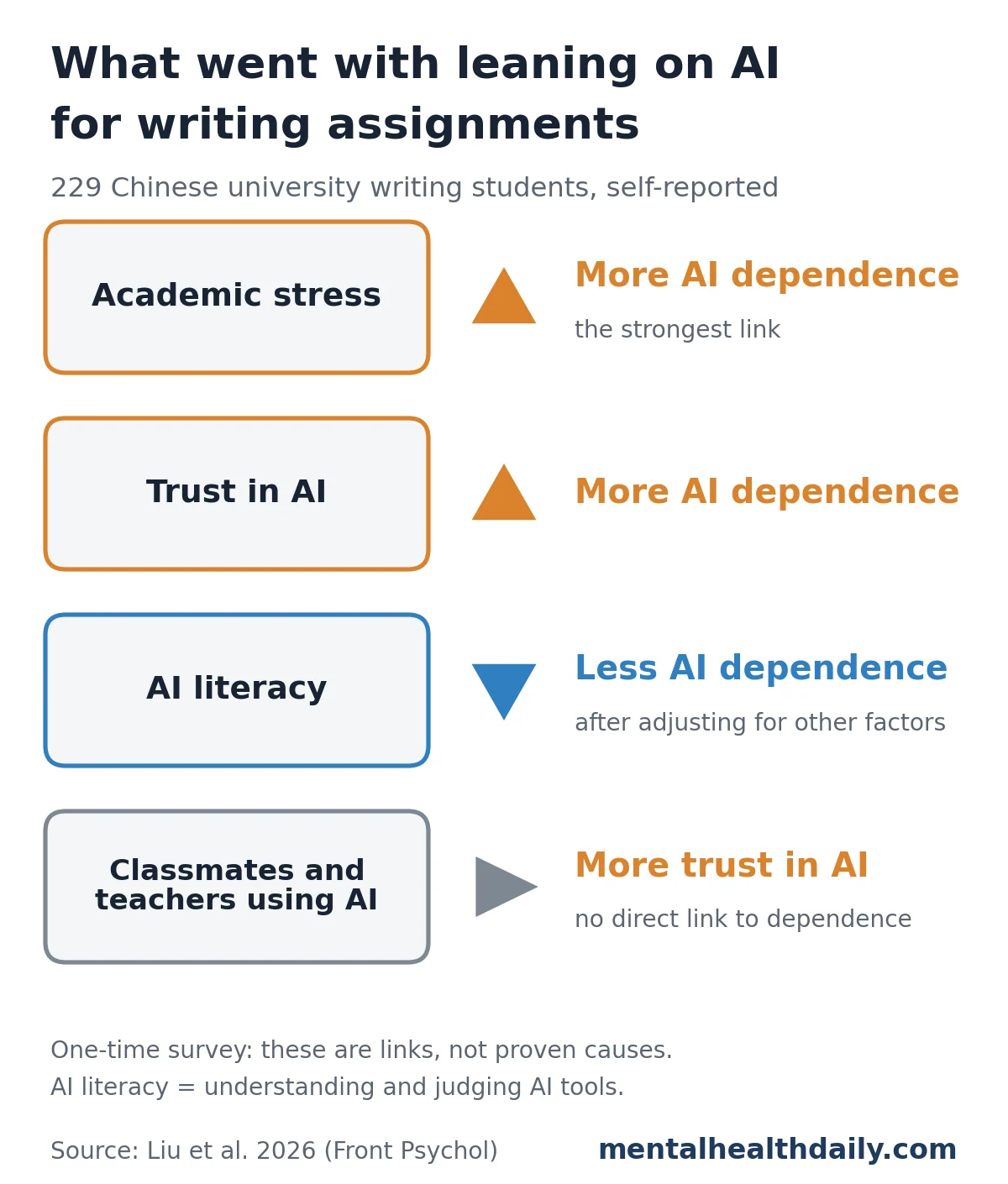
College students grappling with heightened academic stress and a greater inherent trust in artificial intelligence are more likely to heavily rely on generative AI tools for their writing tasks. This significant finding emerged from a comprehensive 2026 survey involving 229 journalism students across two distinct universities in China. Conversely, the study also revealed a crucial mitigating factor: students demonstrating stronger AI literacy reported a reduced dependence on these tools, particularly once other influential factors were meticulously accounted for in the analysis. This research sheds light on the complex interplay of psychological, cognitive, and social elements shaping students’ engagement with rapidly evolving AI technologies in academic settings.
The integration of generative AI into academic life has been one of the most transformative developments in higher education globally since the public launch of tools like ChatGPT in late 2022. Universities worldwide have grappled with the implications for academic integrity, pedagogical practices, and the very nature of learning. China, with its robust technological ecosystem and significant investment in AI research and development, presents a unique context for observing these trends. Domestic AI models such as Doubao, DeepSeek, and Kimi operate alongside global platforms like ChatGPT, offering students a diverse array of tools. This environment creates a compelling case study for understanding how students adopt, adapt to, and potentially over-rely on AI for academic purposes. The journalism discipline, in particular, finds itself at a critical juncture, as AI tools promise efficiency but also pose fundamental questions about original thought, verification, and ethical reporting.
Unpacking the Survey: Methodology and Demographics
The foundational data for this study was collected by Lili Liu et al. through a structured survey administered to undergraduates enrolled in a compulsory research methods course designed for journalism and communication students. These participants were drawn from two public universities, one situated in Fujian province and the other in Guangdong province, offering a geographical and institutional breadth to the sample. Out of 266 students initially invited to participate, 229 provided responses deemed usable after a rigorous screening process that excluded incomplete, rushed, or straight-line answers, ensuring the integrity of the dataset.
The research setting itself was designed to observe AI integration organically. Instructors explicitly taught students how to leverage various AI platforms—including Doubao, DeepSeek, Kimi, and ChatGPT—for practical academic tasks such as literature searching, summarizing academic papers, and proofreading. Crucially, this instruction was not unilateral; it was balanced with critical discussions on the ethical pitfalls of AI, specifically addressing fabricated data, the stringent rules of citation, and the mechanisms of AI detection. This dual approach aimed to foster both proficiency and critical awareness. Two weeks following this instruction, students were tasked with writing a literature review in class, which counted towards their midterm grade. The use of AI was optional for this assignment, but students were mandated to clearly indicate any AI assistance. The survey, which served as the basis for the study’s findings, was administered immediately after this midterm assessment, capturing students’ recent experiences and perceptions. At the time of the survey, AI had already become an established part of many students’ daily academic routines, indicating a rapid adoption curve within the student population.
Defining AI Dependence: A Measured Approach
To quantify "generative AI dependence," the researchers utilized a seven-item questionnaire. These items were meticulously adapted from established scales used to measure phenomena such as Facebook addiction and general dependence, thereby grounding the concept within recognized psychological frameworks. Examples of the statements students responded to included, "I would feel anxious if I were forbidden to use AI tools," and "I have tried to reduce the use of AI tools in learning, but found it impossible to persist." Higher scores on this scale indicated a student’s greater reported reliance on AI and a perceived difficulty in reducing its use. It is vital to underscore that while the scale borrowed wording from addiction research, the study’s authors explicitly differentiated "dependence" from clinical "addiction." They clarified that dependence, in this context, refers to the habitual tendency to delegate thinking and decision-making processes to AI, distinct from the clinical features of addiction, which typically involve intense craving, withdrawal symptoms, and significant impairment in daily functioning. This careful distinction maintains the academic rigor of the findings without venturing into clinical diagnoses.
The theoretical underpinning for this investigation was the I-PACE model (Interaction of Person-Affect-Cognition-Execution), a comprehensive framework proposed by Matthias Brand et al. in 2016. Originally developed to elucidate problematic internet use behaviors such as gaming, gambling, and online shopping, the I-PACE model dissects the process into three core components: predisposing factors (individual vulnerabilities), affective and cognitive responses (emotional and thought patterns related to the behavior), and execution (the actual problematic behavior). In the context of this study, the I-PACE model served as a conceptual map, guiding the researchers in identifying and testing which individual traits and emotional states correlate with heavier reliance on AI, independent of any clinical addiction diagnosis. The researchers employed structural equation modeling, a sophisticated statistical technique, to test these intricate links. This method allowed for the simultaneous estimation of multiple interconnected relationships, ensuring that each identified link was adjusted for the influence of other variables within the model, thus providing a more nuanced and accurate understanding of the causal pathways.
Academic Stress: The Primary Driver of AI Dependence
Among all the factors examined, academic stress emerged as having the strongest and most significant link to AI dependence (p < 0.001). Students who resonated with statements such as "I am unable to catch up if I get behind on the work" and "The competition with my peers for grades is quite intense" consistently reported a higher reliance on generative AI tools. This finding resonates deeply with stress-coping theory, a well-established psychological framework. According to this theory, when individuals experience significant pressure or perceived threats (like academic deadlines or competitive grading), they seek coping mechanisms to alleviate the stress. In the context of demanding academic workloads, an AI tool that can instantly generate a summary, draft a paragraph, or proofread an essay offers immediate and tangible relief. The repeated experience of such rapid relief can then reinforce the behavior, transforming occasional AI assistance into a deeply ingrained habit, a go-to strategy for managing academic pressure. This highlights a crucial vulnerability in the student population, where the allure of quick solutions offered by AI can become a primary coping mechanism, potentially at the expense of deeper learning or critical engagement.
The Paradox of Trust: Believing AI Despite Flaws
Trust in AI also showed a significant link to increased dependence (p < 0.05). Students who expressed agreement with statements like "I believe AI is honest" reported a greater reliance on these tools. This correlation is particularly noteworthy given the educational context of the study. As part of their course instruction, students were explicitly exposed to the fact that AI can generate "fabricated facts" or "hallucinations"—information that is presented confidently but is entirely false. Despite this direct instruction and awareness, the link between trust and dependence persisted. The researchers posited that the polished, fluent, and often highly plausible nature of AI-generated output might make it inherently difficult for students to detect inaccuracies, especially under time pressure or when their cognitive load is high. This creates a paradox: students may intellectually acknowledge AI’s fallibility, yet functionally treat it as a reliable source, particularly when its outputs appear convincing. This blind trust carries significant implications for journalism students, for whom accuracy and source verification are paramount professional ethics.
Social Influence: Shaping Perceptions, Not Direct Dependence
The study also investigated the role of social influence, defined as students’ perceptions that classmates, teachers, or other important individuals expected or encouraged AI use. This was measured through items such as "The teacher encourages me to use AI for learning assistance." Interestingly, the direct link between social influence and AI dependence was not statistically significant (p = 0.251). However, social influence played a crucial indirect role. It was strongly linked to an increased trust in AI (p < 0.001). This, in turn, suggests that observing peers and educators using AI fostered a belief in AI’s reliability, and it was this heightened trust that ultimately correlated with heavier AI reliance. In simpler terms, seeing others use AI did not directly translate into students using it more themselves. Instead, it cultivated an environment where students were more inclined to believe AI was dependable, and that belief then drove their increased dependence. This highlights the powerful role of social norms and peer behavior in shaping attitudes towards new technologies, even if the direct behavioral adoption is mediated through cognitive constructs like trust.
AI Literacy: A Critical Buffer Against Over-Reliance
Perhaps one of the most encouraging findings pertains to AI literacy, defined as an individual’s capacity to comprehend how AI tools function, recognize their strengths and weaknesses, and critically evaluate their outputs. Students demonstrating higher levels of AI literacy reported less dependence on generative AI in the full analytical model (p < 0.05). However, a crucial caveat accompanies this finding: when examined in isolation, AI literacy showed a negligible correlation with dependence (r = –0.006). The protective effect of AI literacy only became evident once other powerful factors such as academic stress, trust in AI, and social influence were accounted for in the statistical model. This suggests that AI literacy does not independently deter AI dependence but acts as a critical buffer, helping students navigate the complexities of AI use when other pressures are present. It’s a modest, adjusted pattern observed in this specific sample, indicating that while AI literacy training holds promise for reducing over-reliance, its effectiveness as a standalone intervention would require further validation through controlled experimental trials.
Student Perspectives: Navigating Deadlines, Detection, and Doubt
Beyond quantitative analysis, the researchers enriched their understanding through qualitative data, conducting interviews with eight students selected for their diverse academic profiles and analyzing open-ended survey responses. Four overarching themes consistently emerged from these student narratives. Students frequently cited the intense pressure of academic deadlines as a primary motivator for turning to AI, perceiving it as a necessary tool to manage workload. They also expressed considerable confusion and anxiety surrounding university policies on AI use, highlighting a widespread lack of clarity regarding permissible and impermissible applications. The concern about AI detection software loomed large, creating a sense of apprehension and uncertainty about potential consequences. Furthermore, students voiced frustrations about the quality of AI-generated content, particularly its propensity for fabricated data and content that was difficult to verify independently. This last point was consistently named as AI’s most significant flaw. Strikingly, very few students articulated concerns about heavy reliance on AI potentially eroding their own critical thinking skills or diminishing their capacity for independent learning, underscoring a potential blind spot in student self-awareness regarding the long-term cognitive implications of AI integration.
The I-PACE Model: A Framework for Understanding Digital Reliance
The utilization of the I-PACE model provides a robust theoretical lens for interpreting these findings. The model posits that problematic internet use stems from an interaction of various factors. In this context, academic stress and social influence can be seen as "predisposing factors" or "triggers." Stress, for instance, acts as an internal pressure, while social cues provide external validation. These factors then lead to specific "affective and cognitive responses"—such as heightened trust in AI as a problem-solver or anxiety about academic performance. Finally, these responses culminate in the "execution" of the behavior, which, in this study, is the heavy reliance on generative AI for writing. This model helps to move beyond simplistic notions of "good" or "bad" AI use, instead framing it within a sophisticated understanding of human-technology interaction, driven by individual vulnerabilities and environmental cues. The structural equation modeling further allowed the researchers to disentangle these complex relationships, demonstrating how factors like social influence might not directly lead to dependence but rather indirectly through modifying a student’s trust in AI.
Broader Academic and Ethical Implications
These findings carry significant implications for the broader academic community and for the ethical considerations surrounding AI in education, particularly within fields like journalism where factual integrity is paramount. The strong link between academic stress and AI dependence suggests that the pressures of modern higher education might inadvertently be pushing students towards tools that could undermine their learning and critical faculties. If students are primarily using AI as a stress-coping mechanism, the deeper educational goals of fostering independent thought, research skills, and ethical reasoning could be compromised. For journalism students, this is especially critical; reliance on AI without rigorous verification can lead to the propagation of misinformation, eroding public trust in media. The paradox of trusting AI despite knowing its flaws also highlights a fundamental challenge in media literacy and critical thinking—the ability to discern truth from sophisticated fabrication. Universities must confront how to foster both technological proficiency and a deep-seated skepticism that encourages verification and original thought.
Global Parallels: Other Studies Echo Chinese Findings
The results from China are not isolated; they align with a nascent but expanding body of international research exploring the relationship between student well-being and generative AI reliance. Studies from various regions have similarly identified stress, mental health concerns, and emotional strain as common pathways into heavy AI use among students. This emerging consensus suggests a global pattern where students under pressure may gravitate towards AI as a seemingly efficient solution to academic demands. Simultaneously, these studies, including the one in China, consistently point to critical AI literacy and the ability to judiciously evaluate AI outputs as potential buffers against over-reliance. This global trend underscores the urgent need for comprehensive strategies that address student mental health, cultivate AI literacy, and establish clear ethical guidelines for AI use in educational settings.
Addressing the Challenge: Recommendations for Educators and Institutions
The study offers several actionable recommendations for students, educators, and institutional policymakers. Firstly, acknowledging that stress is an integral part of the picture, institutions must consider the impact of excessive workload pressure. The research strongly suggests that easing this pressure, alongside robust AI literacy and risk awareness education, could mitigate the propensity for over-reliance. Creating a supportive academic environment where students feel less overwhelmed might reduce their inclination to turn to AI as a primary coping mechanism.
Secondly, the finding that trust deserves careful checking is paramount. Despite being aware of AI’s propensity for error and fabrication, students continued to trust it. This highlights the need for practical, habit-forming strategies that embed critical verification into academic routines. Encouraging students to habitually cross-reference citations, verify facts against original sources, and critically scrutinize AI-generated content is essential. This moves beyond theoretical knowledge of AI flaws to practical application of critical thinking.
Thirdly, the widespread confusion among students about AI usage policies necessitates clearer rules. Universities and instructors must articulate explicit guidelines regarding where AI is permissible, where it is restricted, and what constitutes ethical AI assistance versus academic misconduct. Such clarity can alleviate student anxiety and foster responsible use. Furthermore, maintaining human review of AI-assisted work is crucial to ensure academic integrity and to provide opportunities for instructors to guide students in their AI integration. For students themselves, a simple yet powerful self-check involves asking: "Could I still perform the core intellectual task of this assignment without the AI tool?" If AI has become the default first step whenever a deadline looms, it signals a pattern of dependence that warrants conscious reflection and adjustment.
Acknowledging Limitations and Future Research Directions
While offering valuable insights, this study, like any research, has its limitations. Its cross-sectional design means it captures a snapshot in time, precluding the establishment of definitive cause-and-effect relationships. The reliance on self-reported data introduces potential biases, as students might underreport or overreport certain behaviors or perceptions. The sample, though representative of journalism students in two Chinese universities, may not be generalizable to all student populations or academic disciplines. These limitations underscore the need for future research, including longitudinal studies that track changes in AI dependence over time, experimental trials to test the efficacy of AI literacy interventions, and studies involving more diverse student demographics and institutional contexts. Understanding the long-term cognitive impacts of heavy AI reliance also represents a critical avenue for future investigation.
Conclusion: Fostering Responsible AI Integration
The rapid evolution of generative AI presents both unprecedented opportunities and significant challenges for higher education. This study from China provides crucial evidence that student well-being, particularly academic stress, plays a pivotal role in shaping engagement with these tools. By identifying academic stress and trust in AI as key drivers of dependence, and AI literacy as a protective factor, the research offers a roadmap for cultivating responsible AI integration. Moving forward, a holistic approach that prioritizes student mental health, fosters critical AI literacy, establishes transparent institutional policies, and continuously encourages human critical thinking will be essential to harness the transformative potential of AI while safeguarding the core values of education and intellectual development. The goal is not to eradicate AI from the classroom, but to empower students to use it as a tool for augmentation, not abdication, of their own intellectual capacities.

