

A groundbreaking 2026 study conducted among Swedish memory-clinic patients without dementia has uncovered a significant and complex relationship: more stressful life events were directly linked to a spinal-fluid sign of Alzheimer’s amyloid buildup, but critically, this association was observed exclusively in individuals experiencing moderate-to-high insomnia symptoms. This finding, emanating from research at the Karolinska University Hospital in Stockholm, suggests that stress and disturbed sleep may not act as isolated risk factors for Alzheimer’s disease but rather combine synergistically to influence brain pathology. The study underscores the importance of an integrated approach to understanding and mitigating the multifaceted risks associated with neurodegenerative conditions.
Delving into the Discovery: The Co-STAR Study’s Revelations
The research, led by Jasper Holleman et al., utilized baseline data from the Co-STAR (Cortisol and Stress in Alzheimer’s Disease) study, a comprehensive initiative based at the memory clinic of Karolinska University Hospital. Participants were first-time patients recruited between 2014 and 2017, providing a cohort with fresh diagnostic perspectives. From an initial pool of 188 Co-STAR participants, the researchers meticulously excluded individuals with pre-existing dementia (41 patients), those with missing diagnostic information (1 patient), and those lacking crucial sleep or stress data (22 patients). This rigorous selection process yielded a final analytical sample of 124 individuals. The average age of this cohort was 61.5 years, with women constituting a majority at 60%, reflecting a common demographic pattern in memory clinic populations.
The study employed a multi-faceted approach to quantify key variables. Participants completed detailed questionnaires designed to assess both their sleep quality and their lifetime exposure to stressful events. Insomnia symptoms were gauged using the Karolinska Sleep Questionnaire (KSQ), a validated instrument that captures various aspects of sleep disturbance. Stressful life events were categorized not only by their overall count but also by their timing—distinguishing between events occurring within the past five years (recent) versus those that happened earlier. Furthermore, the nature of these events was differentiated: "acute events" were defined as sudden and short-lived occurrences, such as the death of a close relative, while "chronic events" referred to prolonged stressors, like a close relative’s serious illness. To capture more immediate stress, participants also completed the Perceived Stress Scale, assessing their stress levels over the past month.
A critical component of the methodology involved the collection of cerebrospinal fluid (CSF) via routine lumbar punctures from 103 of the 124 patients. CSF, the clear fluid surrounding the brain and spinal cord, provides invaluable insights into brain health and pathology. Laboratory analysis focused on three standard Alzheimer’s markers: amyloid-beta 42 (Aβ42), total tau (t-tau), and phosphorylated tau (p-tau). On average, the participant group presented with CSF biomarker levels generally on the "normal" side of common clinical cutoffs, meaning Aβ42 levels were typically above the threshold considered abnormal, and both tau markers were below it. This allowed the researchers to investigate subtle differences and early pathological changes, rather than focusing solely on individuals with clear, established Alzheimer’s pathology. All statistical models were carefully adjusted for confounding factors such as age, sex, education level, use of sleep medication, and the presence of depressive symptoms, enhancing the robustness of the findings.
The Interplay of Stress and Sleep: A Deeper Dive into Amyloid Pathology
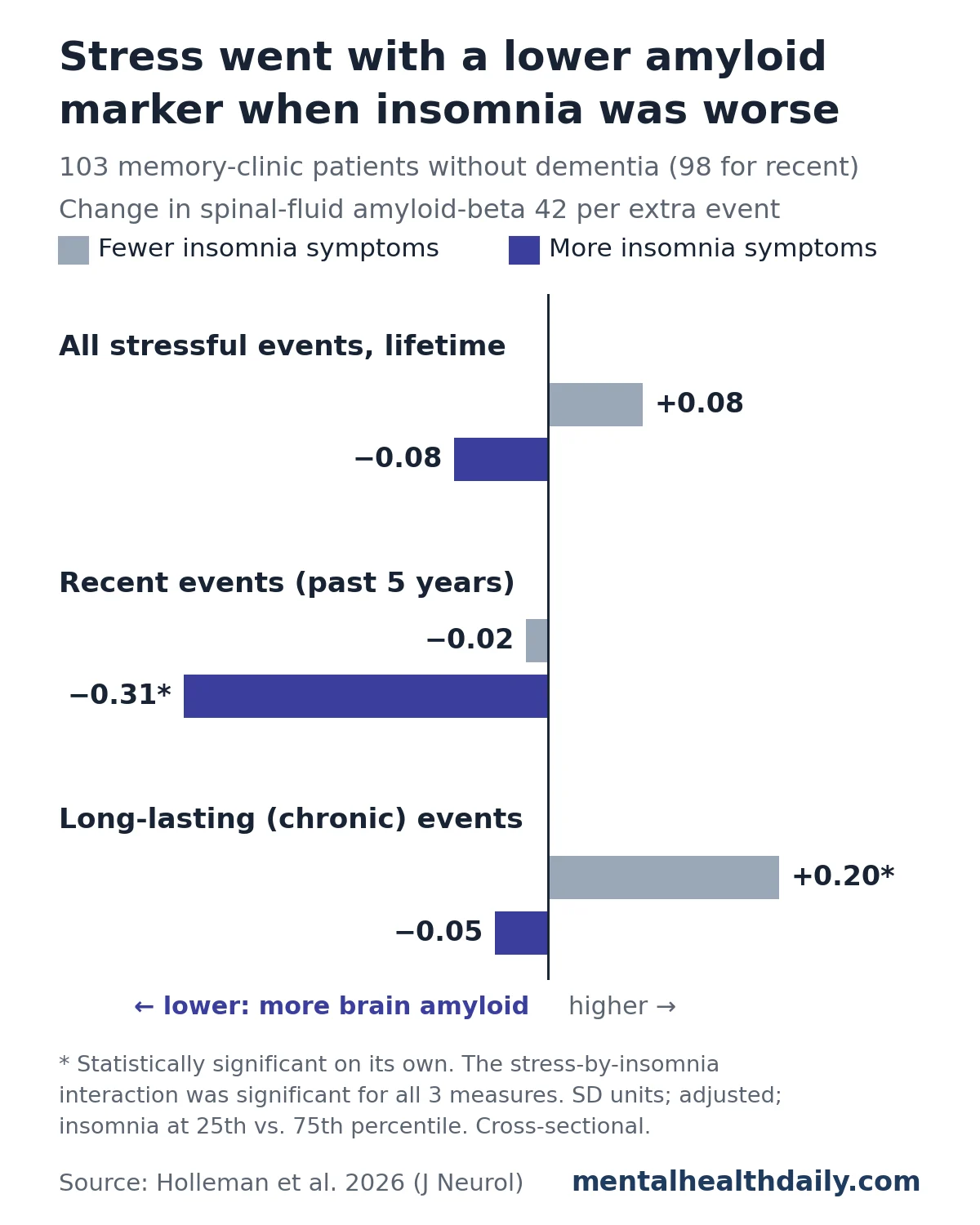
The central revelation of the Co-STAR study was the statistical interaction observed between total lifetime stressful events and insomnia severity in relation to CSF Aβ42 levels. This interaction implies that the effect of stress on amyloid pathology is not constant but changes depending on an individual’s insomnia status. Specifically, the more insomnia symptoms a person reported, the more each additional stressful event was associated with lower CSF Aβ42 levels (b = −0.032, 95% CI −0.053 to −0.011, p = 0.003). In the context of Alzheimer’s research, lower CSF Aβ42 is widely interpreted as a proxy for increased amyloid plaque deposition in the brain, as the amyloid protein is "trapped" in plaques rather than flowing freely in the CSF.
A closer examination of the data revealed a fascinating divergence: at the low end of insomnia symptoms, more stressful events tended to be associated with higher CSF Aβ42, indicating less amyloid burden in the brain. Conversely, at the high end of insomnia symptoms, more stressful events correlated with lower CSF Aβ42, signifying greater amyloid pathology. While neither of these individual associations reached statistical significance on its own, the difference between them – the reversal in the direction of the stress-amyloid link depending on insomnia severity – was highly significant.
Further analysis pinpointed specific types of stress that exhibited the clearest interaction patterns:
- Recent Events (past 5 years): Among individuals reporting more insomnia symptoms, each recent stressful event was linked to CSF Aβ42 levels approximately 0.31 standard deviations (SD) lower (p = 0.014). In contrast, for those with fewer insomnia symptoms, the estimate was near zero (−0.02 SD, p = 0.898). The interaction itself was statistically significant (p = 0.034, n = 98), highlighting the acute impact of recent stressors when compounded by poor sleep.
- Chronic Events: Perhaps the most striking interaction was observed with chronic, long-lasting stressful events. For individuals with fewer insomnia symptoms, more chronic stress was paradoxically associated with higher CSF Aβ42 levels (+0.20 SD, p = 0.016), suggesting a protective or compensatory mechanism in the absence of significant sleep disturbance. However, with more insomnia, this association flipped, becoming slightly negative (−0.05 SD, p = 0.531). This represented the clearest interaction found in the study (p = 0.001), emphasizing the particular vulnerability conferred by chronic stress combined with persistent sleep issues. Non-recent and acute events showed similar trends, though their linear interactions did not reach full statistical significance.
An intriguing aspect of the findings was the observation that the pattern linking stress, insomnia, and amyloid tended to fade at the very highest insomnia scores. When researchers modeled a curved relationship, total lifetime, non-recent, acute, and chronic events all demonstrated a consistent shape: the association between stress and lower Aβ42 intensified as insomnia severity increased, but this effect attenuated or even reversed at the extreme end of insomnia. The researchers propose an explanation for this complex pattern: insomnia on its own was actually linked to higher CSF Aβ42 in this sample (b = 0.089, p = 0.002). This seemingly counterintuitive finding might be explained by a two-stage process. Initially, poor sleep may impair the brain’s ability to clear soluble amyloid-beta, leading to transiently higher levels in the CSF. However, as amyloid starts to clump into insoluble plaques in the brain, it is sequestered from the CSF, causing CSF Aβ42 levels to fall. This dynamic could explain why the stress-amyloid link shifted direction as insomnia progressed from moderate to severe.
Notably, current stress, as measured by perceived stress over the past month, did not show a sustained interaction with insomnia. While an initial interaction was observed, it disappeared once the curved pattern of the insomnia-amyloid relationship was accounted for. This suggests that the impact of stress on amyloid pathology, particularly in combination with insomnia, is likely a cumulative, long-term process better captured by lifetime event measures than by short-term stress perceptions.
Why Tau Remains Unaffected: Understanding the Disease Progression
In contrast to the clear findings regarding amyloid-beta, the study found no significant interaction between any of the six stress measures and insomnia in relation to total tau (t-tau) or phosphorylated tau (p-tau). For total lifetime events, the interaction p-values were 0.447 for total tau and 0.343 for phosphorylated tau, indicating no statistically meaningful relationship.
This absence of a tau link aligns with a broader understanding of Alzheimer’s disease pathology. Amyloid-beta accumulation is generally considered an earlier event in the disease cascade, often preceding the tangles formed by tau protein. Therefore, any sleep-related or stress-related effects on the disease process would logically manifest in amyloid pathology first. Furthermore, previous studies in cognitively healthy adults have predominantly linked poor sleep to amyloid pathology but not necessarily to tau changes. The researchers also acknowledged that the study’s sample size, while adequate for detecting amyloid interactions, might have been too small to detect a potentially weaker or later-stage interaction involving tau.
Separately, the study confirmed a direct link between current perceived stress and insomnia symptoms. Individuals who reported feeling more stressed in the past month also reported more insomnia symptoms (b = 0.066 points per Perceived Stress Scale point, p < 0.001). However, the link between lifetime stressful events and insomnia was weak and non-significant, vanishing entirely once depressive symptoms were included in the analysis. This suggests that past stress might increase the risk of depression, which in turn acts as a primary disruptor of sleep, rather than past stress directly causing insomnia independently of mood.
The Broader Landscape of Alzheimer’s Disease: Context and Significance
Global Burden of Alzheimer’s
Alzheimer’s disease represents one of the most pressing public health challenges of the 21st century. Globally, an estimated 55 million people live with dementia, with Alzheimer’s disease accounting for 60-70% of these cases. This number is projected to nearly double every 20 years, reaching 78 million in 2030 and 139 million in 2050, primarily due to the aging global population. The economic burden is equally staggering, with dementia care costing an estimated $1.3 trillion globally in 2019, a figure expected to rise significantly. In Sweden, like many other developed nations, Alzheimer’s and other dementias are a leading cause of disability and dependency among older adults, placing immense strain on healthcare systems and families. Understanding early risk factors and potential interactions, as highlighted by the Co-STAR study, is crucial for developing effective prevention strategies and mitigating this growing crisis.
The Amyloid Hypothesis
The amyloid hypothesis has been a cornerstone of Alzheimer’s research for decades. It posits that the accumulation of amyloid-beta protein, particularly the Aβ42 isoform, in the brain is the primary event driving the disease. These amyloid plaques are thought to trigger a cascade of downstream pathological events, including tau tangle formation, neuronal dysfunction, and ultimately, neurodegeneration and cognitive decline. While the hypothesis has faced challenges and refinements, the measurement of CSF Aβ42 remains a vital biomarker, with lower levels indicating increased brain amyloid burden. The Co-STAR study’s focus on Aβ42 levels, even within a "normal" range, underscores the importance of detecting subtle changes that may precede overt clinical symptoms and contribute to early disease processes.
Modifiable Risk Factors: A Growing Focus
For many years, Alzheimer’s disease was largely viewed as an inevitable consequence of aging and genetics. However, a significant paradigm shift has occurred, with increasing recognition of the role of modifiable risk factors. The Lancet Commission on Dementia Prevention, Intervention, and Care, in its 2020 report, estimated that up to 40% of dementia cases could potentially be prevented or delayed by addressing 12 modifiable risk factors throughout the lifespan, including education, hypertension, hearing impairment, smoking, obesity, depression, physical inactivity, diabetes, social isolation, excessive alcohol consumption, head injury, and air pollution. The 2024 update further refined these estimates.
While sleep disturbance and chronic stress are not yet formally included in this core list by the Lancet Commission, the Swedish team’s work strongly supports their consideration as promising additional factors. The finding that stress and sleep problems interact to influence amyloid pathology adds a critical layer of complexity and emphasizes that addressing these lifestyle factors may offer tangible pathways for reducing Alzheimer’s risk, especially when they co-occur.
Potential Mechanisms: How Stress and Insomnia May Conspire
The Co-STAR study, being observational, did not directly test the underlying biological mechanisms. However, the researchers, drawing on existing scientific literature, point to several plausible pathways through which chronic stress and disturbed sleep could synergistically contribute to amyloid accumulation:
- Increased Amyloid Production: Both chronic stress and sleep deprivation have been linked to an upregulation of amyloid-beta production. Stress hormones like cortisol can influence the activity of secretases, enzymes involved in cleaving the amyloid precursor protein (APP) into amyloid-beta peptides. Similarly, during wakefulness, metabolic activity in the brain increases amyloid production, and prolonged wakefulness due to insomnia could exacerbate this.
- Impaired Amyloid Clearance: Sleep, particularly slow-wave sleep, is crucial for the brain’s glymphatic system, a waste clearance pathway that removes metabolic byproducts, including amyloid-beta, from the brain. Chronic insomnia disrupts this vital cleansing process, leading to reduced amyloid clearance. Stress, through its impact on neuroinflammation and vascular health, could also indirectly impair the efficiency of the glymphatic system.
- Chronic Inflammation: Both chronic psychological stress and persistent sleep loss are well-established drivers of systemic and neuroinflammation. Inflammatory signals in the brain can promote the aggregation of amyloid-beta peptides into plaques, creating a more permissive environment for pathology development. This chronic inflammatory state can also contribute to oxidative stress, further damaging neuronal cells and impairing their ability to handle amyloid.
The combined effect of higher amyloid production and slower clearance, exacerbated by inflammation, could create a "perfect storm" for accelerated amyloid plaque formation, exceeding the brain’s capacity to maintain amyloid homeostasis. This synergistic model offers a compelling explanation for the observed interaction.
Prior Research and Emerging Evidence
While the Co-STAR study is one of the first to comprehensively examine the interaction between stress and insomnia in relation to Alzheimer’s biomarkers, the independent links between poor sleep and amyloid pathology have been increasingly recognized over the past decade:
- Early studies using PET imaging demonstrated that even a single night of sleep deprivation can lead to an increase in amyloid-beta levels in the brain.
- Longitudinal studies have shown that chronic sleep disturbances, such as short sleep duration, poor sleep quality, and obstructive sleep apnea, are associated with higher amyloid plaque burden in older adults.
- Research has elucidated the role of slow-wave sleep in clearing amyloid-beta, highlighting the specific mechanisms through which sleep deprivation can impair this process.
These earlier findings established poor sleep as an independent risk factor for amyloid pathology. The Swedish study significantly advances this understanding by demonstrating that the impact of stressful life events on amyloid accumulation is not uniform across all individuals but is profoundly modulated by the presence and severity of insomnia. This points towards a more nuanced and interactive model of Alzheimer’s risk.
Methodological Considerations and Study Limitations
While providing crucial insights, the Co-STAR study, like all research, has inherent limitations that warrant consideration:
- Observational Design: The study is observational, meaning it can establish correlations but cannot definitively prove causation. It demonstrates that stress and insomnia go together with amyloid buildup under specific conditions, but it does not prove that reducing stress or treating insomnia will directly lower amyloid levels or prevent Alzheimer’s.
- Memory-Clinic Cohort: The participants were recruited from a memory clinic, meaning they were already experiencing some level of cognitive concern, even if they did not meet the criteria for dementia. This cohort may not be fully representative of the general population, and the findings might not be directly generalizable to cognitively healthy individuals without any memory complaints.
- Indirect Amyloid Measurement: CSF Aβ42 levels are an indirect measure of amyloid plaque burden in the brain. While widely accepted and validated, direct imaging techniques like amyloid PET scans offer a more precise quantification of brain plaques.
- Sample Size for Tau: Although 124 participants constituted a reasonable sample for detecting robust amyloid effects, the researchers noted that the study might have been underpowered to detect weaker interactions or later-stage pathological changes related to tau proteins.
- Self-Reported Data: Stress and insomnia data relied on self-reported questionnaires, which can be subject to recall bias or subjective interpretation. Objective measures of sleep (e.g., actigraphy, polysomnography) and physiological stress (e.g., cortisol levels) could provide additional layers of data.
Despite these limitations, the study’s careful adjustments for confounding variables and its focus on an under-researched interaction strengthen the validity and impact of its findings.
Implications for Public Health and Future Research
Integrated Approach to Risk Assessment
The most compelling message from the Co-STAR study is the critical importance of studying risk factors in combination rather than in isolation. Had the researchers examined stress or insomnia as standalone factors, they would have entirely missed the nuanced and significant amyloid pattern. This finding advocates for a paradigm shift in both research and clinical practice, encouraging a holistic view of an individual’s lifestyle, psychological well-being, and physiological markers when assessing Alzheimer’s risk. Healthcare providers should consider asking about both stress levels and sleep quality, recognizing their potential synergistic impact.
Clinical Relevance and Intervention
While the study does not provide definitive proof that treating insomnia or reducing stress will prevent Alzheimer’s or lower amyloid levels, its implications for clinical practice are significant. Both chronic insomnia and severe stress are detrimental to overall health, impacting mood, cognitive function, and daily quality of life independently of Alzheimer’s risk. Effective treatments exist for both conditions. Cognitive behavioral therapy for insomnia (CBT-I) is widely recognized as the first-line treatment for chronic insomnia, demonstrating high efficacy and long-lasting benefits. Various stress management techniques, including mindfulness, psychotherapy, and lifestyle modifications, can significantly alleviate chronic stress. Therefore, addressing these issues is beneficial for patients’ immediate well-being, regardless of their long-term impact on Alzheimer’s pathology. Individuals experiencing persistent sleep trouble or significant memory concerns should consult a doctor to discuss appropriate evaluation and management strategies.
The Need for Longitudinal Studies and Intervention Trials
The findings from the Co-STAR study lay a strong foundation for future research. The next crucial step involves conducting long-term, prospective studies that track individuals without cognitive impairment over many years, observing how combinations of stress and insomnia evolve and relate to subsequent changes in amyloid biomarkers and clinical dementia onset. Crucially, randomized controlled intervention trials are needed. These trials would involve implementing targeted interventions, such as CBT-I or comprehensive stress reduction programs, in at-risk populations and then monitoring their impact on amyloid pathology and cognitive trajectories. Such trials would be essential to establish a causal link and to determine whether treating these modifiable factors can indeed delay or prevent Alzheimer’s disease.
Policy and Public Awareness
The study also has implications for public health policy and awareness campaigns. Promoting healthy sleep hygiene and stress management techniques from an early age could become integral components of broader dementia prevention strategies. Educational initiatives that highlight the interconnectedness of mental well-being, sleep, and long-term brain health could empower individuals to adopt healthier lifestyle choices, potentially contributing to a reduction in the global burden of Alzheimer’s disease.
In conclusion, the Swedish study provides compelling evidence that the intersection of stressful life events and insomnia symptoms creates a heightened vulnerability for the accumulation of Alzheimer’s-related amyloid pathology. This discovery not only deepens our understanding of the complex etiology of Alzheimer’s disease but also offers actionable insights for integrated approaches to risk assessment and the promotion of overall brain health. As research progresses, addressing the twin challenges of chronic stress and disturbed sleep may emerge as increasingly vital components in the global effort to combat Alzheimer’s disease.

