

Autistic doctors in the United Kingdom frequently encounter avoidable barriers as they transition from the structured environment of medical school into the demanding realities of their initial hospital jobs, according to a pivotal 2026 UK review. This comprehensive analysis not only details the systemic challenges faced by neurodivergent medical professionals but also puts forth a robust, seven-part framework designed to foster a more inclusive and supportive training landscape. The findings underscore a critical need for widespread institutional awareness and practical adjustments to ensure that a valuable segment of the medical workforce can thrive without unnecessary impediment.
Understanding UK Foundation Training: The Crucible for New Doctors
In the UK’s medical education system, graduation from medical school is immediately followed by foundation training, a crucial two-year paid program that serves as the bedrock of a doctor’s career. This period is split into two years: First-Year (FY1) and Second-Year (FY2), during which junior doctors rotate through various hospital specialties under supervision. This structure is broadly analogous to an American intern year and the initial phase of residency, designed to provide broad clinical experience before specialization. The transition into this intense environment is challenging for all new graduates, but for autistic doctors, the hurdles are often magnified by environmental factors rather than clinical competence.
The 2026 review, authored by Chloë Groenewald, an FY2 doctor within an NHS hospital trust, combines a narrative review with a positionality statement. A narrative review synthesizes published research chosen by the author, differing from a systematic review by its less formal search rules. Groenewald’s positionality statement, drawing on her personal clinical experience, provides an invaluable insider perspective, enriching the academic synthesis with lived reality. It’s important to note that this review collects no new empirical data but rather synthesizes existing knowledge to describe prevalent barriers, outline relevant UK law and policy, and propose a practical framework for support. The review consciously adopts identity-first language, referring to "autistic doctors," a preference expressed by the majority of autistic doctors in a 2023 survey, reflecting a shift towards embracing neurodivergent identities rather than viewing autism as merely a condition.
The Seven Systemic Barriers Autistic Junior Doctors Encounter
The journey from medical student to practicing doctor is inherently fraught with challenges, encompassing rapid acclimatization to prescribing responsibilities, managing acutely unwell patients, and navigating the complex, often chaotic, hospital environment with varying levels of supervision. For many autistic doctors, the review posits that the primary stressors stem not from the clinical demands themselves, but from the surrounding organizational and social environment. The review identifies seven distinct areas where systemic barriers disproportionately affect autistic medical students and junior doctors:
- Lack of Structured and Predictable Learning Environments: Unlike the more predictable academic setting of medical school, hospital rotations can be highly dynamic, with frequent changes to rotas, unclear daily task lists, and inconsistent supervision. This lack of explicit structure and predictability creates significant anxiety and difficulty in planning for autistic individuals who often thrive in clear, consistent environments.
- Limited Understanding and Awareness of Neurodiversity: A pervasive lack of neurodiversity training among supervisors, senior staff, and peers leads to misunderstandings of autistic traits, often misinterpreting communication styles or sensory sensitivities as deficits in professionalism or capability. This ignorance fosters an environment where support needs are unrecognized or dismissed.
- Inadequate Provision of Practical Workplace Adjustments: Despite legal mandates, essential practical adjustments such as access to quiet spaces for focused work or de-stimulation, written feedback instead of purely verbal, or consistent schedules are often not provided, or trainees must repeatedly advocate for them at each new rotation.
- Challenges in Communication and Social Interaction: The implicit, often subtle social rules of hospital teams, combined with the fast-paced, high-stakes communication typical in clinical settings, can be exceptionally draining. The review highlights the double empathy problem, suggesting that communication difficulties between autistic and non-autistic individuals are a bidirectional issue, not solely an autistic person’s failing. Misunderstandings often arise from differing communication styles rather than a lack of intent.
- Non-Inclusive Workplace Culture and Stigma: An environment that lacks openness about neurodiversity, where disclosure feels unsafe, and where stigma or bullying is not actively combated, forces autistic doctors to mask their traits. This cultural deficit prevents genuine integration and support.
- Insufficient Mentorship and Peer Support Networks: The absence of trained mentors who understand neurodiversity, coupled with limited access to peer support groups specifically for autistic doctors, leaves many feeling isolated and without a reliable source of guidance or shared experience.
- Compromised Trainee Well-being and Mental Health Support: The cumulative effect of these barriers, often exacerbated by masking and late diagnosis, severely impacts mental health. Inadequate institutional support for well-being, including regular check-ins and access to occupational health services that understand neurodiversity, contributes to high rates of burnout and psychological distress.
The Hidden Toll: Masking, Late Diagnosis, and Autistic Burnout
One of the most profound and insidious challenges described in the review is masking. This refers to the conscious or subconscious suppression or alteration of autistic traits to conform to neurotypical expectations. In a high-pressure clinical setting, masking can manifest as constantly monitoring one’s facial expressions during ward rounds, suppressing visible discomfort in a loud, bright corridor, or painstakingly rehearsing conversations before engaging with team members – all while simultaneously managing critical patient care over a demanding 12.5-hour shift. This sustained effort is not merely tiring; it is neurologically taxing.
Over prolonged periods, this intense masking effort can lead to autistic burnout. Raymaker et al. (2026) defined this as a state of pervasive, long-lasting exhaustion, significant loss of executive function and cognitive abilities, and a lowered tolerance for sensory input, typically persisting for three months or more. It arises from chronic stress and an enduring mismatch between environmental demands and an individual’s capacity without adequate support. Crucially, autistic burnout is distinct from ordinary job burnout and clinical depression, requiring different approaches to recovery and prevention.
Late diagnosis is another prevalent theme among autistic doctors. Many individuals only receive an autism diagnosis well into their medical training or even after qualifying. A 2023 survey revealed that a staggering 74% of autistic doctors did not know or suspect they were autistic while in medical school. This late diagnosis often serves as a powerful lens through which past struggles are reframed. What was previously perceived as personal failure, inadequacy, or inexplicable difficulty can suddenly be understood as a systemic poor fit between an autistic individual and a neurotypically-designed system. This reframing, while validating, also highlights the years of unsupported struggle and the missed opportunities for early intervention and accommodation.
Legal Mandates vs. Lived Realities: The Gap in Workplace Adjustments
The legal framework in the UK provides clear directives for supporting disabled staff. Under the Equality Act 2010, NHS employers are legally obliged to make "reasonable adjustments" for disabled employees. Autism, when it has a substantial and long-term effect on daily life, falls under the definition of a disability for which these duties apply. The duty to make adjustments applies once an employer knows, or could reasonably be expected to know, that a worker has a disability; formal disclosure is not always an absolute prerequisite, as per Acas guidance. Furthermore, the General Medical Council (GMC), the UK’s medical regulator, explicitly states that disability does not inherently prevent safe practice.
However, the review critically argues that despite these legal and regulatory provisions, the practical burden overwhelmingly falls on the trainee. Autistic doctors are frequently left to disclose their diagnosis, explain their specific needs, and repeatedly advocate for the necessary adjustments, often having to reiterate these requests with each new rotation or change in supervisor. This advocacy itself is a significant source of stress and exhaustion, diverting energy that could otherwise be focused on clinical work and learning.
Supporting data from a 2023 online survey of 225 members of Autistic Doctors International, a peer-support group, paints a stark picture of this disparity:
- Only 40% of respondents reported receiving any workplace adjustments.
- A concerning 60% felt they had experienced discrimination due to their autism.
- A substantial 77% had considered suicide at some point in their lives, indicating severe mental health distress within this cohort.
It is crucial to acknowledge that this sample was self-selected from a support group, meaning these figures cannot be directly generalized to all autistic doctors. However, they serve as a potent indicator of the profound mental health challenges and systemic failures experienced by a significant proportion of this professional group. For those struggling, helplines such as Samaritans (116 123 in the UK and Ireland) offer vital support.
The SUPPORT Framework: A Proactive Blueprint for Inclusive Training
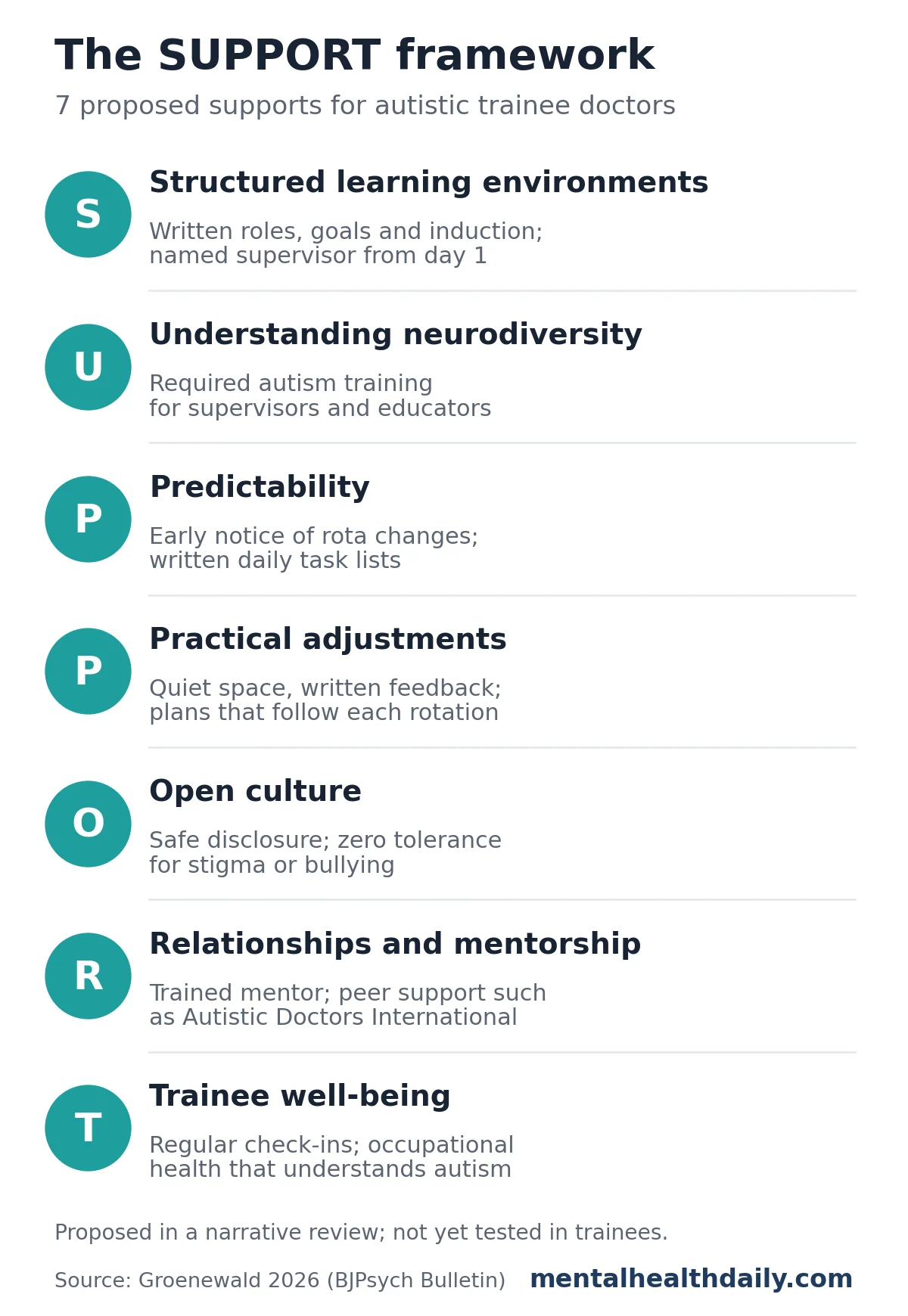
In response to these pervasive challenges, the Groenewald review proposes the SUPPORT framework as a practical, actionable checklist for supervisors, training programs, and hospital trusts. This framework is thoughtfully modeled on Autistic SPACE, an earlier and successful framework developed by Autistic Doctors International to address the needs of autistic patients in healthcare (focused on Sensory needs, Predictability, Acceptance, Communication, and Empathy). SUPPORT aims to translate these principles into tangible actions for supporting autistic trainee doctors.
The seven components of the proposed SUPPORT framework, each accompanied by practical examples, are designed to create a more accommodating and effective training environment:
- Structured learning environments: This includes clear written roles, defined goals, thorough induction processes, and the assignment of a named supervisor from day one. These elements provide the predictability and clarity that are often lacking.
- Understanding neurodiversity: Mandating autism and neurodiversity training for all supervisors is paramount. This ensures that those in leadership roles possess the foundational knowledge to recognize, understand, and appropriately respond to the needs of autistic trainees.
- Predictability: Providing early notice of rota changes and offering written daily task lists can significantly reduce anxiety and enable better planning for autistic doctors, allowing them to anticipate and prepare for their responsibilities.
- Practical adjustments: This encompasses a range of accommodations such as access to quiet spaces for breaks or focused work, provision of written feedback instead of solely verbal, and ensuring that agreed-upon adjustment plans seamlessly follow the trainee through each rotation, eliminating the need for constant re-advocacy.
- Open culture: Fostering an environment where disclosure feels safe, and where there is zero tolerance for stigma, discrimination, or bullying, is fundamental. This encourages autistic doctors to seek support without fear of professional repercussions.
- Relationships and mentorship: Establishing programs with trained mentors who understand neurodiversity, alongside facilitating access to peer support networks, can combat isolation and provide crucial guidance and empathy.
- Trainee well-being: Implementing regular, structured check-ins and ensuring access to occupational health services that are knowledgeable about neurodiversity are essential for proactively monitoring and supporting the mental and physical well-being of autistic trainees.
A significant aspect of the SUPPORT framework is its emphasis on low-cost, high-impact interventions. Many of the suggested changes, such as clear written expectations, specific feedback, and advance notice of schedule changes, require minimal financial outlay but yield substantial benefits. The review compellingly argues that these adjustments would not only benefit autistic trainees but would enhance the training experience for all junior doctors, fostering a more organized, predictable, and supportive learning environment across the board. Furthermore, it advocates for mandatory neurodiversity training for all NHS supervisors and the collection of NHS workforce data to quantify the number of autistic trainees, providing crucial baseline information for targeted support and policy development.
The review illustrates the potential impact of these changes through a clinical vignette: Dr. A, an FY1 doctor diagnosed during medical school, initially struggled with anxiety and exhaustion, feeling they didn’t "fit in." After a supervisor who had attended a brief neurodiversity session created a safe space for disclosure, Dr. A received written task summaries, a quieter workspace, and direct feedback. This resulted in a marked reduction in anxiety and improved performance, highlighting how simple, well-informed adjustments can profoundly impact a trainee’s well-being and professional efficacy.
Broader Context and Supporting Research
The barriers identified in Groenewald’s review are not isolated findings; they resonate strongly with qualitative research and anecdotal reports from autistic students and doctors across various international contexts. Previous studies have consistently highlighted themes such as social isolation, sensory overload in busy hospital environments, communication difficulties, and the profound need for explicit instructions and clear expectations. These studies, though often small in scale, collectively describe a consistent pattern of systemic challenges. While they powerfully articulate the problem, current research is limited in its ability to quantify the prevalence of each barrier or definitively identify which interventions are most effective. This underscores the need for more rigorous, large-scale studies.
Limitations of the Groenewald Review and Future Directions
While highly valuable, the Groenewald review itself acknowledges certain limitations. As a narrative review, it is inherently subjective in its selection of published research. It also collects no new empirical data, meaning its findings are based on synthesis rather than primary research. The inclusion of a personal positionality statement, while offering unique insight, also means the review is not generalizable in the way a large-scale quantitative study would be.
Recognizing these limitations, the review issues a powerful call for future research. It advocates for anonymous surveys to accurately count autistic trainees within the NHS, enabling a clearer understanding of prevalence and needs. It also calls for long-term longitudinal studies to track doctors through their transition into practice, assessing the sustained impact of current systems and potential interventions. Crucially, it recommends trials of structured adjustments, carefully tracking outcomes such as well-being, clinical performance, and retention rates of autistic doctors in medicine. A key recommendation for all future research is the active involvement of autistic doctors in the design and execution of these studies, ensuring that research questions and methodologies are relevant, ethical, and person-centered.
Implications and A Call to Action for a Neuro-Inclusive Future
The 2026 UK review marks a significant milestone in advocating for neuro-inclusive practices within medical training. Its findings carry profound implications for various stakeholders:
For Autistic Students and New Doctors: The review provides powerful validation. It reinforces that requests for written instructions, a quiet space, or advance notice of schedule changes are not "special treatment" but reasonable accommodations essential for effective functioning and well-being. It also highlights the invaluable support offered by peer groups like Autistic Doctors International, which provide a community of shared experience and understanding.
For Supervisors and Training Programs: The SUPPORT framework offers a clear, actionable roadmap. The simplest steps, such as establishing clear written expectations and providing specific, direct feedback, are not only beneficial for autistic trainees but enhance the learning experience for every junior doctor. Creating an "open culture" where disclosure feels safe is the fundamental gateway that allows these practical steps to reach the doctors who need them most. Implementing mandatory neurodiversity training for supervisors is no longer optional but a professional imperative.
For NHS Leadership and Policy Makers: The review underscores the urgent need for systemic change. This includes formalizing neurodiversity training requirements, investing in data collection regarding neurodivergent staff, and reviewing current policies to ensure they proactively support rather than inadvertently hinder autistic doctors. Embracing the SUPPORT framework universally could significantly improve recruitment, retention, and the overall well-being of a valuable segment of the medical workforce.
Ultimately, the Groenewald review is a compelling argument for creating a healthcare system that values neurodiversity as a strength. By dismantling avoidable barriers and implementing thoughtful, evidence-informed support, the NHS can foster an environment where all doctors, including its autistic professionals, can contribute their unique skills and perspectives to deliver exceptional patient care, without sacrificing their well-being in the process. The proposed SUPPORT framework offers a tangible path towards this more equitable and effective future.

