

A recent 2026 case report from China highlights the critical importance of comprehensive diagnostic evaluation, especially in vulnerable populations. The report details the case of a 34-year-old woman with mild intellectual disability, initially referred for evaluation of possible narcolepsy due to severe daytime sleepiness and unexplained nighttime events. However, a thorough diagnostic process, including advanced sleep testing and electroencephalography (EEG), ultimately revealed underlying epilepsy and moderate obstructive sleep apnea (OSA) as the true culprits behind her symptoms. This case serves as a stark reminder that excessive daytime sleepiness, a common symptom with diverse etiologies, demands a meticulous diagnostic approach, particularly when compounded by cognitive impairments that hinder self-reporting.
The Patient’s Journey: A Decades-Long Enigma
The patient’s medical history presented a complex tapestry of lifelong developmental delays. She began speaking around the age of three, a delay indicative of her cognitive challenges. Her formal education ceased after the third grade, and even as an adult, she required significant family assistance with daily living activities such such as cooking and laundry, underscoring her mild intellectual disability. Her full-scale IQ of 56 and adaptive testing results confirmed a diagnosis of mild intellectual disability, characterized by lifelong limitations in reasoning and everyday skills that manifest during childhood.
For many years, the woman had exhibited persistent symptoms that confounded her family and earlier medical assessments. She was a loud snorer, often yawned throughout the day, and dozed off with unusual ease. These symptoms had previously led an external emergency department to tentatively list "sleep apnea?" and "narcolepsy?" as potential diagnoses, reflecting the diagnostic uncertainty surrounding her condition.
Crucially, her family reported two distinct nighttime events, occurring more than three years apart, which further complicated the clinical picture. The first episode involved her suddenly falling out of bed, losing consciousness for approximately one minute, and then remaining confused and drowsy for several hours afterward. The second event saw her sit up in bed, make grunting noises, and display abnormal movements of her limbs for about 30 seconds, followed by a similar period of confusion and drowsiness. The patient’s intellectual disability meant she was unable to describe her subjective experiences before, during, or after these episodes, making her family’s detailed observations indispensable for her diagnostic workup. These reports underscored the challenge in differentiating between parasomnias, seizures, or other sleep-related disorders without direct patient testimony.
Unraveling the Mystery: The Diagnostic Process
Given the ambiguous symptoms, the patient’s inability to provide a detailed history, and the preliminary suspicions, a comprehensive diagnostic battery was initiated. Doctors conducted three primary types of tests: an overnight polysomnography (PSG), a subsequent daytime Multiple Sleep Latency Test (MSLT), and two separate 24-hour EEG recordings. This multi-modal approach proved instrumental in differentiating her conditions.
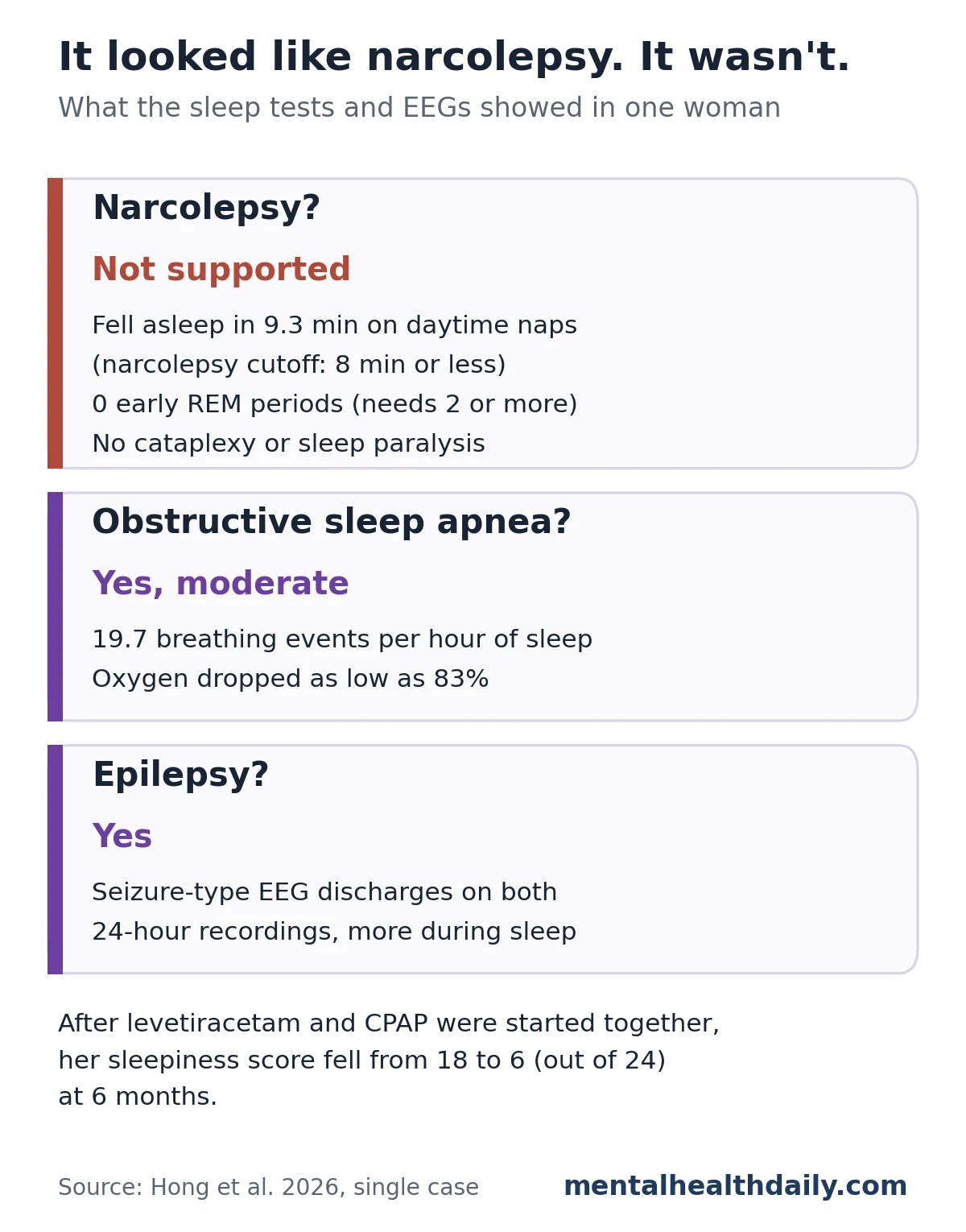
The overnight polysomnography (sleep study) provided crucial insights into her sleep architecture and respiratory function. The results revealed an apnea-hypopnea index (AHI) of 19.7 events per hour. This index, which quantifies breathing pauses (apneas) and shallow breathing episodes (hypopneas) per hour of sleep, strongly indicated a significant sleep-disordered breathing issue. Breaking down the AHI further, she experienced 68 obstructive apneas, 29 hypopneas, and 68 central apneas. Obstructive apneas occur when the upper airway repeatedly collapses during sleep despite respiratory effort, while central apneas involve a temporary cessation of brain signals to breathe. Her oxygen saturation dropped as low as 83%, a concerning level of hypoxemia, and she spent a notable 72.1% of the night sleeping on her back, a position known to exacerbate OSA. This pattern, combined with heavy snoring and frequent breathing-related arousals, unequivocally confirmed a diagnosis of moderate obstructive sleep apnea.
The Multiple Sleep Latency Test (MSLT) was conducted the day after the overnight sleep study, typically used to assess the degree of daytime sleepiness and diagnose narcolepsy. The MSLT involves a series of scheduled daytime naps in a sleep lab, measuring how quickly a person falls asleep and whether they enter REM sleep abnormally fast. In this patient’s case, she took an average of 9.3 minutes to fall asleep across four naps, and importantly, she had no SOREMPs (Sleep Onset REM Periods), which are key markers for narcolepsy. Narcolepsy is characterized by a mean sleep latency of 8 minutes or less and two or more SOREMPs during the MSLT. Furthermore, she did not exhibit other hallmark REM-related symptoms such as cataplexy (sudden muscle weakness triggered by strong emotions), sleep paralysis, or vivid hypnagogic/hypnopompic hallucinations. The clinical team interpreted the MSLT results with caution, acknowledging that her untreated sleep apnea could have influenced the test. However, based on the totality of the clinical picture, they concluded that narcolepsy was unlikely.
The electroencephalogram (EEG) recordings provided the decisive neurological evidence. Two separate 24-hour EEG recordings were performed, both revealing spike-and-slow-wave discharges. These electrical patterns are the characteristic signature of seizure-prone brain tissue and are definitive indicators of epilepsy. The discharges were most prominent over the frontal regions, particularly on the right side of the brain, and significantly increased during sleep, a common finding in many forms of epilepsy. A subsequent brain MRI found no structural abnormalities, suggesting a functional rather than anatomical cause for her seizures.
Based on this comprehensive evaluation, the final diagnoses were established:
- Focal Epilepsy with Impaired Awareness
- Moderate Obstructive Sleep Apnea
- Mild Intellectual Disability
Her severe daytime sleepiness, initially misattributed to narcolepsy, was now primarily understood as a consequence of fragmented, oxygen-poor sleep due due to OSA, potentially compounded by sleep disruption from her nocturnal epileptic seizures.
The Intertwined Pathologies: Sleep Apnea and Epilepsy
The co-occurrence of sleep apnea and epilepsy is not uncommon, and compelling evidence suggests a bidirectional relationship where each condition can exacerbate the other. Obstructive sleep apnea can worsen epilepsy through several mechanisms, including intermittent nocturnal hypoxemia (low oxygen levels), sleep fragmentation, and alterations in brain excitability. Hypoxia can directly increase neuronal excitability and lower seizure thresholds. Conversely, epilepsy can also negatively impact sleep architecture and respiratory control. Certain anti-epileptic medications, while crucial for seizure control, can sometimes worsen existing sleep apnea or induce new sleep-disordered breathing by affecting muscle tone or central respiratory drive.
The prevalence of this pairing is striking. A study conducted at a Korean university sleep center, involving 395 individuals with epilepsy who underwent a full-night sleep study, found that 296 (74.9%) were diagnosed with OSA. Approximately two-thirds of these OSA cases were categorized as moderate to severe. While this figure likely represents a higher prevalence than in the general epilepsy population due to referral bias (patients were specifically referred for sleep testing), it strongly underscores the need for vigilant screening for sleep apnea in individuals with epilepsy.
The question of whether treating OSA can reduce seizure frequency is an area of ongoing research. Continuous Positive Airway Pressure (CPAP), a bedside machine that delivers pressurized air through a mask to keep the airway open during sleep, is the primary treatment for OSA. Evidence suggesting that CPAP improves seizure control is encouraging but still considered limited. Some studies have reported reductions in seizure frequency following effective CPAP therapy, particularly in patients with drug-resistant epilepsy, but larger, well-designed randomized controlled trials are needed to definitively establish this link.
The presence of 68 central apneas in the patient’s sleep study also raised important considerations. Central apneas, where the brain temporarily ceases to signal the body to breathe, can be influenced by seizure activity. Research into sudden unexpected death in epilepsy (SUDEP) often investigates breathing problems around seizures as a potential contributing factor. Without a combined video-EEG and sleep study, the clinical team could not ascertain whether her central apneas correlated directly with any underlying seizure activity, highlighting a diagnostic limitation in this particular case.
Targeted Treatment and Promising Outcomes
Following her comprehensive diagnosis, the patient began a dual treatment regimen tailored to her specific conditions. She was prescribed levetiracetam, an antiseizure medication, at a dosage of 500 mg twice daily. Concurrently, she commenced Continuous Positive Airway Pressure (CPAP) therapy for her obstructive sleep apnea. Additionally, she received counseling on lifestyle modifications, including weight loss and improving her overall sleep hygiene, both of which are important adjunctive measures for managing OSA and promoting better sleep.
The choice of levetiracetam was deliberate and strategic. For a patient already experiencing significant daytime sleepiness, suffering from sleep apnea, and living with cognitive limitations, heavily sedating seizure medications could have profoundly worsened her quality of life and cognitive function. Levetiracetam was selected because previous studies suggest it causes relatively little sedation and has limited adverse effects on sleep architecture and cognitive processes. Clinicians noted that while levetiracetam is generally well-tolerated, potential side effects such as irritability and mood changes still required careful monitoring, especially in a patient who might struggle to articulate such changes. A 2024 meta-analysis of 16 placebo-controlled trials, involving 545 participants, further supported this choice, finding that levetiracetam was associated with better executive function compared to placebo, consistent with a low cognitive burden.
The results at the 6-month follow-up were highly encouraging, based on medical records and family reports. The patient’s Epworth Sleepiness Scale (ESS) score, a subjective measure of daytime sleepiness, dramatically improved, falling from a severely sleepy 18 out of 24 to a normal 6 out of 24. Crucially, her family reported no further seizure-like episodes during this period. Her loud snoring, a long-standing complaint, was significantly reduced, and her overall daytime alertness and activity levels improved markedly. While the simultaneous initiation of both levetiracetam and CPAP meant that the case could not precisely delineate the individual contribution of each treatment, the combined approach clearly yielded substantial benefits.
Addressing Diagnostic Overshadowing in Intellectual Disability
This case powerfully illustrates the phenomenon of diagnostic overshadowing, a critical issue in healthcare for individuals with intellectual disabilities. Diagnostic overshadowing occurs when clinicians attribute new or worsening symptoms to a person’s existing disability, inadvertently overlooking or delaying the diagnosis of a separate, treatable medical condition. In this patient’s situation, her persistent sleepiness, general slowness, and unusual nighttime behaviors could easily have been dismissed as inherent aspects of her intellectual disability, potentially leading to prolonged suffering and delayed intervention.
Research on the prevalence and impact of diagnostic overshadowing presents a mixed picture. A 2024 systematic review of 25 studies focusing on psychological disorders in people with intellectual disability found that while some studies detected significant overshadowing, approximately one-third reported no such bias. The overall quality of evidence was rated as low. This suggests that while the bias is a real concern in certain clinical contexts, it may not be as universally pervasive as sometimes assumed. Nevertheless, the potential for overshadowing remains a significant barrier to equitable healthcare for this population.
Sleep problems, in particular, represent a known gap in care for individuals with intellectual disabilities. A 2024 review published in Thorax highlighted that sleep-disordered breathing is believed to be common in both children and adults with intellectual disability. However, the review pointed out a scarcity of large-scale prevalence studies and a limited number of randomized treatment trials in this specific population, underscoring a critical need for more research and focused clinical attention.
The patient’s inability to articulate her own symptoms underscored the indispensable role of caregivers in the diagnostic process. For individuals who cannot self-report, detailed observations from family members or other caregivers become the primary source of clinical history. Hong et al. recommend that caregivers meticulously record specific details about any concerning symptoms, including the exact onset, frequency, and duration of episodes, any associated symptoms (e.g., changes in breathing, movements, skin color), potential triggers, and the patient’s state immediately following the event (e.g., confusion, drowsiness, memory loss). Such meticulous documentation can provide clinicians with the crucial information needed to differentiate between various conditions and avoid diagnostic overshadowing.
Broader Implications and Future Directions
While this single case report offers a compelling narrative, it is important to acknowledge its inherent limitations. As a retrospective description of one patient, it cannot provide estimates of how frequently such diagnostic challenges occur in the wider population or definitively prove the efficacy of the treatments in a controlled manner. However, its illustrative power is undeniable, highlighting a significant diagnostic trap and offering valuable lessons for clinical practice.
The case underscores the critical need for a systematic and comprehensive diagnostic approach, particularly for patients with intellectual disabilities or other cognitive impairments who cannot reliably report their own symptoms. Medical professionals are urged to look beyond initial superficial diagnoses and pursue thorough investigations when symptoms are complex or atypical.
Hong et al. propose a stepwise workup for anyone presenting with unexplained daytime sleepiness and nighttime events, especially in individuals who cannot articulate their symptoms:
- Thorough Clinical History: Gather detailed information from caregivers about the onset, nature, and frequency of symptoms.
- Comprehensive Physical Examination: Look for signs related to sleep disorders or neurological conditions.
- Overnight Polysomnography (Sleep Study): Objectively assess sleep architecture, respiratory events, and oxygen saturation.
- Electroencephalography (EEG): Evaluate for seizure activity, particularly extended recordings (e.g., 24-hour) to capture nocturnal events.
- Multiple Sleep Latency Test (MSLT): Only if narcolepsy remains a strong consideration after other tests, and ideally after treating any identified sleep apnea.
In conclusion, this case report vividly demonstrates that daytime sleepiness is not synonymous with narcolepsy, and the presence of snoring does not rule out underlying epilepsy. When both sleep apnea and epilepsy are identified, as in this patient, an integrated treatment approach addressing both conditions simultaneously offers the most logical and effective pathway to improving patient outcomes. The medical community must remain vigilant against diagnostic overshadowing and advocate for equitable, thorough diagnostic processes for all individuals, particularly those whose voices may not be heard without careful attention and advocacy. Continued research into the interplay of sleep disorders and neurological conditions in intellectually disabled populations is essential to bridge existing knowledge gaps and enhance clinical care.

